


Table of Contents
- How Serious is the Fake Exchange Problem?
- Tip 1: Check the Domain and URL
- Tip 2: Verify License and Regulatory Information
- Tip 3: Test the Deposit and Withdrawal Process
- Tip 4: Check Team and Community Authenticity
- Tip 5: Use Security Tools for Verification
- Common Phishing Techniques at a Glance
- The Right Way to Choose an Exchange
- Further Reading
How Serious is the Fake Exchange Problem?
The popularity of cryptocurrencies has also led to a surge in scams. According to Chainalysis' 2026 report, global cryptocurrency scam losses in 2025 alone reached approximately $17 billion, with phishing attacks impersonating exchanges and investment platforms being one of the main vectors.
More alarmingly, security agencies have discovered over 236,000 domains used to set up fake cryptocurrency websites—these sites look almost identical to legitimate exchanges like Binance and OKX. They attract users through Google ads, social media promotions, Telegram groups, etc., tricking them into registering, depositing, and ultimately losing everything.
In 2025, attackers promoted a fake Uniswap website through Google ads, stealing over $1.27 million in just two weeks. The highest single victim loss reached $400,000. And this is just the tip of the iceberg.
⚠️ Remember the first principle: In the crypto world, your asset security is 100% your own responsibility. No bank will recover stolen funds for you, and no "exchange customer support" can reverse a blockchain transaction.
Tip 1: Check the Domain and URL
This is the simplest and most effective first step. Most phishing websites rely on "look-alike" domains to deceive you.
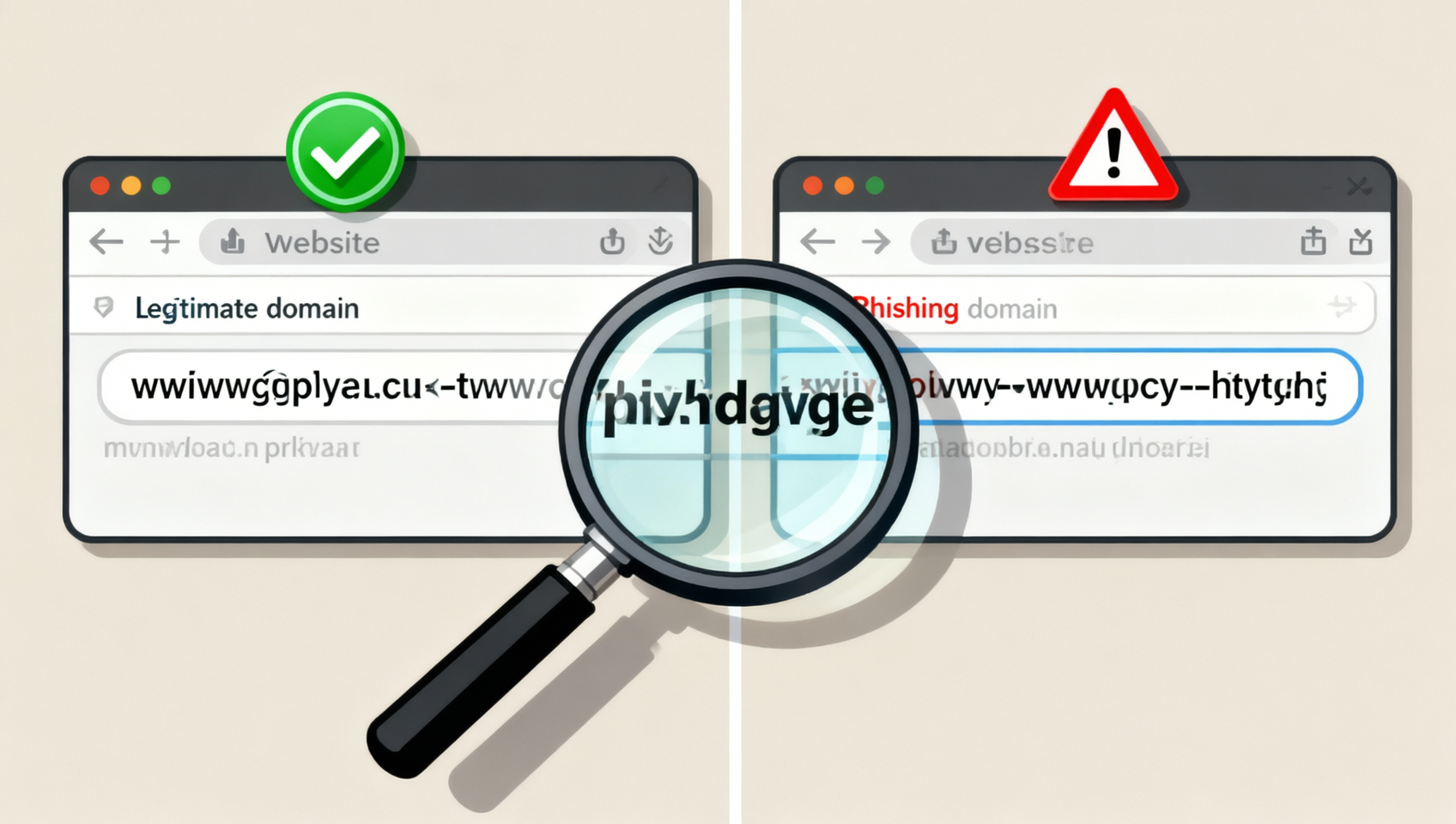
Common Domain Forgery Techniques
| Technique | Legitimate Domain | Fake Domain Example |
|---|---|---|
| Letter Substitution | binance.com | b1nance.com (1 replaces i) |
| Letter Repetition | okx.com | okxx.com |
| Added Words | binance.com | binance-login.com |
| Changed Suffix | binance.com | binance.org / binance.top |
| Spelling Variation | binance.com | binnance.com |
Practical Check Steps
- Only use official domains: Binance is only
binance.com, OKX is onlyokx.com - Check the SSL certificate: Click the small lock icon in the address bar and verify the certificate is issued to the correct entity
- Use Whois to check registration date: Legitimate exchanges have domains registered for years; fake sites are usually less than 6 months old
- Manually type the URL: Don't click any links to enter an exchange; open your browser and type the domain yourself
💡 A good habit: Bookmark your frequently used exchanges and always open them from the bookmark, never through search links.
Tip 2: Verify License and Regulatory Information
Many fake exchanges display various "regulatory license" icons on their websites, which look convincing. But these icons are mostly fake—just images.
How to Verify License Authenticity?
The correct way is to check on the regulator's official website, not what the exchange posts on its site.
Common cryptocurrency regulators include:
| Regulator | Jurisdiction | How to Check |
|---|---|---|
| FinCEN | USA | MSB License Query System |
| MAS | Singapore | Financial Services License Query |
| SFC | Hong Kong | Licensed Entity Query |
| FCA | UK | Financial Services Register Query |
| CySEC | Cyprus | Investment Firm License Query |
| DMCC/DVCM | Dubai | Virtual Asset License Query |
If an exchange displays a regulatory license on its website but you cannot find the corresponding registration on the regulator's official site, that license is 100% fake.
Are Exchanges Without Licenses Trustworthy?
Not all legitimate exchanges hold licenses (especially decentralized exchanges), but exchanges with licenses from major countries have at least passed regulatory compliance reviews and have high exit costs. For centralized exchanges (CEX), licensing is the most basic security guarantee.
Tip 3: Test the Deposit and Withdrawal Process
The core trick of fake exchanges: easy to deposit, hard to withdraw.
A very effective test method:
Step 1: Deposit a small amount (e.g., 20 USDT) Step 2: Try to withdraw immediately
Legitimate exchange → Withdrawal works, arrives in minutes Fake exchange → Withdrawal rejected, then pops up reasons like "need to pay a deposit," "account needs VIP upgrade," "tax freeze"
Common Fake Exchange Withdrawal Excuses
- ❌ "Withdrawal requires a 10% tax deposit first"
- ❌ "Account not KYC-2 verified, please deposit to upgrade"
- ❌ "Your account is at risk, need to deposit equivalent amount to unlock"
- ❌ "Withdrawal amount below minimum, please deposit more"
- ❌ "System detected abnormal transactions, need to pay verification fee"
Legitimate exchanges have clear and transparent withdrawal rules—they won't suddenly come up with reasons for extra deposits when you try to withdraw. The withdrawal fees and minimum amounts you see are disclosed before you deposit.
Tip 4: Check Team and Community Authenticity
Fake exchanges often fabricate team information on their "About Us" pages or directly steal photos from other projects.
How to Check
1. Can team information be verified?
Look for real identities of core team members—do they have LinkedIn profiles? Have they given public speeches, interviews, or participated in industry events? If the team info is just vague descriptions like "experienced team from Wall Street," be wary.
2. Is the community real or fake?
- Are Telegram groups full of bots?
- Are Twitter/X followers real people or bots?
- Is there genuine discussion in Chinese communities?
- Are negative user feedbacks deleted or banned?
3. Is there real media coverage?
Search Google for "exchange name + scam," "exchange name + review" to see real user feedback. Legitimate exchanges usually have coverage from multiple mainstream media outlets, while fake exchanges only have their own sponsored articles.
Tip 5: Use Security Tools for Verification
Don't rely solely on your eyes; use security tools for an extra layer of protection.
Recommended Security Tools
| Tool | Purpose | How to Use |
|---|---|---|
| ScamAdviser | Check website trustworthiness | Enter URL to see security score |
| Whois Lookup | Check domain registration info | See registration date and registrar |
| Token Sniffer | Check token contracts | Verify fake token contract code |
| Revoke.cash | Revoke contract approvals | Regularly check and revoke unnecessary approvals |
| Wallet Security Extensions | Real-time transaction risk alerts | Install browser extensions to auto-detect phishing sites |
Additional Security Tips
- Register on Binance or Register on OKX only through official links
- Enable 2FA (recommend Google Authenticator or hardware keys, not SMS codes)
- Set an anti-phishing code (some exchanges support this; every email will include your code)
- Enable withdrawal address whitelist—only whitelisted addresses can withdraw assets
- Don't set exchange API permissions to "allow all"; only enable necessary functions
Common Phishing Techniques at a Glance
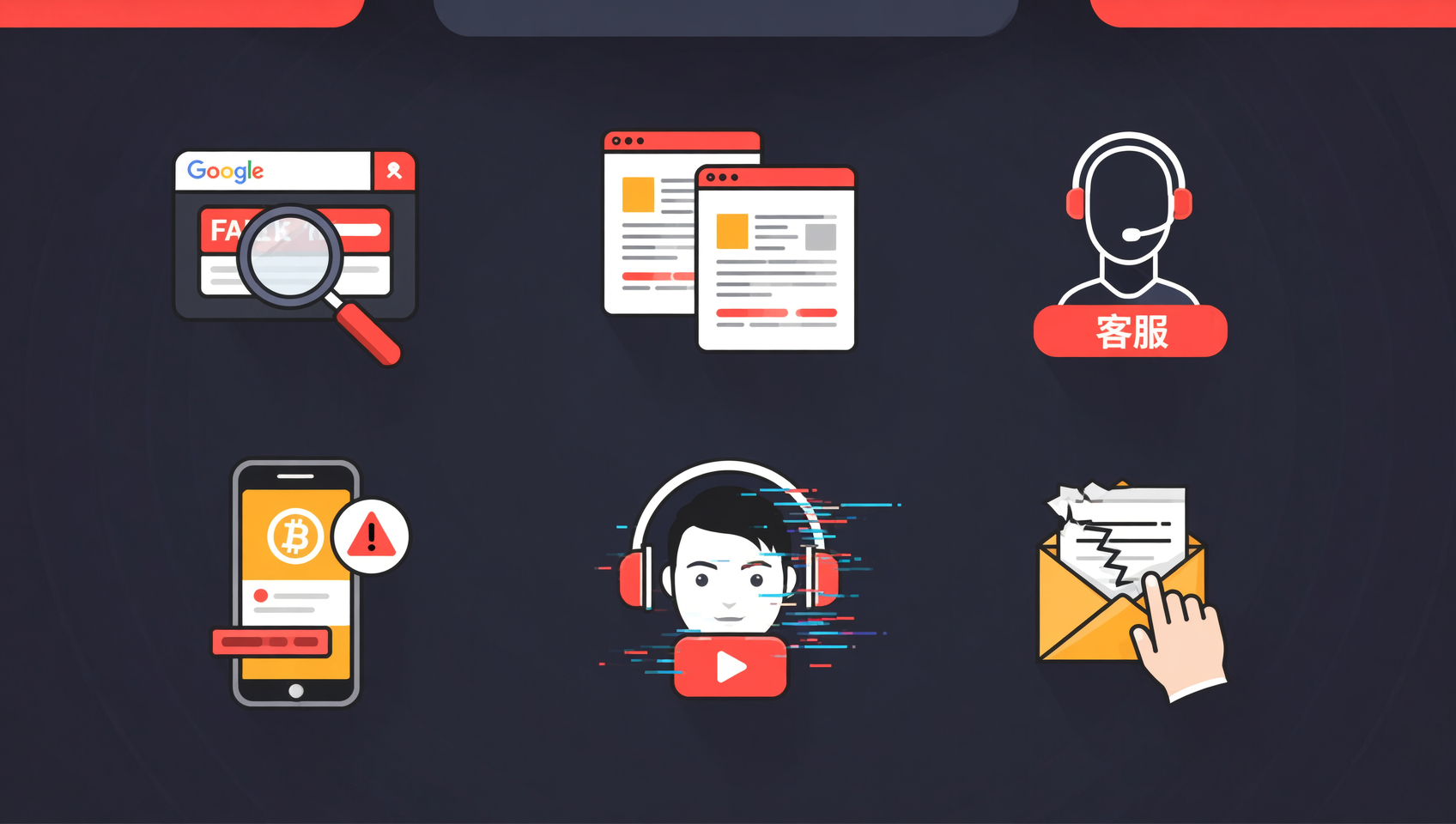
| Technique | How It Works | Real Case |
|---|---|---|
| Google Ad Phishing | Buy search ads to show fake links at top of results | 2025 fake Uniswap ad stole $400,000+ |
| Clone Websites | Fully copy legitimate exchange pages, domain off by one letter | Over 230,000 fake domains identified |
| Fake Customer Support | Impersonate official support in communities, ask for API or private keys | Telegram accounts impersonating Binance/OKX support are rampant |
| Fake Apps | Publish fake apps on third-party markets | Sophos found 167 fake trading apps |
| AI Deepfakes | Use AI to generate videos of celebrities (Elon Musk, etc.) promoting fake platforms | Fastest-growing scam type in 2026 |
| Recovery Scams | Claim to help recover stolen funds, charge a "service fee" | Common second victimization after a scam |
The Right Way to Choose an Exchange
By now, you might ask: So how do I choose a reliable exchange?
The recommended approach is to start with exchanges that have already been verified as safe.
- Binance: The world's largest exchange, holds multiple regulatory licenses, publishes Proof of Reserves, asset transparency
- OKX: One of the world's top exchanges, also holds multiple regulatory licenses, supports Proof of Reserves
💡 If you want more tips on choosing an exchange, check out this article: Top 5 Cryptocurrency Exchanges for Beginners in 2026
Or if you want to start learning crypto basics from scratch, here's a complete tutorial: How to Buy Cryptocurrency for Beginners in 2026
Further Reading
- 2026 Common Cryptocurrency Scams Guide: Identify Tricks, Protect Assets
- Ultimate Cryptocurrency Wallet Security Guide: Anti-Hacker, Anti-Phishing
- Complete Binance Spot Trading Tutorial: Limit Orders, Market Orders, Stop-Loss Orders Explained
- On-Chain Knowledge Base — Learn More About Blockchain and Crypto Security
FAQ (Frequently Asked Questions)
Q1: How can I confirm an exchange is legitimate?
A: You can confirm through these steps: 1) Check on the official financial regulator's website if the exchange holds a valid license; 2) Verify the domain registration date—legitimate exchanges usually have domains registered for years; 3) Check if the exchange publishes Proof of Reserves; 4) Check for real media coverage and community activity; 5) Test with a small withdrawal to see if it works.
Q2: What if I accidentally click on a phishing website?
A: If you only browsed the page without entering any information, just close it. If you entered your username and password, immediately log into the official site, change your password, and enable 2FA. If you entered API keys or private keys, immediately revoke the key and transfer assets to a secure wallet. Always double-check every transaction signature and don't blindly approve contract authorizations.
Q3: What is the most common trick of fake exchanges?
A: The most common is "easy to deposit, hard to withdraw": you deposit and can "trade" and even profit with your balance, but when you try to withdraw, the platform demands additional deposits for reasons like "deposit required," "account abnormal," or "tax freeze." Eventually, you invest more and more but can never withdraw.
Q4: What are the characteristics of legitimate exchange domains?
A: Legitimate exchanges use their official domains, e.g., Binance is binance.com, OKX is okx.com. Phishing sites use similar variations, like binnance.com or b1nance.com for Binance, and 0kx.com or okxx.com for OKX. Check for letter substitutions and extra words.
Q5: What should I watch out for when searching for exchanges on Google?
A: Don't click on "Sponsored" (Ad) results in search results. In 2025-2026, multiple phishing incidents via Google ads promoting fake exchanges have occurred, with single attacks causing losses over $400,000. Manually type the exchange's official URL or use bookmarks.
Q6: Can I recover funds after being scammed?
A: Blockchain transactions are irreversible; once funds are sent, they are almost impossible to recover. Don't trust any third party claiming to "help you recover funds"—this is likely a secondary scam (Recovery Scam). The correct action is to report to local police and financial regulators immediately, and also report to FBI IC3 (ic3.gov).
Disclaimer: This content is for educational reference only and does not constitute investment advice. Cryptocurrency investment carries risks; please make decisions based on your own situation.