

Key takeaways:
- Six platforms are worth comparing in 2026: Binance, OKX, Bybit, Gate, HTX and Bitget. Pick Binance if you want one account for spot; OKX if you rely on CNY C2C and on-chain tools; Bybit or Bitget for futures; Gate for altcoins.
- The "big three" is a 2017 label, not a 2026 ranking. By CoinGecko's 24-hour volume on 8 November 2026, Bybit ranked second, with OKX, Gate and HTX clustered within about 5%.
- Fee differences are smaller than they look. Buying 40,000 CNY of BTC per month costs roughly 288–360 CNY a year in Binance fees versus about 720 CNY at Gate or HTX. A C2C spread, a frozen card or a fake app can cost several times more.
- The biggest risk is the entry point and the counterparty, not the exchange logo. Fake apps, fake support agents, "signal teachers" and money-muling requests account for most mainland-user losses.
- Since the 6 February 2026 notice (Yinfa No. 42), overseas platforms serving mainland residents are explicitly classified as illegal financial activity. This article is information and risk analysis, not legal or investment advice.
⚠️ Read this first: if you have not registered yet, use the registration link or enter invite code BINANBT on Binance. Registering directly inside the app gives you no new-user rewards — the welcome package (up to $19,800 in task-based rewards) and the 20% trading-fee rebate are tied to the invitation at signup and cannot be added reliably later.
For Chinese users in 2026, the realistic shortlist is six exchanges: Binance, OKX, Bybit, Gate, HTX and Bitget. If you want a single account, choose Binance: it has the deepest liquidity, the lowest effective spot fee and the most complete Chinese-language support. If you move money through CNY C2C and spend time on-chain, OKX is smoother. For futures, look at Bybit or Bitget; for long-tail altcoins, Gate; HTX mainly suits users who have been there for years.
But one point comes before any ranking: there is no legal virtual-currency exchange inside mainland China. All six are offshore platforms, and since the February 2026 notice, providing virtual-currency services to mainland residents has been explicitly classified as illegal financial activity, with losses borne by the individual. This article does not explain how to evade restrictions. It compares what the six platforms actually offer and flags the risks that can wipe out your capital after you have already decided to participate.
We compare five verifiable dimensions:
- Liquidity and scale — CoinGecko 24-hour volume, 8 November 2026;
- Spot fees — public fee schedules read on 7–8 November 2026;
- CNY C2C and Chinese-language support;
- Funding and withdrawal paths;
- Mainland-specific risks — frozen cards, fake apps and the legal position after Yinfa No. 42.
Disclosure: this article contains a Binance affiliate link. We may earn a commission if you register through it; your fees do not change. The ranking is based on public data and use cases, not on commission rates.
Table of contents
- The short answer: three user types, three choices
- Where the "big three" label comes from — and why it misleads in 2026
- Best exchanges for Chinese users compared (November 2026)
- Binance: the safest default, but how you register matters more
- OKX: C2C and Web3 wallet are the difference
- Bitget, Gate, HTX and Bybit: each fits one type of user
- The real cost: buying 40,000 CNY of Bitcoin a month
- C2C funding: five ways a bank card gets frozen
- China's 2026 crypto rules: what is actually prohibited
- Fake apps, fake support and signal sellers: four common scams
- From signup to your first Bitcoin: six steps
- FAQ
- Conclusion: secure the entry point first
- 💰 Binance rebate: invite code BINANBT
- Further reading
The short answer: three user types, three choices
Beginners buying spot should start with Binance; frequent CNY C2C users and on-chain users should look at OKX; futures and copy-trading users should consider Bybit or Bitget. No platform wins every dimension, but each user type has one clearly less painful option.
| Your situation | First choice | Alternative | Why |
|---|---|---|---|
| First purchase, a few hundred to tens of thousands of CNY | Binance | OKX | Deepest liquidity, most Chinese tutorials, about 0.06% effective spot fee with BNB and rebate |
| Frequent C2C funding, on-chain activity | OKX | Binance | More CNY merchants, mature multi-chain Web3 wallet |
| Futures and copy trading | Bybit / Bitget | OKX | Deeper derivatives tools; Bitget's copy-trading ecosystem is stronger |
| Long-tail altcoins and early-stage tokens | Gate | MEXC | Widest coin list, but higher fees and more scam tokens |
| Long-time user who does not want to switch | HTX | — | Familiar Chinese community, but no longer top-tier on liquidity or trust ranking |
| Large balances, long-term holding | Binance + self-custody | OKX + hardware wallet | Use the exchange as a gateway, not a vault |
This table is a starting point, not a verdict. Two things matter more than the ranking below: the "big three" label is outdated, and fee differences are small.
Where the "big three" label comes from — and why it misleads in 2026
The "big three" refers to Huobi, OKCoin (now OKX) and Binance before the September 2017 exchange shutdown — not to 2026 market share. The order has changed, yet many Chinese articles still repeat the old label, sometimes claiming HTX handles $10 billion a day when third-party data puts it near $580 million.
CoinGecko's 24-hour volume on 8 November 2026:
| Exchange | 24h volume (BTC) | Approx. USD | CoinGecko trust rank |
|---|---|---|---|
| Binance | 31,852 | $2.41B | #4 |
| Bybit | 17,758 | $1.35B | #35 |
| OKX | 8,087 | $0.61B | #3 |
| Gate | 7,801 | $0.59B | #6 |
| HTX | 7,681 | $0.58B | #51 |
| Bitget | 3,666 | $0.28B | #5 |
Two results are counter-intuitive.
First, Bybit is second by reported volume but only 35th by trust rank. Volume is self-reported; the trust score weighs liquidity, API quality and data transparency. When the two disagree, "biggest" is not the same as "safest", and no single leaderboard is enough.
Second, OKX, Gate and HTX are within about 5% of each other. What separates them is product mix, not size: OKX leads on C2C and Web3 wallets, Gate on coin count, HTX on habit. HTX is not the automatic third member of a "big three"; it is one option in the same volume bracket.
So the right question in 2026 is not "which are the big three" but: do you fund with CNY or on-chain? Do you trade spot or futures? How much platform risk can you tolerate?
Data note: CoinGecko
/exchangesAPI, read on 8 November 2026, converted at $75,793 per BTC. Self-reported volumes can differ from third-party estimates; the table indicates scale, not safety.1
Best exchanges for Chinese users compared (November 2026)
The differences are clear once the six are side by side: Binance wins on liquidity and fees, OKX on C2C and on-chain access, Bybit on futures, Gate on coin selection, HTX on habit and Bitget on copy trading. Fees below are public VIP0 rates and exclude promotions and regional differences.
| Exchange | Background | Spot fee (VIP0) | Platform-token discount | CNY C2C | Best for |
|---|---|---|---|---|---|
| Binance | Founded 2017; largest global volume | 0.10% | BNB: 25% off, 0.075% | Yes, largest merchant pool | The default all-rounder |
| OKX | Founded 2017; formerly OKEx | 0.08% maker / 0.10% taker | No OKB discount | Yes, dense merchant pool | C2C and on-chain users |
| Bybit | Founded 2018; derivatives-first | 0.10% | — | Yes, check the page | Futures traders |
| Gate | Founded 2013; very wide coin list | 0.20% | GT: 25% off, 0.15% | Yes | Altcoin and early-stage hunters |
| HTX | Founded 2013; formerly Huobi | 0.20% | HTX: 25% off, 0.15% | Yes | Long-time users and Chinese community |
| Bitget | Founded 2018; copy-trading-first | 0.10% | BGB discount varies | Yes | Beginners who want to copy trade |
Details that are easy to miss:
- OKX's 0.08% applies to maker orders only; takers still pay 0.10%. Most beginners are takers, so their real cost is close to Binance's, sometimes higher.
- OKB does not discount trading fees. That is the conclusion of OKX's September 2026 fee-rule update; older "40% off with OKB" claims are obsolete.2
- Gate and HTX's 0.20% falls to about 0.15% with their platform tokens. Five basis points looks small until volume grows.
- "CNY C2C available" is not a permanent promise. Merchant counts, payment methods and limits change with compliance policy; trust the registration and C2C pages at the time you use them.
Fee sources: Binance and OKX fee pages read on 7 November 2026; Gate, HTX, Bitget and Bybit pages read on 8 November 2026. VIP tiers, token discounts and promotions change; the account page at order time is authoritative.234
Binance: the safest default, but how you register matters more
Binance is the best choice if you want one account for spot trading: its volume is about 1.8 times Bybit's, its spot fee is the lowest of the six, and its Chinese-language coverage is the most complete. Liquidity is not cosmetic: it means smaller slippage when you buy and easier fills when you sell.
Its strengths are concrete:
- 0.10% spot, 0.075% with BNB, about 0.06% after a 20% invite rebate — the lowest effective fee in this group;
- Broad coin coverage, including majors, stablecoins and selected new listings;
- Complete Chinese support across registration, KYC, C2C and withdrawals;
- A relatively mature security stack, including SAFU and public proof-of-reserves.
Its weaknesses are equally real:
- Persistent regulatory pressure across jurisdictions, which occasionally affects access in some regions;
- Slow support during volatile markets;
- The most impersonated brand, because it is the largest;
- KYC details for mainland users: an ID card or passport works, a mainland driver's licence does not; normal review takes 30 minutes to 2 hours, 2–12 hours at peak, with an official 48-hour outer limit.
What determines your cost is not "Binance or not" but which entry point you use. The invitation relationship is bound at registration. Registering directly in the app binds nothing, so the welcome package and the 20% fee rebate are lost. This is a system rule, not marketing: adding a code later has a limited window, and after that you would need a new account.
For the exact registration, KYC, security and C2C steps, see our Binance registration guide and Binance C2C deposit guide.
OKX: C2C and Web3 wallet are the difference
OKX suits people who move CNY in and out frequently and also use on-chain tools: it has a dense C2C merchant pool and a Web3 wallet that connects exchanges, wallets, bridges and DApps in one app. If you buy and then withdraw to a chain, OKX's path is shorter than Binance's.
Strengths:
- Dense, fast CNY C2C, often smoother than Binance for small USDT purchases;
- A mature Web3 wallet with multi-chain management, DApp browsing and bridging;
- Complete derivatives tools — futures, options and strategy trading;
- 0.08% maker spot fee, an advantage for limit-order traders.
Weaknesses:
- A complex interface; first-time users may struggle to find the buy button;
- No OKB fee discount — do not buy OKB expecting cheaper trades;
- Withdrawal fees vary sharply by chain. As of 3 November 2026, OKX did not support USDT on BEP20; its cheapest standard option was ERC20 at 0.29 USDT, versus 0.60 USDT on Binance ERC20 and 0.01 USDT on Binance BEP20.5
- An exchange is not a bank. The Web3 wallet is self-custodial: lose the key and nobody can recover it. Exchange balances are custodied by the platform, so platform failure is your risk too.
In one line: OKX is smoother for C2C and on-chain use; Binance is stronger on fees and liquidity. Many experienced users keep both and split the work.
Bitget, Gate, HTX and Bybit: each fits one type of user
These four are not "worse". They are less general-purpose: each has one clear strength and one weakness that can cost you money.
Bitget: copy trading is the feature, not a guarantee
Bitget's core pitch is copy trading: you mirror another trader's positions automatically. That sounds friendly to beginners, but it delegates decisions to someone you do not know.
- Good for: people who want to learn and are willing to risk small amounts;
- Bad for: anyone who thinks copy trading means guaranteed profit. Past performance does not predict future returns, and drawdowns are copied too;
- Spot fee 0.10%, but spot depth is thinner than Binance or OKX — watch slippage on large orders.
Gate: the widest coin list, and the most scam tokens
Gate lists an enormous number of small and new tokens, often before larger exchanges. That breadth is useful only if you can screen contracts, liquidity pools and holder distribution.
- Good for: experienced users who can read a contract address and a liquidity pool;
- Bad for: beginners chasing "100x" tokens;
- Spot fee 0.20%, about 0.15% with GT — among the highest here.
HTX: the brand remains, the premium does not
HTX (formerly Huobi) is a 2013-era exchange with a surviving Chinese community and support system, which suits long-time users who do not want to switch. But on 8 November 2026 its volume clustered with Gate and OKX, and its trust rank was 51st — no longer the position implied by "big three".
- Good for: existing users and those who value the Chinese community;
- Bad for: new users chasing the lowest fee or deepest liquidity;
- Spot fee 0.20%, about 0.15% with HTX.
Bybit: strong futures, wrong starting point for beginners
Bybit was built on derivatives and has one of the most complete futures toolkits, with the second-highest reported 24-hour volume. But its trust rank was only 35th, a gap between volume and transparency that matters if you are choosing your first exchange.
- Good for: users who already understand margin, liquidation and funding rates;
- Bad for: first-time buyers — futures can liquidate far faster than spot can fall;
- Spot fee 0.10%, with a complete Chinese interface.
The real cost: buying 40,000 CNY of Bitcoin a month
Bottom line: buying 40,000 CNY a month (480,000 CNY a year) costs roughly 288–360 CNY a year in Binance fees versus about 720 CNY at Gate or HTX — a difference of around 400 CNY. Real, but far smaller than the "choose wrong and lose big" framing suggests.
Assume 10,000 CNY a week, four times a month, all taker orders:
| Exchange | Effective fee | Monthly fee | Annual fee | Difference vs Binance |
|---|---|---|---|---|
| Binance (BNB + 20% rebate) | ~0.06% | 24 CNY | 288 CNY | — |
| Binance (BNB only) | 0.075% | 30 CNY | 360 CNY | +72 CNY |
| OKX (taker) | 0.10% | 40 CNY | 480 CNY | +192 CNY |
| Bitget / Bybit | 0.10% | 40 CNY | 480 CNY | +192 CNY |
| Gate / HTX (after token discount) | 0.15% | 60 CNY | 720 CNY | +432 CNY |
Fees are only the first layer of cost. Two more matter more:
Second layer: the C2C spread. When you buy USDT with CNY, the merchant's quote usually includes a spread over the mid-market rate. Assume 0.5% (higher for small, late-night or urgent orders): on 40,000 CNY a month that is about 2,400 CNY a year, more than five times the fee gap between Binance and Gate.
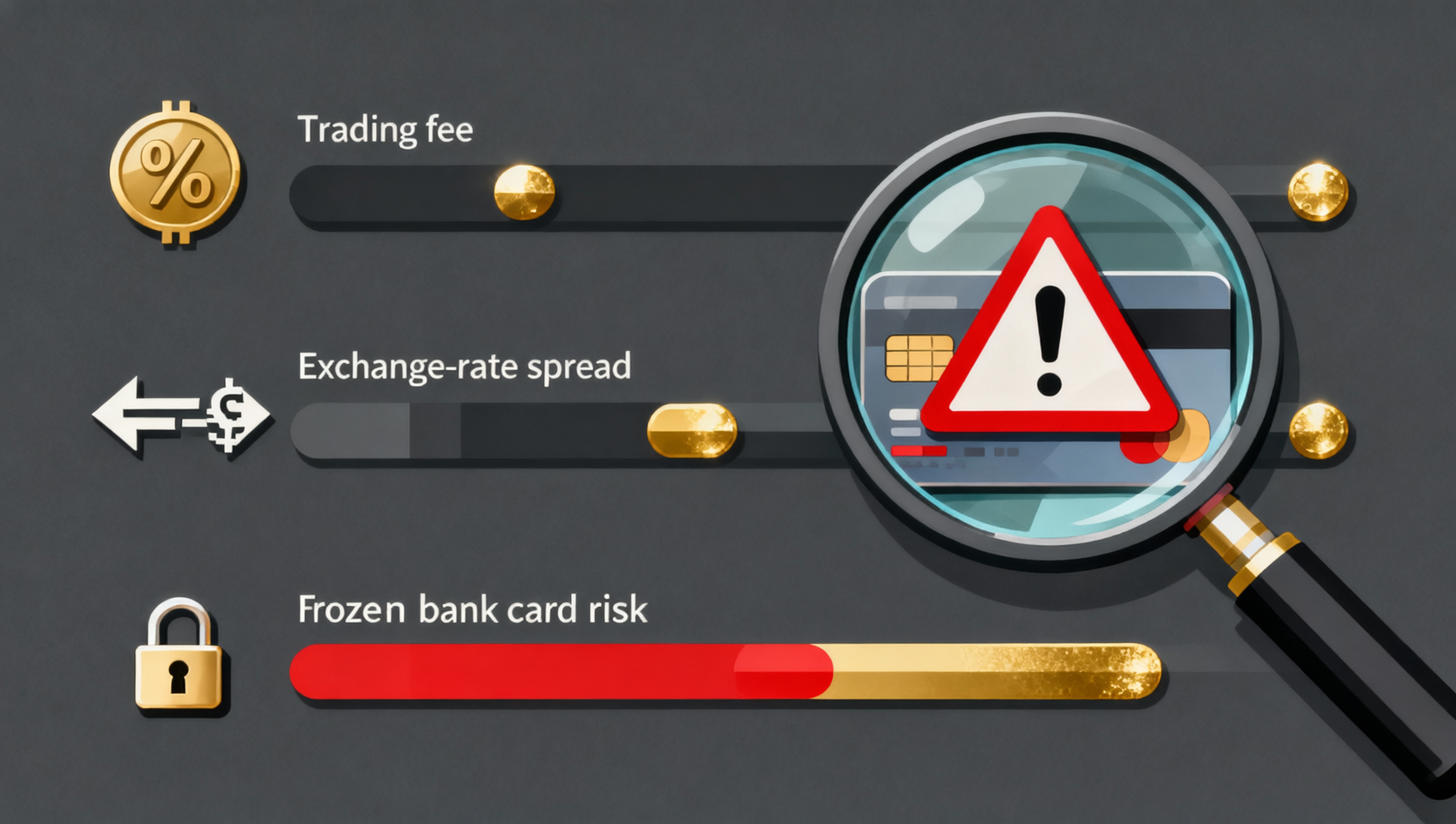
Third layer: frozen cards and scams. One freeze can lock thousands to hundreds of thousands of CNY for weeks or months; one fake app or fake support agent can take everything. Neither has a calculable expected value, but together they dominate mainland-user losses.
The correct priority is therefore: entry-point safety > counterparty quality > withdrawal path > trading fee. Saving 400 CNY by using an obscure platform is a bad trade.
Calculation note: simplified model; excludes VIP tiers, promotions, BNB/GT/HTX price moves and withdrawal fees. The 0.5% spread is an assumption, not a platform promise. Your quote at order time is authoritative.
C2C funding: five ways a bank card gets frozen
A C2C freeze usually starts with the counterparty's money, not the platform. If the CNY you receive traces back to fraud, gambling or money laundering, police can freeze downstream accounts — including your receiving card. The exchange can vet merchants; it cannot unfreeze your account.
Five common red flags:
- A price clearly below the market. Deep discounts often signal urgency, dirty funds or an attempt to move the deal off-platform.
- The payer's name does not match the merchant's verified name. Third-party payment is the fastest route into a fraud investigation.
- Requests to split payments across multiple cards. Legitimate merchants rarely need you to rotate cards; splitting is often used to evade monitoring.
- Being pushed to WeChat or Telegram to settle privately. Once you leave the platform's order and chat system, you lose your evidence and the platform cannot intervene.
- Large late-night or rapid-fire transactions. These are high-risk patterns in both exchange and police models.
Five habits that reduce risk:
- Use a dedicated card — not your salary card, not a card tied to a mortgage, and do not park large balances on it;
- Trade only with verified merchants — check real-name verification, completed orders, completion rate and account age, not just price;
- Require the payer to match the order name — cancel if it does not, regardless of the merchant's explanation;
- Keep order, chat and transfer records for at least six months; they are your evidence if a freeze happens;
- Never receive or forward money for others, and never lend your account. Money-muling can lead to criminal liability for aiding cybercrime or concealing proceeds — it is not "just a favour".
One sales pitch to ignore: Binance's "Shield" merchant protection does not apply to mainland China. It is a merchant-compensation programme for selected markets; mainland users cannot rely on it after a freeze. Vetting still comes down to real-name verification, order history, completion rate, account age and how long the merchant's funds have been settled.6
If a freeze happens: ask your bank which authority issued it and what type it is, then bring the order, chat records and bank statements to explain. Do not trust anyone offering "internal connections" to unfreeze the card — that is the second scam.
China's 2026 crypto rules: what is actually prohibited
The direct answer: there is no legal virtual-currency exchange in mainland China. Holding crypto is not itself criminalised, but virtual-currency business activities are illegal financial activity; related civil acts may be void and losses fall on the individual.
The timeline:
- 4 September 2017 — seven regulators banned ICOs, and domestic exchanges wound down;
- September 2021 — ten departments issued Yinfa No. 237, classifying virtual-currency business (fiat exchange, coin-to-coin exchange, intermediation and pricing, token issuance, derivatives) as illegal financial activity, including overseas exchanges serving mainland residents over the internet;7
- 6 February 2026 — the PBOC and seven other departments issued Yinfa No. 42, repealing No. 237 and, for the first time, explicitly prohibiting overseas entities and individuals from unlawfully providing virtual-currency services to mainland residents, while bringing stablecoins and RWA tokenisation into the framework.8
A common online claim says a 2024 Shanghai Songjiang court ruling "confirmed that individual crypto holding is legal". That misreads the decision. A court recognising the property nature of crypto in a specific civil dispute does not license trading, and cannot override the business-activity classification in Yinfa No. 42. Holding, trading and operating are three different things.
What this means in practice:
- Do not assume "the platform is big, so it is legal". All six are offshore; serving mainland residents is classified as illegal financial activity under the 2026 notice;
- Do not act as an intermediary, buyer-for-hire or money mule. What starts as a civil invalidity can escalate to criminal exposure;
- Use only money you can afford to lose. Regulatory changes can restrict withdrawals or bank rails in ways you cannot control;
- This is not legal advice. Consult a qualified lawyer about your situation; do not use an article as a defence.
Fake apps, fake support and signal sellers: four common scams
Most mainland-user losses happen around the exchange, not inside it. These four scams account for a large share.
| Scam | Typical script | How to spot it |
|---|---|---|
| Fake app / fake site | "It's not in the app store — install this package"; "internal version with lower fees" | Download only from the official site; on Android verify package com.binance.dev and developer Binance Inc.; use the official verification page |
| Fake support | "Your account is abnormal; send the code / let us remote-control / transfer to unfreeze" | Official support never messages first, never asks for codes and never requests remote access |
| Signal seller | "Follow me, guaranteed profit"; "deposit on this small platform; pay a deposit to withdraw" | Any guaranteed return is a scam; a withdrawal fee after profits means the money is already gone |
| Money mule / "payment agent" | "Let me use your bank card for one transfer; 1% commission" | A classic route to criminal liability and frozen accounts |
A hard identifier for the Binance app: the Android package is com.binance.dev, the developer is Binance Inc., the official download domain is download.binance.com, and the verification page is binance.com/en/official-verification. Names, icons and layouts are easy to copy; package names and signatures are not. Check the package after installing and uninstall immediately if it does not match.
Also: never install an APK from Telegram groups, cloud drives or third-party download sites. Those are the main distribution channels for fake apps, especially paid search ads for "Binance download".
From signup to your first Bitcoin: six steps
If you have decided to proceed, here is the full path, with the failure point at each step.
Step 1 — Choose the exchange and use only the official entry. Pick by use case (Binance for beginners, OKX for C2C and on-chain, Bybit/Bitget for futures), then type the official domain manually. Do not click search ads. If the official site will not load, try later; do not download from a third-party mirror.
Step 2 — Register with an invite code and secure the account immediately. Enter BINANBT at signup, or use the registration link. Then enable two-factor authentication (an authenticator app or hardware key), set an anti-phishing code and remove unnecessary API permissions. Do not rely on SMS alone — SIM-swap is a common takeover route.
Step 3 — Complete KYC. Use an ID card or passport. Binance normally reviews in 30 minutes to 2 hours, 2–12 hours at peak, with an official 48-hour limit; attempts per day are limited, so do not resubmit repeatedly. A mainland driver's licence is not accepted, unlike in some other markets.
Step 4 — Buy USDT through C2C. Start small (for example 500–1,000 CNY). Confirm the merchant's real name, payment method and release speed before increasing size. Mark "paid" inside the platform, never transfer off-platform, and never release before payment clears.
Step 5 — Buy BTC on spot. Transfer USDT from the funding account to the spot account and buy BTC/USDT at market. For a first purchase, use a market order; trying to save 0.1% with a limit order while the price moves 3% is a classic beginner mistake.
Step 6 — Withdraw to self-custody (optional but recommended). Move long-term holdings to a hardware or self-custody wallet. Test with a small amount first, and verify the address and network before sending the rest. Withdrawal fees vary sharply by chain: Binance charges 0.01 USDT for USDT on BEP20 and 0.60 USDT on ERC20; OKX does not support USDT on BEP20 and charges 0.29 USDT on ERC20.5 Choosing the wrong network usually costs more than choosing the wrong exchange.
Do not move straight into futures, leverage or copy trading. Complete a full buy–withdraw–sell loop first.
FAQ
Which crypto exchanges do Chinese users actually use in 2026?
The shortlist is Binance, OKX, Bybit, Gate, HTX and Bitget. Binance is the default for beginners and spot buyers; OKX is preferred for CNY C2C and on-chain activity; Bybit and Bitget appeal to futures traders; Gate is for altcoin hunters. All six are offshore platforms — there is no legal virtual-currency exchange inside mainland China.
Are Binance, OKX and HTX still the "big three"?
That label dates back to the 2017 exchange shutdown, not to 2026 market share. By CoinGecko's 24-hour volume on 8 November 2026, Bybit ranked second, while OKX, Gate and HTX were within about 5% of each other. Choose by use case and all-in cost, not by an old nickname.
Can mainland Chinese users open Binance or OKX accounts?
Both offer Chinese-language interfaces and generally accept a mainland ID card or passport for KYC; Binance does not accept a mainland driver's licence. Availability can change with compliance policy, so check the registration page at the time. Under the February 2026 notice, overseas platforms serving mainland residents is classified as illegal financial activity, with losses borne by the individual.
Which exchange has the lowest Bitcoin fees?
At VIP0, Binance charges 0.10% spot (0.075% with BNB, about 0.06% after a 20% rebate), OKX charges 0.08% maker / 0.10% taker, Bitget and Bybit charge 0.10%, and Gate and HTX charge 0.20% before platform-token discounts. On small purchases, the CNY C2C spread usually matters more than the fee difference.
Can a C2C trade freeze my bank card?
Yes. The freeze usually comes from police, not the exchange: if your counterparty's funds are linked to fraud, investigators can freeze downstream accounts, including yours. Use a dedicated card, trade only with verified merchants whose payment name matches the order, keep order and chat records, and never receive or forward money for someone else.
Is buying Bitcoin legal in mainland China?
Holding virtual currency is not itself a criminal offence, but virtual-currency business activities are classified as illegal financial activity. The February 2026 notice (Yinfa No. 42) explicitly bans overseas entities from providing virtual-currency services to mainland residents; related civil acts may be void and losses are borne by the individual. This article is information only, not legal advice.
How much should a first-time buyer start with?
Use money you can afford to lose and will not need for at least six months. Start with a few hundred to a couple of thousand CNY to complete the full loop — registration, KYC, C2C purchase of USDT, spot purchase of BTC and a test withdrawal — before increasing the amount. Avoid futures and leverage at the start.
Conclusion: secure the entry point first
No single exchange is "correct" for everyone; the real dividing line is the entry point and the counterparty. Binance versus OKX may differ by one or two hundred CNY a year in fees. A wrong download link, a dirty-money merchant or a "signal teacher" can cost your entire principal.
If you want the simplest answer:
- First purchase, spot only: Binance, with invite code BINANBT; about 0.06% effective spot fee after BNB and rebate;
- Frequent C2C and on-chain use: OKX as primary, Binance as backup;
- Futures: Bybit or Bitget, after you understand liquidation mechanics with small size;
- Altcoins: Gate, after you can read a contract address and a liquidity pool;
- Long-time users: HTX is fine, but do not pay a 0.20% fee premium out of nostalgia.
One last time: there is no legal virtual-currency exchange in mainland China, and since Yinfa No. 42, overseas platforms serving mainland residents is illegal financial activity. This article is information only, not investment or legal advice. Any platform can restrict withdrawals; any merchant can bring a freeze. Confirm you can bear the worst outcome before participating.
💰 Binance rebate: invite code BINANBT
The fee gap may be a few hundred CNY a year, but the 20% rebate is a long-term discount from your first trade. This article contains an affiliate link; we may earn a reward if you register through it, and your fees do not increase.
- Rebate: 20% of trading fees, ongoing;
- Welcome package: up to $19,800, unlocked through tasks — not cash on signup;
- How to claim: enter BINANBT in the invite-code field at registration; that is the most reliable method;
- Important: registering directly in the app gives you no new-user rewards. An in-app signup binds no invitation, so the welcome package and the 20% rebate are lost.
👉 Register on Binance and claim the 20% fee rebate
Further reading
- Best Bitcoin Trading Platforms 2026: Top 8 Exchanges Ranked
- How to Cut Binance Trading Fees: BNB, VIP Tiers and Rebates
- Binance Registration Guide 2026: Account, KYC and Deposit
- Binance C2C Deposit Guide: Bank Card, Alipay and USDT
- Crypto Exchange Withdrawal Fees 2026
- Is It Safe to Keep Crypto on an Exchange?
- USDT Withdrawal to a Bank Account: Routes and Freeze Risk
Disclaimer: this article is for educational purposes only and is not investment or legal advice. Fees, VIP thresholds, rebate rates, withdrawal charges and platform availability change with policy; figures reflect public data read on 7–8 November 2026 and the live page at order time prevails. Virtual-currency business activities are illegal financial activity in mainland China, and participants bear the risk. Confirm the law in your jurisdiction before acting.
Footnotes
-
Source: CoinGecko Exchanges API (
/api/v3/exchanges), read 8 November 2026, converted at $75,793 per BTC; volumes are self-reported and third-party estimates may differ. ↩ -
Source: Binance spot and futures fee schedule, read 7 November 2026; OKX fees and OKB rules from OKX fees and OKX Trading Fee Rules FAQ, updated September 2026. ↩ ↩2
-
Source: Gate.io fee page, read 8 November 2026; standard spot fee 0.20%, about 0.15% with GT. ↩
-
Source: HTX fee page, read 8 November 2026; standard spot fee 0.20%, about 0.15% with HTX. ↩
-
Source: TeamoRouter, "USDT Withdrawal Fees and Minimums (November 2026)", read 3 November 2026; also Binance withdrawal fees and OKX withdrawal fees. ↩ ↩2
-
Source: Binance announcements and Help Center on the Shield merchant programme; its coverage excludes mainland China, so mainland users cannot rely on Shield compensation. ↩
-
Source: State Council of China, "Notice on Further Preventing and Handling the Risks of Virtual Currency Trading Speculation" (Yinfa No. 237), issued 15 September 2021, published 24 September 2021. ↩
-
Source: Guangming Online, "PBOC and seven departments: virtual-currency business is illegal", 7 February 2026; the document is "Notice on Further Preventing and Handling Risks Related to Virtual Currency" (Yinfa No. 42), issued 6 February 2026 by the PBOC and seven other departments, repealing Yinfa No. 237. ↩