

⚠️ Read this first: if you don't have an account yet, register through the registration link (e.g. "Sign Up") or enter invite code BINANBT — signing up directly inside the app gets you no signup reward at all. The $19,800 welcome package and the 20% fee rebate won't apply. The referral relationship is fixed the moment you register; binding it later has a limited window.
Key takeaways (TL;DR):
- A Binance fee is not one number; it is four layers of cost. The trading fee is only the first layer. Behind it sit funding rates, flat withdrawal fees, and invisible costs such as spreads and slippage.
- The base spot rate is 0.10%/0.10%. The BNB discount brings it to about 0.075%, and a 20% rebate to about 0.06%. That is 40% total, not 25% + 20% = 45% — the two discounts multiply, they do not add.
- The BNB discount is 25% on spot but only 10% on futures. The real cost lever in futures is the maker order: base maker 0.02% against taker 0.05%, a 2.5x gap on a round trip.
- VIP tiers require both 30-day volume and BNB holdings. For an ordinary user, trading extra just to reach a tier usually costs more in fees than it saves.
- Withdrawal fees are flat, not proportional. October 2026 snapshot: about 0.01 USDT on BEP20, 0.3–0.4 USDT on ERC20 and 1.5 USDT on TRC20. On a 20 USDT withdrawal, the flat fee can eat 7.5%.
- The best way to save on fees is not to hunt for the lowest rate but to make fewer unnecessary trades. Rate optimisation saves 40%; halving pointless trades saves 50%.
Contents
- The short answer: four layers of cost, not one fee
- What Binance actually charges: one master table
- Spot fees: how 0.1% becomes 0.06%
- BNB discount: 25% on spot, only 10% on futures
- Invite-code rebate: 20% is multiplicative, not additive
- VIP tiers: you need both volume and BNB holdings
- Futures fees: maker is 2.5 times cheaper than taker
- Withdrawal fees: a flat charge that hurts small amounts
- The invisible costs: spread, slippage and funding rates
- Which saving strategy fits your trading style
- Five common misconceptions
- 💰 Binance fee rebate: invite code BINANBT
- FAQ
- Further reading
The short answer: four layers of cost, not one fee
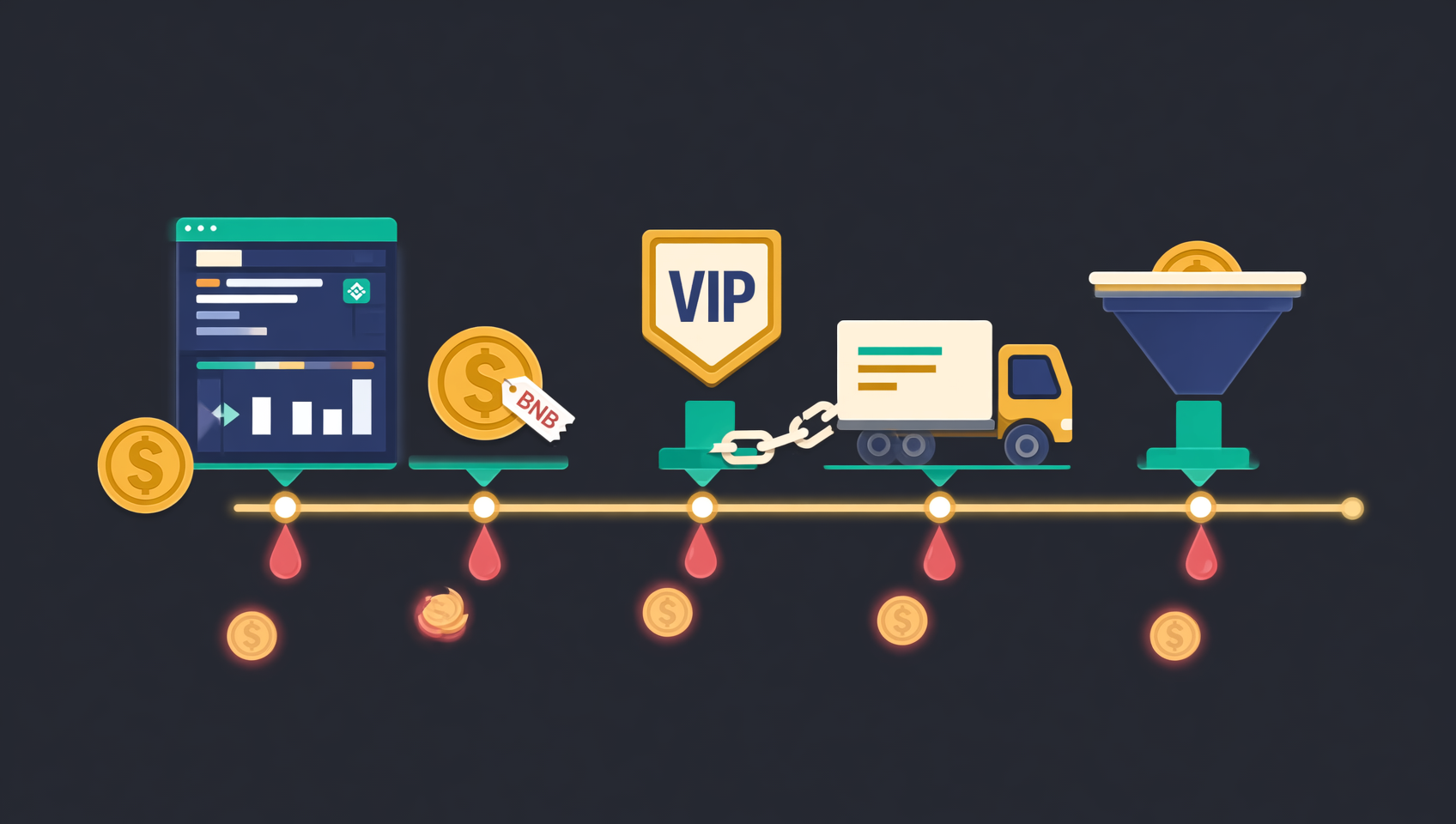
When most people compare exchanges, they read only the "0.10% spot" figure on the homepage. But what a trade actually costs comes in at least four layers:
- Trading fee: charged on traded value; it differs between maker and taker, and between spot and futures.
- Cost of holding: futures settle a funding rate every 8 hours; spot has no equivalent, but borrowed margin carries interest.
- Cost of moving money in and out: withdrawals charge a flat fee per transfer, deposits are usually free, but C2C purchases carry a spread.
- Invisible cost: bid-ask spread, slippage, the Convert spread, stablecoin depeg.
Only when you add all four do you arrive at the real "cost of trading". Watch the first layer alone and you can easily get the situation where fees are 20% lower, then one withdrawal hands the saving straight back.
In one line: the fee schedule solves the first layer; the other three decide how much you actually lose.
What Binance actually charges: one master table
| Scenario | How it is charged | October 2026 reference | BNB discount? | Rebate? |
|---|---|---|---|---|
| Spot trading | On traded value, maker/taker | 0.10% / 0.10% | Yes, 25% | Yes |
| Futures (USDT-margined) | On notional value, maker/taker | 0.02% / 0.05% | Yes, 10% | Yes |
| Futures funding rate | On position notional, every 8 hours | Market-driven, often ±0.01% | No | No |
| Withdrawal | Flat fee per transfer | Network-dependent, about 0.01–1.5 USDT | No | No |
| Deposit | Usually free | 0 | — | — |
| C2C purchase | Merchant quote, spread included | Often 0.1%–0.5% | No | No |
| Convert | Quote includes a spread | Often 0.1%–0.5% | No | No |
| Margin borrowing | Interest charged hourly | Varies by asset and tier | No | No |
The rates above are the public schedule as checked on 31 October 2026. Binance adjusts them by account tier, campaign and region; the fee page in the app and the order confirmation screen take precedence.

Spot fees: how 0.1% becomes 0.06%
The base spot rate is maker 0.10% and taker 0.10%. At VIP 0 there is no maker/taker difference, so "post limit orders to save on fees" does not hold on a low-tier spot account — what actually brings the rate down is three layers stacking:
| Stacking step | Calculation | Per side | Round trip (buy + sell) |
|---|---|---|---|
| Base rate | 0.100% | 0.100% | 0.200% |
| + 25% BNB discount | 0.100% × 0.75 | 0.075% | 0.150% |
| + 20% invite rebate | 0.075% × 0.80 | 0.060% | 0.120% |
Run the numbers: 100,000 USDT of spot volume a month, one round trip.
- Base: 100,000 × 0.2% = 200 USDT
- BNB only: 100,000 × 0.15% = 150 USDT
- BNB + rebate: 100,000 × 0.12% = 120 USDT
So stacking both saves 80 USDT a month, a 40% cut in total cost. But note: 40% is the total reduction relative to the base rate, not 25% + 20% = 45%. The second discount applies to the already-discounted rate, so the two percentages never simply add up.
In one line: stacked discounts multiply, they do not add; every claim of "up to 45% off" has turned a multiplication into an addition.
BNB discount: 25% on spot, only 10% on futures
Once "Pay fees with BNB" is enabled, the system deducts BNB from your spot account first:
- Spot: 25% off, 0.10% → 0.075%.
- Futures: 10% off, taker 0.05% → 0.045%, maker 0.02% → 0.018%.
- The futures wallet needs its own BNB: if the USDT-margined futures account does not hold enough BNB, the discount does not apply and the system charges USDT instead.
There is a trade-off that is often overlooked: holding BNB to save on fees means taking on BNB's own price risk. If BNB falls 5%, a single move can wipe out the 25% you saved on fees. The sensible approach is to keep only a few weeks' worth of fees in BNB, not to take a large position for the discount.
Also, the BNB discount does not apply to every product: withdrawal fees, funding rates and C2C quotes are outside its scope. It only affects trading fees.
In one line: the BNB discount trades price risk for a lower fee rate; it is not risk-free arbitrage.
Invite-code rebate: 20% is multiplicative, not additive
Invite-code rebates are often advertised as "up to 40%" or "up to 50%". The three-party relationship needs untangling first:
- The invitee (you): register through a referral link or enter an invite code, and a share of your trading fees is returned. The industry-wide cap is usually 20%.
- The referrer: receives commission from the platform, possibly at a higher rate, but that is the referrer's income, not your discount.
- How it is paid: usually as a fee rebate, credited in USDT or as a fee credit, depending on the campaign and region.
So when you see "40% rebate", ask first: 40% for whom? If the page is describing the referrer's commission, you as the invitee will not receive 40%.
The critical constraint is when the relationship is bound:
- Enter the code at registration and the relationship takes effect immediately.
- Binding afterwards usually has a window (commonly 30 days from registration) and requires that the account has not traded or that campaign conditions are met.
- Once bound, it usually cannot be switched to another invite code.
In one line: a rebate is not a coupon you can claim whenever you like; it is a relationship that has to be locked in at the moment you register.
VIP tiers: you need both volume and BNB holdings
Binance VIP status is not "trade enough and you move up". It requires 30-day trading volume and BNB holdings at the same time. Here are the spot tiers from the official fee page (October 2026):
| Tier | 30-day spot volume | BNB holdings | maker / taker | maker / taker after BNB discount |
|---|---|---|---|---|
| VIP 0 | < $1,000,000 | 0 | 0.100% / 0.100% | 0.0750% / 0.0750% |
| VIP 1 | ≥ $1,000,000 | ≥ 5 BNB | 0.090% / 0.100% | 0.0675% / 0.0750% |
| VIP 2 | ≥ $5,000,000 | ≥ 25 BNB | 0.080% / 0.100% | 0.0600% / 0.0750% |
| VIP 3 | ≥ $20,000,000 | ≥ 100 BNB | 0.040% / 0.060% | 0.0300% / 0.0450% |
| VIP 4 | ≥ $75,000,000 | ≥ 500 BNB | 0.040% / 0.052% | 0.0300% / 0.0390% |
| VIP 5 | ≥ $150,000,000 | ≥ 1,000 BNB | 0.025% / 0.031% | 0.0188% / 0.0233% |
| VIP 9 | ≥ $4,000,000,000 | ≥ 5,500 BNB | 0.011% / 0.023% | 0.0083% / 0.0173% |
Three things to take from this table:
- The VIP 1 threshold is $1,000,000 per 30 days, not $10,000. An ordinary retail trader cannot reach it in a month, so pushing for a tier makes no sense.
- Taker fees at VIP 1–2 are still 0.10%; only maker falls. In other words, low VIP tiers barely help taker-style traders.
- BNB holdings are a hard requirement. Enough volume but not enough BNB and you still cannot move up; buying BNB to meet the holding requirement is another price risk.
In one line: VIP is built for market makers and high-frequency traders, not for someone who buys and sells occasionally.
Futures fees: maker is 2.5 times cheaper than taker
The base rate on USDT-margined futures is maker 0.02% and taker 0.05%. The gap is far wider than on spot, because futures charge on notional value and leverage magnifies the cost.
Say you use 1,000 USDT of margin at 10x to open a position with 10,000 USDT notional, then close it once:
| Method | Per-side rate | Open + close cost | As % of margin |
|---|---|---|---|
| All taker | 0.050% | 10,000 × 0.1% = 10 USDT | 1.0% |
| Taker + 10% BNB discount | 0.045% | 10,000 × 0.09% = 9 USDT | 0.9% |
| All maker | 0.020% | 10,000 × 0.04% = 4 USDT | 0.4% |
| Maker + 10% BNB discount | 0.018% | 10,000 × 0.036% = 3.6 USDT | 0.36% |
For the same position, all-taker versus all-maker is a 2.5x difference in cost; add leverage and a 1% margin cost compounds quickly with trading frequency. That is why futures traders care about maker/taker more than the headline rate.
But maker orders are not free: a limit order may not fill, the market moves away, you chase it, and the chase turns into a taker fill. Missing a trade in order to earn the maker rate is itself a cost.
In one line: the first lever on futures fees is "use fewer market orders"; the BNB discount is second.
Withdrawal fees: a flat charge that hurts small amounts
Withdrawal fees are charged per transfer, not as a percentage of the amount. Approximate USDT withdrawal fees on major networks in October 2026:
| Network | Withdrawal fee (approx.) | Effective rate on 20 USDT | Effective rate on 1,000 USDT |
|---|---|---|---|
| BEP20 (BNB Chain) | 0.01 USDT | 0.05% | 0.001% |
| ERC20 (Ethereum) | 0.30–0.40 USDT | 1.5%–2.0% | 0.03%–0.04% |
| TRC20 (Tron) | 1.50 USDT | 7.5% | 0.15% |
| Arbitrum One | 0.10 USDT | 0.5% | 0.01% |
| Polygon | 0.07 USDT | 0.35% | 0.007% |
Three conclusions:
- Do not use TRC20 for small withdrawals. A flat 1.5 USDT is 7.5% of 20 USDT — dozens of times more than a trading fee.
- TRC20 is no longer synonymous with "cheapest". In 2026, BEP20 and Arbitrum withdrawal fees are already below TRC20; choose a network by what the recipient supports and by the live fee.
- Withdrawal fees get no BNB discount and no rebate. They pass through an on-chain cost and have nothing to do with your VIP tier.
In one line: the expensive part of a withdrawal fee is not the rate but the word "flat".
The invisible costs: spread, slippage and funding rates
The four layers above at least show up on a statement. The following never appear as a line item:
- Bid-ask spread: the gap between best bid and best ask. On a thin coin the spread can be 0.5%, more than the trading fee you saved.
- Slippage: a large order eats through the order book and fills at an average price away from what you expected. The larger the market order, the greater the slippage.
- Convert spread: the one-tap conversion quote already includes a spread and is usually more expensive than a limit order.
- C2C premium: the amount by which a merchant's quote exceeds the market price. It is a purchase cost, not a fee.
- Funding rate: futures settle every 8 hours. At 0.01%, that is 0.03% a day and roughly 10.95% a year; at 10x leverage that is about 109.5% annualised against your margin.
- Stablecoin depeg: when you price in USDT, any deviation of USDT from $1 is also profit or loss.
Added together, these often exceed the trading fee several times over. So "lowest fee" does not mean "cheapest trade".
In one line: the fee schedule is the visible tax; the spread and slippage are the invisible one.
Which saving strategy fits your trading style
| Your situation | Do this first | Avoid |
|---|---|---|
| Occasional spot buys | Enter an invite code at signup; enable the BNB discount; use limit orders | Trading volume to chase VIP; frequent Convert |
| A few trades a month | Invite code + BNB discount; compare withdrawal networks | Cancelling and re-posting orders to save 0.02% |
| High-frequency spot | Work out the net gain before chasing VIP; be maker where possible | Watching only the taker rate; ignoring the spread |
| Futures trading | Use limit orders as maker; keep a little BNB in the futures wallet; control leverage | Chasing moves with market orders; ignoring funding on long holds |
| Large withdrawals | Pick a low-fee network the recipient supports; test small first | Using TRC20 for small amounts; ignoring network congestion |
| Long-term holding | Trade less; move coins to a self-custody wallet | Rotating positions for airdrops or rebates |
Five common misconceptions
- "Spot is 0.1%, BNB saves 25%, the rebate saves 20%, so I save 45%." Wrong. The discounts multiply: 0.1% × 0.75 × 0.8 = 0.06%, a 40% total reduction.
- "Futures work like spot — BNB saves 25% either way." Wrong. The BNB discount on futures is 10%, and the BNB has to sit in the futures wallet.
- "Higher VIP is always cheaper, so trade up first and worry later." Wrong. VIP needs volume and BNB holdings at once; the extra fees you pay to generate volume usually exceed what the upgrade saves.
- "Withdrawal fees are proportional, so size doesn't matter." Wrong. They are flat per transfer, which makes the effective rate on small withdrawals absurd.
- "Get fees to the absolute minimum and the trade is a good deal." Wrong. Spread, slippage, funding and C2C premiums are often far larger than the fee.
💰 Binance fee rebate: invite code BINANBT
Fees are deducted trade by trade, but the rebate relationship has to be locked in at signup — miss that step and you cannot go back and fix it.
- Rebate: 20% of every trading fee is returned. The rebate cap for invited users is uniformly 20%.
- How to claim: enter BINANBT in the invite-code field at signup. If you missed it, you can still bind within 30 days of registration as long as the account has no trading history.
- Stack it: enable "Pay fees with BNB" for another 25% off spot; with both applied the spot rate is about 0.06% per side, roughly 0.12% on a round trip.
- Important: registering directly inside the app gets you no signup reward at all. In-app signups are not linked to any referral relationship, so the $19,800 welcome package and the 20% fee rebate will not apply — use the registration link or enter BINANBT.
👉 Sign up for Binance and claim the 20% fee rebate
FAQ
What exactly is the Binance spot fee?
For a VIP 0 user the base rate is maker 0.10% and taker 0.10%. Enabling the BNB discount brings it to 0.075%; if a 20% rebate was bound at signup, the effective rate is about 0.06%. VIP tier, campaigns, trading pair and region all affect the final rate; the order confirmation screen is the authority.
Can the BNB discount and the invite-code rebate be used together?
Yes, but the combination multiplies rather than adds. The rebate applies to the fee, and the BNB discount then applies to the discounted amount, so 0.1% ends up at about 0.06% — a 40% total reduction, not 45%. Check the campaign page for the exact stacking rules.
Why is the BNB discount on futures only 10%?
That is Binance's current rule: 25% on spot, 10% on USDT-margined futures. In addition, the futures account has to hold its own BNB; BNB sitting in the spot account is not automatically used for futures fees.
I forgot to enter an invite code at signup — can I still add it?
Usually yes, within limits. The common rule is that you can bind within 30 days of registration while the account has not traded or while campaign conditions are met; once bound, it usually cannot be changed. The invite-code page in the app is the authority.
Can withdrawal fees be paid with BNB or offset by the rebate?
No. Withdrawal fees pass through an on-chain cost, are charged flat per transfer, and take no part in the BNB discount or the rebate. When choosing a network, confirm which chain the recipient supports first, then compare the live withdrawal fees.
Is it worth generating volume to reach a VIP tier?
In most cases, no. VIP 1 requires $1,000,000 of 30-day spot volume and at least 5 BNB held. The fees and spreads you pay to generate that volume usually exceed what the upgrade saves. Pushing for a tier only makes sense for market makers and high-frequency traders who already have steady volume.
Further reading
- How to Trade Spot on Binance 2026: Limit, Market, Stop-Loss Orders and Fees Explained
- Binance Futures Guide 2026: How to Open a USDT-M Perpetual, Choose Leverage and Calculate Your Liquidation Price
- Binance Invite Code 2026: BINANBT 20% Fee Rebate — Signup & Rebind Guide
- Binance Withdrawal Guide 2026: Choosing the Right Network, Address and Memo
- Binance Deposit Guide 2026: Buying USDT via C2C and What Happens After You Pay
- Binance Earn Guide 2026: Flexible, Locked, Dual Investment and Launchpool Explained
- More Binance content: the complete guide
Disclaimer: this article is for educational purposes only and is not investment advice. The fee rates, VIP thresholds, BNB discount and withdrawal fees quoted here are reference values checked on 31 October 2026 and change with Binance's rules, account tier, campaigns and market conditions. The fee page in the Binance app and the order confirmation screen take precedence. Trading and derivatives services are restricted in some countries and regions; confirm the laws that apply where you live1.
Footnotes
-
Sources: Binance's official fee page (spot VIP tiers and BNB discount), Binance futures fee documentation and the Binance withdrawal fee page, all checked on 31 October 2026; live rates shown in the app take precedence. ↩