


⚠️ Read this first: if you have not registered yet, use the registration link (e.g. "Register now") or invite code BINANBT — registering directly inside the app gets you none of the new-user rewards, and the $19,800 welcome package and 20% fee rebate will not apply. The withdrawal fee below is a separate on-chain cost you pay when moving funds, but both affect your real cost of using an exchange.
Key takeaways (TL;DR):
- The same USDT, on the same exchange, can cost 400x more depending on the network. On 3 November 2026, Binance charged 0.01 USDT for a BEP20 USDT withdrawal and 4 USDT for TRC20.
- Withdrawal fees are flat per transaction, not a percentage. That means the smaller the amount, the higher the effective rate: 4 USDT on a 100 USDT withdrawal is 4%; the same 4 USDT on 10,000 USDT is 0.04%.
- TRC20 is no longer the default cheap network. At Binance, OKX, HTX and Kraken, ERC20 was cheaper than TRC20 on the same day; OKX did not list USDT withdrawals on BEP20 at all.
- The first constraint is not price, it is what the receiving side supports. Saving 4 USDT by choosing the wrong network can cost you the entire transfer; confirm the network first, then compare fees.
- Fees change with network congestion and platform policy. Binance's TRC20 USDT fee was 1.5 USDT on 20 October 2026 and 4 USDT on 3 November. Treat every comparison table as a snapshot and check the live withdrawal screen.
Moving 100 USDT to another exchange costs some users 0.01 USDT and others 4 USDT — a 400x gap for the same coin, from the same platform. The difference is not a special rate. It is the network they chose. Withdrawal fees are mostly the exchange passing through on-chain transfer costs, priced separately for each network.
This guide uses public fee pages and APIs read on 3 November 2026 to break withdrawal cost into three numbers: the fee itself, the minimum withdrawal, and the risk you take to save a few dollars. By the end you will know when those dollars matter and when they are not worth a single extra risk.
Table of contents
- The three numbers that matter
- Why the same USDT can differ by 400x
- USDT withdrawal fees by exchange, November 2026
- Who actually charges the withdrawal fee
- How to calculate the effective cost
- A four-step way to choose a network
- Ranking routes when moving USDT between exchanges
- Six common ways people pick the wrong chain
- Hidden costs beyond the withdrawal fee
- 💰 Binance fee rebate: invite code BINANBT
- FAQ
- Further reading
The three numbers that matter
When comparing withdrawal costs, look at three numbers: the fee for the network, the minimum withdrawal, and whether the receiving side accepts that network. If any one fails, the other two are irrelevant.
| What to check | Where to find it | Why it matters |
|---|---|---|
| Withdrawal fee | Shown after selecting the network on the withdrawal screen | Sets the direct cost of the transfer |
| Minimum withdrawal | Same screen, usually below the fee | A cheap network with a high minimum is unusable for small amounts |
| Networks accepted by the receiver | The receiving exchange's deposit page or the wallet's receive page | The wrong network can mean lost funds that are not always recoverable |
Most people compare only the first number and run into one of two failures: they chase a 0.01 USDT fee onto a network the receiver does not support, or they see a 0.29 USDT fee and miss that the minimum withdrawal is 30 USDT.
Verification note: all fees below were read from public fee pages or public APIs on 3 November 2026. Exchanges adjust them with on-chain costs; the live withdrawal screen is authoritative.1
Why the same USDT can differ by 400x
USDT is not one coin. It is the same issuer's token deployed on more than a dozen chains. The network you select decides which chain carries the transfer, what that chain costs, and how much the exchange has to front in miner fees.
The three mainstream networks have very different cost structures:
- BEP20 (BNB Smart Chain): cheap block space, fast confirmation, currently the best value for both small and large transfers — but not every platform supports it.
- TRC20 (Tron): long treated as the default for exchange-to-exchange transfers because almost every exchange accepts it. In 2026 it is no longer cheap: fees are now 1–4 USDT.
- ERC20 (Ethereum): mainnet gas is inherently expensive, but exchanges batch many withdrawals into shared transactions, and the amortised per-withdrawal fee can end up lower than TRC20.
There is no permanent "cheapest chain". The answer depends on the exchange, the date, and the receiver. On 3 November 2026 the result was counterintuitive: Binance charged 0.01 USDT on BEP20 and 4 USDT on TRC20, while OKX did not offer USDT on BEP20 at all and charged 0.29 USDT on ERC20.
USDT withdrawal fees by exchange, November 2026
BEP20 was the cheapest mainstream option at three exchanges, but OKX and Kraken did not support it for USDT. Each cell below is "fee · minimum withdrawal" in USDT.
| Exchange | TRC20 | BEP20 | ERC20 | Notes |
|---|---|---|---|---|
| Binance | 4 · min 10 | 0.01 · min 5 | 0.6 · min 5 | Cheapest mainstream combination that day |
| OKX | 1.5 · min 10 | Not offered | 0.29 · min 2 | ERC20 cheapest among its mainstream options |
| Bitget | 1.5 · min 5 | 0.01 · min 5 | 2 · min 5 | BEP20 matches Binance |
| KuCoin | 1.99 · min 4 | 1 · min 10 | 5.5 · min 30 | High ERC20 minimum rules out small transfers |
| HTX | 1.2 · min 1 | 0.01 · min 1 | 0.3 · min 1 | Lowest minimums in the table |
| Kraken | 1.00 · min 6 | Not offered | 0.5866 · min 0.70 | Non-round figures; check the live screen |
| Coinbase | Not listed | Not listed | Check the app | No fixed public USDT withdrawal fee found |
| Bybit | Check the app | Check the app | Check the app | Public endpoint requires an API key |
Some exchanges also list cheaper, less common networks. On 3 November 2026, OKX charged 0.0022 USDT on X Layer (USDT0) and 0.0034 USDT on Arbitrum One; Binance charged 0.3 USDT on Arbitrum One, 0.7 USDT on Solana, and 0.3 USDT on TON (which requires a memo). These networks are cheaper but far less widely accepted, so confirm the receiver first.
⚠️ Do not let a 0.0022 USDT fee distract you. The real cost of an obscure network is not the fee; it is what happens when the receiver does not support it. On-chain transfers are irreversible, and recovery usually means a manual support ticket, a recovery fee, and a long wait.
Who actually charges the withdrawal fee
The withdrawal fee is the exchange's bundled charge for the on-chain cost it fronts plus its own processing cost. Miners do not bill you directly. When you click withdraw, the exchange broadcasts from its hot wallet, pays the miner fee, and charges you a flat amount per network.
That produces three outcomes:
- The quoted fee can be above or below the actual on-chain cost. Platforms do not reprice instantly when gas falls or rises; the number is a business decision, not a live gas quote.
- Each network is priced separately. That is why BEP20 can be 0.01, TRC20 4, and ERC20 0.6 on the same exchange on the same day.
- The fee is per transaction, not per dollar. Withdrawing 10 USDT or 10,000 USDT on the same network usually costs the same, which is why small withdrawals carry a high effective rate.
Two related concepts are often confused:
- Deposits are usually free. Exchanges generally do not charge to receive funds, though a minimum deposit and a confirmation count may apply.
- Internal transfers do not touch the chain. Moving funds between accounts on the same exchange is usually instant and free, but it only helps within that platform.
How to calculate the effective cost
Effective cost = withdrawal fee ÷ amount withdrawn. Because the fee is fixed, the rate rises sharply as the amount falls. Using Binance's three fees from 3 November 2026:
| Amount | BEP20 (0.01) | ERC20 (0.6) | TRC20 (4) |
|---|---|---|---|
| 100 USDT | 0.01% | 0.6% | 4% |
| 1,000 USDT | 0.001% | 0.06% | 0.4% |
| 10,000 USDT | 0.0001% | 0.006% | 0.04% |
Two conclusions follow:
- For small withdrawals, the network choice dominates everything. A 4% cost on 100 USDT is dozens of times a typical spot trading fee; 0.01% is effectively noise.
- For large withdrawals, rate differences stop mattering. Even the expensive TRC20 route costs 0.04% on 10,000 USDT. Choosing an unfamiliar chain to save 4 USDT is a bad trade.
Now add minimums:
| Scenario | Outcome |
|---|---|
| Withdraw 8 USDT on Binance TRC20 | Not possible; minimum is 10 USDT |
| Withdraw 8 USDT on Binance BEP20 | Possible; minimum is 5 USDT |
| Withdraw 20 USDT on KuCoin ERC20 | Not possible; minimum is 30 USDT |
| Withdraw 0.5 USDT on Kraken ERC20 | Not possible; minimum is about 0.70 USDT |
A low fee is not the same as availability. Small users should compare the fee and the minimum together, never the fee alone.
A four-step way to choose a network
Always choose in this order: receiver support → fee comparison → minimum check → small test. Reversing the order is how people save a few dollars and lose a lot more.
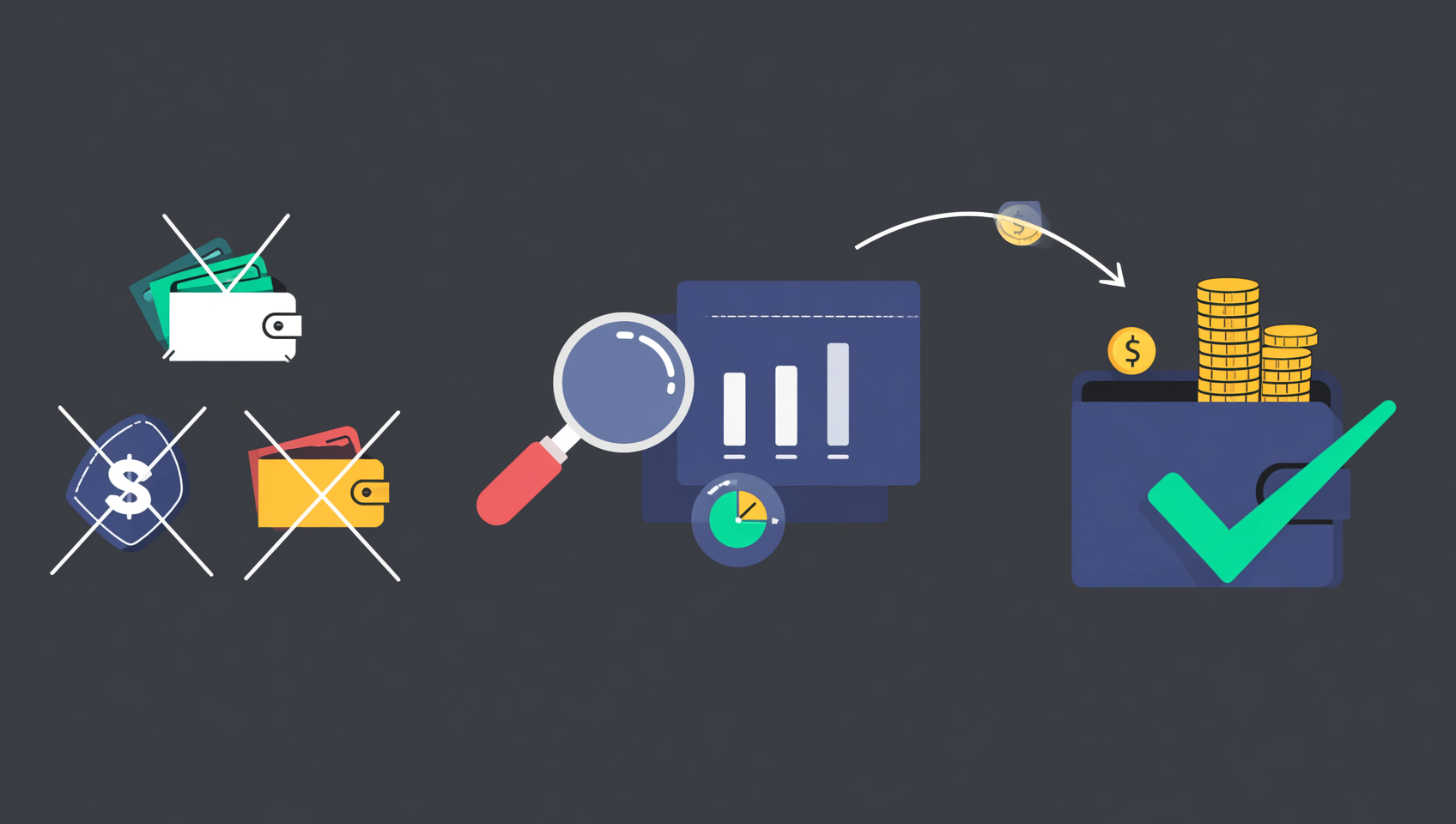
- Ask what the receiver supports. Exchange deposit pages, wallet receive pages, and merchant checkout pages all list their networks. Only consider those.
- Compare fees within that intersection. If both sides support BEP20, start there. If the receiver only takes TRC20 and ERC20, compare those two.
- Check the minimum and confirmation count. A low fee with a high minimum, or a long confirmation wait, is still a real cost.
- Test small before sending big. For a new address or platform, send the minimum first and confirm it arrives and is credited. That fee buys proof that the route works.
A useful rule: if you are agonising over a chain switch for a withdrawal under 100 USDT, first ask whether the receiver even accepts that chain. If yes, pick the cheapest accepted option. If no, the cheap fee is irrelevant.
Ranking routes when moving USDT between exchanges
From cheapest to most expensive, the usual order is: internal transfer < BEP20 < low-fee alt networks < ERC20 < TRC20. That order only holds when both sides support the network.
| Route | Typical cost | Speed | Condition |
|---|---|---|---|
| Same-exchange internal transfer | 0 | Instant | Both accounts on one platform |
| BEP20 | 0.01–1 USDT | About 1 minute | Both sides support BSC |
| OKX X Layer / Arbitrum | 0.0022–0.0034 USDT | A few minutes | Receiver explicitly supports the network |
| ERC20 | 0.29–5.5 USDT | About 2 minutes | Both sides support Ethereum |
| TRC20 | 1–4 USDT | About 1 minute | Both sides support Tron |
| Solana / TON | 0.26–0.7 USDT | Seconds to a minute | TON requires a memo |
If the receiver is another major exchange, BEP20 is usually the best value, because major platforms increasingly support BSC and Binance, Bitget and HTX price it at 0.01 USDT. But OKX and Kraken do not offer USDT on BEP20, so withdrawals from those platforms fall back to ERC20 or TRC20.
If the receiver is a self-custody wallet, also check that the token will be visible after arrival. A wallet configured only for Ethereum may not show a BEP20 transfer until you add that network. In that case, ERC20 is often the simpler choice even if it costs more.
Six common ways people pick the wrong chain
Withdrawal incidents are rarely caused by a fee being too high. They are caused by choosing the wrong chain or ignoring the minimum. These six patterns cover most of them:
- Assuming TRC20 is cheapest out of habit. On 3 November 2026, Binance charged 4 USDT on TRC20 and 0.6 on ERC20; OKX, HTX and Kraken also priced ERC20 lower.
- Choosing an unsupported network to save 0.01 USDT. BEP20 and ERC20 addresses both start with 0x and are 42 characters long, so format validation will not stop you. If the receiver does not support the chain, recovery depends on a manual ticket.
- Ignoring the minimum. KuCoin ERC20 requires 30 USDT and Kraken ERC20 about 0.70 USDT, which blocks small users regardless of the fee.
- Forgetting the fee is deducted from the amount. You enter 100 USDT, the receiver gets 100 minus the fee. If the receiver must receive a full 100, send more.
- Confusing withdrawal fees with trading fees. Trading fees are a percentage of notional; withdrawal fees are flat per transfer. They do not offset each other.
- Trusting "zero fee" claims. Free withdrawals usually apply to specific networks, promotions or account tiers, and may carry caps. If the page is unclear, assume a fee applies.
Hidden costs beyond the withdrawal fee
What really decides whether a transfer is worth it is usually the spread, the settlement time and compliance limits — not the few dollars of fee. Price all four together before moving funds.
- Spread cost: the sell price on exchange A and the buy price on exchange B already differ. Check whether spread minus both trading fees minus the withdrawal fee is still positive.
- Settlement time: the chain may confirm in minutes, but exchange crediting, risk review and first-address cooling periods can add hours.
- New-address locks: some platforms hold newly added withdrawal addresses for 24–72 hours. When you are in a hurry, this matters more than the fee.
- Regional and compliance limits: available networks, coins and KYC tiers vary by jurisdiction. An option that does not appear on the page is not available to you.
In one line: the withdrawal fee is the visible small cost; the wrong chain and delayed settlement are the hidden large ones.
💰 Binance fee rebate: invite code BINANBT
You cannot save much on withdrawal fees, but you can save on trading fees for as long as you trade: register with invite code BINANBT for a 20% trading-fee rebate. This article contains referral links; we may earn a reward if you register through them, at no extra cost to you.
- Rebate: 20% of trading fees, ongoing.
- Welcome package: up to $19,800, unlocked through tasks — not cash on sign-up.
- How to claim: enter BINANBT in the invite-code field during registration. That is the most reliable method.
- Important: registering directly inside the app gets you none of the new-user rewards. In-app registration does not attach any referral relationship, so the $19,800 welcome package and the 20% rebate will not apply. Use the registration link or enter BINANBT.
👉 Register on Binance and claim the 20% fee rebate
FAQ
Which exchange has the lowest withdrawal fee?
On 3 November 2026, Binance, Bitget and HTX all charged 0.01 USDT for USDT on BEP20, the lowest tier in the comparison. Fees change, and the number is only useful if the receiver supports BEP20.
Why does Binance charge 4 USDT for TRC20 when others charge 1.5?
Each platform prices each network independently. Binance's TRC20 USDT fee was 1.5 USDT on 20 October 2026 and 4 USDT on 3 November 2026. When sources disagree, check the date of the data before the number.
Should I use TRC20 or ERC20 for USDT?
At most major exchanges in November 2026, ERC20 was cheaper than TRC20: Binance 0.6 vs 4, OKX 0.29 vs 1.5, HTX 0.3 vs 1.2. The final choice should be a network the receiver supports with a minimum that fits your amount.
Does OKX support USDT withdrawals on BEP20?
According to OKX's public fee page on 3 November 2026, BNB Smart Chain was not listed for USDT withdrawals. From OKX, use ERC20, TRC20 or another network the receiver accepts; confirm on the live withdrawal screen.
Is the withdrawal fee deducted from the amount or charged separately?
Usually deducted. If you enter 100 USDT with a 4 USDT fee, about 96 USDT arrives. Check the "amount received" line before confirming, not just the amount you typed.
What is the cheapest way to withdraw a small amount?
Check the minimum first, then the fee. Below the minimum you cannot withdraw at all. Above it, choose a low-fee network both sides support, commonly BEP20. If the fee exceeds 1–2% of the amount, consider accumulating before withdrawing or using another route.
Are withdrawal fees refundable?
No. The fee pays for broadcasting the transaction and is not refunded after it is on-chain — including when you send to the wrong network or address.
Are internal transfers between accounts on the same exchange free?
Usually yes. Internal transfers do not touch the blockchain, are typically instant, and are free, but only within the same platform. Moving to another exchange still requires a normal withdrawal.
Further reading
- Binance withdrawal guide: networks, addresses and memos
- Binance deposit guide: buying USDT via C2C
- How to save on Binance fees: BNB discount, VIP tiers and rebates
- What is USDT and which network should you use?
- USDT vs USDC: what actually differs
- More exchange guides
Disclaimer: this article is for educational purposes only and is not investment advice. Withdrawal fees, minimums and network support change with platform policy and on-chain conditions; the figures above are public data from 3 November 2026, and the live withdrawal screen is authoritative. On-chain transfers are irreversible — verify the network and address before sending. Confirm that your use of these services is lawful in your jurisdiction.
Footnotes
-
Source: TeamoRouter, "USDT Withdrawal Fees and Minimums (November 2026)", data read on 2026-11-03; also Binance withdrawal fee page and OKX withdrawal fee page. Fees change frequently; check the live withdrawal screen. ↩