



Table of Contents
- TL;DR One-Sentence Summary
- Lesson 1: What Exactly Is Cryptocurrency?
- Lesson 2: Complete Four-Step Guide for Beginners
- Lesson 3: Essential Tools for Beginners
- Lesson 4: Top 5 Pitfalls Beginners Easily Fall Into
- Lesson 5: What to Learn Next?
- FAQ
TL;DR One-Sentence Summary
Cryptocurrency is a decentralized digital currency that allows you to transfer money to anyone worldwide without going through a bank. Beginners only need four steps: choose an exchange → register and verify → buy USDT → buy coins. Keep your first investment under $100; going through the process once is more useful than reading ten tutorials.
Lesson 1: What Exactly Is Cryptocurrency?
You may have heard of Bitcoin, Ethereum, Dogecoin, but what is cryptocurrency really?
Plain Language Version
Cryptocurrency = "Digital Money" on the Internet. Its difference from regular RMB is:
| Comparison | Regular Currency (RMB) | Cryptocurrency |
|---|---|---|
| Issuer | Central Bank (Government) | No central authority (Decentralized) |
| Storage | Bank Account | Digital Wallet (You hold the private key) |
| Transfer Speed | Cross-border 1-5 days | Minutes to arrive |
| Can it be printed more? | Central bank can | Fixed supply, cannot be overissued |
| Who can freeze it? | Banks and government can | No one can freeze |
Not a New Invention, It's a 17-Year-Old "Old Technology"
Many think cryptocurrency emerged only in recent years, but Bitcoin has existed since 2009 and has been running for 17 years. During these 17 years, it has experienced countless "Bitcoin is dead" claims, yet it still operates normally with a market cap exceeding $1 trillion.
When I first encountered it, I also felt it was "vague," but after deeper understanding, I realized: What truly supports cryptocurrency's value is not any institution or country, but the consensus of tens of millions of people worldwide on this set of rules. Sounds mysterious, but in simple terms—isn't gold the same? People think it's valuable, so it becomes valuable.
Lesson 2: Complete Four-Step Guide for Beginners
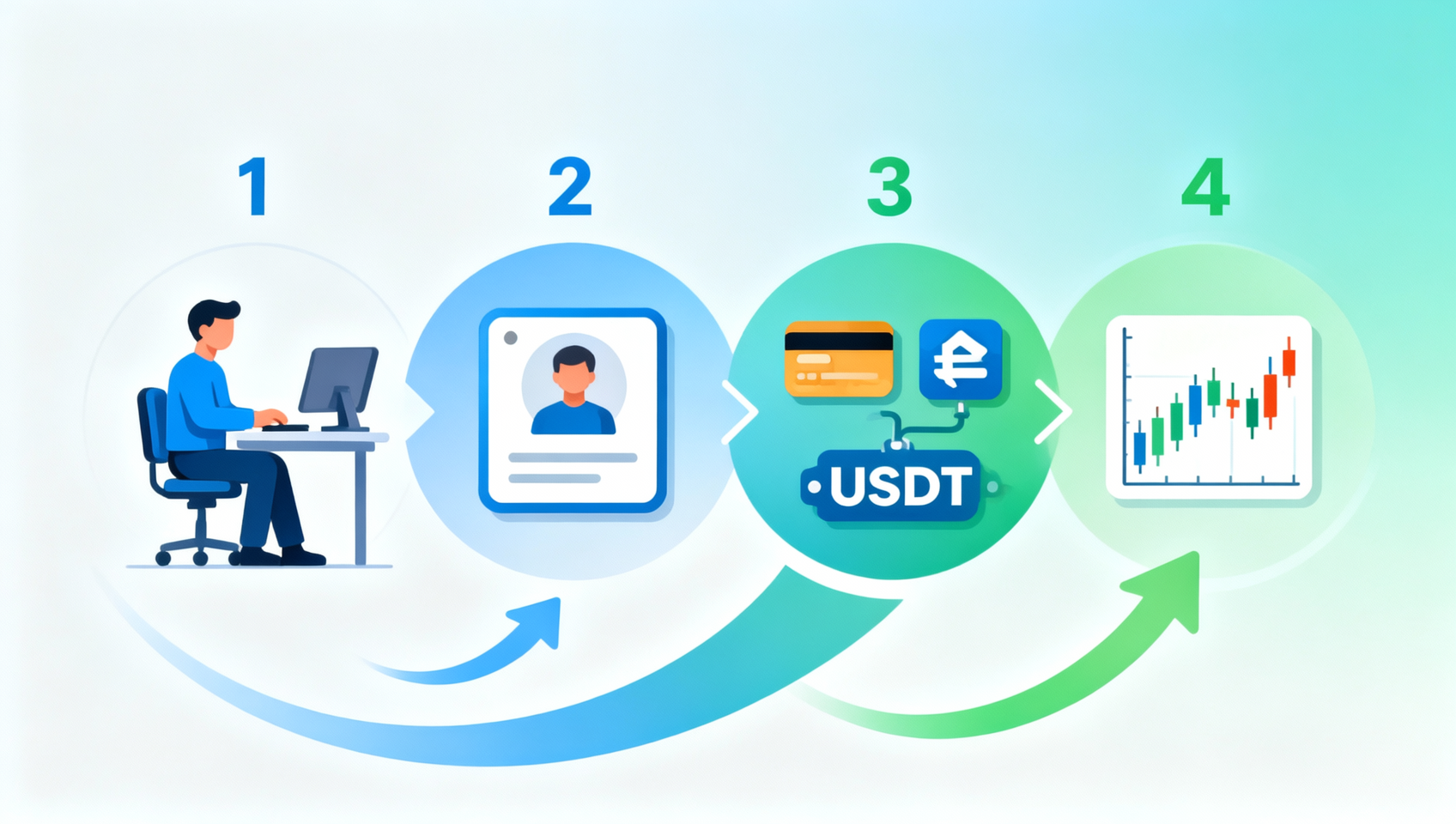
This is the most proven path tested by countless beginners. You don't need to understand every detail before starting—just do it, and learn by doing.
Step 1: Choose a Reliable Exchange
For beginners, choosing a secure and compliant exchange is the most important step. The two most mainstream global exchanges are:
- Binance – The largest exchange by trading volume, with the most comprehensive coin selection and good Chinese support
- OKX – Another top global exchange with a user-friendly interface
💡 Beginner Tip: Start with just one exchange. Binance is recommended for its extensive tutorials and Chinese community support. Explore other platforms once you're familiar.
📌 Registration Links: Binance Registration | OKX Registration
The registration process is straightforward: fill in email or phone number → set password → complete email/phone verification. It takes about 3 minutes.
Step 2: Complete Identity Verification (KYC)
After registration, the exchange will require you to complete identity verification (KYC, short for Know Your Customer).
The required materials are simple:
- ID card or passport (valid)
- Photo holding your ID (some platforms require)
- Facial recognition (just scan with your phone camera)
KYC review usually takes minutes to hours. Don't find it troublesome; without KYC, you can't even deposit funds.
Step 3: Convert RMB to USDT
USDT is a "stablecoin," where 1 USDT ≈ 1 USD. The reason to buy USDT first instead of directly buying Bitcoin is:
- Most trading pairs on exchanges are paired with USDT
- USDT price is stable, not volatile
- Buying USDT first allows you to slowly choose the right time to buy other coins
Specific operation: Find "C2C Trading" (or "Quick Buy") on the exchange → choose to buy USDT with RMB → transfer money to the seller via Alipay or WeChat Pay → the seller releases USDT to your account.
⚠️ Note: For your first small amount, use Alipay for fast arrival. For larger deposits, use bank transfer for better security. For detailed operations, see this Binance C2C Buy Guide, which includes tips to avoid frozen cards.
Step 4: Buy Your First Cryptocurrency
Once USDT arrives, you can buy any cryptocurrency on the exchange's "Spot Trading" page. For beginners, start with these:
- Bitcoin (BTC) – The "leader" of cryptocurrencies, the safest choice
- Ethereum (ETH) – The most widely used smart contract platform
- BNB – Binance ecosystem token, can be used to reduce trading fees
The operation is simple: select a trading pair (e.g., BTC/USDT) → enter the amount you want to buy → click buy. It's recommended to buy $50-100 worth of Bitcoin for your first purchase.
Lesson 3: Essential Tools for Beginners
Don't rush to use a bunch of complex tools. For beginners, these are enough:
| Tool | Purpose | Recommendation |
|---|---|---|
| Exchange App | Buy/sell and check prices | Binance App |
| Price Tracker | Check real-time prices and market data | CoinGecko or CoinMarketCap |
| Wallet | Store cryptocurrency (not urgent yet) | Consider hardware wallet when you have over $1000 |
| Learning Resources | Systematic blockchain knowledge | Chain Guide or Binance Academy |
💡 Core Principle: As a beginner, keeping coins on the exchange is perfectly fine. First, learn how to buy and sell. Don't dive into wallets, gas fees, cross-chain bridges, etc., right away—those are things you'll learn two months later.
Lesson 4: Top 5 Pitfalls Beginners Easily Fall Into
I've seen too many beginners lose money due to these reasons. Knowing them in advance helps you avoid them.
❌ Pitfall 1: Going All-In Immediately
"Bitcoin is about to rise again, let's put all savings into it!" —This is the fastest way to lose money.
Correct Approach: Only invest money you can afford to lose entirely. It's recommended to invest no more than 5% of your total assets initially. Even if you lose it all, it shouldn't affect your life.
❌ Pitfall 2: Chasing Pumps and Selling in Panic
Seeing a coin surge 50% in a day, you jump in, then it drops 30% the next day, and you panic-sell. This is classic retail behavior.
Correct Approach: Dollar-cost averaging (DCA). Invest a fixed amount on a fixed date each month, regardless of price. Over time, this is the safest strategy for ordinary people.
❌ Pitfall 3: Saving Seed Phrases as Screenshots on Your Phone
This is a very subtle but serious mistake. Your "seed phrase" (12 or 24 English words) is the only way to recover your wallet. Saving it on your phone = waiting to be stolen.
Correct Approach: Write it down on paper with a pen and store it in a safe place. Never take photos, screenshots, save to cloud storage, or send it to yourself via WeChat.
❌ Pitfall 4: Believing in "Guaranteed Profit" Signal Groups
"The teacher provides daily signals, 30% profit guaranteed, join the group for only 999!" —100% scam. Real investment experts don't have time to lead groups on WeChat daily.
Correct Approach: Block any paid signal groups. Beginners should self-study first, not blindly follow anyone.
❌ Pitfall 5: Trading During Peak Volatility
When Bitcoin suddenly surges, exchange servers get very slow, transfers are delayed, and orders may face high slippage.
Correct Approach: Avoid trading during periods of extreme market volatility. Set a plan and don't constantly check prices; checking less often actually leads to more profit.
Honestly, I've fallen into almost all these pitfalls myself. Especially the seed phrase one—when I first used a wallet, I saved my seed phrase in WeChat favorites. Thinking back, it's terrifying. You don't need to experience these lessons firsthand because we've summarized them for you.
Lesson 5: What to Learn Next?
After completing the four steps above, you've already surpassed 90% of those who just watch. Next, learn in order:
- Understand Blockchain Basics – How this public ledger actually works → Simplified Blockchain Basics
- Master Stablecoin Differences – How to choose between USDT, USDC, and DAI → Complete Stablecoin Guide
- Learn to Identify Scams – Latest scam techniques and prevention tips for 2026 → Common Crypto Scams Guide
- Explore On-Chain Assets – From wallets to RWA, truly owning your assets → What Are On-Chain Assets?
FAQ
Q: Is it difficult for a complete beginner to learn?
Not at all. The operation logic of cryptocurrency is actually similar to Alipay and WeChat Pay—register → deposit → trade. The only additional concepts you need to learn are "private key" and "wallet," but these are things you'll need in the second month. For the first week, just learning to buy and sell is enough.
Q: Is there a minimum investment amount for cryptocurrency?
No strict limit. The minimum spot trading amount on Binance is usually around $10 (in USDT), and C2C buying starts at about 100 RMB. Although one Bitcoin costs tens of thousands of dollars, you can buy 0.001 BTC (about $65) or even 0.0001 BTC (about $6.5).
Q: Should I buy Bitcoin or altcoins?
Beginners should only buy Bitcoin (BTC) and Ethereum (ETH). Altcoins are highly volatile and risky, with many projects lacking real value. Once you have a good understanding of the market, you can try altcoins with no more than 10% of your capital in small positions.
Q: Can cryptocurrency really make money?
It can make money, but also lose money. This is not a "guaranteed principal and interest" financial product. Bitcoin has indeed increased millions of times over the past decade, but that doesn't mean it will continue. Treat it as a high-risk asset allocation, invest with a long-term holding mindset, and don't try to get rich quickly.
Q: Do I need to watch prices every day?
Absolutely not. In fact, the more you watch prices daily, the more likely you are to lose money. The recommended strategy is: choose good assets → buy in batches → hold long-term. Checking prices once a month is enough. Less screen time and more other activities are the most comfortable state for your wallet.
📚 Further Reading:
- How to Buy Cryptocurrency in 2026: Complete Beginner Guide
- What Types of Crypto Exchanges Exist? CEX vs DEX Full Comparison
- Chain Guide – More blockchain education and crypto beginner knowledge
Disclaimer: This content is for learning reference only and does not constitute investment advice. Cryptocurrency investment carries risk; please make decisions based on your own situation.