


⚠️ Read this first: planning to buy ADA? Don't tap "sign up" inside the app — only registrations through the registration link (e.g. "Sign Up") or with invite code BINANBT unlock Binance's new-user rewards (20% fee rebate plus a welcome package worth up to $19,800).
Key takeaways (TL;DR):
- Cardano is a proof-of-stake blockchain launched in 2017, and ADA is its native token for fees, staking and governance. Its defining feature is an academic design process and onchain governance, not "a faster Ethereum."
- First counterintuitive point: a 57% staking ratio is not bullish — it is the other side of low usage. In October 2026 about 57%–58% of circulating ADA was staked, yet network yield was only 2.1%–2.7%, because fee revenue is thin1.
- Second: a 92% drawdown does not mean the project is dead, and it does not mean ADA is cheap. ADA trades near $0.20–$0.21, about 92% below its September 2021 high of $3.09, while daily active addresses fell from about 135,000 to 9,000–16,000 and DeFi TVL sits near $58 million23.
- Third: upgrades and price are separate things. Leios aims to raise throughput 3–5x toward 1,000+ TPS, with mainnet expected in H2 2026 — but adding lanes does not create traffic4.
- Bottom line: buying ADA means buying a chain with complete governance and solid engineering whose ecosystem has not yet proven demand. It suits small, long-horizon positions for people who track the roadmap, not anyone expecting a quick re-rating or high staking yield.
What is Cardano? In one sentence: Cardano is a proof-of-stake blockchain that emphasizes peer-reviewed design and onchain governance, and ADA is the native token used for fees, staking and voting. It was founded in 2015 by Charles Hoskinson, a co-founder of Ethereum, and its mainnet launched in September 2017.
Newcomers often get stuck comparing Cardano with Ethereum: both support smart contracts, both have DeFi and NFTs, both talk about scaling. But the decision does not hinge on those similarities. It hinges on three practical questions: how many people actually use the chain, where does staking yield come from, and how much of the roadmap has shipped? This guide is organized around them.
Contents
- What Cardano is: a chain that writes the paper first
- Cardano in 2026: four numbers that define it
- Counterintuitive 1: a 57% staking ratio is not bullish
- Counterintuitive 2: down 92% is neither dead nor cheap
- Counterintuitive 3: Leios adds lanes, not traffic
- ADA tokenomics: how the 45 billion cap releases
- How to buy ADA: five steps from signup to withdrawal
- How to stake ADA: exchange versus onchain
- Six risks to check before buying
- 💰 Binance rebate: invite code BINANBT
- FAQ
- Further reading
What Cardano is: a chain that writes the paper first
What sets Cardano apart is the order of work: the mechanism is written as a paper, peer-reviewed, and only then implemented. That makes progress slow, but it avoided many dead ends in consensus and governance.
Three technical features matter:
First, consensus is Ouroboros Praos. A proof-of-stake protocol that selects block producers randomly by staked weight. It has no slashing — delegating cannot cost you principal if a pool misbehaves; the deterrent is lost rewards, not fines.
Second, the ledger model is eUTxO. Ethereum uses an account model (balances added and subtracted, like a bank account); Cardano uses extended UTxO (like cash: spend a note and receive change). That gives high parallelism and deterministic execution, but makes smart-contract development less intuitive, which is why its developer ecosystem trails EVM chains.
Third, governance is onchain. The Chang hard fork in September 2024 and the Plomin hard fork on January 29, 2025 handed voting power to DReps and a constitutional committee, and treasury spending now requires onchain votes5. That is one of Cardano's most concrete 2026 achievements: the three founding entities no longer set direction alone.
The combined result: Cardano is a chain with unusually complete institutional design. But complete design does not mean usage, and the next section shows the gap.
Cardano in 2026: four numbers that define it
Judge a chain by four numbers: price, usage, total value locked and stablecoin supply. In October 2026 all four point the same way — the infrastructure is there, demand is not.
| Metric | October 2026 | What it means |
|---|---|---|
| ADA price | About $0.20–$0.21 | About $0.2066 on October 28; roughly 92% below the all-time high2 |
| Market cap and rank | About $7.6–9.5B, around #17 | Out of the top ten; down about 66%–69% in 20262 |
| Daily active addresses | About 9,000–16,000 | About 135,000 in 2024, a decline of roughly 90%3 |
| DeFi TVL | About $58 million | About $71 million in early October, lower by month end3 |
Two more numbers fill in the picture. Cardano's total stablecoin supply is about $69.2 million, of which Circle-issued USDCx is about $43.5 million, or 62.9%. On October 27 that supply exceeded the chain's own DeFi TVL by about $11.27 million6. Stablecoins outnumbering TVL means money is on the chain but not in DeFi protocols — it sits in wallets, waiting for a use case worth using.
DEX volume tells the same story: about $850,000 a day and $6.08 million over seven days, down 28%6. For comparison, Solana's market cap is about 7x Cardano's, but its DeFi deposits are about 90x larger. This is not "Cardano has bad technology"; it is a network-effect gap: developers, liquidity and users are elsewhere.
Counterintuitive 1: a 57% staking ratio is not bullish
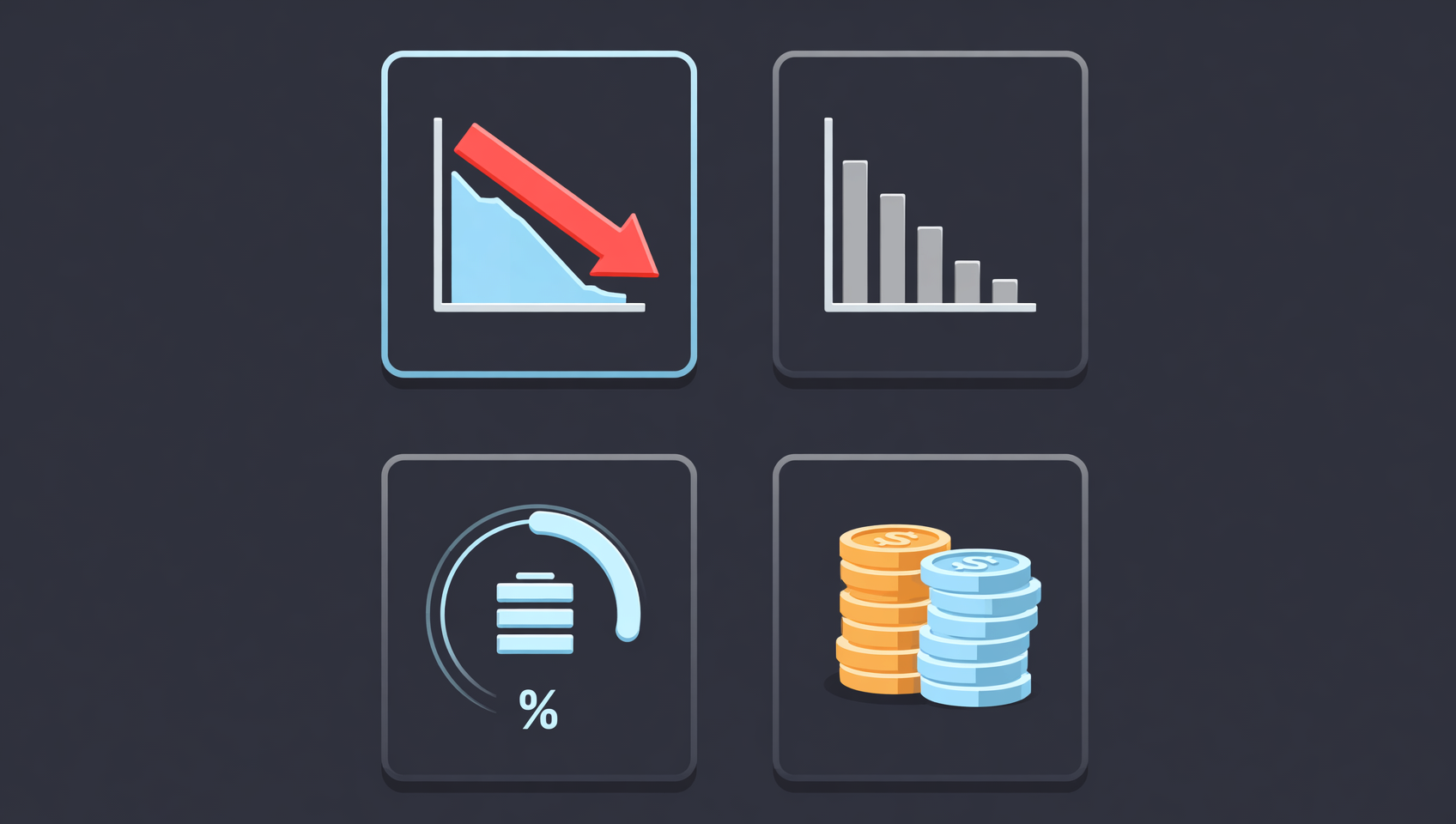
Many people treat "more than half of all ADA is staked" as a bullish signal. It also means a large share of holders are not selling — but are not using the chain either. A high staking ratio reflects willingness to hold, not demand to use.
The data: in October 2026 about 57%–58% of circulating ADA (roughly 21.3–21.6 billion) was staked across about 2,700–2,900 pools1. That is high for a major chain.
But the yield is low: network staking APR is about 2.1%–2.7%, with StakingRewards recording 2.12% on October 7, 20261. Why? Because staking rewards come from transaction fees and reserve releases, and Cardano's fee revenue is small — look at the active-address and DEX numbers above.
Here is the practical math: hold $10,000 of ADA at a 2.4% yield and you earn about $240 a year; ADA fell about 66%–69% in 2026, so a single day's move can exceed that. Staking yield is a subsidy for holding, not a reason to buy.
Also note the pool cost structure: every pool has a fixed cost floor of 170 ADA per epoch, deducted from rewards first. Delegating tiny amounts across many pools dilutes returns; delegating to a pool that is well saturated but not oversaturated gets you close to the network average.
Counterintuitive 2: down 92% is neither dead nor cheap
"Down 92%" only shows that expectations were cut. It does not prove failure, and it does not prove a bargain. Whether it is cheap depends on usage, not the size of the drawdown.
Cardano's mainnet still produces blocks, cumulative transactions exceed 123 million, developer commits exceed 303,000, and the Leios upgrade is in progress4. That is evidence the project is alive.
But "alive" and "worth buying" are different. Compare three usage metrics:
- Daily active addresses: from about 135,000 in 2024 to 9,000–16,000 in 20263. Users are leaving, not arriving.
- DeFi TVL: about $58 million, outside the top 30 chains3. An $8 billion chain with less than 1% of its market cap locked.
- Stablecoin supply: about $69.2 million, already above TVL6. Capital enters and does not stay.
So the accurate statement is: Cardano's problem is not "bad technology" but "technology that has not converted into demand." Its valuation still contains a large "the ecosystem will come" premium, and that premium has gone unearned for several years. You can choose to believe Leios changes it, but treat that as a hypothesis to verify, not a fact that has happened.
Counterintuitive 3: Leios adds lanes, not traffic
Leios is Cardano's most important 2026 upgrade, but it solves capacity, not demand. Faster blocks do not make more people want to use the chain.
According to Input Output's roadmap published on October 20, 2026, Leios rolls out in stages: a Dijkstra hard fork makes the protocol available, stake pools register new voting keys, the network is stress-tested, and governance votes release capacity in increments — 3–5x throughput first, with later votes potentially reaching 10–15x. A public testnet was targeted for June 2026, mainnet activation for H2 2026, aiming toward 1,000+ TPS; phase one of the testnet peaked at 26.8 TxkB/s, about 6x the current Praos data throughput4.
Technically the path is credible: Ouroboros Linear Leios handles throughput, and the later Peras upgrade handles faster finality. But the market does not care about TPS figures; it cares whether anyone uses the capacity. For a chain with 10,000 daily addresses and $850,000 of daily DEX volume, a 5x throughput increase has limited marginal value in the near term.
That is why Cardano's price and upgrade news often diverge: upgrades change supply capacity; prices reflect demand expectations. If, after Leios, two of the three metrics — daily addresses, TVL, stablecoin supply — grow for three consecutive months, that is a fundamental turn. Buying on the mainnet-activation headline alone usually means buying after the news.
ADA tokenomics: how the 45 billion cap releases
ADA's cap is 45 billion, but only about 37 billion circulate today. That gap matters because it sets the dilution schedule.
| Item | Figure | Meaning |
|---|---|---|
| Max supply | 45 billion ADA | Fixed in the protocol and constitution; no arbitrary issuance5 |
| Circulating supply | About 37–37.5 billion | Roughly 82%–83% of the cap2 |
| Reserve release | About 0.3% of the reserve per epoch | Five-day epochs; the release shrinks over time |
| Treasury share | 20% of new issuance | Allocated by onchain governance votes |
This differs from Bitcoin: Bitcoin halves a fixed block reward, while Cardano releases a percentage of the remaining reserve. Inflation starts higher and declines, with no "halving" narrative. The practical effect for holders: mild dilution continues for several years, but the rate is falling and part of the new issuance goes to the treasury rather than straight to the market.
One caveat: a 45 billion cap does not mean "no more inflation." Until the reserve is exhausted, circulating supply still rises each year, just more slowly. When you see "fixed supply, therefore inflation-proof," check whether the claim is about the cap or the current float.
How to buy ADA: five steps from signup to withdrawal
Buying ADA is simple; the step that goes wrong is the last one — choosing the wrong network on withdrawal. Here is the sequence.
Step 1: Register and complete KYC. Sign up on Binance through the registration link or with invite code BINANBT, then verify your identity. Note: registering directly in the app creates no referral relationship, so you get neither the new-user rewards nor the rebate.
Step 2: Deposit funds. The most common route is buying USDT with fiat through C2C, then swapping to ADA on spot; cards work too. On C2C, pick merchants with high volume and a long history, and keep chat and release inside the platform — never transfer off-platform.
Step 3: Buy on spot. Search for the ADA/USDT pair and place a limit order at a price you accept; market orders suit small, fast fills. Check the fee rate and the minimum order size (usually about $5 equivalent) before you submit.
Step 4: Decide whether to withdraw. If you plan to hold long term and manage your own keys, move it to a self-custody wallet. If you are trading short term or staking, leaving it on the exchange is simpler. If you have never self-custodied, do not rush the withdrawal.
Step 5: Withdraw, if needed. Choose the Cardano (ADA) network and paste an address starting with addr1. ADA is not an ERC-20 token, so never send it to an Ethereum address; wrong-chain transfers are usually unrecoverable. Send a small test amount (say $10–$20 equivalent) first, confirm arrival, then send the rest. Fees and minimums are shown live on the withdrawal page.
How to stake ADA: exchange versus onchain
There are two ways to stake ADA: leave it on an exchange in an earn product, or move it onchain and delegate to a stake pool. Yields are close, but control and risk differ.
| Dimension | Exchange staking | Onchain delegation |
|---|---|---|
| Difficulty | One tap | Needs a wallet and address; set up once |
| Yield | Usually slightly lower (platform cut) | About 2.1%–2.7% |
| Control | Platform holds the assets | You hold them in your wallet |
| Lock-up | Flexible or fixed, product-dependent | None; undelegate anytime |
| Payout rhythm | Per platform rules | Every 5-day epoch; first reward in about 15–20 days |
| Main risk | Platform risk | Address and seed-phrase management |
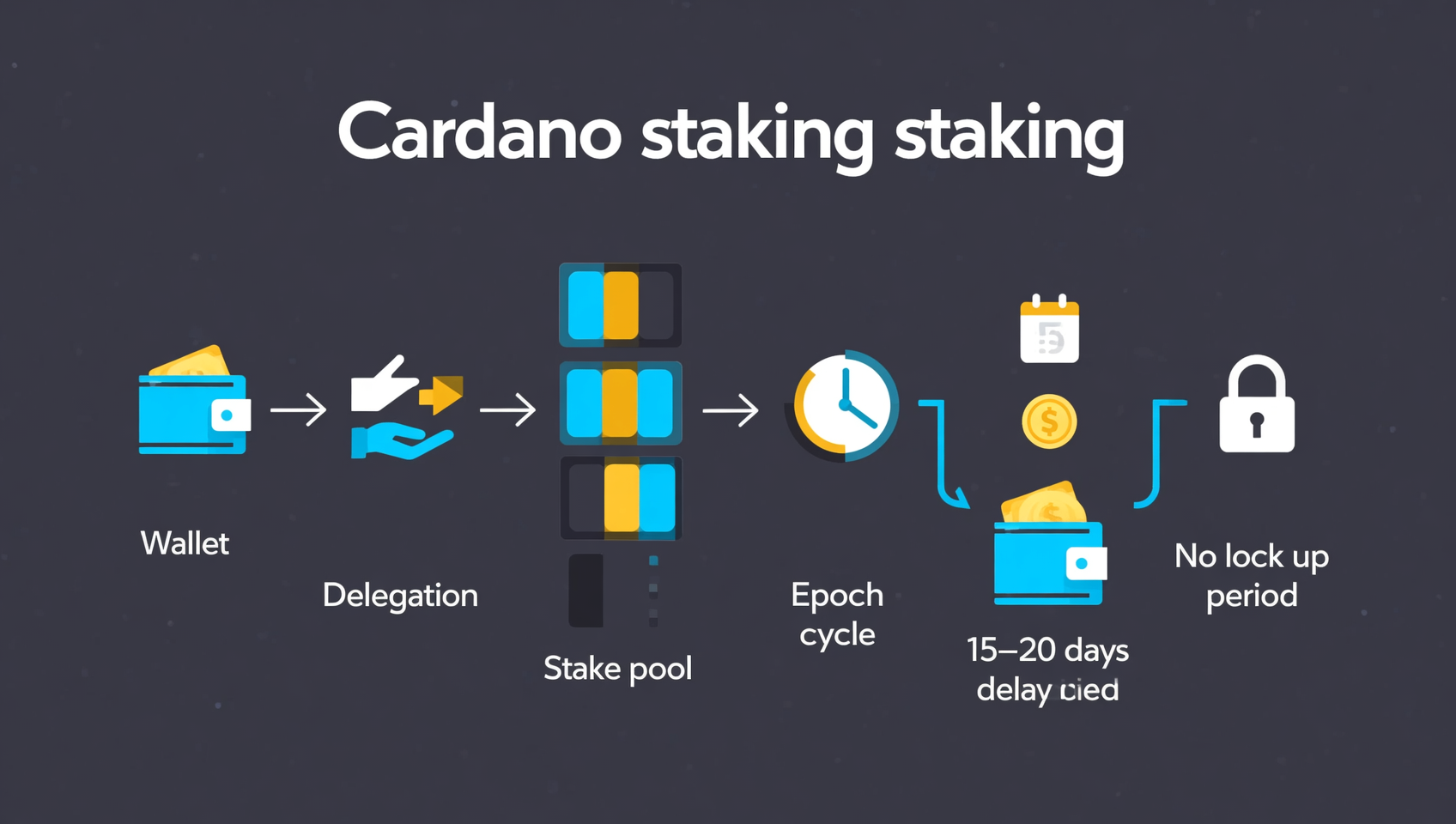
Onchain staking, step by step:
- Set up a Cardano wallet (Lace, Yoroi, Eternl and similar) and back up the seed phrase offline.
- Withdraw ADA from the exchange to a wallet address starting with
addr1; test with a small amount first. - In the wallet, choose "Delegate" and pick a stake pool. Check three things: saturation (near full but not over), fixed cost (lower is better for small delegations) and block-production history.
- Confirm. You pay a roughly 2 ADA staking-key deposit (refundable on undelegation) plus a transaction fee.
- Wait. Delegation takes effect in the next epoch, and rewards are delayed — usually 15–20 days before the first payout.
Three common myths to correct: first, staking does not lock your coins; you can move or redelegate anytime. Second, Cardano has no slashing, so a misbehaving pool cannot take your principal — the worst case is no rewards. Third, staking is not capital protection; a 2% yield cannot offset price swings.
Six risks to check before buying
The risk in ADA is not a vague "could it go to zero" but six concrete, observable variables. Go through them one by one.
- Price risk. About 92% below the all-time high and down 66%–69% in 20262. Size the position so a 50% drop does not affect your life.
- Usage risk. Daily addresses, DeFi TVL and DEX volume are all low3. If they stay low after Leios, "good technology" remains a narrative.
- Liquidity risk. Depth inside Cardano's DEXs is thin, so large orders slip; moving in and out across chains depends on bridges, which are themselves a risk.
- Execution risk. Leios involves pool registration, governance votes and stress tests, and the schedule can slip4. Do not treat "expected H2" as a fixed date.
- Regulatory risk. Rules for layer-1 tokens, staking services and exchanges differ by jurisdiction and can change availability and liquidity. Mainland China restricts crypto business activity; this article offers no workarounds.
- Operational risk. ADA only goes to Cardano addresses, wrong-chain sends are unrecoverable, a leaked seed phrase means lost funds, and a wrong pool only lowers yield while a wrong address loses principal.
Who it suits: people who understand proof of stake and self-custody, can track the roadmap over one to three years, and keep the position within about 5% of their portfolio. Who it does not: anyone expecting a quick double, treating staking yield as the main return, who has never used a self-custody wallet, or who cannot stomach another 50% decline.
💰 Binance rebate: invite code BINANBT
Before buying ADA, cut your trading costs: register on Binance with invite code BINANBT for a 20% fee rebate. This article contains a referral link; we may earn a reward if you register through it, and it costs you nothing extra.
- Rebate: 20% of every trading fee returned. The invitee cap is 20% across the board.
- How to claim: enter BINANBT in the invite-code field at signup. If you miss it, you can still bind it within 30 days.
- Stack it: turn on "pay fees with BNB" to save roughly another 25%, and hold BNB in Simple Earn to qualify for HODLer Airdrops snapshots.
- Important: registering directly inside the app earns you no new-user rewards at all. In-app signups are not tied to any referral relationship, so the $19,800 welcome package and the 20% rebate will not apply — you must use the registration link or enter invite code BINANBT.
👉 Register on Binance and claim the 20% fee rebate
FAQ
What is Cardano in one sentence?
Cardano is a proof-of-stake blockchain launched in 2017 and designed through peer-reviewed research, with onchain governance as a core feature. ADA is its native token, used for fees, staking and voting. It is not an Ethereum clone: both its ledger model and its smart-contract language are different.
Does ADA have a supply cap, or does it keep inflating?
The cap is 45 billion ADA, written into the protocol and the constitution. About 37 billion are circulating; the rest is released from the reserve each epoch at roughly 0.3% of the reserve, with 20% going to the treasury. Inflation declines over time, there is no fixed block reward like Bitcoin's, and no proposal to raise the cap.
Is ADA staking safe, and can I be slashed?
Cardano's Ouroboros protocol has no slashing, so delegating cannot cost you your principal even if a pool misbehaves; the worst case is that the pool stops producing blocks and your rewards pause. There is also no lock-up, so you can undelegate anytime. Staking does not protect against price declines, which dwarf a 2%–3% yield.
Staking yields only about 2% — is it worth it?
If you already plan to hold ADA long term, staking is a free add-on: about 2.1%–2.7%, no lock-up, one setup. If you are buying ADA specifically for the yield, it does not compensate for price volatility. Treat it as a subsidy while you hold, not a reason to buy.
Why is ADA down 92% from its all-time high? Did the project fail?
A 92% drawdown means the market cut its growth expectations, not that the technology failed. Cardano still produces blocks and ships upgrades, but daily active addresses fell from about 135,000 in 2024 to 9,000–16,000 in 2026, and DeFi TVL is only about $58 million. Price tracks usage, not roadmaps.
What is the minimum to buy ADA on Binance?
Binance spot orders typically have a $5 equivalent minimum, but the real constraint is fees as a share of your position. Walking through deposit, buy and withdraw with $20–$50 is a sensible start; smaller amounts get eaten by fixed costs and teach you nothing. The exact minimum is shown on the order page.
Can I send ADA to an Ethereum wallet?
No. ADA is a native Cardano asset, not an ERC-20 token, and sending it to an Ethereum address means losing it. Choose the Cardano network when withdrawing and use a recipient address starting with addr1. Wrong-chain transfers are usually unrecoverable, so test with a small amount first.
Can I use DeFi on Cardano?
Yes, but depth is limited. In October 2026 Cardano's DeFi TVL was about $58 million and DEX volume about $850,000 a day, so slippage and execution costs are much higher than on Ethereum or Solana. It suits small experiments and niche assets, not large liquidity positions.
Further reading
- What Is Bitcoin? A 2026 Beginner's Guide
- Ethereum in 2026: From Smart Contracts to L2s
- Blockchain Basics: Hashes, Blocks and Chains
- Proof of Work vs Proof of Stake
- Spot vs Futures: A Beginner's Guide
- Binance Spot Trading Guide
- Binance Deposit Guide: Buying USDT via C2C
- What Is a Stablecoin? A 2026 Guide
- More beginner guides
Disclaimer: This article is for educational purposes only and is not investment advice. ADA is highly volatile, sits about 92% below its all-time high, and carries risks of further declines, thin liquidity and slower-than-expected ecosystem growth. Staking does not protect principal, yields depend on network parameters, and a wrong withdrawal network or address, or a leaked seed phrase, can cause permanent loss. Price, staking and onchain data are dated and change with the market; rely on live data and official announcements. Rules differ by jurisdiction — confirm your compliance status.
Footnotes
-
Sources: StakingRewards (Cardano staking APR 2.12% on October 7, 2026), Cexplorer, Cardanoscan and industry reports (about 57%–58% of circulating supply staked, roughly 21.3–21.6 billion ADA, about 2,700–2,900 pools, APR about 2.1%–2.7%; fixed pool cost floor of 170 ADA per epoch; k=500 and pool saturation about 77.8 million ADA). ↩ ↩2 ↩3
-
Sources: CoinGecko, CoinMarketCap and The Block market data, October 8–28, 2026 (ADA about $0.20–$0.25, about $0.2066 on October 28; market cap about $7.6–9.5B, around #17; about 92% below the September 2021 all-time high of $3.09; circulating supply about 37–37.5 billion; down about 66%–69% in 2026). ↩ ↩2 ↩3 ↩4 ↩5
-
Sources: DeFiLlama and TheCryptoBasic/KuCoin reporting, October 2026 (Cardano DeFi TVL about $57.93 million, down from about $65–71 million in early October; daily active addresses about 9,000–16,000 versus about 135,000 in 2024; DEX volume about $850,000 a day and $6.08 million over seven days). ↩ ↩2 ↩3 ↩4 ↩5 ↩6
-
Sources: Input Output's Leios roadmap published October 20, 2026, plus AInvest and CoinMarketCap Community reporting (public testnet targeted for June 2026, mainnet expected H2 2026; 3–5x first, later 10–15x; target 1,000+ TPS; testnet phase one peaked at 26.8 TxkB/s; Dijkstra hard fork, pool registration and governance votes; about 123 million cumulative transactions and 303,000 developer commits). ↩ ↩2 ↩3 ↩4
-
Sources: Cardano governance documentation and public reporting (Chang hard fork September 2024; Plomin hard fork January 29, 2025; CIP-1694 governance; constitution confirming the 45 billion cap; van Rossem upgrade activated July 18, 2026 with Protocol Version 11). ↩ ↩2
-
Sources: DeFiLlama and TheCryptoBasic, "Cardano Stablecoin Supply Tops DeFi TVL by $11 Million," October 27, 2026 (total stablecoin supply about $69.2 million, USDCx about $43.5 million or 62.9%, USDM about $13.2 million, USDrf about $5.4 million; stablecoin supply above TVL by about $11.27 million). ↩ ↩2 ↩3