
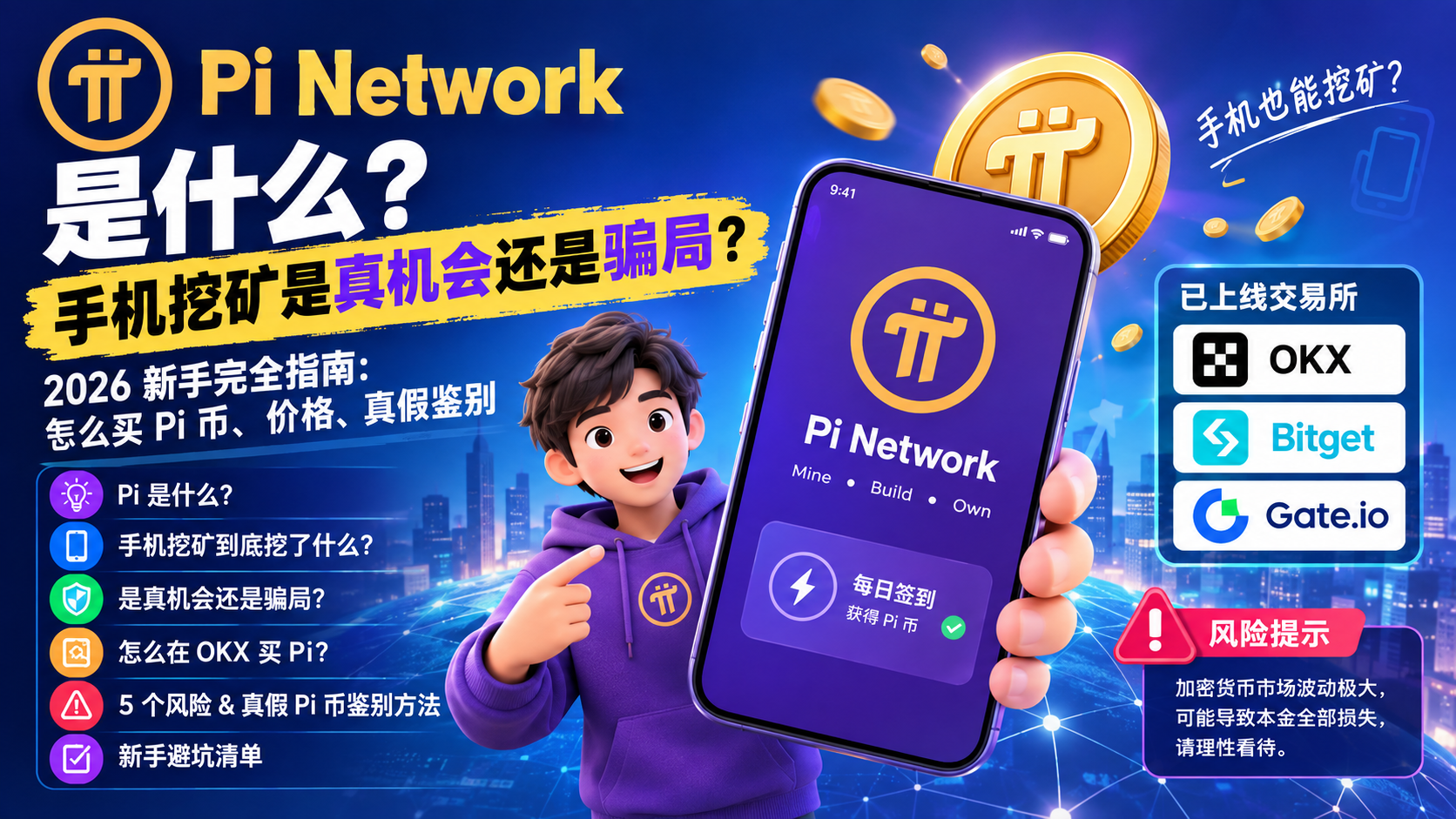
What Is Pi Network? Is Mobile Mining a Real Opportunity or a Scam? (2026 Beginner's Guide: How to Buy Pi, Price, and Spotting Fake Tokens)
Pi Network is a 'mobile mining' project launched in 2019 by a Stanford PhD team. Its Open Mainnet went live on February 20, 2025, and Pi is listed on OKX, Bitget, Gate.io, and other exchanges. It isn't real mining in the Bitcoin sense — it's a daily check-in style token distribution mechanism. This guide explains what Pi is, what mobile mining actually mines, whether it's an opportunity or a scam, how to buy Pi on OKX, five risks to know, and how to tell real Pi from fake tokens.
TL;DR
Pi Network is a project where you "mine" by tapping your phone, but what you're mining isn't computing power — it's a check-in-style points system. As a beginner you only need three takeaways: ① Pi's "mobile mining" is not real mining; it's essentially a daily check-in for points, and inviting more people makes you earn faster — this distribution model is exactly why it's been accused of resembling a pyramid scheme; ② on February 20, 2025, Pi's Open Mainnet listed on OKX, Bitget, Gate.io, and others (not Binance or Coinbase), and the price fell from about $2 to around $0.09 by September 2026, down roughly 97% from its peak; ③ it is neither a classic "exit scam" nor an "undervalued next Bitcoin" — it's a high-risk, highly contested project that has never authorized exchange listings and has been publicly rejected by institutions like Bybit. Before buying, separate "free to participate" from "guaranteed returns."123
🎁 No exchange account yet? Signing up with the invite codes below costs you nothing extra; we may receive a commission from the platform: OKX (where you can buy Pi): https://www.promooboost.com/join/60895497 invite code 60895497 Binance: https://www.bsmkweb.cc/register?ref=BINANBT invite code BINANBT (⚠️ Binance does not list Pi yet — use OKX to buy Pi)
1. What Is Pi Network (In One Sentence)
Pi Network launched on March 14, 2019 (Pi Day), founded by two Stanford PhDs, Nicolas Kokkalis and Chengdiao Fan.1
Its pitch was compelling: "Mine cryptocurrency without a rig or electricity — just open the app and tap once a day." That ultra-low barrier drew tens of millions of registered users worldwide, spreading especially fast among beginners and older adults who wanted a low-cost way into crypto.
But hidden here is the single most important point for a beginner: Pi's "mining" is not the same thing as Bitcoin mining. It isn't "your phone contributes computing power and gets rewarded with coins." It's closer to "check in daily and the system credits you Pi points." The actual consensus and record-keeping are done by server nodes controlled by the core team; your phone performs almost no real computation.
In one sentence: Pi is a project that uses the word "mining" to describe what is really a check-in-style distribution. Understand that, and judging whether it's an opportunity or a scam becomes straightforward.
Want the fundamentals first? See Cryptocurrency Beginner's First Step and Blockchain Node Types: Full, Light, and Archive Nodes.
2. What Pi's "Mobile Mining" Actually Mines
This is the first step in deciding whether Pi deserves serious attention. Put Pi next to real mining and the difference is immediately clear:
| Dimension | Bitcoin mining (real mining) | Pi "mobile mining" |
|---|---|---|
| What it does | Competes with computing power, packs blocks, verifies transactions | Taps once a day, collects points by rule |
| Who keeps the ledger | Thousands of independent miners/nodes worldwide | Server nodes controlled by the core team |
| Barrier to entry | Needs a rig, electricity, cost | A phone, zero cost |
| Source of "hash" | Real consumed hash power | No actual computation, just "activity" |
| How coins are distributed | Fairly by contributed work | Faster the more people you invite and the more active you are |
The conclusion is direct: Pi's "mining" is fundamentally a user-growth and distribution mechanism, not a blockchain consensus mechanism. That isn't automatically "bad" — many projects use "check in for points" to attract early users — but it means two things:
- Its value doesn't come from mining scarcity, but from how much people are willing to pay for the token. This was exposed brutally after launch: a free entry barrier didn't create real demand, so the price collapsed.
- Its distribution structure inherently rewards referrals: the more people you invite and the more active your team, the faster you "mine." This is the technical reason it's been accused of resembling multi-level marketing — and it leads straight into the core question of the next section.
3. Is Pi Network a Real Opportunity or a Scam
Give the conclusion first, then the evidence: Pi is not a typical "take your money and run" scam, but it isn't a defensible opportunity either — the more accurate description is "a centralized distribution project with a real shell but high risk, heavy controversy, and no independent verification."
That judgment comes from laying out the public facts on both sides:
The "it's not a scam" case:
- The founding team is real (two Stanford PhDs), and the project has run for over seven years since 2019 without an exit scam.
- In February 2025 it actually launched a mainnet, and Pi is genuinely tradable on OKX, Bitget, and other exchanges.
- Participation is genuinely free: no deposit, no rig, just time spent checking in — so ordinary users face no direct cash loss.
The "high-risk / scam-like" case:4
- A referral mechanism that resembles a pyramid scheme: the more people you invite, the faster you mine — a classic MLM structure.
- Highly centralized and opaque: the core team controls the validator nodes with no independent validators, so "decentralized" is misleading.
- A long-running KYC bottleneck: many users checked in for years but are stuck in identity verification and can't migrate Pi to the mainnet (so they can't withdraw it).
- An ambiguous relationship with exchanges: the official team repeatedly said it "never authorized any exchange listing," yet let Pi trade freely while telling users to "trade at your own risk."
- Institutions publicly rejecting it: Bybit CEO Ben Zhou publicly called Pi a scam, citing a 2023 Chinese police warning about fraud targeting the elderly, and Bybit refused to list Pi.
A decision framework for beginners: don't ask "is it a scam?" — ask three more useful questions: ① where does its value actually come from (real usage, or referrals); ② how transparent is it (who controls it, is there independent verification); ③ where is the price now (early or expensive). Apply those three to Pi, and the answer becomes clearer than agonizing over "scam or not."
4. Pi Coin's Real Price Performance Since Launch
The numbers back up the qualitative judgment. Pi's price path over its first year tells the story directly:23
| Time | Price (approx.) | Note |
|---|---|---|
| 2025-02-20 open | ~$2 | Listed on OKX and others |
| Hours after launch | $0.59–0.64 | Down 65–70%, early miners cashing out |
| Late Feb 2025 | ~$2.98 | All-time high (Binance-listing speculation) |
| Oct 2025 | ~$0.17 | Steady decline |
| Feb 2026 | ~$0.13 | Near all-time low |
| Early Sep 2026 | $0.09–0.095 | Market cap ~$1.06 billion |
Do the math: if you bought near the February 2025 high of about $2.98, by September 2026 at about $0.095 you'd be down roughly 97%. This is the other side of "free mining" — mining was free, but the buyers who took the other side absorbed almost the entire decline.
One line for beginners: the lesson of Pi isn't "don't buy cheap things"; it's "a token distributed for free doesn't hold its scarcity or real demand in its own hands." The crash wasn't an accident — it was the predictable result of this distribution model once trading opened.
5. Where Can You Buy Pi Coin
Clear up a common beginner confusion first: Pi is not on Binance, and not on Coinbase. As of September 2026, the official Pi token is listed on these centralized exchanges:5
| Exchange | Lists Pi? | Note |
|---|---|---|
| OKX | ✅ Listed | Supports PI/USDT spot — the entry this guide recommends |
| Bitget | ✅ Listed | Also supports PI/USDT |
| Gate.io | ✅ Listed | Supports PI/USDT |
| MEXC | ✅ Listed | Supports PI/USDT |
| HTX | ✅ Listed | Supports PI/USDT |
| Binance | ❌ Not listed | Still no follow-up after its Feb 2025 community poll |
| Coinbase | ❌ Not listed | — |
So while this site usually recommends "Binance + OKX" together, buying Pi means OKX only — a key difference from most mainstream coins. Don't panic if you can't find Pi on Binance.
⚠️ Remember: the Pi Network team never authorized any exchange to list Pi and has repeatedly said "trade at your own risk." The Pi you buy on an exchange is a secondary trade outside the official mainnet, so liquidity and compliance risks are yours to bear.
6. How to Buy Pi as a Beginner (OKX, Step by Step)
If you've understood the risks and still want to try with money you can afford to lose, the safest path is OKX spot:
- Register on OKX using invite code 60895497 (costs you nothing extra; we may receive a commission).
- Complete identity verification (KYC) by following the prompts to upload ID and do a face scan.
- Buy USDT with fiat via C2C: choose a "verified" merchant and pay from your own verified account.
- Buy Pi in spot: go to spot trading, search PI/USDT, enter an amount, and buy.
Fee reference (Sep 2026, subject to the live platform page): OKX spot fees are about 0.08%–0.1%. If you spend 100 USDT on Pi, the fee is roughly 0.08–0.1 USDT — negligible. What you should actually watch isn't this fee, but Pi's volatility — daily moves of a few or even tens of percent are common, so only risk what you can afford to lose.
👉 Register on OKX (invite code 60895497): https://www.promooboost.com/join/60895497
For registration and deposit details, see the OKX Registration Guide and How to Buy Bitcoin 2026.
7. Five Risks to Know Before Buying Pi
Remember all five:
"Free mining" isn't "free money." Participating is free, but the tokens that free participation earned kept falling after launch. Most check-in users are either stuck in KYC or waiting for returns that never came. Don't mistake "I don't have to pay" for "I'm guaranteed to profit."
It's down about 97% from its peak. Any claim that "Pi will return to $3 or $10" is a prediction, not a fact. This article gives no prediction, and you shouldn't use someone else's price target as a reason to buy.
Centralization and opacity are structural problems. The core team controls the nodes, there are no independent validators, and the official team won't back exchange trading — so your Pi is harder to verify than Bitcoin or Ethereum at every layer.
Real and fake Pi are mixed together (see next section). Decentralized exchanges host many third-party "Pi" look-alikes that have nothing to do with the official token — buying the wrong one can mean going to zero.
Regulatory risk is real. The "pyramid scheme / fraud" accusations and police warnings around Pi aren't baseless, and future regulatory action in various countries could directly affect its trading and price.
8. How to Tell Real Pi from Fake Pi
This is a Pi-specific trap you must remember: the official Pi (PI) currently trades only on centralized exchanges like OKX, Bitget, Gate.io, MEXC, and HTX. The "Pi" you see on decentralized exchanges like PancakeSwap or Uniswap is almost always a third-party token with the same name, completely unrelated to the official Pi Network.
Here's how they differ:
| Feature | Official Pi (real) | Fake Pi (watch out) |
|---|---|---|
| Where it trades | Centralized exchanges (OKX, Bitget, Gate, etc.) | Look-alike tokens on DEXs like PancakeSwap |
| Contract address | Not a single-chain ERC-20 address | Forged on any chain, addresses vary wildly |
| Price | Around $0.09 | Some already down 98%, near zero |
| Backing | Official hasn't authorized listings but uses the "PI" symbol | Official has clearly said "unrelated to these tokens" |
A one-line rule: only buy the "PI/USDT" you find on a centralized exchange, and never buy any token called "Pi" on a DEX. To learn how to systematically avoid air tokens and honeypots, see the Honeypot Token Detection Guide and What Is a Rug Pull? How to Identify Scam Coins.
9. FAQ
Is Pi Network a scam?
You can't answer with a simple "scam" or "not a scam." Pi has a real team, a real mainnet, and real exchange trading, but it isn't a conventional blockchain project: its referral mechanism has multi-level-marketing traits (the more people you invite, the faster you "mine"), the core team controls the validator nodes with no independent validators, and transparency has long been questioned. It isn't a typical "exit scam," but it is a high-risk, high-uncertainty asset that institutions like Bybit have publicly refused to list.
Can you really make money mining Pi on your phone for free?
Pi's "mobile mining" genuinely requires no mining rig and no electricity cost — you just tap once a day. But separate two things: what the daily tap earns is "Pi tokens/points," not "valuable returns." After launch Pi fell from about $2 to near $0.09, and most early miners were either stuck in KYC migration or simply watched the price fall. The entry is free; the returns are not guaranteed.
Which exchanges list Pi? Is it on Binance?
As of September 2026, Pi is listed on OKX, Bitget, Gate.io, MEXC, HTX, and CoinDCX, but not on Binance or Coinbase. The easiest way to buy Pi is to search "PI/USDT" on OKX. Note that the official project never authorized any exchange listing, and you trade at your own risk.
What is the Pi coin price now? Will it go back to $3?
In early September 2026 Pi trades around $0.09–0.095 with a market cap near $1.06 billion, down roughly 97% from its all-time high of about $2.98 in February 2025. This article gives no price prediction, and you shouldn't use "it will go back to $3" as a reason to buy — where it goes depends on real ecosystem usage, not on how many people "mine" for free.
Why are there several "Pi" prices, some near zero?
Because there are many fake Pi tokens. On decentralized exchanges like PancakeSwap, third parties can issue tokens called "Pi" that have nothing to do with the official Pi Network — some have already dropped 98%. Only buy the official PI token on centralized exchanges like OKX or Bitget, and never buy look-alike tokens on DEXs.
Should a beginner buy Pi coin?
For most beginners, the answer is "don't rush to buy." Pi isn't an asset that's automatically worth buying just because it's cheap: it has fallen over 90% from its peak, real usage is limited, and regulatory and transparency disputes are significant. If you're just curious, you can risk an amount small enough that losing it won't affect your life — but don't treat it as "the next Bitcoin" or a can't-miss entry.
10. Summary: Three Things to Remember
First: Pi doesn't mine coins — it mines check-in points. Its mobile mining is not the same thing as Bitcoin mining; it's fundamentally a referral-driven distribution mechanism, and that's the starting point for understanding all of its controversies.
Second: it isn't a classic scam, but it isn't a good opportunity either. The team, mainnet, and exchange listings are real, but it's down about 97% from its peak, centralized and opaque, and the official team won't back exchange trading. Don't replace real judgment with the binary "scam or not."
Third: if you want to try, only risk what you can afford to lose, on OKX. Binance doesn't list Pi, so buy Pi on OKX spot (invite code 60895497), and stay away from fake Pi tokens on DEXs. A free entry barrier was never a free return.
If you'd rather start with the most battle-tested asset, see What Is Bitcoin? A Complete Beginner's Guide — that's the starting point most people should actually master first.
If you haven't registered yet, use the official links (invite codes cost you nothing):
🎁 OKX (where you can buy Pi): https://www.promooboost.com/join/60895497 invite code 60895497 🎁 Binance: https://www.bsmkweb.cc/register?ref=BINANBT invite code BINANBT (Binance doesn't list Pi yet)
About the Author
CoinVado Research is CoinVado's content research team, focused on blockchain education, on-chain data analysis, and crypto investment literacy. We keep every data point verifiable and never fabricate, helping beginners build sound crypto knowledge and risk awareness.
⚠️ Risk disclaimer: This article is for educational purposes only and does not constitute investment advice. Pi Network is highly contested and its price is extremely volatile — you could lose most or all of your money. Only risk what you can afford to lose, and verify the latest platform rules, fees, prices, and regulatory status before acting.
📖 Related reading:
- What Is Bitcoin? A Complete Beginner's Guide — master the battle-tested asset first
- What Is XRP? 2026 Beginner's Complete Guide — same "how to buy X coin" structure
- Solana Beginner's Guide — mainstream chain basics
- Honeypot Token Detection Guide — avoid honeypot/fake tokens
- What Is a Rug Pull? How to Identify Scam Coins — spot exit scams
- Spot vs Futures: What Should a Beginner Start With — spot vs futures at a glance
- On-Chain Guide (CoinVado) — more on-chain data and crypto education
Footnotes
-
Pi Network official whitepaper and website (minepi.com) — project launched 2019-03-14; total supply 100 billion PI (65% community mining / 20% core team / 10% ecosystem / 5% liquidity); Enclosed Mainnet since Dec 2021 → Open Mainnet 2025-02-20; founders Nicolas Kokkalis and Chengdiao Fan. Verified 2026-09-07. ↩ ↩2
-
Coinspeaker, The Express Tribune, Brave New Coin, and other reports — Open Mainnet launched 2025-02-20; opened near $2 on OKX then fell 65–70% within hours; all-time high near $2.98 (late Feb 2025); institutions such as Bybit refused to list. Verified 2026-09-07. ↩ ↩2
-
CoinMarketCap / CoinGecko price pages — Pi near $0.09–0.095 in early Sep 2026; market cap near $1.06 billion; circulating supply roughly 10.4–11 billion PI (~10–11% of total supply); all-time low near $0.13 (Feb 2026). Verified 2026-09-07. ↩ ↩2
-
Bybit CEO Ben Zhou's public statements and multiple reports — called Pi Network a scam, cited a 2023 Chinese police warning about fraud targeting the elderly, Bybit refused to list Pi; and Pi Network's public response that it "never authorized exchange listings, users trade at their own risk." Verified 2026-09-07. ↩
-
Exchange announcements and media reports — OKX, Bitget, Gate.io, MEXC, HTX, and CoinDCX listed PI spot; Binance and Coinbase did not (Binance had no follow-up after its Feb 2025 community poll). Verified 2026-09-07. ↩