
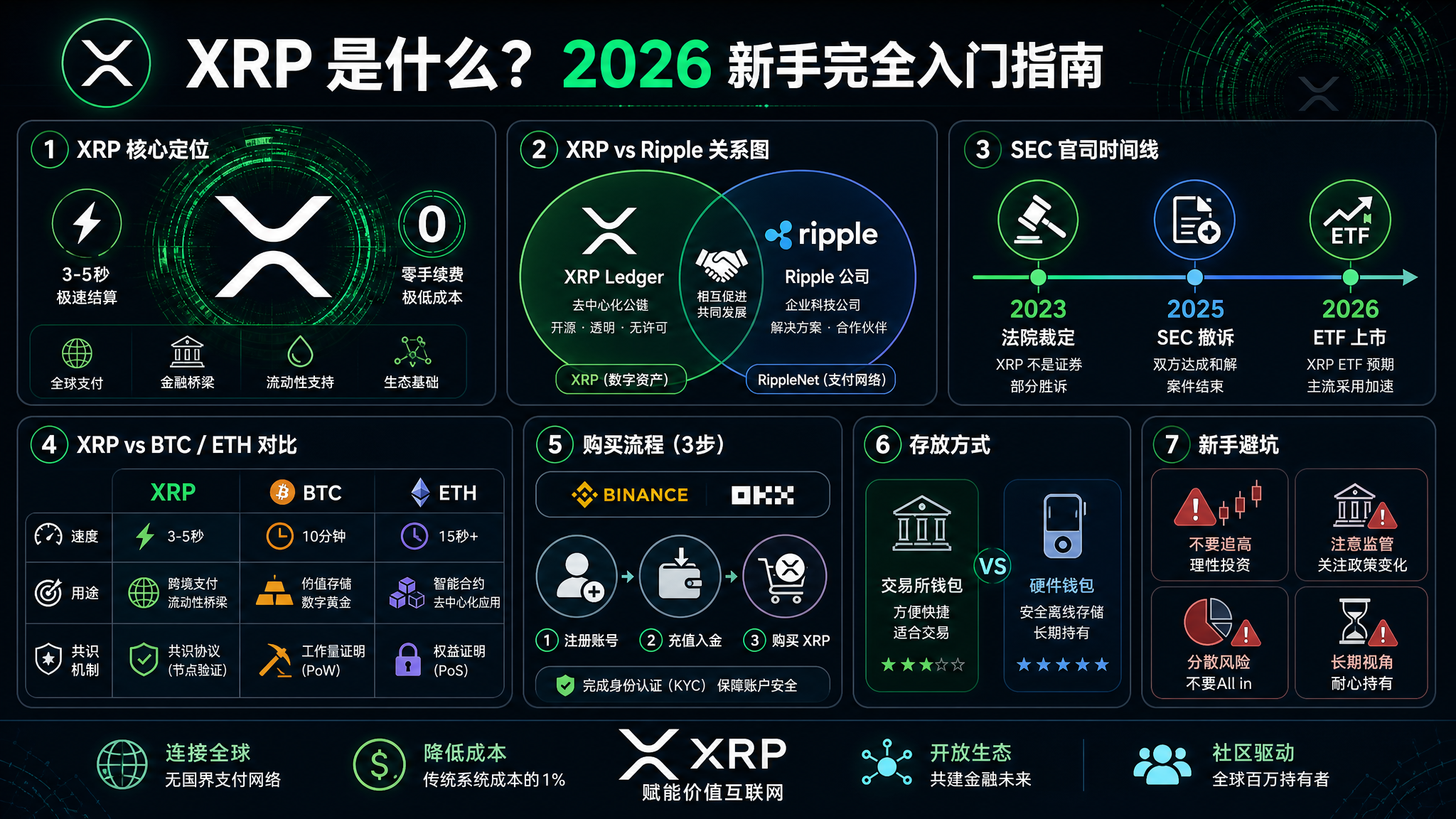
What Is XRP? 2026 Beginner's Complete Guide (How to Buy Ripple, the Ripple Connection, and the SEC Case Explained)
XRP is the native token of the XRP Ledger (XRPL), built in 2012 by Ripple's founding team for ultra-fast cross-border settlement (3–5 seconds, near-zero fees). In 2023 a court ruled XRP secondary-market sales are not securities, in 2025 the SEC dropped its appeal, and XRP spot ETFs launched in 2026. This guide explains XRP from zero — what it is, how it differs from the Ripple company and from Bitcoin/Ethereum — and walks you through buying XRP on Binance/OKX and choosing where to store it, plus a beginner's mistake checklist.
TL;DR
XRP is the native token of the XRP Ledger (XRPL), built for ultra-fast cross-border settlement — a transfer confirms in 3–5 seconds and costs under a cent. As a beginner, you only need to remember three things: ① XRP and the Ripple company are not the same thing — XRP is a token on an independent, decentralized ledger, and Ripple is just one of its largest holders and backers; ② the years-long SEC case is over (a 2023 ruling said secondary-market sales aren't securities, the appeal was dropped in 2025, and XRP spot ETFs launched in 2026), so the regulatory overhang is largely cleared; ③ the easiest way to buy XRP is the Binance/OKX spot market (register → verify identity → buy USDT via C2C → buy XRP in spot), and you can start with a few dollars. But remember: XRP has historically been extremely volatile — don't mistake "good company news" for "the price must rise."123
🎁 No exchange account yet? Signing up with the invite codes below costs you nothing extra; we may receive a commission from the platform: Binance: https://www.bsmkweb.cc/register?ref=BINANBT invite code BINANBT OKX: https://www.promooboost.com/join/60895497 invite code 60895497
1. What Is XRP (In One Sentence)
XRP is the native token of the XRP Ledger (XRPL), created around 2012 by David Schwartz, Jed McCaleb, Arthur Britto and others, with the later-founded Ripple Labs (now Ripple) taking over its development.1
Its biggest difference from Bitcoin and Ethereum is the problem it's trying to solve: Bitcoin wants to be "digital gold," Ethereum wants to be a "programmable world computer," and XRP has done one thing from day one — make money move quickly and cheaply between different countries and currencies.
To achieve this, XRPL made two technical trade-offs:
- No mining, no staking: it relies neither on PoW computing competition nor on PoS staking. Instead, a set of validator nodes that know each other through a trust network (UNL, Unique Node List) agree on transaction order via a "federated consensus protocol." This has two direct results — fast (3–5 second confirmation) and cheap (about 0.00001 XRP per transaction, far under one cent).1
- Fixed supply: XRP's total supply is fixed at 100 billion, with no more ever created. Roughly half is circulating; the rest is held by Ripple in escrow and released to the market gradually each month.
For a beginner, the most tangible experience of XRP is: when you send XRP, it arrives almost instantly and costs almost nothing. That's why it has long been pitched against the huge cross-border remittance market.
To fill in the most basic concepts first, read the first crypto beginner lesson; to understand the general "chain / token" framework, read What are on-chain assets? A beginner's guide.
2. XRP vs Ripple (the Company): What's the Actual Relationship
This is the first thing beginners should get straight — and the easiest to mix up. Ripple is a company; XRP is a token on an independent ledger. They are not the same thing.
| Dimension | Ripple (company) | XRP (token) |
|---|---|---|
| Nature | A company that builds cross-border payment software | The native token of the XRP Ledger |
| Who controls it | Run by company management | The ledger is decentralized, maintained by a validator network |
| Role | Software sold to banks/payment providers (RippleNet, etc.) | The asset used for on-chain transfers and settlement |
| Relationship | One of XRP's largest holders and ecosystem backers | Not owned by Ripple; runs independently |
Why does this matter? Because "Ripple signs a bank partnership" does not automatically equal "XRP's price goes up." In reality, a significant share of RippleNet partners use Ripple's technology without necessarily touching the XRP token itself. That's part of a 2026 "XRP paradox": the company's business and institutional endorsements look good, but the price hasn't risen the way many early holders expected.3
One sentence for beginners: you're buying the XRP token, not Ripple company stock. When evaluating XRP, look at "real demand for the XRP token," not "which bank Ripple just signed."
3. XRP vs Bitcoin vs Ethereum
Three major public chains with completely different positioning are clearest side by side:
| Dimension | XRP | Bitcoin | Ethereum |
|---|---|---|---|
| Core positioning | Cross-border settlement | Digital gold / store of value | Programmable smart-contract platform |
| Consensus | Federated consensus (validator nodes) | PoW proof-of-work | PoS proof-of-stake (post-2022 Merge) |
| Confirmation | ~3–5 seconds | ~10 min/block | ~12 sec/block |
| Fee per transfer | Under a cent | Varies with congestion | High on mainnet, lower on L2 |
| Supply | Fixed 100 billion | Capped 21 million | No hard cap (has burn) |
| Representative narrative | Bank adoption, ETF | Institutional store of value, ETF | DeFi, RWA, stablecoin ecosystem |
Conclusion for beginners: these aren't "who replaces whom" — they solve different problems. If you believe in the "cross-border settlement" use case, XRP's experience is genuinely smooth; if you value "the most decentralized store of value," pick Bitcoin; if you want to "write programs on-chain and play DeFi," use Ethereum. The three can coexist; there's no single right answer.
4. The SEC Case: What Actually Happened (2026 Status)
XRP is best known in crypto for its multi-year lawsuit against the SEC (US Securities and Exchange Commission). It deeply shaped XRP's price and its standing in the US, so beginners should know the timeline:2
| Date | Event |
|---|---|
| Dec 2020 | SEC sues Ripple, alleging XRP is an "unregistered security" |
| Jul 2023 | Southern District of New York rules: XRP sales on secondary/retail markets are not securities, only some institutional sales are violations (partial win for Ripple) |
| Aug 2024 | Court imposes a penalty on the institutional sales |
| Aug 2025 | SEC and Ripple jointly withdraw appeals, effectively ending the case |
| Mar 2026 | SEC and CFTC jointly classify XRP as a "digital commodity" |
What does this mean for beginners? Three points:
- Regulatory risk is largely settled: the "is XRP a security" question in the US is legally resolved — secondary-market trading is not a security transaction, and XRP is classified as a digital commodity.
- That's the precondition for ETFs: precisely because the regulation is now clear, XRP spot ETFs were approved and launched in late 2025 (issuers include Bitwise, Grayscale, 21Shares, Canary Capital, Franklin Templeton and others), with roughly $1.1–1.5 billion in net inflows in the first weeks; in March 2026 Goldman Sachs disclosed about $150 million in XRP spot ETF positions.4
- But "good news" ≠ "must rise": the case was won, ETFs listed, institutions came in — yet XRP's price still traded well below its highs. That's exactly the lesson: judging whether a coin is worth buying requires looking at real usage and your entry price, not just "good news."
5. What Is XRP Actually Used For
XRP's value proposition centers on "payments," in three directions:
| Use case | What it means | What beginners should know |
|---|---|---|
| Cross-border settlement | Use XRP as a "bridge currency": convert A-currency to XRP in seconds, then to local currency in country B | Understand "it wants to be the fast lane for global remittances" |
| Payment liquidity | Banks/payment providers use XRP as a source of on-demand liquidity (Ripple's ODL) | This is Ripple's main enterprise scenario |
| On-chain transfer asset | Transfer and hold XRP on XRPL with near-zero fees | This is the part ordinary users can use most directly |
One sentence: XRP's ambition isn't "building another DeFi ecosystem" — it's "capturing the efficiency dividend of cross-border remittances." You should study whether to hold XRP only if you agree with that direction — not because someone shouts "XRP is about to take off."
6. How to Buy XRP as a Beginner (Binance / OKX, Step by Step)
For beginners, the simplest, least error-prone way to buy XRP is the spot market of a centralized exchange. The full path is four steps:
- Register on an exchange: choose Binance or OKX and sign up with an invite code (no extra cost to you; we may earn a commission).
- Complete identity verification (KYC): upload your ID and do face verification as prompted — usually minutes to a few hours.
- Buy USDT with fiat via C2C: pick a merchant with a verified/shield badge on the C2C page, pay with an account under your own name, and the merchant sends USDT to your account.
- Buy XRP in the spot market: open spot trading, search XRP/USDT, enter an amount and buy.
XRP buying thresholds and fees (2026-09, always check the platform's live page):5
| Platform | XRP channel | Minimum | Spot fee (standard tier) |
|---|---|---|---|
| Binance | Spot XRP/USDT | A few dollars equivalent for major pairs | ~0.1% (cheaper with BNB or rebate) |
| OKX | Spot XRP/USDT | ~$1 equivalent | ~0.08%–0.1% |
Work out the fee: if you spend 500 USDT on XRP at 0.1%, the fee is about 0.5 USDT. XRP's unit price is low and its volatility isn't small, so what beginners should really watch is not trading too frequently — buying in batches and lowering trade frequency matters more than chasing a 0.02% fee difference.
👉 Sign up for Binance (invite code BINANBT): https://www.bsmkweb.cc/register?ref=BINANBT 👉 Sign up for OKX (invite code 60895497): https://www.promooboost.com/join/60895497
For the details of registration and funding, see the Binance registration guide and the OKX registration guide; to compare buying channels side by side, see How to buy Bitcoin? 2026 platform comparison.
7. Where to Store XRP After Buying (Three Options + Two XRP-Specific Notes)
After buying XRP, "where to keep it" is the second most common beginner question. Three options, each with trade-offs:
| Option | Best for | Pros | Cons |
|---|---|---|---|
| Exchange account | Small amounts, frequent trading, pure beginners | Simple, recoverable password | Platform risk (extreme cases of hacks/exit) |
| Self-custody wallet | Medium/long-term holding | You control the keys, can use all dApps | If keys are lost/leaked, coins are gone |
| Cold wallet (hardware) | Large long-term holdings | Keys offline, most secure | Higher barrier, extra hardware cost |
Common self-custody wallets in the XRP ecosystem are Xaman (formerly XUMM), Trust Wallet, and Exodus; Ledger and Trezor hardware wallets both support XRP.
XRP has two specific notes beginners must remember:1
- Wallet reserve: activating a new address on XRPL requires locking a base reserve (about 1 XRP to start, plus 0.2 XRP per additional trust line/object). This XRP stays "reserved" — it's not a fee, but it's not freely spendable either. So don't drain an address to zero XRP, or some operations may fail.
- Destination Tag / Memo: when depositing XRP from a wallet to an exchange, the exchange usually requires a "destination tag" to tell whose deposit it is. Missing or mistyping it can mean your coins don't reach your account and you'll need manual recovery through support. Withdrawing from an exchange to your own wallet usually doesn't need one, but deposits to an exchange must be double-checked.
Default advice for beginners: a few hundred dollars' worth of XRP is fine to leave on the exchange; once the amount grows and you want to hold long-term, learn a self-custody wallet and move some over; consider a cold wallet only for amounts you truly can't afford to lose. The principle remains "small amounts for convenience, large amounts for safety."
For how to choose wallets and the hot-vs-cold distinction, see the complete crypto wallet guide.
8. The Most Common XRP Beginner Mistakes
Remember these five:
The destination tag is the #1 accident point. When depositing XRP to an exchange, always enter the platform's Destination Tag / Memo correctly. This is where XRP differs most from Bitcoin and Ethereum, and missing it can leave your coins "stuck" at the exchange for a long time.
Don't mistake "Ripple the company succeeding" for "XRP will rise." As explained in section 2, a company signing bank partnerships ≠ rising XRP token demand. One reason XRP's price underperformed expectations in 2026 is that the market and retail investors conflated these two things.3
Don't believe "XRP target price $X." The flood of "XRP will hit $5 or $10" claims online are price predictions, not facts. This article gives no prediction, and I'd advise you not to use someone else's prediction as a buy reason — only trust your own judgment of whether the asset is worth the price.
Beware "high-yield XRP products." Any non-official channel promising "earn X% daily by holding XRP" is basically a Ponzi or scam. XRP itself has no native "staking for yield" mechanism (it's not PoS), and certainly no crazy stable returns.
XRP has been historically extremely volatile. It has gone through years of underperforming the broader market, and also violent rallies and crashes. Only invest what you can afford to lose, and don't go all-in just because "the regulation is settled and ETFs are live."
9. FAQ
What's the relationship between XRP and Ripple (the company)?
Ripple is a company, and XRP is an independent token on the XRP Ledger — they are not the same thing. XRP was created early on by Ripple's founding team, but the ledger runs decentralized and doesn't belong to any company; Ripple is just one of XRP's largest holders and ecosystem backers. The most common mistake is equating "Ripple signs a bank partnership" with "XRP will go up" — in reality a significant share of RippleNet partners use Ripple's technology without touching the XRP token.
How does XRP differ from Bitcoin and Ethereum?
Completely different positioning: Bitcoin is "digital gold / store of value," Ethereum is a "programmable smart-contract platform," and XRP is "cross-border payment settlement." XRP uses neither PoW mining nor PoS staking; instead a group of validator nodes reaches agreement via a federated consensus protocol, which is why it's fast (3–5 seconds) and extremely cheap (under a cent per transaction). It's not trying to be "the next Ethereum" — it's solving how money moves quickly and cheaply between countries.
How do beginners buy XRP? How much do I need?
The easiest way is a centralized exchange: register on Binance or OKX, complete identity verification, buy USDT with fiat via C2C, then search "XRP/USDT" in the spot market and buy. XRP's unit price is low, so you can start with the equivalent of a few dollars — you don't need to buy a whole XRP.
Where is it safest to keep XRP after buying? Do I need a "destination tag"?
Small amounts are most convenient on the exchange. For larger amounts or long-term holding, move to a self-custody wallet (Xaman/XUMM is common in the XRP ecosystem, or Trust Wallet, Exodus) or a hardware wallet (Ledger/Trezor). Note two XRP-specific points: first, activating an address requires a "wallet reserve" (about 1 XRP to start); second, depositing XRP from a wallet to an exchange usually requires a "Destination Tag / Memo" — missing or mistyping it can mean your coins don't reach your account.
Is the XRP SEC case over?
Yes, effectively. In July 2023 a court ruled XRP secondary-market sales are not securities; in August 2025 the SEC and Ripple jointly withdrew their appeals; and in March 2026 the SEC and CFTC jointly classified XRP as a "digital commodity." The regulatory uncertainty from this years-long lawsuit is now largely resolved — which is also the precondition for XRP spot ETFs listing in the US.
How high can XRP go?
No one can accurately predict a price, and this article gives no price prediction. XRP's all-time high was around $3.65 in July 2025; in early September 2026 the price was around $1.4, down roughly 60% from the peak. Where it goes depends on ETF inflows, regulatory follow-through (such as the CLARITY Act), and real growth in cross-border payment usage — but "good company news" doesn't mean "the price must rise," as history has repeatedly shown.
10. Summary: Three Things for Beginners to Remember
First: XRP is a "cross-border payment token," not Ripple stock. Its 3–5-second, near-zero-fee settlement supports the "money moving fast around the world" use case — but it's a separate thing from the Ripple company, so get that straight before buying.
Second: buy XRP via "Binance/OKX spot," starting with a few dollars. Register → KYC → buy USDT via C2C → buy XRP in spot. Four steps, done. Pay special attention to the "destination tag" when transferring.
Third: regulation settled ≠ price must rise; returns are secondary, protect your principal first. XRP's lawsuit was won and ETFs are live, but the price will still swing violently. Only use money you can afford to lose, don't believe target prices, and stay away from "earn X% daily" temptations — and you'll already be ahead of most beginners.
If you haven't registered yet, use the official entry points (the invite codes cost you nothing):
🎁 Binance signup link: https://www.bsmkweb.cc/register?ref=BINANBT invite code: BINANBT 🎁 OKX signup link: https://www.promooboost.com/join/60895497 invite code: 60895497
About the Author
CoinVado Research is the content research team at CoinVado, focused on blockchain education, on-chain data analysis, and crypto investment literacy. We keep every data point verifiable and never fabricate, helping beginners build correct crypto awareness and risk consciousness.
⚠️ Risk warning: this article is educational crypto content only and does not constitute investment advice. Cryptocurrency prices are extremely volatile and may fall sharply or even to zero; only use assets you can afford to lose, and always verify each platform's latest rules, fees, and prices before acting.
📖 Related reading:
- How to buy Bitcoin? 2026 buying channels and platform comparison — compare buying channels side by side
- Spot vs futures: which should beginners start with — a table to understand spot vs futures
- USDT vs USDC: how to choose a stablecoin — understand stablecoins before buying
- What are on-chain assets? A beginner's guide — the framework from wallets to RWA
- Binance 2026 registration guide — account, KYC and funding
- OKX 2026 registration guide — account, KYC and funding
- The complete crypto wallet guide — hot vs cold wallets
- On-chain guide (CoinVado) — more on-chain data and crypto education
Footnotes
-
XRP Ledger official docs (https://xrpl.org/) — XRP and XRPL positioning, federated consensus protocol, 3–5 second settlement, ~0.00001 XRP fee per transaction, fixed 100 billion supply, wallet reserve and destination tag mechanism, checked 2026-09-06. ↩ ↩2 ↩3 ↩4
-
Ripple v. SEC public case records and multiple reports — Dec 2020 lawsuit, Jul 2023 SDNY "secondary-market sales are not securities" ruling, Aug 2025 joint withdrawal of appeals, Mar 2026 SEC and CFTC classifying XRP as a digital commodity, checked 2026-09-06. ↩ ↩2
-
CoinMarketCap XRP page and Coinspeaker et al. Sep 2026 reports — XRP all-time high around $3.65 (Jul 2025), early Sep 2026 price around $1.37–1.42, market cap consistently top-ranked, and the "Ripple business vs XRP token demand disconnect" paradox, checked 2026-09-06. ↩ ↩2 ↩3
-
Multiple reports (Bitwise, Grayscale, 21Shares, Canary Capital, Franklin Templeton et al.) — XRP spot ETFs launched around Nov 2025, ~$1.1–1.5 billion net inflows in first weeks, Mar 2026 Goldman Sachs disclosing ~$150 million XRP spot ETF positions, checked 2026-09-06. ↩
-
Binance spot trading rules and OKX spot fee page — minimum amounts vary by pair with no uniform threshold, standard spot fee around 0.08%–0.1% (BNB discount available on Binance), check the live trading page, checked 2026-09-06. ↩