

⚠️ Read this first: before buying or withdrawing, you need an account — use the registration link (e.g. "Register now") or invite code BINANBT to sign up for Binance and get the new-user rewards (20% fee rebate + up to $19,800 welcome package). Choosing the wrong address type will not make coins disappear, but choosing the wrong network will; get the entry point and network right first.
Key takeaways (TL;DR):
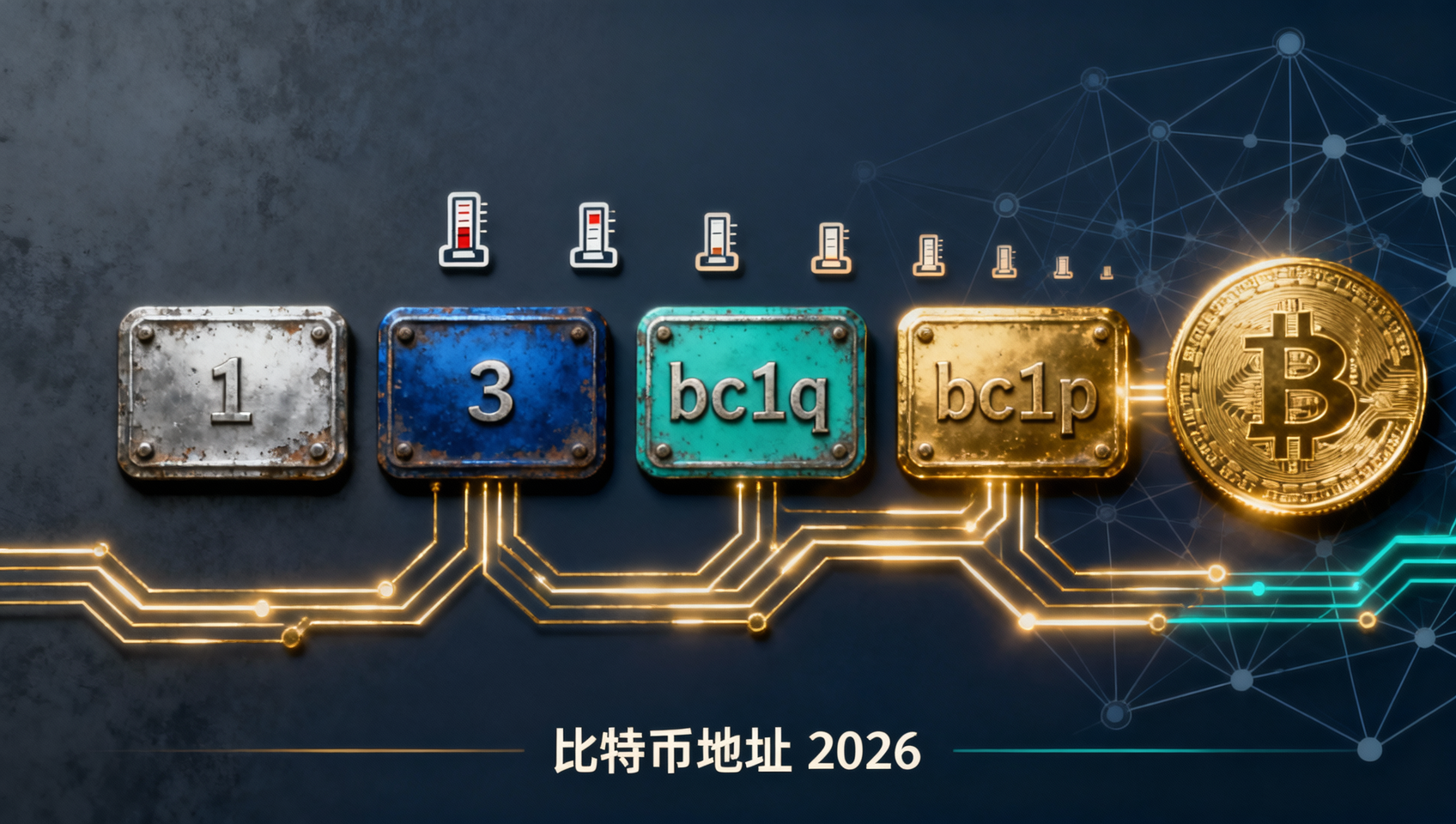
- 1, 3, bc1q and bc1p are all Bitcoin mainnet addresses. They are not different coins or chains; the difference is which script locks the funds.
- Fees differ by input size. For a one-input, two-output transaction: Legacy about 227 vB, nested SegWit about 166 vB, native SegWit about 141 vB, Taproot about 155 vB. At 10 sat/vB, the most and least expensive differ by about $0.90.
- Counterintuitive: bc1p is not always cheapest. Taproot has a smaller input but a larger output; for a simple transfer the total can be close to, or even slightly above, bc1q. Its real advantage is script flexibility and privacy.
- bc1 addresses cannot mix case. bech32/bech32m requires all lower case or all upper case; mixed case is invalid. That is a built-in typo check.
- Verify two things before sending: the network is Bitcoin mainnet, and the first/last six characters match. Wrong address type usually still arrives; wrong network (for example BTC to a BEP20 address) loses funds.
- When unsure, test with a small amount. New address, new platform, new wallet: send a small test first.
Contents
- One-line answer: same network, different envelopes
- The four address types compared
- How much do fees differ? A worked example
- Why so many types: four eras
- How to verify an address: five checks
- Which address should my wallet use?
- Six common myths
- Compatibility in 2026
- 💰 Binance rebate: invite code BINANBT
- FAQ
- Further reading
One-line answer: same network, different envelopes
A Bitcoin address is not an account; it is a description of a lock. The 1, 3, bc1q and bc1p you see are four different locking scripts encoded for humans. When a miner validates a transaction, it checks whether the script can be unlocked by your private key, not what the address looks like.
Therefore:
- A 1-address and a bc1-address can send to each other. They are both on Bitcoin mainnet; the format does not affect interoperability.
- The address type does not change your private key. One seed phrase can derive addresses in different formats, but the addresses are different — do not mix them up.
- The address type affects two things: how much block space the funds take when spent later (the fee), and whether the counterparty's wallet or platform supports that format (compatibility).
The four address types compared
| Type | Prefix | Encoding | Typical length | Input size (approx.) | Common use |
|---|---|---|---|---|---|
| Legacy / P2PKH | 1 |
Base58Check | 26–35 chars | 148 vB | Oldest format, best compatibility |
| P2SH / nested SegWit | 3 |
Base58Check | 26–35 chars | 91 vB | Multisig, P2SH-P2WPKH |
| Native SegWit / P2WPKH | bc1q |
bech32 | 42 chars | 68 vB | Most common single-sig address today |
| Native SegWit / P2WSH | bc1q |
bech32 | 62 chars | about 104 vB+ | Multisig, complex scripts |
| Taproot / P2TR | bc1p |
bech32m | 62 chars | about 57.5 vB (key path) | New wallets, multisig, privacy |
Note: input sizes are approximate. Actual size depends on signature type, number of inputs and whether the script is multisig. The numbers are for comparison, not a quote.
Points that are easy to confuse:
- A 3-address is not necessarily multisig. Most 3-addresses are nested SegWit (P2SH-P2WPKH); only some are multisig.
- bc1q comes in two lengths. 42 characters is usually single-sig P2WPKH; 62 characters is usually multisig P2WSH.
- bc1p is always Taproot. There is no other P2TR form.
- The prefix indicates script type, not network. Testnet uses
tb1, regtest usesbcrt1, and mainnet usesbc1.
How much do fees differ? A worked example
Bitcoin fees are charged by virtual size (vB) × fee rate (sat/vB), not as a percentage of the amount. The address type affects how many vB the input takes.
Assume a standard transaction: one input, two outputs (one payment + one change), fee rate 10 sat/vB, BTC at $100,000 (for scale only).
| Address type | Input | 2 outputs | Other overhead | Total size (approx.) | Fee (approx.) | USD |
|---|---|---|---|---|---|---|
| Legacy P2PKH | 148 vB | 68 vB | 11 vB | 227 vB | 2,270 sat | $2.27 |
| P2SH nested SegWit | 91 vB | 64 vB | 11 vB | 166 vB | 1,660 sat | $1.66 |
| Native SegWit P2WPKH | 68 vB | 62 vB | 11 vB | 141 vB | 1,410 sat | $1.41 |
| Taproot P2TR | 57.5 vB | 86 vB | 11 vB | 154.5 vB | 1,545 sat | $1.55 |
Three conclusions:
- Legacy is the most expensive; bc1q is the cheapest. For the same transfer, Legacy pays about 60% more than native SegWit.
- bc1p has the smallest input but a larger output. A Taproot output is about 43 vB, versus about 31 vB for P2WPKH. So for a simple one-in, two-out transfer, bc1p can be slightly more expensive than bc1q.
- The gap widens with the fee rate. At 50 sat/vB during congestion, the dollar differences in this table are five times larger.
One line: to save fees, receive to bc1q; bc1p's advantage is complex scripts and privacy, not automatic savings. (Input/output sizes in the table are typical estimates; the method is in footnote 1.)
Why so many types: four eras
2009: Legacy (P2PKH, starting with 1)
The earliest Bitcoin address format, encoded with Base58Check. Its script is "pay to public key hash". It has the best compatibility, but the signature and public key both take block space, so fees are highest.
2012: P2SH (starting with 3)
BIP-13 introduced "pay to script hash", letting multisig and complex scripts be represented by a short address. Later, P2SH was used for "nested SegWit": a 3-address on the outside, wrapping a SegWit transaction inside, for compatibility with old wallets.
2017: Native SegWit (bc1q)
BIP-141 introduced Segregated Witness, separating signature data from the transaction body and reducing the effective size. BIP-173 introduced bech32 encoding, the bc1q address. Native SegWit is more compact than nested SegWit and cheaper.
2021: Taproot (bc1p)
BIP-341 introduced Taproot and BIP-350 introduced bech32m encoding2. Taproot uses Schnorr signatures and MAST (Merkelized Abstract Syntax Trees), making complex scripts look like ordinary single-key spends on-chain, which improves privacy; a key-path spend also has a smaller input. But the output format is larger, so simple transfers are not necessarily cheaper.
How to verify an address: five checks
The address type itself will not make coins disappear; the real risks are the wrong network and a swapped address. Do these five checks:
1. Confirm the network is Bitcoin mainnet
A Bitcoin address only works on the Bitcoin network. Sending BTC to a BEP20, ERC20 or TRC20 address — or USDT to a BTC address — loses funds. On an exchange withdrawal page, choose the "BTC" network, not BEP20 or another chain.
2. Check the first six and last six characters
Addresses are too long to verify character by character. Confirm at least the first six and last six match; the middle can be preserved by copy-paste or QR code. For large transfers, ask the recipient to send the address again, or confirm by voice/video.
3. Check the case of bc1 addresses
bech32/bech32m requires the address to be all lowercase or all uppercase; mixed case is invalid3. If you hand-copied it or copied from a chat and the case looks inconsistent, do not guess — copy the original again.
4. Watch for address poisoning and clipboard hijacking
An attacker generates a fake address with the same first and last characters as one you use, sends you a zero-value token to plant it in your history, or uses malware to replace your clipboard. Do not copy addresses from transaction history; use the latest address from the recipient and verify the ends.
5. Test with a small amount first
New address, new platform, new wallet: send a small test, confirm arrival, then send the rest. A few dollars in extra fees is far cheaper than sending a large amount to the wrong place.
Which address should my wallet use?
| Scenario | Recommendation | Reason |
|---|---|---|
| New wallet default | bc1q or bc1p | Generated by major wallets, low fees |
| Everyday receiving | bc1q | Best balance of compatibility and fees |
| Multisig / complex scripts | bc1p or P2WSH | Taproot privacy; P2WSH more mature |
| Old platform / old wallet | 1 or 3 | Best compatibility, higher fees |
| Hardware wallet | Follow the device | Verify the address on the device screen |
| Large holdings | Cold wallet + bc1q/bc1p | Offline custody, less online exposure |
Do not: insist that a counterparty use bc1p because you prefer it, or assume someone who gives a 1-address is "unsafe" or "doesn't understand". Address type is a technical choice, not a security level.
Six common myths
Myth one: addresses starting with 1 are safer
No. The address type does not affect private-key security. Legacy addresses simply cost more and take more block space; they are not less secure than bc1. Security is determined by how you store the key.
Myth two: all 3-addresses are multisig
No. Most 3-addresses are nested SegWit (P2SH-P2WPKH); only some are multisig. You cannot tell multisig from the prefix.
Myth three: bc1 is another chain or coin
No. bc1 is still a Bitcoin mainnet address, just a newer encoding. It is not BCH, BSV or a USDT address. Always confirm the network when transferring.
Myth four: bc1p is always cheapest
Not necessarily. Taproot has a smaller input but a larger output. A simple transfer's total size can be close to, or slightly above, bc1q. Its advantages are script flexibility, privacy and complex spending.
Myth five: addresses can be reused freely
Technically yes, but it is not recommended. Reusing an address reduces privacy and makes your transactions easier to link. Modern wallets usually generate a new receiving address each time; that is normal, not an error.
Myth six: an address is an account
No. One wallet (one seed phrase) can derive unlimited addresses; an address is just one lock. A changing address in your wallet does not mean assets are lost.
Compatibility in 2026
- bc1q: supported by essentially all major wallets, exchanges and hardware wallets. Safe to use.
- bc1p: widely supported, but a few older platforms, specific earning products or niche wallets may still only support bc1q. Read the withdrawal page and test small first.
- 1 / 3 addresses: the best compatibility for old systems; higher fees.
- Testnet addresses: start with
tb1. Sending between mainnet and testnet loses funds; never mix them.
Practical advice: receive with bc1q day to day; use bc1p when you need Taproot's advanced features; when dealing with an uncertain platform, check which types it supports or simply use the deposit address it generates.
💰 Binance rebate: invite code BINANBT
New users who enter invite code BINANBT at registration get a 20% trading-fee rebate that compounds over time. This article contains a referral link; we may receive a reward if you register through it, but it costs you nothing extra.
- Rebate: 20% of trading fees, ongoing; the more you trade, the more you save.
- Welcome package: up to $19,800, unlocked by tasks, not cash at registration.
- How to claim: enter BINANBT in the invite-code field during registration; it is the most reliable route.
- Important: registering directly inside the app gets you none of the new-user rewards. In-app registration creates no referral relationship, so the $19,800 package and the 20% rebate will not apply — you must use the registration link or enter code BINANBT.
👉 Register on Binance and get a 20% fee rebate
FAQ
What is the difference between a Bitcoin address starting with 1 and one starting with bc1?
Both are Bitcoin mainnet addresses; the difference is the output script. 1 is Legacy (P2PKH), 3 is usually P2SH (multisig or nested SegWit), bc1q is native SegWit, bc1p is Taproot. Legacy inputs take the most space and cost the most; bc1q is cheapest; bc1p has a smaller input but a larger output, so simple transfers are not always cheaper.
Can I still use an address starting with 1? Will I fail to receive funds?
Yes. Legacy addresses have worked since 2009 and all major wallets and exchanges support them. The only downside is higher fees; they are not expired or unsafe.
Is bc1 a different chain or coin?
No. bc1 is still a Bitcoin mainnet address, just encoded for SegWit/Taproot. It is not BCH, BSV or USDT, and cannot be used cross-chain.
What is the difference between bc1q and bc1p?
bc1q is SegWit v0 (P2WPKH/P2WSH), launched in 2017. bc1p is Taproot (P2TR), launched in 2021. bc1p uses Schnorr signatures and MAST, with more flexible scripts, better privacy and a smaller input; but its output is larger, so the total fee for a simple transfer is not necessarily lower than bc1q.
Why can't bc1 addresses mix upper and lower case?
bech32/bech32m requires all lowercase or all uppercase; mixed case is invalid. It is a typo-protection rule that also reduces errors in hand-copying and QR scanning.
Which parts of an address should I verify before sending?
At least the first six and last six characters, and that the network is Bitcoin mainnet. For bc1, check that the case was not changed; do not copy from transaction history; test with a small amount before large transfers.
Which address type should my wallet use?
A new wallet can default to bc1q or bc1p. For everyday receiving, prefer bc1q; for multisig or advanced scripts, use bc1p or P2WSH; for old platforms, use 1 or 3. When paying, use the recipient's address.
Which address type should I choose when withdrawing from an exchange?
Withdrawal pages usually just ask for the network (BTC) and the address. 1, 3, bc1q and bc1p are all Bitcoin mainnet addresses, but a few older platforms may not support bc1p. Test small first, then withdraw the rest.
Further reading
- What is Bitcoin? A complete beginner guide for 2026
- Bitcoin transaction stuck in the mempool: RBF, CPFP and accelerators
- How to make money with Bitcoin in 2026: six methods compared
- Cold wallets and hardware wallets: complete 2026 guide
- Binance withdrawal guide 2026: networks, addresses and memos
- Blockchain technology explained: hashes, chains and immutability
- More Bitcoin guides
Disclaimer: This article is for educational purposes only and is not investment advice. Address lengths, input/output sizes and fees are typical estimates as of November 2026; actual values depend on transaction structure, signature type, wallet implementation and network fee rates. Rely on live data from your wallet and a block explorer before sending. On-chain transactions are irreversible; verify the address and network before transferring, and never share your private key, seed phrase or 2FA code. Crypto services are restricted in some countries and regions; confirm your local rules first.
Footnotes
-
Source: typical transaction-size estimates from Bitcoin Core and major wallets: P2PKH input about 148 vB, P2SH-P2WPKH about 91 vB, P2WPKH about 68 vB, P2TR key path about 57.5 vB; outputs about 34/32/31/43 vB; other overhead about 11 vB. Actual sizes vary with inputs, outputs and signature type. ↩
-
Source: Bitcoin BIP-13 (Pay to Script Hash, 2012), BIP-141 (Segregated Witness, 2017), BIP-173 (bech32), BIP-341 (Taproot, 2021) and BIP-350 (bech32m); prefix-to-script-type mapping follows Bitcoin Core and major wallet implementations. ↩
-
Source: bech32/bech32m specifications require all-lowercase or all-uppercase addresses; mixed case is invalid. Mainnet prefix is bc1, testnet tb1 and regtest bcrt1. ↩