



Introduction
What is blockchain technology? In one sentence, blockchain is a distributed ledger technology where data is cryptographically linked into "blocks" — each block connected to the previous one through a hash pointer, forming an unbreakable chain of data stretching from the genesis block to the latest block. This seemingly simple structure is the technical foundation of Bitcoin, Ethereum, and every cryptocurrency in existence.
Understanding blockchain technology requires answering three core questions: What is inside a block? How are blocks linked together? And why can't data be changed once it is recorded? This article breaks down these questions layer by layer.
As of July 2026, the total global cryptocurrency market cap stands at approximately $2.2 trillion, and the Bitcoin and Ethereum blockchains have accumulated over a decade of transaction history each — never once successfully tampered with1. This promise of immutability is not enforced by any institution — it is built entirely on the mathematics of block structure and hash chains.
Blocks: The Basic Storage Unit of Blockchain
Physical Structure of a Block
Each block consists of two parts: the Block Header (80 bytes) and the Block Body (the transaction list). The block header acts as the block's "identity card", while the body contains all the transaction data.
Analogy: Think of the block header as a book cover (title, author, edition, ISBN) and the block body as the book's pages. You only need to check the cover to verify the book's identity — similarly, nodes only need the 80-byte block header to validate the entire chain's integrity.
Block Header Fields (80 bytes)
| Field | Size | Description |
|---|---|---|
| Version | 4 bytes | Protocol version number |
| Prev Block Hash | 32 bytes | SHA-256 hash of the previous block — the core field that enables chain linking |
| Merkle Root | 32 bytes | Hash summarizing all transactions in the block |
| Timestamp | 4 bytes | Block creation time (Unix timestamp) |
| Bits | 4 bytes | Current mining difficulty target |
| Nonce | 4 bytes | Counter adjusted during mining to find a valid hash |
| Total | 80 bytes |
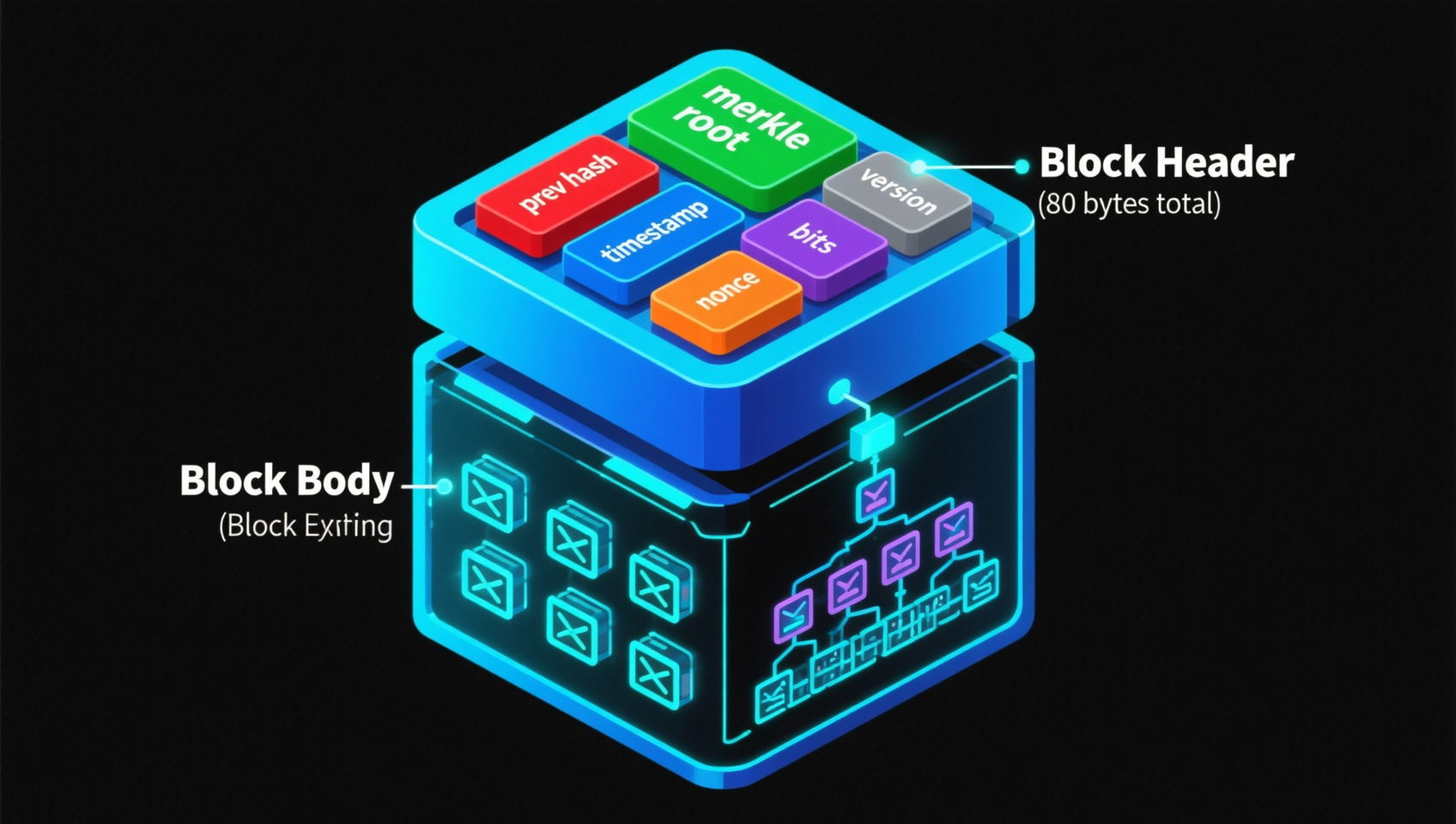
The Prev Block Hash and Merkle Root are the two most critical fields — the former enables chain linking, the latter compresses all transactions into verifiable form.
Block Body: The Transaction Container
The block body contains a list of transactions organized into a Merkle tree, producing a single 32-byte Merkle Root stored in the block header. A Bitcoin block can hold approximately 7,000-10,000 transactions (SegWit effective limit of ~4 MB), while Ethereum can process 500-1,000 simple transfers per block (limited by ~30M Gas).
Bitcoin's block size upper limit is 4 MB (expanded from 1 MB after the SegWit upgrade)2. Ethereum uses Gas Limit (~30M Gas) rather than a byte size limit to control block capacity.
Hash Pointers: The Cryptographic Core of Chain Linking
What Is a Hash Pointer?
A hash pointer is the key cryptographic construction that enables blockchain's chain structure. Unlike a regular pointer, a hash pointer does two things simultaneously:
- Points to a location: tells you where the next block is
- Locks the content: proves what the pointed-to block's data should be
In blockchain, each block's header stores the SHA-256 hash of the complete previous block's data. This hash is a hash pointer — it both proves the previous block hasn't been tampered with and binds the current block to the entire chain history.
Intuitive understanding: Imagine a chain of locks — each lock's combination is calculated from the contents of the previous lock. If any lock in the middle is replaced, all subsequent locks' combinations become invalid. A hash pointer is the cryptographic implementation of this dependency.
The Hash Chain: From Genesis to Latest Block
The complete chain linking process works as follows:
- Genesis Block (Block 0): Has no previous block — its Prev Block Hash field is all zeros
- Block 1: Computes the SHA-256 hash of the entire genesis block data and stores it in Block 1's Prev Block Hash
- Block 2: Computes the hash of Block 1 and stores it in Block 2's Prev Block Hash
- And so on: Each new block "locks in" the content of the previous block
As of July 2026, Bitcoin has produced approximately 880,000 blocks forming an unbroken chain from genesis to the present3. Ethereum's block count exceeds 21 million.
Tamper Detection Mechanism
If an attacker modifies a transaction in Block N, the following chain reaction occurs:
- Block N's content changes → its hash changes
- Block N+1's Prev Block Hash still points to the old hash → mismatch
- Block N+1 becomes invalid
- All subsequent blocks after Block N also become invalid
For the attacker to make the chain valid again, they must:
- Recompute the Nonce for Block N (Proof of Work)
- Recompute Nonces for Block N+1, N+2... all the way to the latest block
- This requires computational power exceeding the entire remaining network
This is blockchain's mathematical guarantee of immutability — not physically unchangeable, but economically infeasible to alter.
Merkle Trees: Efficient Verification Through Data Compression
How Merkle Trees Work
A Merkle tree (binary hash tree) is a data structure that compresses a large set of data into a single hash value. In blockchain, it organizes all transactions within a block:
- Each transaction is hashed individually (leaf nodes)
- Adjacent leaf hashes are paired and hashed again (parent nodes)
- This process repeats until a single Merkle Root (32 bytes) is obtained
Tree structure (simplified):
- Layer 0 (leaves):
Hash(Tx1)Hash(Tx2)Hash(Tx3)Hash(Tx4)- Layer 1:
Hash(H(Tx1)+H(Tx2))Hash(H(Tx3)+H(Tx4))- Layer 2 (Merkle Root):
Hash(Layer1 pair)
This 32-byte Merkle Root is the "digital fingerprint" of all transactions in the block — change any transaction or its order, and the Merkle Root changes completely.
Two Essential Functions of Merkle Trees
1. Data Compression: A Bitcoin block may contain thousands of transactions, but through the Merkle tree, they are compressed into a single 32-byte hash stored in the 80-byte block header. Without Merkle trees, the header would need to store thousands of hashes, expanding it hundreds of times.
2. SPV (Simplified Payment Verification): This is the most important application. Light wallets (like mobile wallets) don't need to download the full blockchain (580+ GB). They only need each block's 80-byte header (about 70 MB total) and can verify whether a transaction is included in a block through a Merkle Proof — requiring only log₂(N) hash computations. For a block with 2,000 transactions, that's just about 11 hashes4.
What this means for you: When your mobile wallet (like MetaMask or Trust Wallet) confirms a payment has arrived, Merkle proofs are doing the heavy lifting — no need to sync hundreds of gigabytes of blockchain data.
Proof of Work: The Economic Barrier Against Tampering
Why Hash Chains + Merkle Trees Are Not Enough
Hash pointers can detect tampering — but they cannot prevent it. An attacker with enough computational power could start from an early block, recalculate all subsequent Nonces, and produce a completely valid alternative chain. Hash chains alone are a detection mechanism, not a prevention mechanism.
Nonce and Proof of Work
Proof of Work (PoW) solves this by making creating new blocks extremely difficult:
- Bitcoin uses SHA-256 double-hashing: find a Nonce such that
SHA-256(SHA-256(block header + Nonce))begins with a specific number of zeros - This can only be solved through brute force (trillions of hashes per second)
- Current total network hashrate: approximately 700 EH/s (7×10²⁰ hashes per second)3
- Average time to find a valid Nonce: about 10 minutes
This means rewriting one block requires repeating this trillions-of-attempts process. Rewriting N blocks requires N times the work. As new blocks keep being added to the chain's tip, the cost of rewriting old blocks grows linearly — eventually becoming completely impractical.
The Longest Chain Rule
When two valid blocks appear simultaneously (a temporary fork), the Bitcoin protocol resolves the conflict through the Longest Chain Rule:
Nodes always consider the chain with the greatest accumulated Proof of Work as the authoritative chain.
This mechanism ensures the network converges to a single history. An attacker would need to produce blocks faster than the honest network to reverse transactions — this is what makes a "51% attack" so difficult.
Two Main Accounting Models
Different blockchains use different transaction accounting models:
UTXO Model (Bitcoin)
UTXO (Unspent Transaction Output) treats each record as a "coin fragment":
- Every transaction input is a previous transaction's unspent output
- Every transaction creates new UTXOs as outputs
- Your "balance" is the sum of all UTXOs you can spend
UTXO analogy: Like cash in your wallet — you receive a $100 bill (old UTXO), spend $25 (spend the old $100), and receive a new $75 UTXO as change. Your total cash is the sum of all UTXOs you own.
Account/Balance Model (Ethereum)
Ethereum uses a model similar to traditional banking:
- Each address has a global state (balance, nonce, stored data)
- Transfers directly debit from one account and credit another
- No need to trace UTXO history
Comparison:
| Aspect | UTXO Model | Account Model |
|---|---|---|
| Privacy | Higher (new address per transaction) | Lower (address traceability) |
| Parallelism | High (no state dependency) | Sequential (state-dependent) |
| Complexity | More complex (manage UTXO set) | Simpler (intuitive balance) |
| Smart Contracts | Not suited | Native (EVM state machine) |
| Data Size | Smaller (outputs only) | Larger (full state) |
Blockchain Nodes: Who Maintains the Chain?
Full Nodes
- Download and validate the complete blockchain (Bitcoin: ~580 GB, Ethereum archive: ~12 TB)
- Independently verify every transaction and block
- Relay transactions and blocks to peers
- More full nodes = more decentralized = harder to attack
As of July 2026, Bitcoin has roughly 18,000 reachable nodes5, and Ethereum has approximately 7,000 accessible consensus layer nodes6.
Light Nodes (SPV Nodes)
- Download block headers only (80 bytes per block)
- Verify transactions through Merkle Proofs
- Typical light nodes: mobile wallets, browser wallets
Archive Nodes
- Store full state history from the genesis block
- Ethereum archive nodes require ~12 TB storage
- Used primarily by block explorers and analytics platforms
What this means for you: When you run a full Bitcoin Core client, you are operating a full node — you don't need to trust anyone because your node independently verifies the entire history. This is the practical embodiment of "Don't Trust, Verify."
Common Misconceptions
Is "Blockchain Data Is Immutable" Absolute?
Not physically absolute, but economically impractical. An attacker with enough hashrate can technically rewrite a fork. The reality:
- Rewriting Bitcoin history requires: current global hashrate × number of blocks to rewrite
- An Antminer S21 XP costs ~$5,000; reaching even 1% of global hashrate requires tens of thousands of units
- It is physically infeasible to concentrate the necessary hardware and electricity
Does Every Node Store All Data?
No. Different node types store vastly different amounts:
- Full nodes: complete ledger (580 GB to 12 TB)
- Pruned nodes: recent blocks + UTXO set (~5 GB)
- Light nodes: block headers only (~70 MB)
Is Blockchain Just Bitcoin?
No. Bitcoin was the first successful application of blockchain, but blockchain is a general-purpose distributed ledger technology. Ethereum introduced smart contracts, transforming blockchain from a simple value transfer system to a "world computer." As of July 2026, blockchain is used across DeFi, NFTs, supply chain tracking, digital identity, and RWA tokenization7.
The Future of Blockchain Technology
Scalability Challenge
Blockchain's "impossible triangle" (decentralization, security, scalability) is the fundamental bottleneck. Current solutions:
| Solution | Examples | Principle | Effect |
|---|---|---|---|
| Bigger blocks | Bitcoin SV | Increase block size | Sacrifices decentralization |
| Sharding | Ethereum (abandoned for Rollup-first) | Split chain into parallel sub-chains | Complex security model |
| Layer 2 (Rollup) | Arbitrum, Optimism, zkSync | Execute off-chain, verify on-chain | Most successful solution |
| Sidechains | Polygon POS | Independent chain + bridge | Independent security |
New Consensus Mechanisms
- PoS (Proof of Stake) : Ethereum has fully adopted PoS, reducing energy consumption by 99.9% and ETH inflation to ~0.5% annually8
- DPoS (Delegated Proof of Stake) : Vote for a small set of block producers — higher TPS but more centralized
- DAG (Directed Acyclic Graph) : Abandons chain structure — transactions confirm each other directly, theoretically higher throughput
FAQ
What fields are in a blockchain block?
Each block has a Block Header (80 bytes) and Block Body. The header contains: Previous Block Hash, Timestamp, Difficulty Target (Bits), Nonce, Merkle Root, and Version. The body contains the list of confirmed transactions.
What's the difference between a hash pointer and a regular pointer?
A regular pointer stores only a memory address (where). A hash pointer stores both the address and a cryptographic hash of the data (what). In blockchain, each block's header contains the hash of the previous block — this is a hash pointer that both locates and locks the previous block's content.
Why can't blockchain data be tampered with?
Immutability comes from three layers: (1) Each block's hash pointer links to the previous block — changing any block breaks its hash and invalidates all subsequent hashes; (2) PoW requires recomputing the Proof of Work for every rewritten block; (3) Full nodes each maintain their own copy of the complete ledger.
What does the Merkle tree do in blockchain?
The Merkle tree pairs and hashes all transactions together into a single Merkle Root stored in the block header. This compresses thousands of transactions into 32 bytes, and enables SPV verification — light nodes only need block headers (80 bytes each) and a Merkle Proof to verify transactions.
Why is blockchain designed as a chain rather than a tree or network?
A chain structure guarantees a single, unique history — every block has exactly one parent block, and all nodes agree on the path from genesis to the latest block. Tree or network structures would create conflicting histories and prevent consensus on transaction ordering.
What is the Bitcoin block size? How many transactions per block?
Bitcoin's block size limit is 4 MB (post-SegWit). A typical 4 MB block holds approximately 7,000-10,000 transactions. Ethereum uses a Gas Limit of ~30M, processing about 500-1,000 simple transfers per block.
What types of blockchain forks exist?
Three types: Hard fork (protocol-breaking upgrade, chain splits permanently — e.g. BTC→BCH), Soft fork (backward-compatible, chain stays unified), Temporary fork/Reorg (two miners find blocks simultaneously, resolved by the longest chain rule).
Why is blockchain TPS so low? Can it be improved?
Bitcoin's theoretical TPS is about 7 tx/s, Ethereum's is about 15-30 tx/s8. The bottleneck is that larger blocks or faster block times increase node storage and bandwidth requirements, reducing decentralization. The most effective solution is Layer 2 — process transactions off-chain and submit only the results to the main chain.
Does blockchain data grow forever?
Yes, but most users don't need to store all of it. Bitcoin's full chain is ~580 GB, Ethereum's archive nodes ~12 TB. However, pruned nodes need only ~5 GB (Bitcoin) or ~1.5 TB (Ethereum snapshot). Light wallets store just ~70 MB of block headers.
What is a 51% attack? Has it happened?
A 51% attack occurs when a miner or pool controls more than 50% of the network hashrate, enabling them to prevent transaction confirmations or reverse already-confirmed transactions (double-spending). It has occurred on smaller chains (Bitcoin SV, ETC Classic), but Bitcoin's ~700 EH/s hashrate makes it economically prohibitive.
Further Reading
Related Articles
- What Is Blockchain? A Complete Beginner's Guide — Blockchain basics for absolute beginners
- Bitcoin Whitepaper: UTXO, PoW, and Decentralized Consensus — Deep dive into Bitcoin's technical design
- Bitcoin Address Generation: From Private Key to Address — Practical cryptography in blockchain
- Crypto Wallet Complete Guide 2026 — Private key management in wallets
External Resources
- Bitcoin.org Bitcoin Whitepaper — Original Bitcoin whitepaper by Satoshi Nakamoto
- Mastering Bitcoin 2nd Edition (O'Reilly) — The authoritative intermediate Bitcoin technical textbook
- Learn Me A Bitcoin — Interactive Bitcoin learning resource
- Blockchain.com Explorer — Bitcoin block explorer with detailed field views
- Ethereum Whitepaper — Original Ethereum whitepaper
- Chain Guide — Learn Blockchain From Zero — More blockchain educational articles
Disclaimer: This article is for educational purposes only. Cryptocurrency and blockchain technology evolve rapidly — data may change over time. Always verify with live blockchain explorers for the most current information.
Footnotes
-
CoinGecko, Total Cryptocurrency Market Cap, July 2026 ↩
-
Bitcoin Wiki, Block Size Limit and SegWit ↩
-
Blockchain.com, Bitcoin Hashrate and Block Height, July 2026 ↩ ↩2
-
Investopedia, Merkle Proof Verification Process ↩
-
Bitnodes.io, Bitcoin Reachable Node Count, July 2026 ↩
-
Etherscan, Ethereum Node Count, July 2026 ↩
-
DefiLlama, Blockchain Sector TVL Data, July 2026 ↩
-
Ethereum.org Official Documentation, PoS Ethereum and Gas Mechanics ↩ ↩2