

⚠️ Read this first: buying and withdrawing crypto both start with an exchange account. Don't just tap "sign up" inside the app — only registrations through the registration link (e.g. "Register now") or with invite code BINANBT unlock Binance's new-user rewards (a 20% trading fee rebate plus a welcome package worth up to $19,800).
Key takeaways (TL;DR):
- A cold wallet keeps the private key offline and signs inside the device. It removes the "remote hacker" risk, but not three others: how the seed was generated, who handled the device before you, and what you approve.
- The two largest self-custody losses of 2026 did not break a device remotely. A Coldcard firmware bug from 2021 produced weak seeds; Galaxy Research confirmed about 1,367 BTC (~$88.6M) stolen1. Some Ledger units sold by a reseller carried hidden LTE implants, with losses estimated above $86 million2.
- "Genuine Check passed" is not the same as safe. Ledger's check validates the secure element; the added circuit board behind the screen is invisible to it. Once Keystone's verification key was stolen, even the "genuine device" check could be forged3.
- A firmware update does not fix an old seed. Coldcard's fixed firmware only guarantees that future seeds are random. A weak seed stays weak — create a new wallet, generate a new seed, move the funds.
- Bottom line: the value of a cold wallet is not which device you buy. It is buying direct + generating your own seed + multisig for large balances. The device is one link in that chain.
What is a cold wallet? In one sentence: a cold wallet keeps the private key away from the internet and performs every signature inside an offline device — a hardware wallet is the most common form. Its central promise is narrow and absolute: the private key never leaves the device. You connect over USB or scan a QR code, the device signs internally, and the signed transaction goes back to your computer for broadcast.
That promise is real, and it only covers part of the risk. The incidents of 2026 all slipped past the "key leaves the device" checkpoint: some seeds were never random enough in the first place, and some devices had been modified before the owner ever powered them on. Understanding what a cold wallet does and does not protect is more useful than memorizing brand names.
Table of contents
- What a cold wallet actually protects
- Three 2026 incidents that changed how to choose
- Counterintuitive: it blocks the network, not the factory
- The three-layer risk model
- How to choose: five hardware wallets compared
- Your first hour: six steps to complete
- Large balances: multisig and splitting
- Six myths that have cost people real money
- 💰 Binance rebate: invite code BINANBT
- FAQ
- Further reading
What a cold wallet actually protects
A cold wallet protects the private key from internet exposure: malware, remote access, clipboard hijacking and phishing sites. A hot wallet puts all of that on a connected machine. A cold wallet moves the signing step to a device that never touches the network, so an infected laptop still cannot extract the key.
| Dimension | Exchange account | Hot wallet (e.g. MetaMask) | Cold wallet (hardware) |
|---|---|---|---|
| Who holds the key | The exchange | You, in software | You, in an offline device |
| Network exposure | None (but the platform can freeze you) | High | Low — signing is offline |
| Main theft route | Platform breach, account takeover | Malicious signatures, extensions, malware | Seed generation, supply chain, what you sign |
| Daily use | Easiest | Easy | Plug in or scan, slightly slower |
| Best for | Trading balances, short holding | Small amounts, frequent DApp use | Long-term, large holdings |
The key row is "main theft route": the three wallet types fail in completely different ways. Exchanges fail through platform and account risk. Hot wallets fail when you sign something you should not. Cold wallets fail at the device itself and the seed generation step. So "I bought a hardware wallet, I'm safe" only holds if your previous risk was a hot wallet being phished.
Three 2026 incidents that changed how to choose
2026 did more damage to hardware wallet reputations than any year before it: three incidents hit seed generation, the physical supply chain and customer data. They point at one conclusion: the device is one link, and any link can break.
Incident one: Coldcard's seed randomness flaw (~$88.6M)
On July 30, 2026, Block's security team disclosed a five-year-old firmware problem to Coinkite. During a March 2021 integration, an #ifndef guard checked whether the hardware RNG was defined rather than enabled; because the setting was 0, the check passed and seed generation was silently routed to MicroPython's deterministic Yasmarang PRNG instead of the chip's hardware source1.
Entropy collapsed: roughly 40 bits on Mk2/Mk3 and 72 bits on Mk4/Mk5/Q, against a 128-bit target. Attackers could enumerate candidate seeds offline, derive addresses and match them against the chain — no device contact and no signature required.
Galaxy Research's onchain tracking shows the first wave began about 30 hours before disclosure: 1,196 addresses and 1,082.65 BTC (~$70.2M) in 41 minutes. By August 2 the confirmed total reached 1,367 BTC (~$88.6M) across about 4,585 addresses, and later updates put all waves together near 2,055 BTC (~$130M)1.
The detail to remember: updating firmware does not repair an existing seed. Affected versions (Mk2/Mk3 4.0.1–4.1.9, Mk4/Mk5 below 5.6.0, Q below 1.5.0Q) are fixed going forward only. Old seeds must be retired: create a new wallet, generate a new seed, move the coins. Seeds created with at least 50 dice rolls or a strong BIP-39 passphrase carry materially lower risk.
Incident two: Ledger reseller devices with LTE implants (~$86M+)
In October 2026, Ledger confirmed that some devices sold through authorised Southeast Asian reseller CryptoBilis (Indonesia, Malaysia, the Philippines) had a small circuit board added behind the screen assembly: a microcontroller plus an LTE modem and eSIM. During setup, while the device displayed the 24 words, the board decoded them and sent them out over cellular data2.
The critical part is that it defeated every normal check: the secure element was genuine, the firmware was official, the packaging was sealed, and Ledger's Genuine Check validates the secure element — it cannot see added hardware behind the screen. Onchain investigator Specter put losses above $86 million, with reported ranges between $72M and $102M; Tether froze about $10 million in linked USDT2.
This overturns a popular claim: "buy only from an authorised reseller and you're safe" is not quite true. Authorised resellers can be acquired or compromised, and official channels can fail. What actually reduces risk is buying direct where possible, generating the seed yourself, and trusting nothing that came pre-configured.
Incident three: data breaches — no coins lost, more people phished
In August, Trezor's fulfilment partner ShipMonk was breached: 13,689 customers were exposed first, then about 67,000 more US customers in September — roughly 80,000 names, emails, phone numbers and shipping addresses. In October, Keystone's website was breached, exposing 25,964 order records and a device authentication key used for "genuine device" verification, prompting Keystone to destroy 18,835 unsold units that used the old key43.
Neither incident moved coins directly, and that is why the damage is underestimated: knowing when you bought which hardware wallet tells an attacker who you are and roughly how much you hold. What follows is targeted phishing, fake support calls and sometimes physical threats. Most "official support" calls to hardware wallet owners trace back to leaks like these.
Counterintuitive: it blocks the network, not the factory
"Offline" closes one link in the attack chain, and 2026's largest losses happened at other links. Treating a cold wallet as a safe makes you skip the checks that matter.
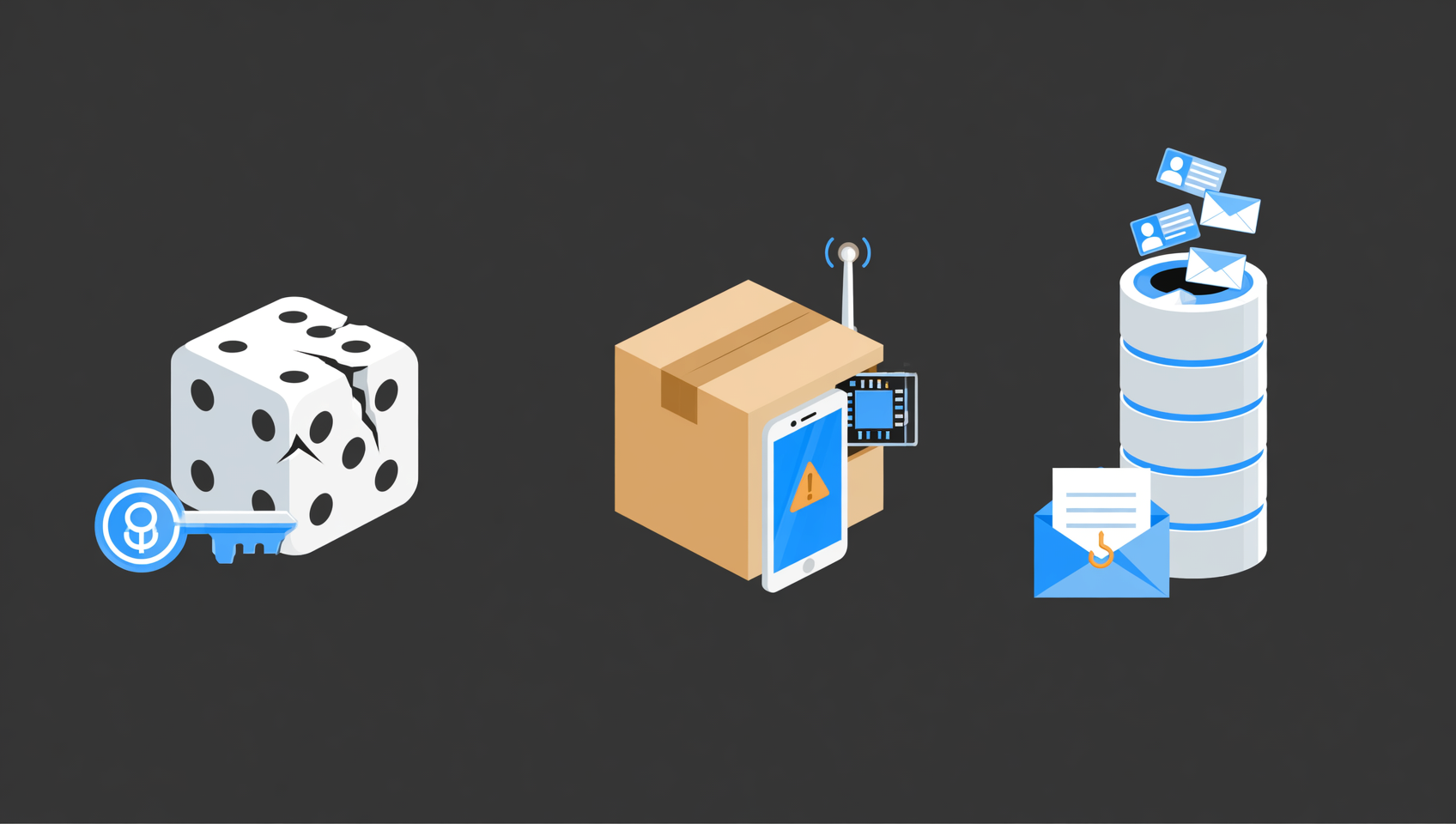
The classic threat model is: hacker remotely compromises your computer → steals the key. A cold wallet cuts that path. But at least three other surfaces remain:
- The seed was weak at birth. If randomness is poor, the search space shrinks from 2¹²⁸ to 2⁴⁰ and brute force goes from impossible to hours. Whether the device is online is irrelevant.
- The device was handled before you got it. Hardware implants, pre-written seed phrases and repackaging all happen in logistics and resale, before you press the power button.
- You approved something you should not have. A cold wallet faithfully signs every transaction you confirm, including one that hands your entire balance to someone else. The device does not judge intent; it signs.
So the accurate statement is not "cold wallets are safe". It is: a cold wallet moves risk from "remote" to "factory, logistics and you". All three need your own diligence, and no vendor can do it for you.
The three-layer risk model
Judge a hardware wallet by three layers in order — seed generation, device provenance, signing behaviour. If one layer fails, the other two do not save you.
| Layer | What goes wrong | How to reduce it |
|---|---|---|
| 1. Seed generation | Weak randomness, deterministic PRNG, pre-written phrase | Generate on-device, add dice entropy, use a strong BIP-39 passphrase, verify on the device screen |
| 2. Device provenance | Reseller implants, second-hand units, fake firmware | Buy direct, inspect seals, verify firmware signatures, never import a phrase from anyone else |
| 3. Signing behaviour | Blind signing, unlimited approvals, swapped addresses, phishing DApps | Check recipient and amount on the device screen, refuse signatures you cannot read, revoke approvals regularly |
Layers one and two are one-time checks at purchase and setup. Layer three is a daily habit. Most people focus entirely on layer three — worrying about clicking the wrong link — while the two largest 2026 losses came from layers one and two.
How to choose: five hardware wallets compared
There is no "most secure" hardware wallet, only a device whose risk profile fits you. These five are the most discussed in 2026; the differences are the secure element, whether firmware is open source, and how it connects.
| Device | Secure element | Firmware | Connection | Best for |
|---|---|---|---|---|
| Ledger Flex / Stax | EAL6+ certified chip | ❌ Closed source | USB-C / Bluetooth / NFC | Many chains, ecosystem and polish |
| Trezor Safe 7 / Safe 5 | EAL6+ chip | ✅ Open, reproducible | USB-C (Safe 7 adds Bluetooth and touch) | People who value transparency and verifiability |
| OneKey Pro | Multiple EAL6+ chips | ✅ Open source, third-party audited | Bluetooth + QR air-gap | Air-gap security with a modern UX |
| Keystone 3 Pro | Dual secure chips from different vendors | ✅ Open source | QR-only air-gap | Bitcoin and a few chains, maximum physical isolation |
| Coldcard Q / Mk5 | Secure element + open firmware | ✅ Open source | QR / USB, supports dice entropy | Bitcoin-only long-term holders |
A few selection rules are more useful than a brand ranking:
- Closed source is not automatically unsafe, but it cannot be independently reviewed. Ledger's chip certification is high-grade; the trade-off is that the logic must be trusted. Trezor, OneKey, Keystone and Coldcard choose open source, with lower chip grades on some models.
- Air-gap is not mysticism. A QR-only device never exchanges data over USB or Bluetooth, shrinking the attack surface — at the cost of slower workflows and narrower chain support.
- Devices that accept user-supplied entropy have a structural advantage on layer one. Coldcard lets you roll dice; Trezor mixes device and host entropy and asks you to confirm both were used. After 2026, that design is worth prioritising.
- Price anchors: in 2026 the mainstream range is about $79–$169 entry, $249–$299 mid-to-high, and $399 flagship5. Price does not determine security; the chip design, openness and your habits do.
Your first hour: six steps to complete
The first hour after a hardware wallet arrives decides how reliable it will be for years. Do these six steps in order, and stop and contact official support if anything looks wrong.
- Buy only from an official channel. The brand's own store first, then officially listed direct resellers. No second-hand marketplaces, no social-media group buys, no "I bought an extra one" transfers. Keep the shipping address separate from your usual address to limit correlation after a data leak.
- Inspect the seal and contents. Check the seal, compare accessories with the official list, and look for signs of disassembly. Any pre-written seed phrase, spare QR card or "scan to activate" insert means treat the device as tampered with.
- Generate the seed on the device. Choose "create new wallet on this device", never import a phrase supplied by someone else. Add dice entropy where supported, and set a strong BIP-39 passphrase stored separately from the seed — that is what creates two independent layers.
- Update firmware and verify the source. Update only through the official desktop app or mobile app, and confirm where the download came from. Remember: an update only guarantees future seeds; it cannot repair an existing weak seed. If the device was already initialised when it arrived, start over with a new wallet.
- Run a small test transaction. Send a small amount and complete the full loop: receive, verify the address on the device screen, sign, broadcast, confirm. Only then move meaningful funds.
- Back up and split. Stamp the phrase on metal, store two copies in separate locations, never photograph it or keep it in the cloud, and never type it into a website. After backing up, wipe the device once and restore from the backup to prove the backup actually works.
Large balances: multisig and splitting
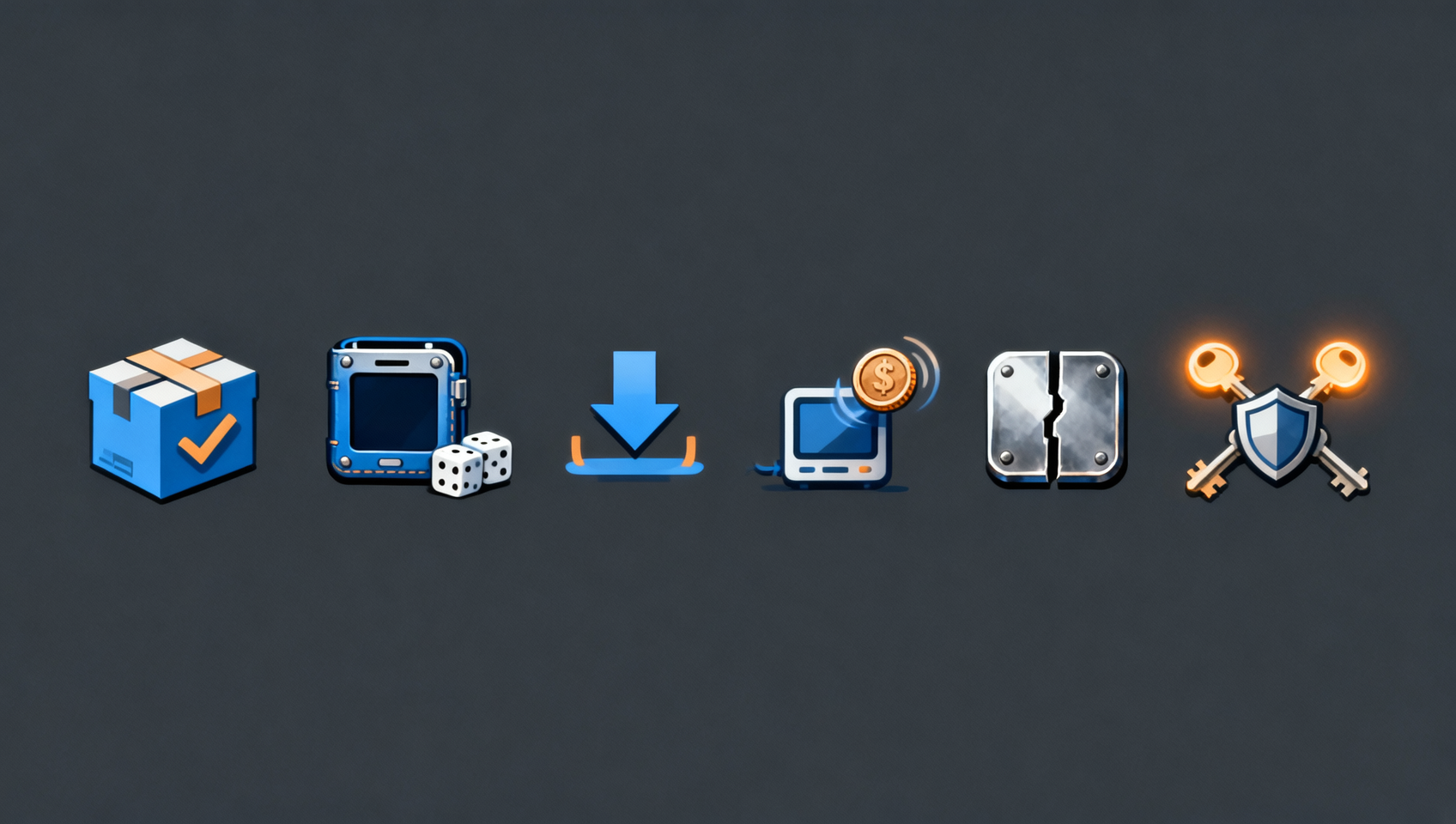
Once the amount exceeds "losing this would seriously hurt", a single hardware wallet is not enough — move to multisig. Single-signature fails at one key, one firmware and one vendor; any of them fails completely.
The most common setup is 2-of-3 multisig: three keys on three different brands (for example Ledger + Trezor + Coldcard), with any two required to sign. The benefits are direct:
- One compromised, lost or buggy device cannot move funds on its own;
- A supply-chain incident at any one vendor affects only one key;
- One key can be stored off-site to cover fire or theft.
The cost is operational complexity: every transaction needs two devices, recovery takes longer, and beginners can make setup mistakes. A sensible ladder:
| Balance | Suggested setup |
|---|---|
| Under $1,000 | Exchange plus hot wallet is fine |
| $1,000–$10,000 | One hardware wallet, bought direct, seed generated locally |
| $10,000–$100,000 | Hardware wallet with a strong passphrase, or 2-of-3 multisig |
| Above $100,000 | 2-of-3 or 3-of-5 multisig, different brands, different locations, rehearsed recovery |
Multisig is not for everyone. If you transact a few times a year with a moderate balance, a Coldcard with dice entropy and a passphrase already covers most realistic risks. The value of multisig is eliminating a single point of failure, not being "more advanced".
Six myths that have cost people real money
Misconceptions about cold wallets are more common than actual device flaws. Each of these has a corresponding real loss.
| Myth | Reality |
|---|---|
| "A hardware wallet makes me safe" | It only fixes the signing layer; seed generation, purchase channel and your own approvals are bigger |
| "Genuine Check means it's authentic" | In the Ledger implant case, verification passed — the implant was behind the screen |
| "Updating firmware fixes it" | Coldcard's update protects new seeds only; old seeds must be retired and funds moved |
| "A photo in my phone is convenient" | Gallery sync means the phrase is in the cloud; a stolen or compromised phone leaks it |
| "Second-hand is cheap, just factory reset it" | A factory reset cannot remove hardware implants; provenance cannot be re-established |
| "Support can help me recover my wallet" | Anyone contacting you first, asking for a phrase or offering remote help, is a scammer |
💰 Binance rebate: invite code BINANBT
Before you buy the hardware wallet, cut the cost on the exchange side: enter invite code BINANBT when you register on Binance and get a 20% trading fee rebate. This article contains referral links; registering through them may reward us, but it never costs you a cent extra.
- Rebate amount: 20% cashback on every trading fee; the rebate ceiling for invitees is a uniform 20%.
- How to claim: enter BINANBT in the invite-code field at registration; if you miss it, you can still link it within 30 days.
- Stacking benefit: enabling "Use BNB to pay fees" saves roughly 25% more, and holding BNB in Simple Earn qualifies you for HODLer Airdrops snapshots.
- Important: signing up directly inside the app gets you no signup reward at all. An in-app registration binds to no referral, so the $19,800 welcome package and the 20% fee rebate simply don't apply — you have to use the registration link or enter invite code BINANBT.
👉 Register on Binance and claim the 20% fee rebate
FAQ
What is a cold wallet, and how is it different from a hot wallet?
A cold wallet keeps the private key offline and signs inside the device; a hardware wallet is the most common form. Hot wallets such as MetaMask or exchange apps keep keys on an internet-connected machine. The difference is not whether one can be hacked, but whether the key ever touches the internet. A cold wallet removes remote attack paths, but seed generation, the supply chain and the transactions you approve are still on you.
Can a hacker steal from a hardware wallet remotely?
Connecting to the internet cannot move funds out of a cold wallet, because the signature has to happen on the device. The two big 2026 incidents show the risk lies elsewhere: Coldcard's factory randomness was predictable, so attackers derived keys offline; some Ledger units had an LTE implant added by a reseller that exfiltrated the seed at setup. Neither required breaking into your device remotely.
What happened with Coldcard in 2026, and is my device affected?
A March 2021 firmware integration error routed seed generation to a weak deterministic PRNG, cutting entropy to about 40 bits on Mk2/Mk3 and about 72 bits on Mk4/Mk5/Q. Bulk thefts began July 30, 2026; Galaxy Research confirmed about 1,367 BTC (~$88.6M) from roughly 4,585 addresses. Affected firmware: Mk2/Mk3 4.0.1–4.1.9, Mk4/Mk5 below 5.6.0 and Q below 1.5.0Q. Updating protects future seeds only — old seeds must be replaced and funds moved.
Is it safe to buy a used hardware wallet?
No. The whole value of a hardware wallet is that nobody touched it between the factory and you. Second-hand devices, unknown distributors and social-media group buys can be pre-initialised or physically modified. In the October 2026 Ledger reseller case, packaging was sealed and Genuine Check passed; the implant sat behind the screen assembly.
Ledger or Trezor — which is more secure?
They take different approaches, so a simple ranking is misleading. Ledger protects keys with a certified secure element (EAL6+) but keeps firmware closed, so the logic cannot be independently reviewed. Trezor ships open-source, reproducibly built firmware, but some models use lower-grade chips. The 2026 lesson is that no brand is immune to supply-chain attacks: buy direct, generate your own seed, and split large balances across vendors with multisig.
What is the safest way to back up a seed phrase?
Paper is no longer enough. Stamp or engrave the words on metal to survive fire and water, then store two copies in separate locations so one fire or burglary cannot destroy both. Never photograph it, never store it in the cloud, never type it into a website and never send it to anyone — including self-described official support. A BIP-39 passphrase adds a second layer: a leaked phrase alone will not restore the wallet.
What happens if I lose my hardware wallet?
If you still have the seed phrase, nothing is lost. Restore it on another compatible device, then move the funds to a freshly generated wallet and retire the old one. Conversely, if both the phrase and the passphrase are gone, no vendor and no support agent can recover anything — that is the price of self-custody.
How much crypto justifies buying a hardware wallet?
There is no universal number; use 'can I absorb this loss' instead. A common approach is to consider a hardware wallet above $1,000 and multisig or splitting above $10,000. Holding period matters more than amount: assets you plan to hold for a year or more justify a $100–$300 device, while active trading balances are better left on an exchange.
Further reading
- MetaMask in 2026: setup, seed phrases and approval safety
- How to find crypto airdrops without getting drained
- What is Bitcoin? A 2026 beginner's guide
- Bitcoin: six ways people try to make money in 2026
- What is DeFi in 2026?
- Binance registration 2026: sign up, KYC and deposit
- More wallet content: the wallet hub
Disclaimer: This content is for educational purposes only and is not investment advice. Self-custody means you are entirely responsible for your assets: a lost seed phrase, a damaged device, a mis-signed transaction or a supply-chain attack can all cause irreversible loss, and no vendor or support agent can recover it for you. Incident figures come from public reporting and onchain analysis firms; verify against official announcements and any legal conclusions. Before buying or using a device, check the vendor's latest security notices and firmware version1.
Footnotes
-
Sources: Block security team disclosure and Coinkite's official notice, July 30, 2026; Galaxy Research onchain tracking (first wave: 41 minutes, 1,196 addresses, 1,082.65 BTC, ~$70.2M; August 2 confirmed 1,367 BTC, ~$88.6M, ~4,585 addresses; later all-wave estimate near 2,055 BTC, ~$130M); The Hacker News, BleepingComputer, eSecurity Planet. ↩ ↩2 ↩3 ↩4
-
Sources: Ledger's official statement and Donjon security team briefing, October 10–13, 2026; SecurityWeek, CoinPaprika, PrimeXBT and others (LTE implant behind the screen in CryptoBilis-sold devices; losses estimated at $72M–$102M, Specter above $86M; Tether froze about $10M). ↩ ↩2 ↩3
-
Source: Keystone security notice, October 20, 2026 (updated October 26): 25,964 order records exposed, device authentication key stolen, 18,835 unsold units using the old key destroyed. ↩ ↩2
-
Source: Trezor disclosure (August 13, 2026: 13,689 customers; September 4: about 67,000 additional US customers, roughly 80,000 total) after the ShipMonk fulfilment breach attributed to ShinyHunters; no seed phrases or private keys were exposed. ↩
-
Sources: The Block, "Best crypto hardware wallets in 2026", plus 2026 review roundups (Trezor Safe 7 about $249, OneKey Pro 2 about $299, Ledger Nano S Plus about $79, Ledger Stax about $399, Trezor Safe 5 about $169); prices vary by channel and promotion — check the official store. ↩