


TL;DR
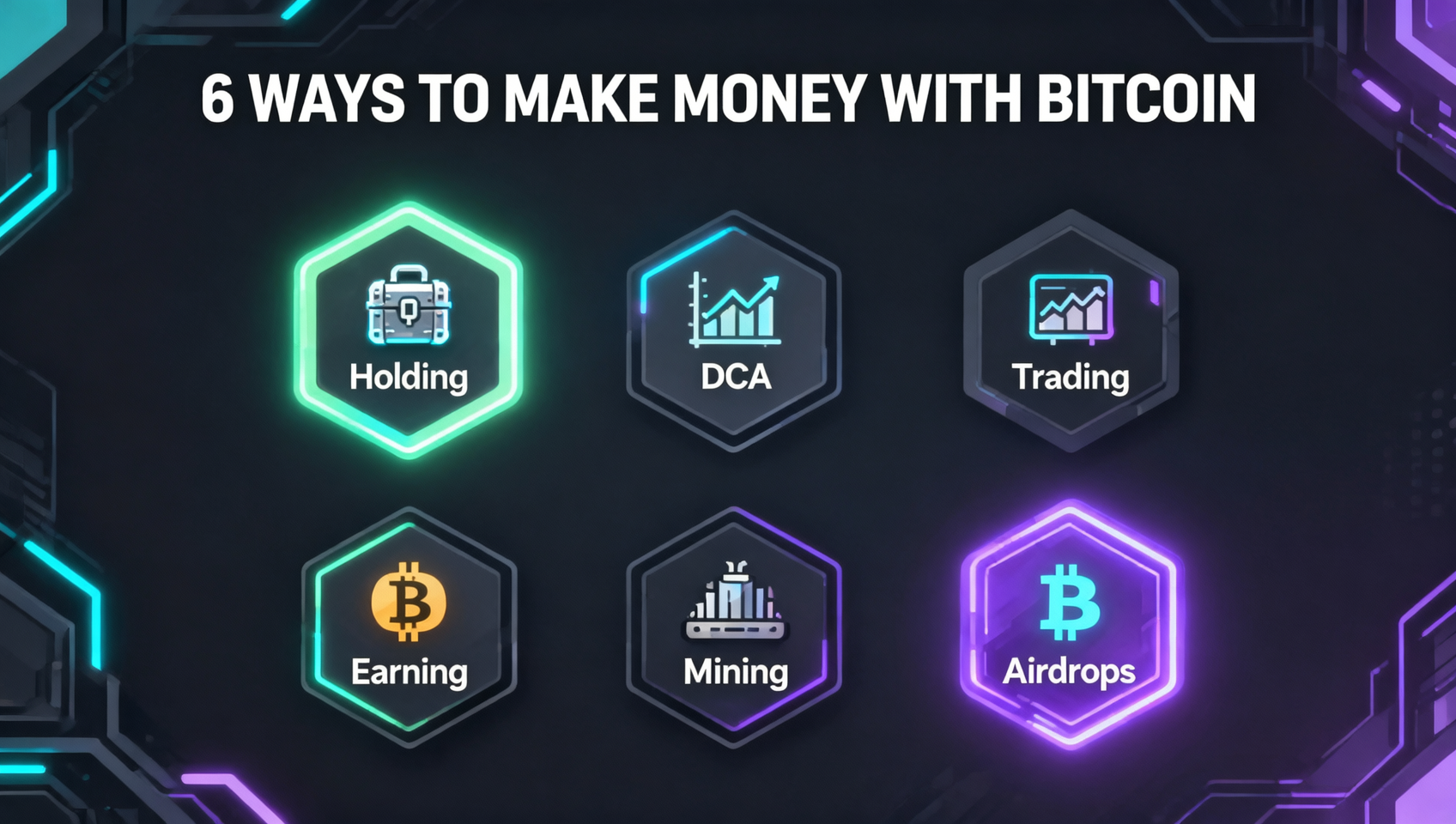
- Making money with Bitcoin isn't just "buy low, sell high" — six methods pay you for six different things: holding pays long-term appreciation, DCA pays discipline, trading pays swings, earning pays interest, mining pays block rewards, airdrops pay new tokens
- Direct answer for beginners: start with holding + DCA on two legs, and stay away from leveraged futures, mining, and get-rich airdrops
- The biggest mistake is turning "buying" into "gambling" — the "simplest" holding/DCA approach often beats "clever" frequent trading over the long run
- Bitcoin can't be staked like Ethereum — "Bitcoin yield" is only 1%–3% and still carries platform risk
Most people who ask "how to make money with Bitcoin" have one picture in their head: buy low, sell high. But the people who actually make money use six completely different methods — they're paid for different things, and their risk levels differ by orders of magnitude.
Sorting out these six methods matters more than rushing to place an order. If you don't, you might turn "I want to buy a little Bitcoin" into "I blew up my account trading futures." This guide walks through the mechanics, risk, and right audience for each method, then hands you a decision table to match yourself against.
Table of Contents
- First, get clear: 6 methods pay you for different things
- Method 1: Holding (HODL) — earn long-term appreciation
- Method 2: DCA — earn from discipline, smooth your cost
- Method 3: Trading — earn from swings, highest risk
- Method 4: Earning interest — yield, but with platform risk
- Method 5: Mining — block rewards, a very high barrier
- Method 6: Airdrops/launchpads — new tokens, highest zero-out rate
- Match yourself: decision table
- 4 reality checks beginners need most
- 3 mistakes beginners make most
- FAQ
- Summary: how to remember it in one line
First, get clear: 6 methods pay you for different things
Before you act, untangle the knot beginners get stuck in. "Making money" with Bitcoin isn't one thing — it's six, and they're paid from different sources:
| Method | What you're paid for | Risk | Who it suits |
|---|---|---|---|
| ① Holding (HODL) | Long-term appreciation | Medium | Long-term believers, hands-off people |
| ② DCA | Smoothed long-term gains | Low-medium | Beginners, salaried people |
| ③ Trading | Short-term swings | High | People with time and experience |
| ④ Earning interest | Lending/deposit yield | Medium (platform risk) | People holding coins idle |
| ⑤ Mining | Block rewards + fees | Very high (barrier) | People with miners and cheap power |
| ⑥ Airdrops/launchpads | New-token rewards | High (zero-out rate) | On-chain veterans with time |
Remember it in one line: ① and ② are "investing" logic — they earn long-term money; ③④⑤⑥ are "operating" logic — they earn swing money, interest money, or money from luck and resources. Beginners should put 90% of their energy into the first two.
Method 1: Holding (HODL) — earn long-term appreciation
Holding means buying BTC and leaving it alone, earning from long-term price appreciation. It's the oldest and most underrated way to make money with Bitcoin — it needs zero skill, just "buy, store, and wait."
The logic is simple: Bitcoin has a fixed supply of 21 million coins, and over the long run its scarcity supports a rising price. As of October 2026, Bitcoin trades around $82,000–83,000, with an all-time high near $126,200 (October 2025).12 Long-term holders earn from "time," not from "trading."
- Suits: people who believe in Bitcoin's long-term value, have no time to watch charts, and can't stomach constant trading
- Risk: high short-term volatility — a 50% mid-bull drawdown is normal; people who can't hold panic-sell at the bottom
- How: buy BTC on a licensed exchange, keep small amounts on the exchange, withdraw large amounts to a self-custody or hardware wallet. Start with what Bitcoin is, then how to buy Bitcoin (Binance/OKX)
Key note: holding only pays if you can actually hold. Most people couldn't stomach the 70% drawdown of 2022 — which is exactly why the next method exists.
Method 2: DCA — earn from discipline, smooth your cost
Dollar-cost averaging means buying a fixed amount of Bitcoin on a fixed schedule, using discipline to smooth your entry cost. It's the first money-making method a beginner should learn, because it removes the need to time "the bottom."
You'll never catch the exact bottom, but DCA guarantees you buy more when it's cheap and less when it's expensive, landing your long-term cost near the average. DCA pays you for beating your own psychology — it forces you to keep buying when others panic, instead of chasing pumps.
- Suits: beginners, salaried workers, anyone with steady income building a long-term position
- Risk: relatively the lowest, but it needs long-term discipline — stopping halfway wastes the effort
- How: set a weekly or monthly amount (say $50), and configure the auto-buy / recurring-buy feature on Binance or OKX so it executes on schedule. Full method: crypto DCA guide
Holding and DCA are siblings: holding answers "should I buy," DCA answers "how do I buy without anxiety." Do these two well and you've already beaten most people.
Method 3: Trading — earn from swings, highest risk
Trading means buying low and selling high to capture short-term swings, in two flavors: spot and futures — the latter is leveraged and the riskiest. This is what most people picture as "making money with Bitcoin," and it's also where most people lose it.
- Spot trading: buy BTC with real money, sell when it rises. A drop only loses part of your principal — you won't go to zero. Suits people with time and technical-analysis skills. Start with crypto trading for beginners
- Futures trading: uses leverage (Binance goes up to 100x+), magnifying gains and losses — a single wick can liquidate you to zero. It's gambling, not investing. Learn the difference in spot vs futures
Key note: the data consistently shows most retail futures traders lose money over time. If you just "want to buy some Bitcoin," do a spot buy and hold — don't touch futures. To understand leverage risk, see the futures leverage guide.
Method 4: Earning interest — yield, but with platform risk
Earning interest means depositing BTC into exchange earn products or lending platforms to collect annualized yield. Many people wrongly assume Bitcoin can be "staked for high yield" like Ethereum.
Bitcoin is a proof-of-work coin with no native staking — it can't earn 3%–4% on-chain like ETH staking. What you can do is hand BTC to a platform (e.g. Binance Earn's flexible/fixed products) that lends it to leveraged traders and passes you a small cut — typically just 1%–3% APY, far below stablecoins.3
- Suits: people who'd hold the coins anyway and want a little extra
- Risk: low yield + platform risk (CeFi collapses, commingled funds). The 2022 lending-platform blowups are the cautionary tale
- How: a small amount in Binance Earn flexible is fine to try; for large amounts, 2% isn't worth handing your coins to a platform long-term. Compare products in the Binance Earn guide; the high-yield option is stablecoins, not BTC — see stablecoin yield strategy
Method 5: Mining — block rewards, a very high barrier
Mining means running dedicated ASIC machines to provide hashrate to the Bitcoin network and earn block rewards plus fees. It's the most "classic" way to earn Bitcoin, but by 2026 it's essentially closed to ordinary people.
Mining is fundamentally a "hashrate + electricity" arms race: the higher the network hashrate, the thinner each machine's share of rewards — and miners are power-hungry, so your electricity price decides whether you ever break even. Buying one or two machines as an individual means a long payback and high risk, often crushed by power costs and rising difficulty before you recover your investment.
- Suits: people with cheap, stable electricity and mining-operation resources (basically not ordinary people)
- Risk: very high — hardware cost, power price swings, price drops, and difficulty increases all stack up
- How: most people shouldn't. To understand mining mechanics, the 21M cap, and halving rewards, see the Bitcoin 2026 complete guide (mining & Layer 2)
Blunt conclusion: in 2026, "mining for profit" is an empty phrase for ordinary people. Don't fall for "phone mining" or "cloud mining passive income" — those are scams.
Method 6: Airdrops/launchpads — new tokens, highest zero-out rate
Airdrops/launchpads mean participating in new projects (farming airdrops, exchange Launchpad sales) to earn free or discounted new tokens. Of all six methods, this carries the heaviest "get rich" narrative — and the most scams.
The airdrop logic: a project issues a new token to attract users, gives early users free tokens, and you sell them on an exchange for BTC or USDT after listing. It sounds like free money, but reality is brutal — most airdrop tokens pump then dump after listing, and a large share go to zero. They may be taxable the moment you receive them, and "fake airdrops" are a scam hotbed (tricking you into approving your wallet and draining your assets).
- Suits: people with on-chain experience, plenty of time, and tolerance for going to zero
- Risk: high — tokens go to zero, fake-airdrop scams, wallet-draining approvals
- How: use a small position, only join airdrops with clear sources, and never approve your wallet to a shady "airdrop" site. Find and vet airdrops in the airdrop guide; exchange launchpads in Binance Launchpad & Megadrop
Match yourself: decision table
Now match yourself using need + risk tolerance + time:
| Your situation | Best method | Why |
|---|---|---|
| Beginner, no time, afraid of losses | Holding + DCA | Most hands-off, strongest long-term logic |
| Spare cash, building long-term | DCA | Smooths cost, beats psychology |
| Coins sitting idle, want a little extra | Earning interest (small position) | 1%–3% APY; don't risk large sums |
| Time to watch, can stomach swings | Spot trading | Capture swings, no high leverage |
| Want fast money, high risk appetite | (Careful) Futures | Liquidation risk is extreme; beginners should skip |
| Have miners and cheap power | Mining | Calculate power cost and payback first |
| On-chain veteran, plenty of time | Airdrops/launchpads | High zero-out rate; small position only |
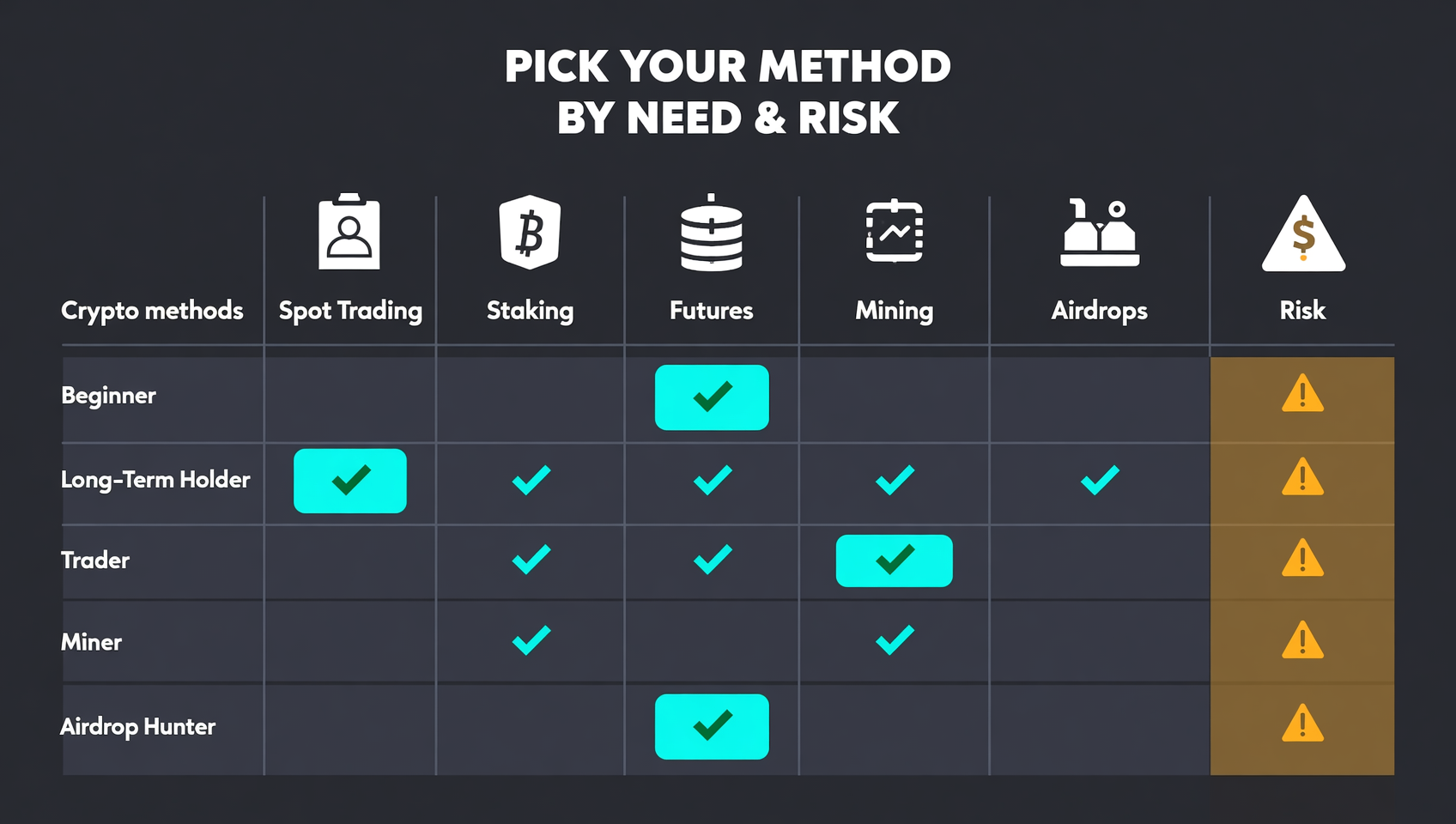
In one line: for beginners, "holding + DCA" is the optimal answer; add spot trading once you have experience; futures, mining, and airdrops are three "high-reward, high-mortality" doors — never make them your main path.
4 reality checks beginners need most
"Making money" isn't only about buying the dip. Six methods pay you for different things — mixing them up is a beginner's biggest mistake. What you need isn't "which is most profitable" but "which fits me."
Simple doesn't mean less profit. "Holding + DCA" looks dumb but often beats frequent trading long-term — because most people aren't killed by the market, but by chasing pumps, overtrading fees, and emotion.
Bitcoin can't be staked like Ethereum. "Bitcoin yield" is marketing — it's really "lend your coins to a platform" for 1%–3% plus platform risk. Giving up custody for that little isn't worth it.
Mining isn't 2017 anymore. "GPU mining" has become an ASIC arms race — without cheap power you're just donating money. Anything pitching "phone mining" or "cloud mining passive income" is almost always a scam.
3 mistakes beginners make most
Turning "buying" into "trading futures." You wanted to buy a little Bitcoin, but you opened the futures page, added leverage, and got liquidated on one wick. Decide whether you're "investing" or "gambling" — the former is spot, the latter should be avoided. See spot vs futures.
Handing coins to sketchy platforms for "high yield." You hear "20% Bitcoin yield" and get drawn in, then the platform runs and you lose everything. Remember: Bitcoin has no high yield — high yield is a red flag. Stick to top exchanges' earn products, small positions only.
Treating airdrops as free money. You chase a "free airdrop" and approve your wallet on a shady site, and your coins get drained in one click. Airdrops aren't free money — learn to spot fakes in the airdrop security guide.
FAQ
How do you make money with Bitcoin?
There are six main ways: ① holding (long-term appreciation), ② DCA (smoothed long-term gains), ③ trading (buy low, sell high), ④ earning interest (lend/deposit for yield), ⑤ mining (block rewards for hashrate), and ⑥ airdrops/launchpads (new tokens). Beginners should start with holding + DCA and avoid leveraged futures.
How can a beginner make money with Bitcoin?
Start with holding + DCA. Buy a little BTC and hold it, then buy a fixed amount on a schedule to average your cost. Once you're comfortable with volatility, consider spot trading. Futures, mining, and airdrops are too risky or too high-barrier for beginners.
Can I earn interest on my Bitcoin on an exchange?
Yes, but the rate is low and you take platform risk. Bitcoin is proof-of-work and can't be staked natively like Ethereum — you can only lend it via Binance Earn at roughly 1%–3% APY, far below stablecoins. For large amounts, that little yield isn't worth the custody trade-off.
Is Bitcoin mining still profitable? Can ordinary people mine?
In 2026, mostly no. Mining needs ASIC hardware, cheap power and scale. Individuals face long payback and high risk, often crushed by power costs and rising difficulty. Unless you have cheap power and mining resources, skip it.
Can I make money faster trading Bitcoin futures?
Faster, but you also lose faster. Leverage magnifies gains and losses, and one wick can liquidate you. Most retail futures traders lose money. Holding and DCA offer far more certainty than leveraged gambling.
Do I pay tax on Bitcoin profits? How do I cash out?
It depends on local tax rules. Most countries tax crypto gains as income, and airdrops may be taxable when received. Cashing out via P2P carries bank-freezing risk — use your own account and leave the note blank. Consult a local tax professional.
Summary: how to remember it in one line
Making money with Bitcoin = first separate "investing" from "operating" — beginners earn long-term money with holding + DCA, add spot trading with experience, and treat futures, mining, and airdrops as three high-risk doors, never your main path.
To take the first step, register on Binance (code BINANBT) or register on OKX (code 60895497), then walk through "register → verify → buy BTC → hold" — see the how to buy Bitcoin tutorial. To build your foundation, read what is Bitcoin.
Disclaimer: This content is for educational purposes only and does not constitute investment advice. Cryptocurrency is volatile and can lose significant value or go to zero. Only invest what you can afford to lose, and verify each platform's latest rules and fees yourself.
📚 Further reading:
- Chain Guide (CoinVado) — more on-chain data and crypto education
- How to buy Bitcoin: Binance/OKX beginner tutorial
- Crypto DCA guide
- Spot vs futures: what a beginner should pick
- Airdrop guide: how to find and safely claim
Footnotes
-
Investing.com and multiple market data sources, BTC spot price around $82,000–83,000 (≈$82,790 on Oct 10, 2026), checked Oct 2026. ↩
-
Macrotrends and multiple sources, BTC all-time high around $126,200 (Oct 2025), checked Oct 2026. ↩
-
Binance Earn and other major exchange earn pages, BTC lending APY around 1%–3% (well below stablecoins), checked Oct 2026. ↩