

⚠️ Read this first: if you want to buy BTC, don't just tap "Sign up" inside the app — only registration through the registration link (e.g. "Register now") or with invite code BINANBT unlocks the new-user rewards (a 20% trading fee rebate plus a welcome package worth up to $19,800).
Key takeaways (TL;DR):
- Bitcoin is a decentralized electronic cash system launched in 2009, with a hard cap of 21 million coins written into its code; in October 2026 it trades near $81,276 with a market cap of about $1.63 trillion, the largest crypto asset.
- 21 million is the ceiling, not the tradable supply: about 20.1 million have been mined, and roughly 2.3–3.7 million may be permanently lost, leaving only 16–17.8 million genuinely available.
- A halving is not a price guarantee: after the April 2024 halving Bitcoin peaked at $126,080 in October 2025 and was back near $81,276 by October 2026, about 35% below that high.
- Bitcoin is not anonymous (its ledger is fully public). To buy: register on Binance, verify, buy USDT, then BTC/USDT — use invite code BINANBT for the 20% fee rebate.
What is Bitcoin? In one sentence: Bitcoin (ticker BTC) is a decentralized electronic cash system that launched in 2009, and BTC is the unit of account inside that system. No bank issues it and no government backs it. Instead, thousands of miners around the world maintain a public ledger with their computing power, and the supply cap is hard-coded into the software: 21 million coins. As of October 28, 2026, Bitcoin trades at about $81,276, with a market cap of roughly $1.63 trillion and about 20.1 million coins already mined — the largest crypto asset in the world by market value1.
But if the only three things you remember are "21 million coins, digital gold, halvings pump the price", the 2026 market will teach you an expensive lesson: Bitcoin still sits about 35% below its all-time high of $126,080 from October 20251, and the "halving means a rally" story simply did not deliver in the latest cycle. This guide covers what Bitcoin is, how it works, which popular claims are wrong, how to buy it and how to store it — all in one pass.
Table of contents
- What is Bitcoin? A one-sentence definition
- How Bitcoin works: the ledger, UTXOs and mining
- Three counterintuitive things about Bitcoin in 2026
- Bitcoin vs Ethereum vs Dogecoin
- The four real risks of Bitcoin
- How to buy Bitcoin: the full Binance walkthrough
- How to store it: custodial or self-custody
- Is Bitcoin worth buying? A table for four types of people
- 💰 Binance rebate: invite code BINANBT
- FAQ
- Further reading
What is Bitcoin? A one-sentence definition
Bitcoin is not really "a coin" — it is a ledger that the whole world maintains together and that no single party can rewrite unilaterally. The BTC you hold is, in substance, one line in that ledger reading "this address may spend this much".
It was born in 2008, in the aftermath of a financial crisis: in October, a pseudonymous figure called Satoshi Nakamoto published a nine-page white paper, "Bitcoin: A Peer-to-Peer Electronic Cash System", proposing to settle transfers with cryptography and a distributed network — no bank, no central bank. On January 3, 2009, the network mined its first block (the genesis block) and the system went live.
A handful of hard-coded settings are the entire foundation for understanding Bitcoin:
- A hard cap of 21 million coins: fixed in the code; nobody can issue more.
- A block time of about 10 minutes: a new block every 10 minutes records the transactions since the last one.
- A halving every four years: the reward for each new block halves every 210,000 blocks (about four years). After the April 2024 halving the block reward is 3.125 BTC; the next halving is expected in 2028, and the last bitcoin should be mined around 2140.
- No central institution: no company, no server room, no customer support. Every node around the world keeps its own copy of the ledger.
💡 In one line: Bitcoin answers "if there is no bank, who keeps the books and who confirms the money?" with three ingredients: a fixed supply, a public ledger and a competition for computing power.
How Bitcoin works: the ledger, UTXOs and mining
Bitcoin's operation breaks down into three parts: a public ledger (the blockchain), a set of bookkeeping rules (the UTXO model), and a mechanism deciding who writes the next page (proof-of-work mining).
1. The blockchain: transactions are packed into blocks, and blocks are chained
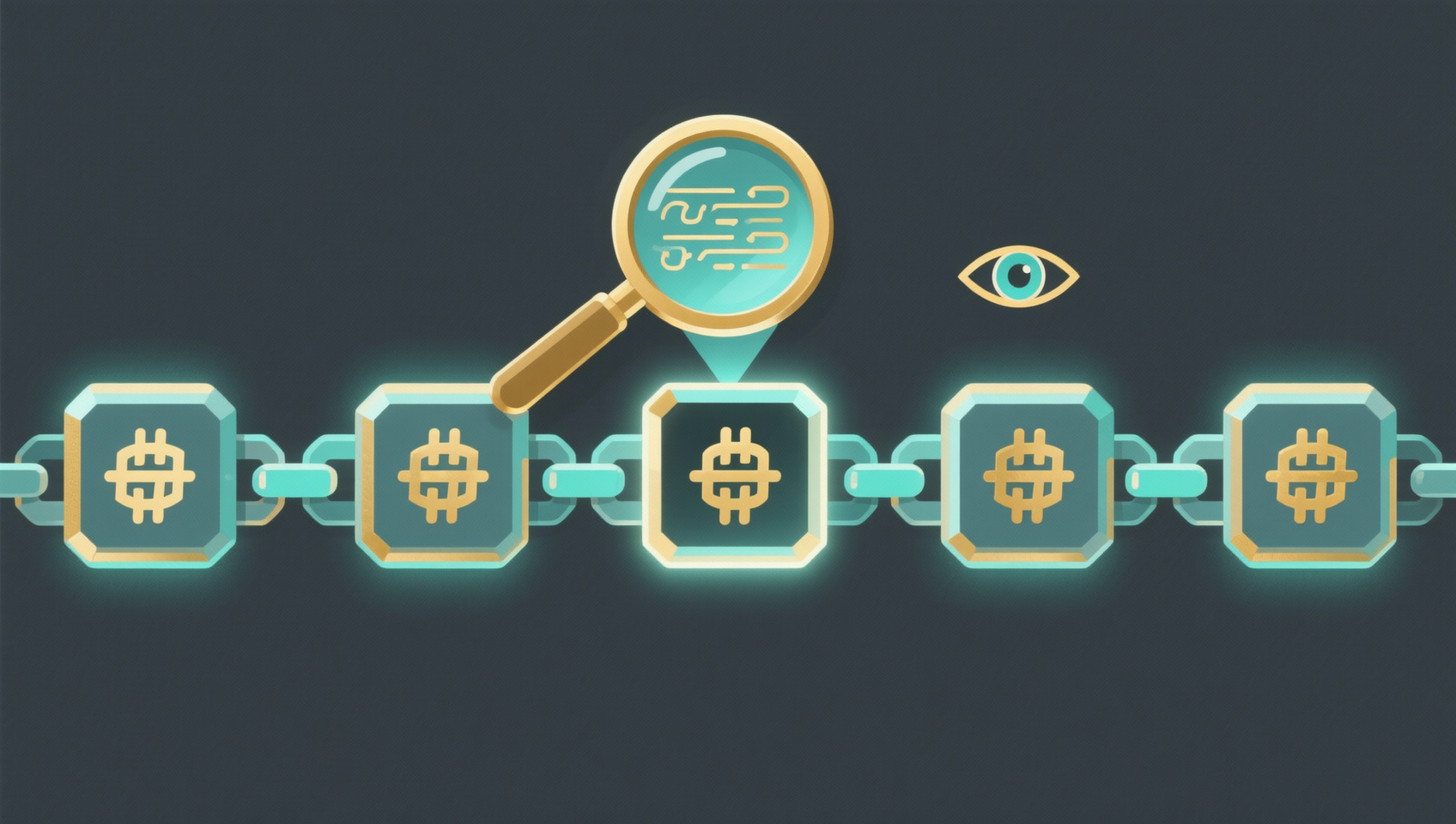
When a user sends a transfer, the transaction first queues in the mempool. Miners pick transactions by fee level and pack them into a block, and every new block contains the hash of the previous block — alter a historical block and every hash after it becomes invalid. That is where "immutability" comes from technically. To understand this layer properly, see Blockchain technology explained: hashes, blocks and chains.
2. UTXOs: Bitcoin has no "balance", only unspent receipts
This is where most beginners get stuck: a Bitcoin account does not hold a balance number the way a bank account does. It is a series of "unspent transaction outputs" (UTXOs). Think of it this way: you are not holding "a $100 bill", you are holding "three $20 bills and a $40 receipt" — and when you spend $50, the system breaks a receipt and hands you change. This design is entirely different from Ethereum's account-balance model, and it is the key to understanding Bitcoin fees and privacy.
3. Mining: competing with computing power for the right to write
Miners keep trying different nonces until a block header's hash falls below an extremely low target. Whoever gets there first wins the right to write the block, and takes the newly issued bitcoin plus every transaction fee in that block. The mechanism is called proof of work (PoW), and its purpose is not "issuing coins" — it is making an attack on the network too expensive to be worth trying. To compare it with the other mainstream mechanism, see PoW vs PoS: how the two consensus mechanisms differ.
The mining reality for ordinary people: ASIC machines built specifically for Bitcoin have made mining on a home PC or GPU economically pointless. An individual can only join a mining pool, and only with extremely cheap electricity; otherwise the power bill will usually exceed the output. For the vast majority of people, buying coins is the way to participate.
Three counterintuitive things about Bitcoin in 2026
The three most repeated claims about Bitcoin — "21 million total", "halvings pump the price", "Bitcoin is anonymous" — each one needs a correction, and the correction is where the real information lives.
Counterintuitive #1: 21 million is the cap, not "how much you can buy"
21 million is the ceiling in the code, but the amount actually circulating is far smaller. As of October 2026, about 20.1 million coins have been mined, close to the cap; and according to Chainalysis estimates, roughly 2.3 to 3.7 million of them (11%–19% of the circulating supply) may be permanently unreachable because of lost private keys, dead hard drives and forgotten early addresses. Glassnode's conservative estimate is 1.5 to 2.5 million2. That leaves roughly 16 to 17.8 million bitcoin genuinely available to trade.
There are two sides to this. On one hand, the scarcity is even more extreme than the "21 million" headline suggests, and that is the real basis for the digital-gold narrative. On the other hand, it is a reminder that losing coins is not a theoretical risk. Bitcoin has no customer support: lose the private key and the coins are gone forever — which becomes the single most important factor when you decide whether to self-custody or leave your coins on an exchange.
Counterintuitive #2: a halving is not a rally
"Every four years the reward halves, supply shrinks, the price rises" is the most widely circulated Bitcoin investment logic. But lay the 2024 cycle out and it fails:
- On April 20, 2024, Bitcoin completed its fourth halving at block height 840,000, cutting the block reward from 6.25 BTC to 3.125 BTC.
- On October 6, 2025, Bitcoin set an all-time high of about $126,080 — roughly 18 months after the halving.
- By October 28, 2026, it trades around $81,276, about 35% below that high1.
A halving changes only how fast new coins enter the market. Price is set by demand, liquidity, regulation and leverage together. The more realistic point: the halving "catalyst" was anticipated and priced in years in advance, so by the time the headline appears it is rarely a good moment to buy.
Conclusion first: a halving is a supply-schedule event, not a price promise. Treating "the halving" as a buy signal is the most expensive sentence a beginner can learn.
Counterintuitive #3: Bitcoin is not anonymous — it is more transparent than a bank
Bitcoin's ledger is completely public: the amount, timestamp and input and output addresses of any transfer can be looked up by anyone on a block explorer, permanently. The only anonymous part is that addresses do not carry names.
But addresses get tied to identities very easily. Withdraw through a KYC exchange and the exchange knows that address is yours; receive a transfer from someone on the same address and they know too. Once one address is linked to a real identity, the entire flow of funds behind it can be reconstructed from the ledger. For the same transfer, a bank's ledger is visible only to regulators, while Bitcoin's ledger is visible to the whole world. If you want privacy you need extra tooling — "using Bitcoin" alone does not give it to you.
Bitcoin vs Ethereum vs Dogecoin
The most fundamental difference between the three is not price but the problem each is trying to solve: Bitcoin does value storage and payments, Ethereum does programmable applications, Dogecoin does community and attention.
| Dimension | Bitcoin (BTC) | Ethereum (ETH) | Dogecoin (DOGE) |
|---|---|---|---|
| Launched | January 2009 | July 2015 | December 2013 |
| Positioning | Digital gold / store of value | A programmable "world computer" | Community meme / attention asset |
| Supply | Capped at 21 million | No hard cap (tiny annual issuance, some burned) | No cap, 10,000 new coins per minute |
| Consensus | PoW (SHA-256 mining) | PoS (staking) | PoW (Scrypt mining) |
| What it can do | Transfers, store of value | Smart contracts, DeFi, NFTs, L2 | Transfers, community tipping |
| Core narrative | Inflation hedge, decentralized savings | Ecosystem and applications | Sentiment and hype |
The judgment behind this table is simple: Bitcoin bets that "digitally scarce assets" remain valid over the long run, Ethereum bets that on-chain applications reach mass adoption, and Dogecoin bets that attention keeps flowing. The risk structures of those three bets are completely different. To go deeper on each, see The complete Ethereum guide for 2026 and What is Dogecoin (DOGE)? A beginner's guide.
The four real risks of Bitcoin
Bitcoin's risk is not that "the technology might break" — it is price volatility, regulation, self-custody and scams.
- Volatility is the norm, not an accident. Bitcoin has had several drawdowns deeper than 70%. In October 2026 it is still about 35% below its high from a year earlier, which means a full year of holding can easily produce a negative return. Any narrative of "it only goes up" is not credible.
- Regulation changes how you can participate. How each country classifies Bitcoin, what licenses exchanges need and where fiat on- and off-ramps are allowed are all moving targets. The same action can be compliant in one jurisdiction and illegal in another. Investors in mainland China in particular need to understand the local regulatory stance on crypto trading and judge the risk for themselves.
- Self-custody means "no customer support". Lost seed phrase, a transfer to the wrong address, a signature phished away by a fake site — all four kinds of loss are irreversible. There is no undo button on-chain and nobody can get your coins back.
- Scams always follow the hype. The usual plays: fake exchange support staff asking for verification codes, fake airdrops demanding a token "approval", "send BTC and get double back", and KOL signal groups selling "can't-lose strategies". There is only one core rule of thumb: anyone who asks for your seed phrase or private key, or pushes you to click an unknown link and sign an approval, is a scammer.
How to buy Bitcoin: the full Binance walkthrough
The simplest way to buy Bitcoin is on Binance with USDT, in six steps that take about 10 minutes once you are used to them. The flow below matches Binance's current interface; button placement may vary on the page you actually see.
- Create a Binance account: register with invite code BINANBT via registering on Binance to claim a 20% trading fee rebate. Registration is free and works without a code, but the code is what unlocks the rebate and the welcome package (details in our Binance registration guide).
- Complete KYC: upload your ID and pass face verification to unlock deposits, trading and withdrawals.
- Deposit funds: in "Buy Crypto / P2P", buy USDT from a verified merchant with your local currency (or deposit fiat directly). USDT is the currency you will use to buy Bitcoin.
- Find the BTC/USDT pair: open "Spot", search BTC and select BTC/USDT.
- Place a buy order: beginners should use a market order (fills immediately at the current price); with experience you can switch to a limit order at your target price, which costs nothing until it fills.
- Check your holdings: once filled, your Bitcoin appears under "Assets → Spot".
If you haven't installed the app yet, follow the Binance app download guide or the Android APK installation tutorial. Do not download from "official mirror" pages in search results — that is where phishing concentrates.
💡 Fee tip: after registering with code BINANBT you get a 20% rebate on every trading fee; enabling "Use BNB to pay fees" saves roughly 25% more on top. For anyone dollar-cost averaging, those two add up to a meaningful amount over a year. If you are comparing the cost of different routes, see How to choose a Bitcoin trading platform and How little can you spend on your first crypto purchase?.
How to store it: custodial or self-custody
Once you have bought Bitcoin there are only two paths: leave it on the exchange (custodial) or withdraw it to a wallet you control (self-custody). This is not a technical question — it is a question of how much responsibility for security you are willing to take.
| Approach | Who it suits | Advantages | Trade-offs |
|---|---|---|---|
| Leave it in an exchange spot account | Small amounts, frequent trading, no interest in key management | Simple, password recovery via support, always ready to trade | The platform holds the assets; if it fails you can only wait; accounts can be frozen by risk controls |
| Self-custody wallet | Long-term holding, larger amounts, willing to learn | The private key is yours, no platform dependency | Lost seed phrase means permanent loss; wrong-chain transfers are irreversible; phishing risk is yours |
The barrier to self-custody is lower than it looks, and it comes down to one sentence: there are no coins in the wallet; the coins are on-chain, and the wallet is only the interface that manages your private keys. The seed phrase (12 or 24 English words) is your entire ownership. Write it on paper, store it offline, never screenshot it, never send it to anyone. If you plan to go the self-custody route, the installation, seed-phrase backup and approval management are covered in How to use MetaMask: the complete wallet tutorial.
Is Bitcoin worth buying? A table for four types of people
There is no single answer to "is it worth buying", but there is a single framework: first ask whether you can stomach a drawdown, then ask how long you intend to hold.
| Your situation | Is Bitcoin a fit? | Why |
|---|---|---|
| Want a small long-term allocation to hedge fiat debasement | Yes, a small dollar-cost-averaged position | Fixed supply and the deepest liquidity make it a natural high-risk sleeve in a portfolio |
| Want to make a quick profit | High risk, not recommended | Volatility is extreme; a 35% drawdown is normal by historical standards |
| Cannot tolerate any unrealized loss | Not suitable | Any entry point can be followed by a deep drawdown |
| Want to learn on-chain operations and hold assets yourself | Suitable, start small | Bitcoin is the most standard, most mature entry asset |
One idea that needs correcting: a high unit price does not mean "expensive". Bitcoin above $81,000 sounds intimidating, but its smallest unit, the satoshi, is 0.00000001 BTC, so you can buy a few dollars' worth. Whether something is expensive is a question of market cap and supply and demand, not "how much one coin costs" — the same reason a $3,000 stock is not necessarily pricier than a $3 stock.
💰 Binance rebate: invite code BINANBT
Claim your rebate before you buy: register on Binance with invite code BINANBT for a 20% trading fee rebate — over years of dollar-cost averaging that is real money. This article contains referral links; registering through them may reward us, but it never costs you anything extra.
- Rebate amount: 20% cashback on every trading fee; the rebate ceiling for invitees is a uniform 20%.
- How to claim: enter BINANBT in the invite-code field at registration; if you miss it, you can still link it within 30 days.
- Stacking benefit: enabling "Use BNB to pay fees" saves roughly 25% more.
- Important: signing up directly inside the app gets you no signup reward at all. An in-app registration binds to no referral, so the $19,800 welcome package and the 20% fee rebate simply don't apply — you have to use the registration link or enter invite code BINANBT.
👉 Register on Binance and claim your 20% fee rebate
FAQ
What is Bitcoin in one sentence?
Bitcoin is a decentralized electronic cash system that launched in 2009, and BTC is the unit of account inside that system. No bank or government issues it: miners around the world maintain a public ledger with computing power, and the supply cap of 21 million coins is written into the code.
Is the Bitcoin supply really 21 million?
21 million is the hard-coded cap, not the amount available to buy. As of October 2026 about 20.1 million coins have been mined, and roughly 2.3 to 3.7 million of those are probably lost for good because the private keys are gone — so the truly spendable supply is closer to 16 to 17.8 million. The scarcity is real; "exactly 21 million" is shorthand.
Does Bitcoin always go up after a halving?
No. A halving only cuts the rate at which new coins are issued; it changes the supply schedule, not the price. After the fourth halving in April 2024, Bitcoin reached an all-time high of about $126,080 in October 2025, then fell back to roughly $81,000 by October 2026 — about 35% below that high. Treating a halving as a buy signal is the most common beginner misjudgment.
Is Bitcoin anonymous?
No. Bitcoin's ledger is completely public: the amount, timestamp and addresses of every transfer can be checked on a block explorer, and addresses do not directly correspond to real identities. But once an address is linked to you (through a KYC withdrawal at an exchange, for example) its history becomes linkable. Its privacy is weaker than a bank account's.
Can ordinary people still mine Bitcoin?
Mining on a home PC or GPU has essentially no profit margin. Bitcoin uses SHA-256 proof of work, the hashrate is dominated by professional ASICs, and an individual's electricity bill usually far exceeds the output. Buying coins is the realistic route, or joining a pool if you have very cheap power.
What is the minimum amount of Bitcoin I can buy?
Exchanges set a minimum order size, and on Binance spot a few dollars' worth will usually fill. What matters more is the fee as a share of the order — on small purchases fees can eat the gain, so start with an amount that makes a normal fee worthwhile.
Should I buy Bitcoin or a Bitcoin ETF?
A spot ETF suits people who already have a brokerage account, do not want to manage private keys and accept a management fee (about 0.25% on mainstream products). Buying coins directly suits people who want 24/7 trading, want to custody the asset themselves, or need to move value on-chain. An ETF gives you no private keys and is not automatically safer — it simply transfers custody to a fund.
Can Bitcoin go to zero?
Nobody can guarantee the price of any asset. Bitcoin has survived several drawdowns deeper than 70% and recovered each time, but history is not a promise about the future. What is certain is that the network still produces blocks and remains the largest crypto asset by market cap; the risk is volatility and regulation, not the ledger disappearing.
Further reading
- Binance registration 2026: sign up, KYC and buying crypto
- Binance invite code 2026: how to claim the 20% fee rebate
- How to choose a Bitcoin trading platform: 8 exchanges compared
- Blockchain technology explained: hashes, blocks and chains
- PoW vs PoS: how the two consensus mechanisms differ
- How to use MetaMask: download, seed phrase and security
- What is XRP and how do you buy it?
- The complete Bitcoin guide: basics, buying and storage
Disclaimer: This content is for educational purposes only and is not investment advice. Bitcoin is highly volatile and can cause you to lose your entire principal; make decisions that fit your own situation. All price, market cap and supply figures are dated as noted — always verify against the exchange's live pages and official announcements1.