

⚠️ Read this first: don't just tap "Sign up" inside the app to buy USDT — only registration through the registration link (e.g. "Register now") or with invite code BINANBT on Binance unlocks the new-user rewards (a 20% trading fee rebate plus a welcome package worth up to $19,800).
Key takeaways (TL;DR):
- USDT is a dollar stablecoin issued by Tether — not dollars themselves. You hold a redemption claim kept at $1 by reserves, mostly US Treasuries; in October 2026 it trades near $0.9988 with a market cap of about $181.6 billion, third overall.
- Q2 2026 reserves: assets of $187.75B, liabilities of $183.64B, excess reserves of $4.11B (down by half from the $8.23B Q1 peak) — and it is still an attestation, not an audit.
- Three depegs (2017, 2018, 2022) all point the same way: panic sells first. Stablecoin risk sits with the issuer and on-chain operations, not with the price ticker.
- "TRC-20 is cheapest" is out of date: in 2026 a TRC-20 transfer costs about $2–5 with roughly 1 USDT withdrawal fee, while ERC-20 network fees are cents but withdrawals cost $5–15. Wrong-chain sends are irreversible — always test small first.
What is USDT? In one sentence: USDT (Tether) is a dollar stablecoin issued by Tether Limited, designed so that 1 USDT always equals 1 U.S. dollar, and it exists to act as a dollar stand-in inside crypto markets. It launched in 2014 and is now the most widely used stablecoin in crypto: as of October 28, 2026, USDT trades at about $0.9988, with a market cap of roughly $181.6 billion, making it the third-largest crypto asset in the world1. Tether's Q2 2026 attestation put its user base above 650 million2.
For a beginner, though, three things about USDT need to be said up front: it is not the dollar — it is an IOU from a private company; it does not live on "a blockchain" — it lives on more than a dozen at once; and money sent on the wrong chain is essentially gone. This guide covers what USDT actually is, why the peg holds, how to buy and withdraw it, and which chain to pick.
Table of contents
- What is USDT, and how is it related to the dollar?
- What backs USDT's $1 peg
- Three depegs and what they teach you
- Three things to update about USDT in 2026
- Which chain is your USDT on: TRC-20, ERC-20 or BEP-20
- How to buy USDT: the full Binance C2C walkthrough
- How to withdraw: network, fees and wrong-chain mistakes
- USDT vs USDC: when to switch
- Is USDT worth holding long term?
- 💰 Binance rebate: invite code BINANBT
- FAQ
- Further reading
What is USDT, and how is it related to the dollar?
USDT is not digitized dollar cash. It is a redeemable claim issued by a private company. Holding 1 USDT means holding an IOU from Tether Limited that is payable in one U.S. dollar — except that this IOU can be sold on a market at any moment, and its price tracks $1 almost exactly.
That definition may sound pedantic, but it settles three things:
- There is no deposit insurance. Dollars in a bank sit behind deposit insurance. USDT sits behind nothing of the kind. If something genuinely goes wrong, your claim is on a company, not on a government.
- "1 USDT = 1 dollar" depends on reserves and trust, not on code. A smart contract can guarantee that a transfer cannot be tampered with; it cannot guarantee that the issuer's vault really holds the matching assets.
- It exists in three forms, each with a different risk. Held in an exchange account, it is the exchange's liability to you. Withdrawn to an on-chain wallet, it is Tether's liability to you. Only once it is converted to fiat in your bank account is it genuinely a dollar.
One common confusion is worth clearing up here: USDT is issued by Tether, USDC is issued by Circle, and DAI/USDS is generated on-chain from overcollateralized debt. All three are called stablecoins, but the source of credit behind them is completely different — one company's balance sheet, another company's balance sheet, and on-chain collateral. For a closer look at the two main options, see USDT vs USDC: a deep comparison.
What backs USDT's $1 peg
The peg rests on two things: reserves that are sufficient (and broadly believable), and someone willing to redeem at $1. You need both.
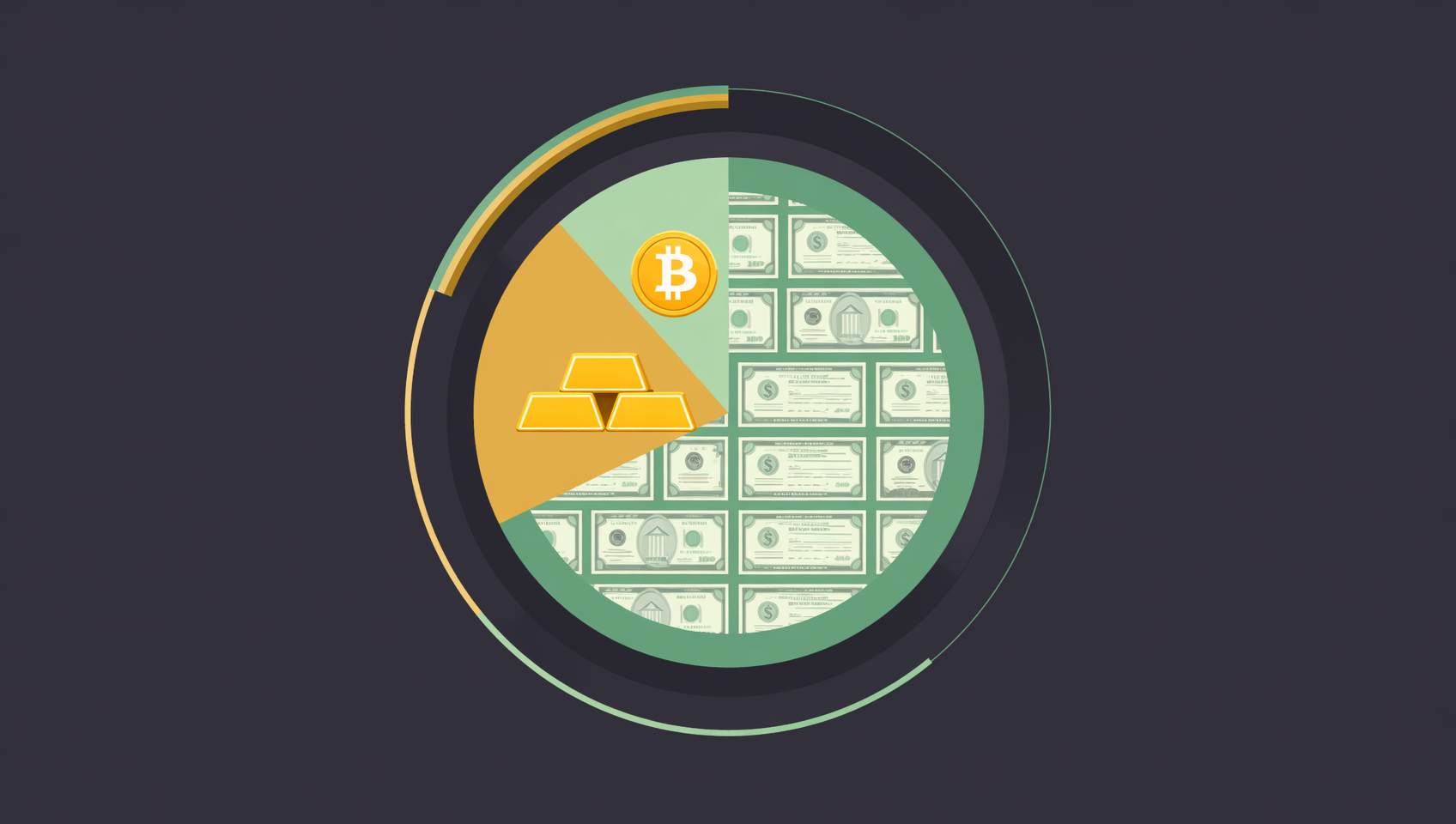
Layer one: the reserves. Tether publishes a quarterly attestation prepared by BDO. The core numbers for Q2 2026 (as of June 30) are2:
| Item | Amount |
|---|---|
| Total assets | $187.75B |
| Total liabilities (USDT in circulation) | $183.64B |
| Excess reserves | $4.11B (down from a Q1 peak of $8.23B — roughly halved) |
| U.S. Treasury bills (held directly) | ~$114.96B |
| Reverse repurchase agreements | ~$25.62B |
| Gold | 146.2 tonnes (~$18.84B) |
| Bitcoin | 98,933 BTC (~$5.8B) |
| Secured loans | $13.45B (cut 15% in six months) |
Two things matter in that table. First, the bulk really is Treasuries plus cash equivalents — that is the reason USDT has not broken in a decade. Second, the excess reserve cushion is thinning fast — with gold and Bitcoin prices falling in the first half of 2026, Tether's comprehensive result for H1 2026 came in at about -$3.17B, even though Q2 operating profit was still $1.5B2. In plain terms: its ability to earn from interest is strong, but the gold and Bitcoin in its reserves shrink along with the market.
Layer two: redemption. In theory you can hand USDT back to Tether for dollars, but the official redemption channel has a very high minimum (reportedly in the $100,000 range; check the official terms). Which means the retail "peg" is really the bid in the secondary market: as long as someone will buy your USDT at $0.999, the peg holds. That is also why, in every panic, the price drops first and the redemption queue forms later.
⚠️ Remember it in one line: USDT's stability comes from the fact that most of its assets are Treasuries, not from the label "stablecoin". Judge a stablecoin by the composition and transparency of its reserves, not by its name — and that rule applies to every stablecoin on the market.
Three depegs and what they teach you
"Stablecoins don't depeg" is an illusion. USDT has had at least three clear depegs, and each one was a crisis of trust, not a technical failure.
| Date | Low | Trigger | Outcome |
|---|---|---|---|
| April 2017 | ~$0.91 | Partner banks cut Bitfinex's clearing channels | Repegged within days |
| October 2018 | ~$0.88–0.91 | Accused of misappropriating $850 million of reserves (later substantiated in the New York Attorney General case) | Repegged after bank balance confirmations were published |
| May 2022 | ~$0.95 | Contagion panic from the UST/LUNA collapse | ~$7B redeemed in 48 hours, ~$20B within a month; supply fell from $83.1B to $65.3B |
All three recovered. But the lessons matter more than the reassurance:
- In a panic, the first instinct is to run, not to reason. In those two days in May 2022, redemptions came to roughly a tenth of reserves — no stablecoin can absorb a run at that speed. Whether it survives depends on the liquidity of its reserves, meaning whether the Treasuries can be turned into cash immediately.
- The opportunity cost of a depeg is brutally asymmetric. You might hold USDT for a 3% yield, but a single depeg to $0.88 is a 12% mark-to-market loss. The yield is a percentage; the risk is a percentage of your principal — and that is especially visible in stablecoins.
- Regulatory penalties are real. In 2021 Tether settled with the U.S. Commodity Futures Trading Commission ($41 million) and with the New York Attorney General ($18.5 million), both over statements about its reserves3. That does not mean there is a problem today, but it is a reminder: stablecoin transparency has been forced out by regulators, not offered by nature.
Three things to update about USDT in 2026
Three of the most repeated claims about USDT — "it is just the dollar", "TRC-20 is the cheapest", "it is one chain" — all need patching in 2026.
Counterintuitive #1: USDT is not on "a blockchain" — it is on more than a dozen at once
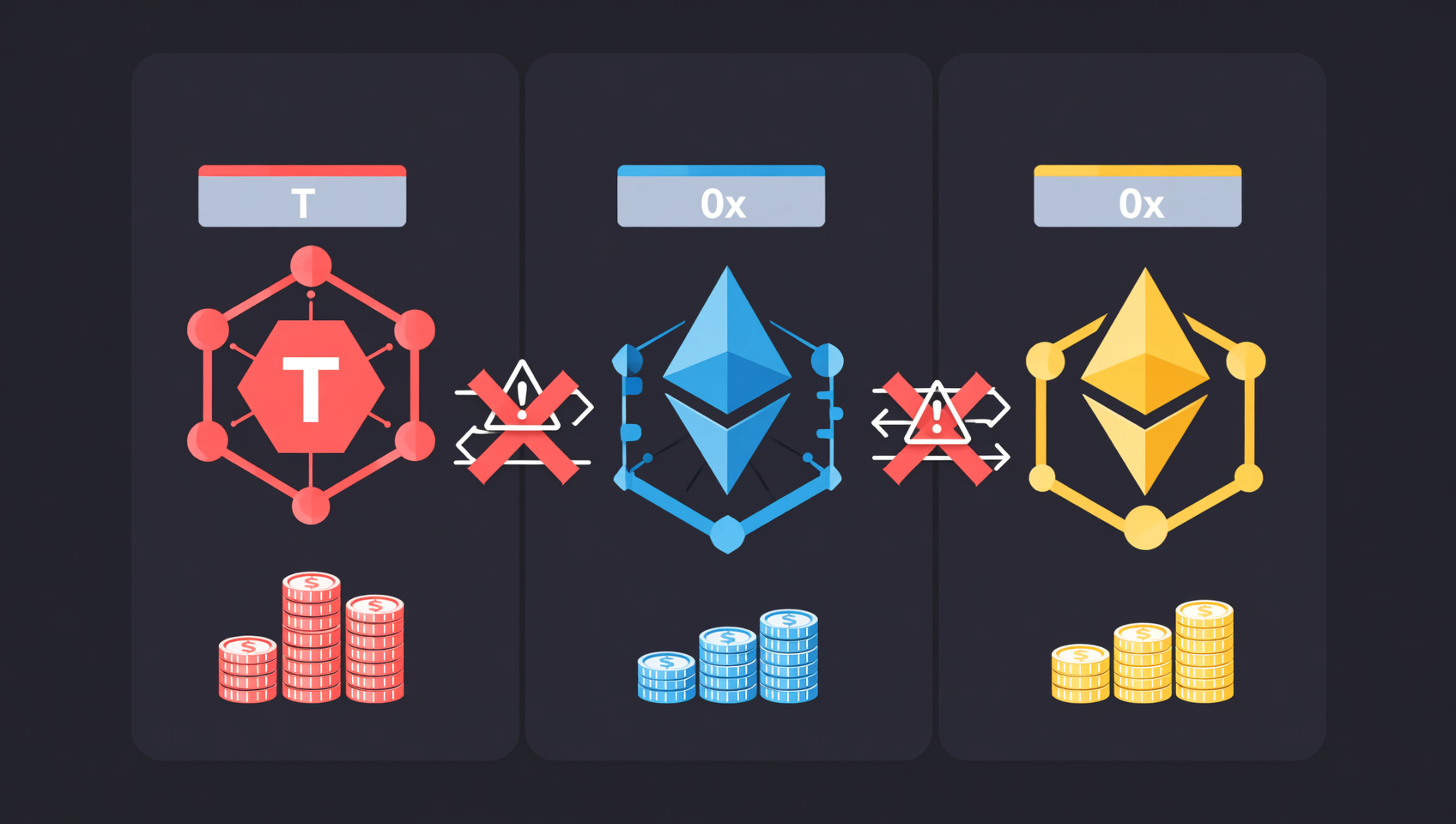
Many people assume USDT is a coin on a single chain. In reality Tether issues USDT on more than a dozen chains, and the USDT on each chain is a separate token that cannot move to another chain on its own. Roughly half of all USDT currently sits on Tron and about 40% on Ethereum.
The implication: the USDT you buy on Binance and the USDT on Ethereum are the same brand but different entities. When you transfer, the chain you send on must match the chain the recipient receives on, or the money lands on a network they do not recognize — which is the single most expensive beginner mistake, covered in the next section.
Counterintuitive #2: "TRC-20 is cheapest" is out of date
That was true from 2020 to 2022, when a TRC-20 transfer was essentially free. In 2026 the math has to be redone:
| Item | TRC-20 (Tron) | ERC-20 (Ethereum) | BEP-20 (BNB Chain) |
|---|---|---|---|
| Address prefix | Starts with T (34 characters) | Starts with 0x (42 characters) | Starts with 0x (42 characters) |
| Network fee | ~$2–5 (without staking TRX) | normally ~$0.07–0.19, several dollars when congested | usually under $0.50 |
| Exchange withdrawal fee | ~1 USDT | ~$5–15 | ~$0.5–1 |
| Settlement time | 3–10 seconds | 1–3 minutes (longer when congested) | a few seconds |
| Main use | Moving funds between exchanges, small frequent transfers | DeFi, NFTs, contract calls | BNB ecosystem, cheap routing |
The conclusion is not "which chain is best" but "match the chain to the job": moving money only between exchanges, TRC-20's withdrawal fee is usually cheaper; going into DeFi or holding long term in the Ethereum ecosystem, you have to use ERC-20; when both sides support it, BEP-20 tends to be the cheapest. Stop applying the single rule "TRC-20 is cheapest" everywhere — the fee structure has changed over the past two years.
Counterintuitive #3: the risk is not the price, it is the issuer and the chain
Beginners ask "will USDT fall?", but what actually costs you money is rarely a dip to $0.998. It is these three things:
- Sending on the wrong chain: USDT sent to a network the recipient does not support is effectively unrecoverable.
- The wrong contract address: adding a token manually in a wallet with a fake contract address shows you a fake balance, or gets you caught by a malicious token.
- Platform risk: parking stablecoins on a small exchange long term until it collapses or freezes withdrawals — nothing to do with USDT itself.
None of those three is a USDT depeg, and every one of them can cost you your entire principal.
Which chain is your USDT on: TRC-20, ERC-20 or BEP-20
Three rules will serve you better than memorizing ten comparison tables.
Rule one: the address prefix can rule a chain out, but never confirm one.
- Starts with T (34 characters) = Tron TRC-20, and can never be an Ethereum address.
- Starts with 0x (42 characters) = an EVM chain (Ethereum, BNB Chain, Polygon, Arbitrum and so on), and ERC-20 and BEP-20 look exactly the same.
So "starts with 0x" tells you it is an EVM address and nothing about which chain. The only valid basis for a decision is the network currently selected in the wallet plus the chain the recipient has explicitly told you.
Rule two: verify the official contract address, and copy it only from a trusted source. When adding a token manually in a wallet, never use a contract address you found through a search engine. USDT's official contracts are:
- Tron TRC-20: the contract beginning with TR7NH (for the full address, use the one published on Tether's official site)
- Ethereum ERC-20: the contract beginning with 0xdAC17F (for the full address, use the one published on Tether's official site)
The safest approach is not to add it manually at all — mainstream tokens display automatically on supported exchanges and wallets. If you must add one, verify it against Tether's official site or a block explorer.
Rule three: check a block explorer afterwards. Once the transfer is sent you get a transaction hash (TXID); look up its status on Tronscan for Tron or Etherscan for Ethereum. Only when it shows Success with enough confirmations has the money actually arrived.
How to buy USDT: the full Binance C2C walkthrough
The most common route for buying USDT is the exchange's C2C market (also called P2P): you buy from a verified merchant in your local currency, pay by bank transfer or a payment app, and the USDT lands directly in your spot account. Five steps, and under ten minutes once you have done it a few times.
- Create a Binance account: register with invite code BINANBT via registering on Binance to claim a 20% trading fee rebate. Registration itself is free and works without a code, but the rebate and the welcome package only come with one (full walkthrough in our Binance registration guide).
- Complete KYC: upload your ID and pass face verification; only then do C2C purchases and withdrawals unlock.
- Open "Buy Crypto → C2C": select USDT and your local currency, enter an amount (typically around $15 or the local equivalent is enough to start), and the system lists merchant quotes.
- Pick the merchant, not just the price: favor verified merchants with a high number of completed trades and a completion rate above 98%. The cheapest quote is often a scam or money-laundering account running a "low price plus off-platform payment" play.
- Pay as instructed and wait for release: confirm the payment only inside the platform, never move the transaction off-platform, and never accept "message me and we'll do it cheaper privately". Once the merchant releases, the USDT appears in your spot account.
💡 Three rules that keep you alive in C2C: ① pay only from a bank account in your own verified name — paying from someone else's card is the top cause of frozen accounts; ② refuse any merchant who asks you to "confirm receipt before sending the money"; ③ if a dispute starts, open a case on the platform immediately instead of trying to settle it privately.
Two paths after the purchase: if you want to trade right away, leave the USDT in your spot account; if you plan to hold long term or use DeFi, withdraw it to a self-custody wallet. For how much to start with and how fees eat into small orders, see How little can you spend on your first crypto purchase?. If you have not installed the app yet, use the Binance app download guide — and do not click "official mirror" pages in search results.
How to withdraw: network, fees and wrong-chain mistakes
Withdrawal is the one irreversible step in the whole process, and it deserves an extra two minutes.
Four checks before you withdraw:
- Ask which chain the recipient uses: TRC-20, ERC-20 or BEP-20? "I'll send you USDT" is not a sufficient answer.
- Check the address format: T-prefix matches TRC-20, 0x-prefix matches an EVM chain. If the format and the chain disagree, stop and ask again.
- Compare fees on both sides before choosing a chain: the exchange withdrawal fee plus any network fee the recipient's side may charge.
- Send a small test first: 10–20 USDT on the first transfer, confirm it arrives, then send the rest. That is standard practice for any on-chain transfer.
What if you sent it on the wrong chain? Two cases:
- Sent to an address you control (withdrawing to MetaMask over BEP-20, for example): recoverable. Switch the wallet to the matching network (BNB Chain) and the USDT appears, then bridge it or send it back. Details in our MetaMask wallet guide.
- Sent to a chain the recipient does not support, or to the wrong address: effectively hopeless. On-chain transactions cannot be reversed, Tether will not and cannot "reissue" it to you on another chain, and the exchange cannot help. Which is exactly why you send a small test first.
⚠️ One counterintuitive warning: before withdrawing to an unfamiliar new chain (USDT on some smaller networks, for instance), confirm that your own wallet can display it. Money that arrives somewhere you cannot read it is indistinguishable from money that is lost.
USDT vs USDC: when to switch
This is not a choice between two of the same thing; it is two different jobs. As of October 28, 2026, USDT's market cap is about $181.6 billion against USDC's $71.1 billion1 — USDT's liquidity advantage is substantial, and "safer" does not replace it.
| Situation | Better fit | Why |
|---|---|---|
| Trading, C2C deposits and withdrawals | USDT | Most trading pairs, deepest order books, most merchants |
| Large long-term holdings | Mostly USDC, diversified | Reserves are mostly cash and short-term debt, inside a clearer U.S. regulatory framework |
| Compliance-sensitive use in Europe | USDC | Some European exchanges have delisted USDT under MiCA |
| Cross-chain transfers, small frequent payments | Either, on fees | Pick by the actual network fee; the difference is minor |
| DeFi lending collateral | Whatever the protocol supports | Major protocols support both — mind the version on each chain |
In one line: trade with USDT, store value leaning toward USDC, and do not leave large balances with a single issuer. For the full comparison and each one's history of stress events, see USDT vs USDC: a deep comparison.
Is USDT worth holding long term?
USDT is a tool, not an asset. Leaving it parked long term means keeping your money at a company with no deposit insurance, in exchange for zero interest.
| Your situation | Suitable for long-term USDT? | Reasoning |
|---|---|---|
| Ready to buy coins or trade swings at any moment | Yes, but do not sit on it too long | Keep your ammunition liquid and available — that is its main value |
| Looking to "park" money safely for years | Cautious; diversify into USDC | Single-issuer credit risk, and depegs have happened |
| Chasing interest income | Not suitable as a direct hold | USDT pays nothing itself; yield products are lending in disguise |
| Large long-term balances (say $100,000+) | Not suitable | Diversify, and convert part into fiat or government debt instruments |
One calculation that needs correcting: people work out that "8% on USDT beats any bank account". But what you are taking on is downside risk to your principal — in those two days in May 2022, USDT briefly traded at $0.95, so an 8% yield came with a 5% instantaneous mark-to-market loss. That risk-return trade is not attractive. A stablecoin's yield should always be priced against the question of whether the issuer might fail.
💰 Binance rebate: invite code BINANBT
Claim the rebate before you buy USDT: register on Binance with invite code BINANBT for a 20% trading fee rebate. This article contains referral links; registering through them may reward us, but it never costs you anything extra.
- Rebate amount: 20% cashback on every trading fee; the rebate ceiling for invitees is a uniform 20%.
- How to claim: enter BINANBT in the invite-code field at registration; if you miss it, you can still link it within 30 days.
- Stacking benefit: enabling "Use BNB to pay fees" saves roughly 25% more.
- Important: signing up directly inside the app gets you no signup reward at all. An in-app registration binds to no referral, so the $19,800 welcome package and the 20% fee rebate simply don't apply — you have to use the registration link or enter invite code BINANBT.
👉 Register on Binance and claim your 20% fee rebate
FAQ
What is USDT, and how is it related to the dollar?
USDT (Tether) is a dollar stablecoin issued by Tether Limited in 2014, designed so that 1 USDT is pegged to 1 U.S. dollar. But it is not the dollar itself and it is not covered by U.S. deposit insurance — what you hold is a redemption claim on Tether, and the peg rests on the Treasury bills and other reserves the company holds, not on code or on any legal guarantee.
Can USDT lose its peg? Has it happened before?
Yes, at least three times: April 2017, when it fell to about $0.91; October 2018, when it fell to roughly $0.88–0.91; and May 2022, when the UST collapse dragged it to about $0.95. All three recovered to near $1 within days, but each one showed that "1 USDT = 1 dollar" is a market consensus, not a law of physics.
Should I withdraw USDT over TRC-20 or ERC-20?
Look at three things: the recipient's chain, the fees on both sides, and what you plan to do next. In 2026 a TRC-20 transfer costs about $2–5 if you are not staking TRX, while ERC-20 fees are normally a few cents to $0.20 — but exchange withdrawal fees run about 5–15 USDT on ERC-20 versus roughly 1 USDT on TRC-20. Going into DeFi, use ERC-20; moving funds only between exchanges, TRC-20 is usually cheaper.
I sent USDT on the wrong chain. Can I recover it?
Almost certainly not. USDT on each chain is a separate token, there is no cross-chain "send it back" mechanism, and an exchange cannot help. The one exception is sending to an address you control and hold the key for — for example, withdrawing to MetaMask over BEP-20, where switching the wallet to BNB Chain makes the balance appear. Which is why you always send a small test transfer first.
ERC-20 and BEP-20 addresses both start with 0x. How do I tell them apart?
You cannot, and that is where people lose the most money. The formats are identical but they belong to different blockchains, so sending to the wrong one means sending to a network the recipient does not support. The only reliable basis is the network currently selected in the wallet plus the chain the recipient has explicitly stated — never how the address looks.
USDT or USDC — which one should I use?
Use USDT for trading and for moving money in and out, because liquidity and depth are the best. With compliance requirements or large long-term holdings, USDC's reserves are more transparent (mostly cash and short-term debt, inside a U.S. regulatory framework). You do not have to choose: USDT on the exchange plus USDC for large wallet balances is a common setup.
Is USDT safe? Could it collapse to zero one day?
The risk is not a technical failure but issuer credit risk and the risk of a run. Tether publishes a quarterly attestation — Q2 2026 showed total assets of $187.75B, liabilities of $183.64B and excess reserves of $4.11B — but it is an attestation, not a full audit. It has survived several runs, which does not guarantee it will survive the next, so keeping your entire portfolio in a single stablecoin is not advisable.
Can I earn interest by holding USDT?
USDT itself pays no interest. Exchange "USDT flexible savings" and "earn" products lend your coins to the platform or to counterparties who need liquidity; the yield comes from that lending, and the risk transfers to you. For any product advertising "8%+ APY", ask first what the money is actually being used for.
Further reading
- USDT vs USDC: which is safer in 2026, and how to choose
- How little can you spend on your first crypto purchase? The fee threshold explained
- How to use MetaMask: setup, seed phrase and security
- Binance registration 2026: sign up, KYC and buying crypto
- Binance app download guide 2026: Android, iOS and fake-app defence
- Spot vs futures: liquidation price and the real cost of leverage
- What is Bitcoin? A complete beginner's guide for 2026
- How to choose a Bitcoin trading platform: eight exchanges compared
- More stablecoin content: the stablecoin guide
Disclaimer: This content is for educational purposes only and is not investment advice. Stablecoins carry issuer credit risk, depeg risk and on-chain operational risk, and on-chain transfers are irreversible. All price, market cap, reserve and fee figures are dated as noted; always verify against Tether's official announcements, the exchange's live pages and a block explorer1.
Footnotes
-
Source: CoinGecko USDT / USDC market data (price, market cap, circulating supply), queried October 28, 2026. ↩ ↩2 ↩3
-
Source: Tether's Q2 2026 attestation report (issued by BDO, as of June 30, 2026), plus reporting from CoinDesk and ForkLog, July 31, 2026. ↩ ↩2 ↩3
-
Source: U.S. Commodity Futures Trading Commission (CFTC) 2021 settlement order, the New York Attorney General's 2021 settlement announcement, and public reporting on the three depeg episodes. ↩