



TL;DR
- USDT ($185B) is the world's largest stablecoin with the deepest liquidity and the widest range of trading pairs, ideal for daily trading and leverage on centralized exchanges. However, its reserve transparency lags behind USDC, and MiCA compliance is progressing slowly.
- USDC ($75B) leads in regulatory transparency and the DeFi ecosystem, regulated by the New York DFS with monthly audit reports. The CCTP cross-chain protocol and Base chain ecosystem are its key differentiators.
- The MiCA transition period ended in July 2026 — USDC has obtained compliance, while USDT faces delisting risk in Europe. If the CLARITY Act passes, it will further strengthen USDC's compliance advantage.
- Recommendation: use USDT on exchanges, USDC for on-chain savings/DeFi — holding both covers all scenarios.
一、USDT vs USDC: 2026 Overview
Stablecoins are the lifeblood of the cryptocurrency market — they bridge the fiat and crypto worlds, serve as the unit of account on exchanges, and provide the core liquidity for DeFi. As of July 2026, the total market cap of global stablecoins has surpassed $280B, with USDT and USDC together accounting for over 92% of that total.1
| Dimension | USDT (Tether) | USDC (Circle) |
|---|---|---|
| Market Cap | ~$185B | ~$75B |
| Founded | 2014 | 2018 |
| Issuer | Tether Limited (Hong Kong) | Circle (Boston, USA) |
| Regulator | No single primary regulator | New York DFS (NYDFS) |
| Audit Frequency | Quarterly third-party attestation | Monthly independent audit |
| Major Blockchains | Ethereum / TRON / 10+ chains | Ethereum / Solana / 15+ chains |
| DeFi Integration | Moderate | High |
| CCTP Cross-Chain Protocol | ❌ Not supported | ✅ Supported (15+ chains) |
| MiCA Compliance | ❌ Slow progress | ✅ Licensed |
| Transfer Fee (TRC-20) | ~$0.2-$0.5 | — |
| Core Strength | Deepest liquidity, widest trading pairs | Highest transparency, strongest DeFi ecosystem |
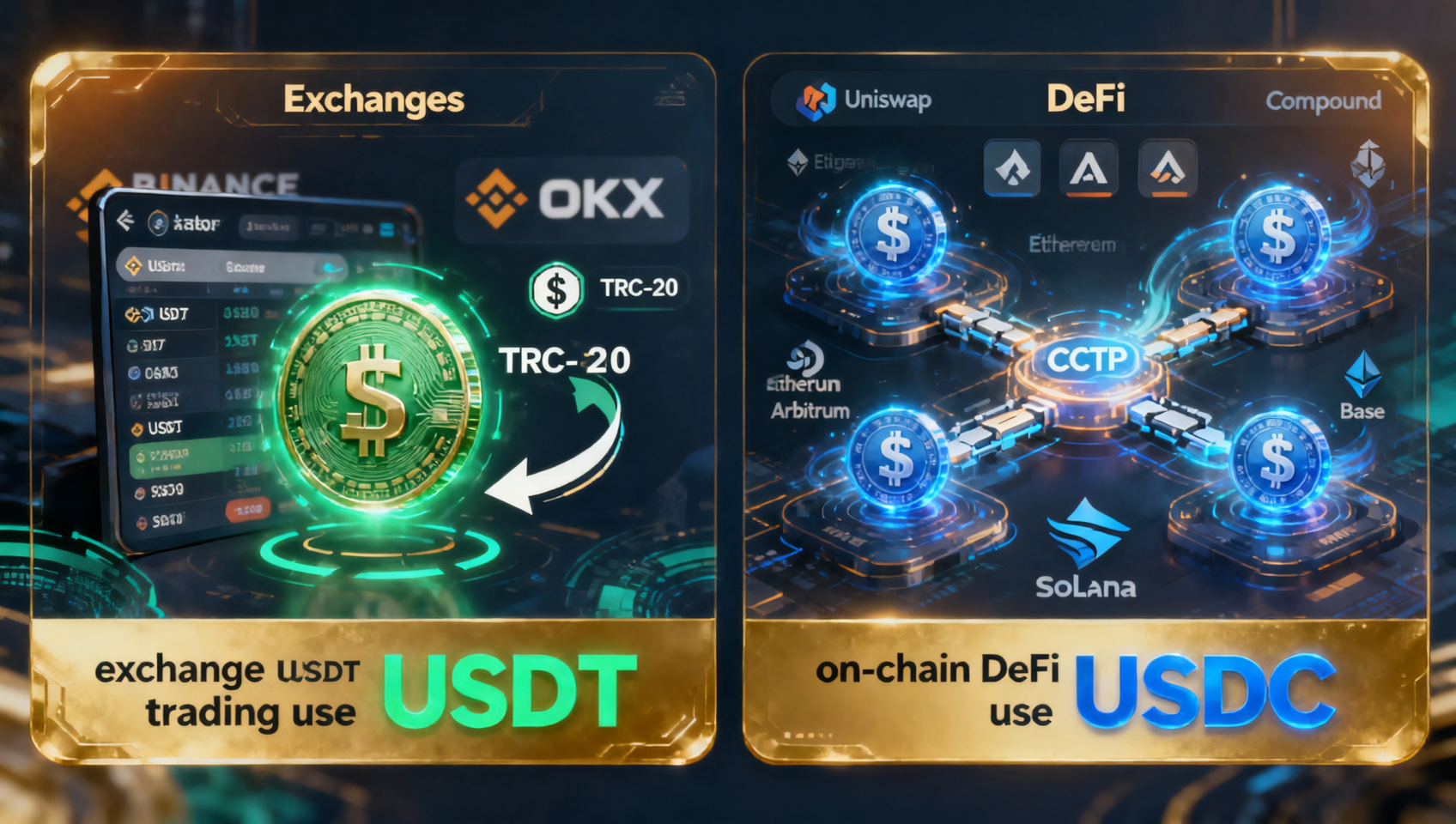
As of July 2026, USDT accounts for approximately 70-75% of trading volume on centralized exchanges, while USDC accounts for roughly 55-60% of value locked in DeFi protocols — the two stablecoins are forming a parallel landscape of "USDT for centralized trading, USDC for on-chain DeFi."2
Why Do We Need Two Stablecoins?
If you only use one wallet and one exchange, you might think "USDT is enough." But in reality, USDT and USDC have fundamentally different design philosophies and use cases:
- USDT's core logic is liquidity-first — born in the wild west era of crypto trading (2014), its goal was to provide exchanges with a stable unit of account. It prioritizes maximum exchange coverage and deepest liquidity.
- USDC's core logic is compliance-first — launched in 2018 by Circle and Coinbase, its goal was to provide institutions and regulation-sensitive users with a "bank-grade" stablecoin solution.
Understanding this difference directly affects your fund safety, trading costs, and on-chain experience.
二、Reserve Transparency — The Core Safety Difference
A stablecoin's safety ultimately depends on whether the issuer holds equivalent reserve assets and how transparent those reserves are. Without sufficient transparency, a "1:1 backing" claim is just an empty promise.
USDT Reserve Structure
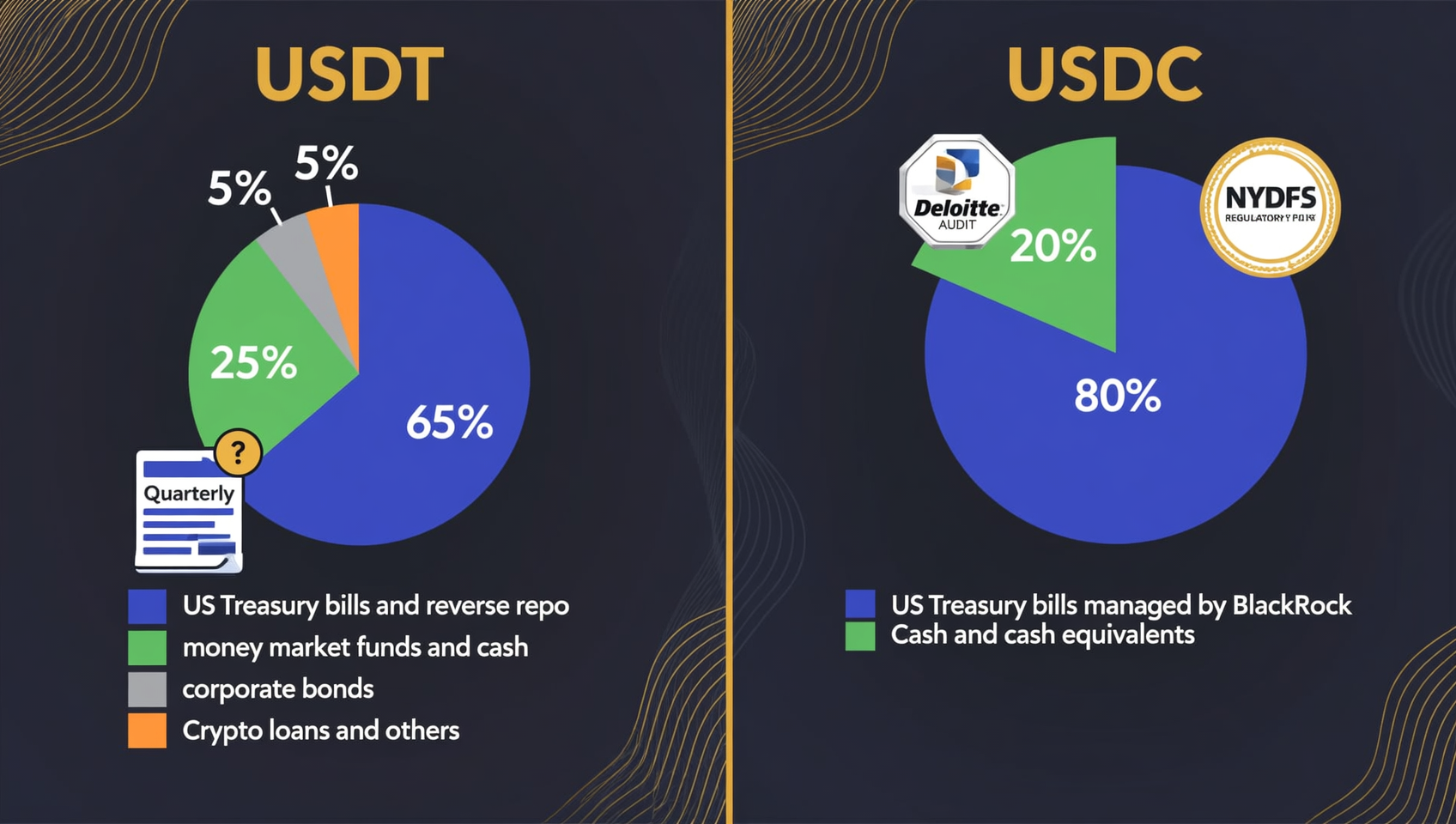
After the severe trust crisis in 2019 when it was revealed that only 27% was backed by cash, Tether significantly improved its reserve management. According to the latest Q2 2026 quarterly report, USDT's reserve composition is as follows:
| Asset Class | Percentage | Notes |
|---|---|---|
| US Treasuries & Reverse Repos | ~65% | The most liquid and safest asset class |
| Money Market Funds & Cash Deposits | ~25% | Cash deposits of approximately $4B |
| Corporate Bonds & Secured Loans | ~5% | Lower-risk fixed income assets |
| Crypto-Backed Loans & Other | ~5% | Includes Bitcoin-backed loans, digital token investments |
Key Metrics:
- Total reserves: exceeding 100% of circulating token face value
- Excess reserves: approximately $3.5B (buffer funds)
- Commercial paper holdings: reduced to 0% (liquidated after 2022)
However, Tether's attestation reports have two points of controversy:
- Quarterly attestation, not monthly audit — the quarterly attestation is conducted by BDO, but it is still not a Full Audit. This means the auditor only confirms specific data points rather than expressing an opinion on the overall financial position.
- Risk exposure beyond commercial paper — while commercial paper has been fully liquidated, the ~5% allocated to crypto-backed loans and investments still suffers from insufficient transparency.3
USDC Reserve Structure
USDC's reserve management is known for being "extremely conservative." Circle has been audited monthly by Deloitte since 2021, with all reserves managed to the strictest compliance standards:
| Asset Class | Percentage | Notes |
|---|---|---|
| US Treasuries | ~80% | Managed through a BlackRock Treasury fund |
| Cash & Cash Equivalents | ~20% | Held in regulated US banks |
| Commercial Paper / Corporate Bonds | 0% | Not held at all |
| Crypto-Backed Loans | 0% | Not involved at all |
Key Metrics:
- Audit frequency: Monthly full audit
- Audit firm: Deloitte
- Regulator: New York State Department of Financial Services (NYDFS)
- Reserve form: 100% held in cash and US Treasuries4
Transparency Comparison
| Dimension | USDT | USDC |
|---|---|---|
| Audit Frequency | Quarterly | Monthly |
| Audit Type | Third-party attestation (limited assurance) | Full audit (reasonable assurance) |
| Audit Firm | BDO | Deloitte |
| Reserve Detail Disclosure | Asset classes disclosed | Daily reserve address publication |
| Regulatory Oversight | No single primary regulator | NYDFS continuous supervision |
| Historical Trust Issues | 2019: only 27% cash; 2021: CFTC fine | 2023: SVB $3.3B deposit crisis (resolved) |
Conclusion: From a reserve transparency standpoint, USDC is clearly superior to USDT. USDC's monthly audits + daily reserve address publication + NYDFS supervision form a triple layer of protection. USDT's reserves have improved significantly but still lag in transparency and regulatory oversight.
三、Regulatory Compliance — The Most Critical Change of 2026
MiCA Transition Period Ends: The EU Market Divergence
In July 2026, the MiCA (Markets in Crypto-Assets Regulation) transition period for stablecoins officially ended in the EU. The European Securities and Markets Authority (ESMA) made it clear: stablecoin issuers without an Electronic Money Institution (EMI) license must cease operations in the EU.
The impact on USDT and USDC is starkly different:
- USDC: Circle has obtained an EMI license from the French AMF (Autorite des Marches Financiers), allowing compliant operations in the European market. Circle began proactively pursuing compliance early in the MiCA legislative process.
- USDT: Tether has been slow on MiCA compliance. Multiple European exchanges (such as Binance Europe, Bitstamp, and Kraken Europe) have begun adjusting USDT trading support, and some platforms have already delisted USDT trading pairs.5
Market impact: MiCA may lead to a gradual decline in USDT circulation within the EU and an increase in USDC's share. If USDC's EU market share rises from the current ~40% to 70%, this would represent approximately $20-30B in demand shifting from USDT to USDC — enough to significantly alter their relative market share trajectory.
The CLARITY Act — A US Regulatory Milestone
Today (July 23, 2026), the US Senate is targeting a vote on the CLARITY Act. This bill aims to clearly define SEC and CFTC jurisdiction over digital assets — including stablecoins.
The CLARITY Act's potential impact on USDC:
- Stablecoin issuance clearly defined as non-security — the CLARITY Act defines payment stablecoins as "digital commodities" rather than securities, eliminating the regulatory risk of USDC being classified as a security.
- Clear compliance pathway — the bill requires stablecoin issuers to meet 100% reserve coverage, monthly audits, regulatory reporting, and other requirements — exactly what Circle is already doing.
- Bank custody compliance — the bill allows banks to provide digital asset custody services, giving USDC's bank-grade reserve management regulatory recognition.
If the CLARITY Act passes, USDC will be the most benefited stablecoin — it already meets nearly all the requirements under the new regulations. Conversely, USDT may need to significantly restructure its operations to meet US standards.6
Regulatory Compliance Comparison Summary
| Dimension | USDT | USDC |
|---|---|---|
| US Regulation | No registration | NYDFS regulated |
| MiCA (EU) | ❌ Slow progress | ✅ EMI license obtained |
| CLARITY Act Beneficiary | Low — needs operational restructuring | High — already compliant |
| Asia Regulation | Gradually tightening across jurisdictions | Registered in major markets |
| Regulatory Risk Rating | ⚠️ Moderate to high | 🟢 Low |
四、Transaction Fees and Liquidity — Exchange Usage Comparison
For users trading on exchanges, fees and liquidity are the most practical considerations when choosing a stablecoin.
Liquidity Comparison
| Trading Pair | Avg. Bid-Ask Spread | Relative Liquidity |
|---|---|---|
| BTC/USDT (Binance) | ~0.01% | Deepest |
| BTC/USDC (Binance) | ~0.03%-0.05% | ~1/5 to 1/3 of USDT |
| ETH/USDT (Binance) | ~0.01% | Deepest |
| ETH/USDC (Binance) | ~0.03%-0.05% | ~1/5 to 1/3 of USDT |
On-Chain Transfer Fee Comparison
| Network | USDT Fee | USDC Fee | Confirmation Speed |
|---|---|---|---|
| Ethereum (ERC-20) | ~$2-8 | ~$2-8 | Depends on gas |
| TRON (TRC-20) | ~$0.2-0.5 | — | 3-5 minutes |
| Solana | — | ~$0.0002 | 1-2 seconds |
| BSC (BEP-20) | ~$0.05-0.15 | ~$0.05-0.15 | 3 seconds |
| Arbitrum | ~$0.02-0.1 | ~$0.02-0.1 | 1-5 minutes |
USDT's extremely low transfer fees on the TRC-20 network are a significant differentiator — for users who frequently deposit and withdraw, each transfer costs only $0.2-$0.5, far below ERC-20's $2+. This is one of the key reasons USDT dominates the Asian market, especially for exchange deposits and withdrawals.
Practical Exchange Selection Strategy
If you trade on Binance or OKX:
- Use USDT as your primary trading pair — nearly all trading pairs are denominated in USDT, offering the deepest liquidity and lowest slippage.
- Use USDC for savings — on Binance Earn and OKX Earn, USDC yield products sometimes offer 0.5-1% higher APY than USDT, as platforms need to balance liquidity between the two stablecoins.7
- USDT for margin/futures trading — USDT-margined contracts are the most liquid products on both Binance and OKX.
- USDC for moving on-chain — if you plan to transfer assets out of the exchange to DeFi, USDC is more convenient.
Recommended registrations:
- Binance Registration — Use referral code BINANBT for fee discounts
- OKX Registration — Register to get up to 40% fee rebate
五、DeFi and On-Chain Ecosystem — USDC's True Battlefield
If you only trade on exchanges, USDT is nearly irreplaceable. But once you step into the on-chain world, USDC's advantages become very clear.
USDC's On-Chain Ecosystem Advantages
1. CCTP (Cross-Chain Transfer Protocol)
Circle's CCTP is USDC's most differentiating feature. It enables native cross-chain transfers across 15+ chains without relying on third-party bridges (such as Multichain, Stargate, etc.). This means:
- No need to trust third-party bridge security (cross-chain bridge attacks resulted in ~$860M in losses in 2025)
- Confirmation time of only 1-5 minutes (depending on the destination chain's confirmation speed)
- Support for Ethereum, Arbitrum, Optimism, Base, Solana, Avalanche, Polkadot, and other major chains
2. Base Chain Ecosystem
Base, Coinbase's L2 network, natively uses USDC as its gas token, creating a unique "Coinbase (centralized on-ramp) → Base Chain → USDC" closed-loop ecosystem. Base's active addresses surpassed 8 million in 2026, with TVL exceeding $3.5B, where USDC serves as the largest liquidity and gas token.8
3. DeFi Protocol Integration
| Protocol | USDT Liquidity | USDC Liquidity |
|---|---|---|
| Uniswap | Moderate | High |
| Aave | Moderate | High |
| Compound | Moderate | High |
| Curve (3pool) | High | High |
| Morpho | Moderate | High |
USDT's On-Chain Ecosystem
USDT also has its own on-chain advantages:
1. TRC-20 Network Cost Advantage
USDT issued on the TRON network offers ultra-low transfer fees (~$0.2-$0.5), making it the preferred choice for deposits and withdrawals in Asian markets. As of July 2026, TRC-20 USDT supply exceeds $55B, representing approximately 30% of total USDT supply.
2. Internal Exchange Transfers
When moving USDT between exchanges (from Exchange A to Exchange B), the TRC-20 network is typically used — very low cost and fast confirmation.
3. DeFi Limitations
However, USDT's usage in DeFi is declining — partly because after the 2022 LUNA crash, the DeFi community's trust in USDT's transparency weakened, leading many to shift to USDC as the primary stablecoin liquidity.
六、Market Cap Trends and Ecosystem Evolution
Market Cap Growth Comparison
| Year | USDT Market Cap | USDC Market Cap | USDT/USDC Ratio |
|---|---|---|---|
| 2020 | ~$20B | ~$4B | ~5:1 |
| 2021 | ~$78B | ~$45B | ~1.7:1 |
| 2022 | ~$66B | ~$45B | ~1.5:1 |
| 2023 | ~$91B | ~$24B | ~3.8:1 |
| 2024 | ~$140B | ~$40B | ~3.5:1 |
| 2025 | ~$170B | ~$55B | ~3.1:1 |
| July 2026 | ~$185B | ~$75B | ~2.5:1 |
The sharp decline in USDC's market cap in 2023 was primarily due to the Silicon Valley Bank (SVB) crisis — Circle held $3.3B of its reserves at SVB, triggering massive capital flight and a depeg event. It took roughly a year and a half for USDC to gradually rebuild trust and recover its market cap.9
Notably, USDC's growth has accelerated significantly since the beginning of 2026 — from ~$55B to $75B, an increase of approximately 36%. Over the same period, USDT grew from ~$170B to $185B, an increase of roughly 9%. If this trend continues, USDC's market share could approach 40-45% of USDT's by early 2027.
DeFi TVL Comparison
| Chain/Protocol | USDT TVL | USDC TVL |
|---|---|---|
| Ethereum Mainnet | ~$18B | ~$32B |
| Arbitrum | ~$4B | ~$8B |
| Base | ~$1B | ~$7B |
| Solana | ~$1.5B | ~$5B |
| Polygon | ~$0.8B | ~$2B |
Key insight: In DeFi, USDC's total value locked surpasses USDT across the board, especially on Base (thanks to the Coinbase ecosystem) and Solana, where the gap is most pronounced.
七、Use Case Selection Guide
After all the analysis above, here is a straightforward recommendation for selecting the right stablecoin by scenario:
| Use Case | Recommended | Reason |
|---|---|---|
| Exchange Spot Trading | USDT | Widest range of trading pairs, deepest liquidity, tightest spreads |
| Exchange Futures Trading | USDT | USDT-margined contracts are mainstream with the best liquidity |
| Exchange Savings/Earn | USDC > USDT | USDC APY is typically 0.5-1% higher |
| DeFi Lending (Aave/Compound) | USDC | Deeper liquidity, higher integration |
| DEX Trading (Uniswap/Curve) | USDC | Deeper pools, lower slippage |
| Cross-Chain Transfers | USDC | CCTP supports native transfers across 15+ chains without bridging |
| Deposits/Withdrawals | USDT (TRC-20) | Lowest fees (~$0.2-$0.5), fastest speed |
| Institutional / Large Holdings | USDC | Monthly audits + NYDFS oversight + transparent reserves |
| EU Market | USDC | MiCA compliant; USDT may face delisting |
| Southeast Asia Market | USDT (TRC-20) | Most widely supported by exchanges and on/off-ramp channels |
Asset Management Golden Rule
Large position risk management: It is not advisable to hold all assets in a single stablecoin. A sensible allocation would be 70% USDT (for trading and liquidity) + 30% USDC (for on-chain savings and reserves), adjusted dynamically based on your use case.
⚠️ Risk Disclaimer: This article provides an in-depth comparative analysis of stablecoins and does not constitute investment advice. Stablecoins are not risk-free assets — issuer risk (insufficient reserves, bankruptcy risk), smart contract risk (stablecoin pools in DeFi protocols), and depeg risk (price deviation under extreme market conditions) all exist. MiCA and the CLARITY Act are improving the regulatory environment for stablecoins, but users must still assess risks for themselves. The cryptocurrency market is highly volatile — please manage your risk accordingly.
Recommended registrations:
- Binance Registration — Referral code BINANBT for fee discounts
- OKX Registration — Register for up to 40% fee rebate
📚 Further reading: On-Chain Guide - Learn Blockchain from Zero — Blockchain fundamentals and in-depth stablecoin analysis
📖 Related articles:
- Stablecoin 2026 Complete Guide: USDT, USDC, DAI Mechanisms Explained
- July 23, 2026 Crypto Market Deep Analysis
Footnotes:
Footnotes
-
Source: CoinGecko stablecoin market cap data, July 2026; CoinMarketCap stablecoin market cap tracker ↩
-
Source: The Block Research stablecoin volume report, Q2 2026; DeFiLlama stablecoin TVL data, July 2026 ↩
-
Source: Tether Q2 2026 third-party attestation report; BDO attestation statement; Tether transparency page https://tether.to/en/transparency/ ↩
-
Source: Circle June 2026 audit report (Deloitte); Circle transparency page https://www.circle.com/en/transparency; NYDFS regulatory statement ↩
-
Source: ESMA MiCA transition period end announcement, July 2026; Binance Europe USDT trading pair adjustment notice; CoinDesk "European Exchanges Begin Limiting USDT Access Post-MiCA," July 2026 ↩
-
Source: CryptoBriefing CLARITY Act analysis, July 23, 2026; Polymarket CLARITY Act passage probability; CoinDesk "White House Accepts Key CLARITY Act Ethics Provisions," July 22, 2026 ↩
-
Source: Binance Earn USDC/USDT rate comparison page, July 2026; OKX Earn stablecoin product rate page ↩
-
Source: Dune Analytics Base chain metrics, July 2026; L2Beat Base TVL data; Circle CCTP official documentation ↩
-
Source: CoinGecko historical market cap data, 2020-2026; Circle SVB crisis public statement, March 2023; The Block Research stablecoin market report ↩