


⚠️ Read this first: if you don't have an account yet, register through the registration link (e.g. "Sign Up") or enter invite code BINANBT — signing up directly inside the app gets you no signup reward at all. The $19,800 welcome package and the 20% fee rebate won't apply. Token launch campaigns require KYC and are only open in eligible regions.
Key takeaways (TL;DR):
- The three programs are not the same thing. Launchpool locks assets and pays you a share of the new token based on your pool weight. Megadrop locks BNB and scores Web3 tasks. HODLer requires no action at all — it pays out on your BNB balance at snapshot time.
- BNB parked in Simple Earn is enrolled automatically (a Binance rule since April 2025). Flexible or locked BNB joins Launchpool and HODLer on its own; Megadrop only counts BNB locked in a fixed-term product, not a flexible balance.
- A launch is not "free coins" — it is compensation for three kinds of risk. You carry BNB's price risk while it stays locked, the risk that the new token falls after listing, and the time and gas cost of completing tasks.
- The APR on the page is not what you take home. APR is usually estimated from the opening price; new tokens have thin liquidity, listing-day highs are common, and your actual sale price may be far below the page's figure.
- Megadrop scores are multiplicative: total = (locked BNB score × Web3 task multiplier) + task bonus. Lock BNB without doing the tasks and the multiplier stays at 1.
- HODLer has a floor and a ceiling: at least 0.01 BNB, random hourly snapshots, and, in some campaigns, a per-user cap. BNB pledged as loan collateral does not count, and sub-accounts are calculated separately.
- The biggest risk is not missing an airdrop — it is overloading on BNB to qualify for one. Airdrop rewards are usually a few hundred dollars; a 10% drop in BNB can cost thousands.
Contents
- The short answer: launchpool rewards are not free coins
- Three programs in one table
- Launchpool: lock assets, earn a share of the new token
- Megadrop: locked BNB plus Web3 tasks, and how points work
- HODLer: no action, just hold for the snapshot
- Auto-enrollment: what happens when BNB sits in Simple Earn
- How the payout is calculated: APR, pool share and what you actually get
- Should you sell at listing? Three questions
- Risk checklist: lock-ups, tasks, regions and fake airdrops
- Choose a plan based on your BNB holdings and timeline
- Five common misconceptions
- 💰 Binance fee rebate: invite code BINANBT
- FAQ
- Further reading
The short answer: launchpool rewards are not free coins
Binance token launches are often described as "hold BNB and get new coins for free". A more accurate description is this: the platform subsidises you with new tokens in exchange for locking assets, completing on-chain interactions, or simply holding a position for a period of time. What you receive is not a free lunch but compensation for three costs:
- Opportunity cost. Locked BNB cannot be sold or used for anything else, and if BNB falls during the lock-up you absorb the loss.
- New-token risk. An airdropped token has no price history. It can open high and fall from there, or be too illiquid to sell at all.
- Operational cost. Megadrop's Web3 tasks consume gas, time and attention, and expose you to phishing sites.
So the real question is not "what is this campaign's APR" but how much BNB am I willing to lock, for how long, and against how much price volatility, in exchange for this airdrop?
In one line: the upside of a launch is a subsidy; the cost is risk. Look only at the upside and a BNB drawdown will take back the airdrop and your principal with it.
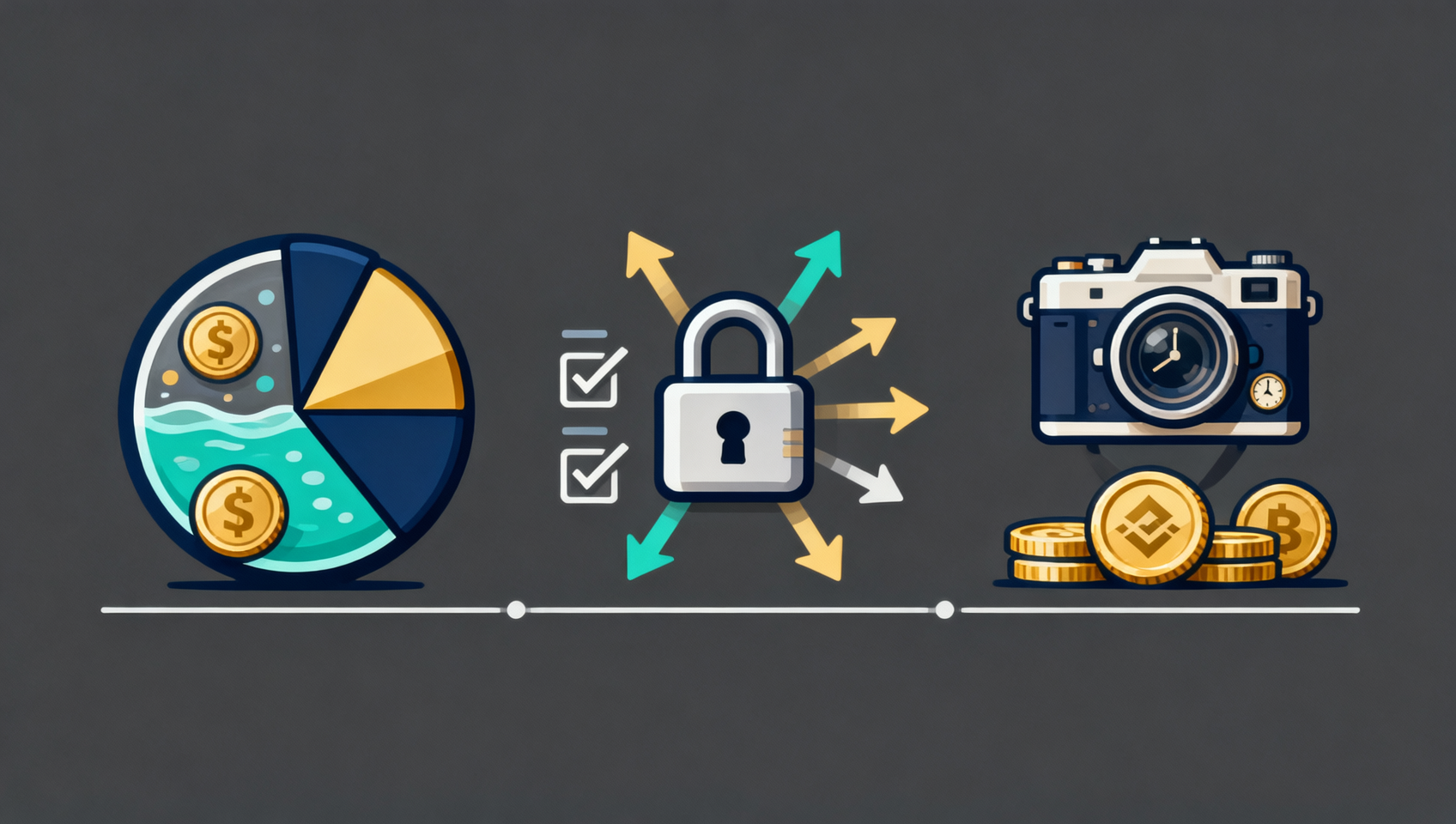
Three programs in one table
| Dimension | Launchpool | Megadrop | HODLer Airdrops |
|---|---|---|---|
| What you do | Lock designated assets such as BNB, USDC or FDUSD | Lock BNB in a fixed term and complete Web3 tasks | Hold BNB in Simple Earn; no action needed |
| Lock-up required | Locked for the campaign; early unlock allowed | Fixed-term lock only; flexible does not count | No lock-up, but BNB must sit in Simple Earn / On-Chain Yields |
| How rewards are calculated | Your share of the pool, paid in the new token | Allocation by points, ranked proportionally | Based on your BNB balance at snapshot time |
| Main cost | Opportunity cost, new-token price risk | Lock-up plus task gas and time | BNB price risk, possible per-user caps |
| Best suited to | People with BNB or stablecoins who want low-friction exposure | People who can accept a fixed lock-up and will do the tasks | Long-term BNB holders |
| How it pays out | Settled to Spot at campaign end or early unlock | Distributed after the campaign ends | Sent to Spot after the announcement |
All three can run at the same time: Launchpool and HODLer stack, and when Megadrop overlaps with Launchpool each is calculated separately. Check each campaign page for the specifics.
Launchpool: lock assets, earn a share of the new token
Launchpool is the simplest mechanism: you lock a designated asset into a pool, rewards accrue hourly in the new token during the campaign, and at the end your principal and rewards return to your Spot account.
How to take part
- Open the Binance app and find Launchpool under "More" (or enter from the campaign banner on the home screen).
- Pick an active project and review the campaign window, supported assets, reward pool and estimated APR.
- Choose a pool (commonly BNB, USDC or FDUSD), enter the amount and confirm.
- You can unlock early during the campaign; rewards already accrued are kept.
- When the campaign ends, principal and rewards return to your Spot account automatically.
How the split works
Your reward = total new-token reward × (your locked amount ÷ total locked in that pool).
An illustrative example (the numbers show the structure, not a live offer):
A Launchpool campaign pays 10,000,000 new tokens over 7 days, and the BNB pool holds 1,000,000 BNB in total. You lock 100 BNB, or 0.01% of the pool. At the end you receive 10,000,000 × 0.01% = 1,000 new tokens. If the token lists at $0.50, that is $500 on paper; at $0.20, only $200.
Note: APR is an estimate derived backwards from the opening price, not a promised return. The larger the total pool, the smaller your share; the lower the token price, the less you actually earn.
BNB pool vs stablecoin pool
- BNB pool: usually the higher yield, but you also take BNB's price risk.
- USDC/FDUSD pool: the principal is a stablecoin, so price risk is low, but the value of the token reward still moves.
- Splitting across pools: you can join several pools for the same project, but each pool's share is calculated independently.
In one line: the risk in Launchpool is not whether the lock holds — it is what the new token is worth at unlock, and how far BNB has fallen.
Megadrop: locked BNB plus Web3 tasks, and how points work
Megadrop adds a layer: you do not just lock BNB; you also complete designated Web3 tasks to earn a higher points multiplier.
The points formula
Binance's official rule is:
Total score = (locked BNB score × Web3 task multiplier) + Web3 task bonus
Three variables matter:
- Locked BNB score: more BNB and a longer term mean a higher score; each campaign sets different coefficients by term.
- Web3 task multiplier: you only receive the multiplier by completing every designated task; if you don't finish them all, it counts as 1.
- Task bonus: extra points for completing all tasks, different in every campaign.
An illustrative example (the numbers show the structure only):
You lock 100 BNB for 90 days and receive 1,000 points; you complete every Web3 task, giving a multiplier of 2 and a bonus of 500. Total = 1,000 × 2 + 500 = 2,500 points. If you lock and skip the tasks, total = 1,000 × 1 = 1,000 points. The same BNB, with or without the tasks, is a 2.5x difference in points.
Three traps
- Only fixed-term BNB counts. Flexible BNB does not enter the Megadrop lock score; to take part you must choose a fixed-term product.
- Your Web3 wallet must be created and backed up inside Binance Wallet. Imported wallets do not count; tasks must be completed in Binance Web3 Wallet and verified on the task page.
- Snapshots are time-weighted averages. If you lock after the campaign starts, only part of the day counts; to earn the full score, lock before the snapshot window opens.
In one line: Megadrop points are lock × tasks — skip one and your allocation can halve or worse.
HODLer: no action, just hold for the snapshot
HODLer Airdrops is the most passive of the three: no lock-up and no tasks. As long as you hold eligible BNB at snapshot time, you receive the new token.
Key rules
- Where it must sit: BNB has to be in Simple Earn (flexible or locked) or On-Chain Yields; a Spot balance does not count.
- Minimum threshold: at least 0.01 BNB at snapshot time.
- Snapshot method: several random snapshots per hour, averaged over the hour; a campaign may use a historical snapshot from an earlier period.
- Distribution: the new token is sent to your Spot account after the announcement, usually with no manual claim.
- Per-user cap: each campaign caps the BNB that counts, and anything above the cap earns nothing.
- Exclusions: BNB pledged as collateral for Binance Loans does not count, and sub-accounts are calculated separately.
- Eligible assets: besides BNB, slisBNB/slisBNBx held in Binance Wallet may count in some campaigns; check each announcement.
Why "holding BNB" does not guarantee an airdrop
- Your BNB has to be in the right place (Simple Earn / On-Chain Yields); a Spot balance does not count.
- Snapshots are random, so a gap in the campaign window can cost you the allocation.
- Every campaign has caps and regional restrictions, so not every user qualifies.
- The airdropped token can fall on listing day; paper value is not cash.
In one line: HODLer's "passive income" comes with conditions: right place, right time, under the cap, eligible region.
Auto-enrollment: what happens when BNB sits in Simple Earn
Since April 2025, Binance has folded several BNB rewards into Simple Earn. The core change: eligible BNB is enrolled in Launchpool and HODLer automatically, with no need to sign up campaign by campaign.
Specifically:
| Where your BNB sits | Launchpool | HODLer | Megadrop |
|---|---|---|---|
| Simple Earn, flexible | Auto-enrolled | Auto-enrolled | Not scored |
| Simple Earn, locked | Auto-enrolled | Auto-enrolled | Scored (lock required) |
| Spot wallet | Not included | Not included | Not included |
| Loan collateral | Not included | Not included | Not included |
| Binance Web3 Wallet (slisBNB) | Per campaign rules | May count | Per task rules |
Auto-enrollment saves effort, but the downside is that you may be enrolled in several campaigns at once without knowing which pools your BNB is feeding. Before each campaign starts, check:
- Is my BNB in flexible or locked?
- Does this campaign count flexible balances?
- Is there a cap, and is my BNB above it?
- Does the campaign window clash with when I need the money?
In one line: automatic enrollment is not automatic optimisation; the platform signs you up, it does not calculate your risk or liquidity for you.
How the payout is calculated: APR, pool share and what you actually get
The APR on a launch page is usually built like this: estimate the reward value at the new token's opening price, then annualise it over the campaign days. Three things in that number are uncertain:
- The token price: the opening price is not your sale price; a thin token can drop 30% in minutes.
- Total pool size: if others add to the pool during the campaign, your share is diluted.
- The BNB price: if you farm with BNB and BNB falls, the loss on principal can exceed the airdrop gain.
A full worked example
Assume BNB is at $705 (a 2026-10-31 reference), you lock 100 BNB worth $70,500, the campaign runs 7 days, and you are allocated 1,000 new tokens.
| Sale price of the new token | Airdrop value | 7-day return | Annualised |
|---|---|---|---|
| $0.50 | $500 | 0.71% | about 37% |
| $0.20 | $200 | 0.28% | about 15% |
| $0.05 | $50 | 0.07% | about 3.7% |
Now add the BNB price: if BNB falls 10% over those 7 days, 100 BNB is $7,050 underwater — far more than the $500 airdrop. That is why "buying heavy BNB for the airdrop" is the most dangerous move in this whole category.
In one line: APR is an advertising number derived from the opening price; your real return is sale price × share − BNB opportunity cost.
Should you sell at listing? Three questions
Once the airdrop lands, the usual question is whether to sell on opening day or hold. There is no standard answer, but three things help:
- The airdrop's share of circulating supply: a large allocation with more unlocks ahead means heavier selling pressure at the open.
- Whether the project has a real product and revenue: projects with narrative but no usage tend to slide after listing.
- Your position and cost basis: the airdrop is costless inventory, but if you locked a large BNB position to farm it, BNB is the position that matters.
A practical approach is to sell in tranches: take some off at the open to recover any cost, hold the rest according to your own view, and don't hold everything just because "someone said it will double".
In one line: the right way to sell an airdrop is not "at the top" — it is "bank some first, then let the rest take the risk".
Risk checklist: lock-ups, tasks, regions and fake airdrops
- BNB price risk. BNB can fall while locked, and the airdrop may not cover the paper loss on principal.
- Lock-up liquidity risk. Fixed-term BNB has a redemption waiting period; you cannot get it out in an emergency.
- New-token price risk. Listing-day highs, thin liquidity, and selling pressure from later unlocks.
- Task phishing risk. Web3 tasks should only be completed on Binance's official campaign pages and inside Binance Web3 Wallet. Any page asking for a seed phrase, private key or unlimited approval is a stop sign.
- Region and KYC risk. Campaigns are only open in eligible regions; do not use another person's identity, fake documents or region-bypass methods.
- Fake airdrops and fake support. Websites, Telegram "support" and paid "launch farming" services impersonating Binance are mostly scams; Binance will never ask you to transfer funds to claim an airdrop.
- Cap risk. Some HODLer campaigns have a per-user cap, and extra BNB above it is ignored.
- Rule-change risk. Campaign windows, pools, multipliers and regional limits can all be adjusted; yesterday's rules do not bind today's campaign.
In one line: the worst loss in this category is not missing out — it is exposing your principal to larger risk in order to qualify.
Choose a plan based on your BNB holdings and timeline
| Your situation | First choice | Watch out for |
|---|---|---|
| Long-term BNB holder with no plan to sell | BNB in Simple Earn; auto-enrolled in Launchpool + HODLer; consider Megadrop only if you can lock | Check caps and campaign windows |
| You have BNB but may need it anytime | Flexible BNB and Launchpool only; skip fixed-term Megadrop | Flexible BNB does not count for Megadrop |
| No BNB, want low-risk exposure | Launchpool stablecoin pool (USDC/FDUSD) | The token price still moves |
| Want to maximise Megadrop | Lock BNB in a fixed term and complete every Web3 task | Price the task gas and time first |
| No tasks, no lock-ups | HODLer (BNB in Simple Earn) | Right place, under the cap, eligible region |
| Region unsupported / cannot KYC | Do not participate | Do not use fake documents or bypasses |
Five common misconceptions
- "Launches are free." Wrong. You pay BNB's opportunity cost, lock-up liquidity, new-token price risk and task costs.
- "The page APR is what I'll earn." Wrong. APR is estimated from the opening price, and your actual sale price may be much lower.
- "HODLer just needs BNB." Wrong. BNB must be in Simple Earn / On-Chain Yields, at least 0.01 BNB, snapshots are random, there is a cap, and loan collateral does not count.
- "Locking BNB is enough for Megadrop." Wrong. Lock without doing the Web3 tasks and the multiplier is 1; points can differ by more than double.
- "More sub-accounts means more airdrops." Wrong. Sub-accounts are calculated separately, but caps, KYC and risk-control rules still apply; using another person's identity or fake documents can trigger account restrictions.
💰 Binance fee rebate: invite code BINANBT
A launch earns you new tokens, but trading fees are the money leaking out every day — lock in 20% off when you register.
- Rebate: 20% of every trading fee is returned. The rebate cap for invited users is uniformly 20%.
- How to claim: enter BINANBT in the invite-code field at signup. If you missed it, you can still bind within 30 days of registration as long as the account has no trading history.
- Stack it: enabling "pay fees with BNB" saves about 25% on spot, which compounds with the rebate to bring single-side spot fees to roughly 0.06%.
- Important: registering directly inside the app gets you no signup reward at all. In-app signups are not linked to any referral relationship, so the $19,800 welcome package and the 20% fee rebate will not apply — use the registration link or enter BINANBT.
👉 Sign up for Binance and claim the 20% fee rebate
FAQ
What is the difference between Launchpool and Launchpad?
Launchpad is Binance's new-token issuance platform, and Launchpool is one of its farming mechanisms. Launchpool lets you lock BNB, USDC, FDUSD or other assets and receive a share of the new token based on pool weight; Launchpad can also include direct subscriptions and other formats. What people usually call a "token launch" is mostly Launchpool.
Can flexible BNB join Megadrop?
No. Megadrop only counts BNB locked in a Simple Earn fixed-term product; flexible BNB does not enter the lock score. To take part you must choose a fixed-term product and lock during the campaign.
Do I need to sign up for HODLer airdrops?
Not separately. Eligible BNB held in Simple Earn (flexible or locked) or On-Chain Yields is enrolled automatically, and the new token is sent to Spot after the snapshot. But note the 0.01 BNB minimum, the random snapshots, possible per-user caps and the regional limits.
When do the new tokens arrive?
Launchpool settles at campaign end or early unlock, with principal and rewards returning to Spot; Megadrop distributes after the campaign ends; HODLer distributes after the announcement. Check each campaign page for the exact timing.
Are launch rewards taxable?
It depends on your local tax law. Airdrops may be treated as income, and selling may create capital gains. This article is not tax advice; consult a local tax professional for larger amounts.
Can users in mainland China take part?
Binance campaigns have regional restrictions, and eligibility depends on your KYC region and the current rules. Do not use another person's identity, fake documents or region-bypass methods; confirm local law and Binance's terms before participating.
Further reading
- Binance Earn Guide 2026: Flexible, Locked, Dual Investment and Launchpool Explained
- Binance Fees 2026: How BNB, VIP Tiers and Rebates Cut Your Costs
- How to Trade Spot on Binance 2026: Limit, Market, Stop-Loss Orders and Fees Explained
- How to Find Crypto Airdrops in 2026 Without Getting Drained
- Binance Invite Code 2026: BINANBT 20% Fee Rebate — Signup & Rebind Guide
- More Binance content: the complete guide
Disclaimer: this article is for educational purposes only and is not investment advice. The BNB price, campaign rules, points formula, caps and regional restrictions quoted here are reference values checked on October 31, 2026, and change with Binance's rules and the market; the live campaign page and official announcements take precedence. Token launches involve lock-ups, price volatility and new-token risk, and you can lose principal; do not participate with essential living funds or borrowed money. Crypto services are restricted in some countries and regions, so confirm the law in your jurisdiction first1.
Footnotes
-
Sources: Binance Academy, "Your Guide to Binance Launchpool" (updated 2026-06-29); Binance Megadrop and BNB fixed-term product FAQs; Binance HODLer Airdrops FAQ (updated 2026-04-27); CoinGecko BNB price (2026-10-31). Rules are governed by each campaign page. ↩