


⚠️ Read this first: if you don't have an account yet, register through the registration link (e.g. "Sign Up") or enter invite code BINANBT — signing up directly inside the app gets you no signup reward at all. The $19,800 welcome package and the 20% fee rebate won't apply. Earn requires KYC, and the products available vary by region.
Key takeaways (TL;DR):
- Binance Earn protects the number of coins, not the price of those coins — and it is not a bank deposit. There is no deposit insurance; your counterparty is the platform or the product issuer. If the coin falls, your coin count stays the same and your USDT value does not.
- Almost every high headline rate has a condition. A "7% flexible" offer usually applies only to the first few hundred USDT through a bonus tier, with the rest earning the base rate. Term, cap, campaign window, lock-up or exercise condition — at least one is limiting you.
- The real difference between flexible and locked is not safety; it is whether you can leave. Flexible redeems at any time, subject to daily limits. Locked products forfeit accrued rewards on early redemption and can take 48–72 hours to return funds.
- Dual Investment is not a high-yield deposit; it is an options position. At settlement, your USDT can be converted into a coin at the target price, or your coin can be converted into USDT. You are collecting a premium for selling the possibility that price reaches a level.
- The main value of holding BNB in Earn is often airdrop eligibility, not interest. Launchpool, Megadrop and HODLer Airdrops all require holding or locking BNB. That can be worth far more than a few percent — but it also exposes you to BNB's own price moves.
Contents
- The short answer: Earn sells yield, not principal protection
- The Binance Earn product map
- Flexible: interest every minute, but two different rates
- Locked: a higher rate in exchange for time
- Dual Investment: an option dressed as savings
- Launchpool, Megadrop and HODLer: eligibility is the point
- APR, APY and what you actually receive
- Risk checklist: Earn can lose money
- How to choose based on how long you can leave the money
- Five costly mistakes
- 💰 Binance fee rebate: invite code BINANBT
- FAQ
- Further reading
The short answer: Earn sells yield, not principal protection
The first thing you see on the Earn page is an annual percentage rate. Before you tap subscribe, answer three questions:
- How long can this money stay untouched? If it might be needed tomorrow, only flexible works; a higher rate requires a lock-up.
- Can you tolerate the coin's price moving? Earn guarantees a quantity of coins, not a quantity of dollars.
- Where does this yield come from? Platform subsidy, lending interest, options premium or a new-token reward? The source determines the risk.
In one line: a deposit's counterparty is a bank backed by deposit insurance; Earn's counterparty is a platform and a product structure. Treating Earn as a deposit is the most common — and most expensive — misunderstanding in this category.
The Binance Earn product map
Binance groups these products under "Earn". There are many labels, but only five ways the money actually earns:
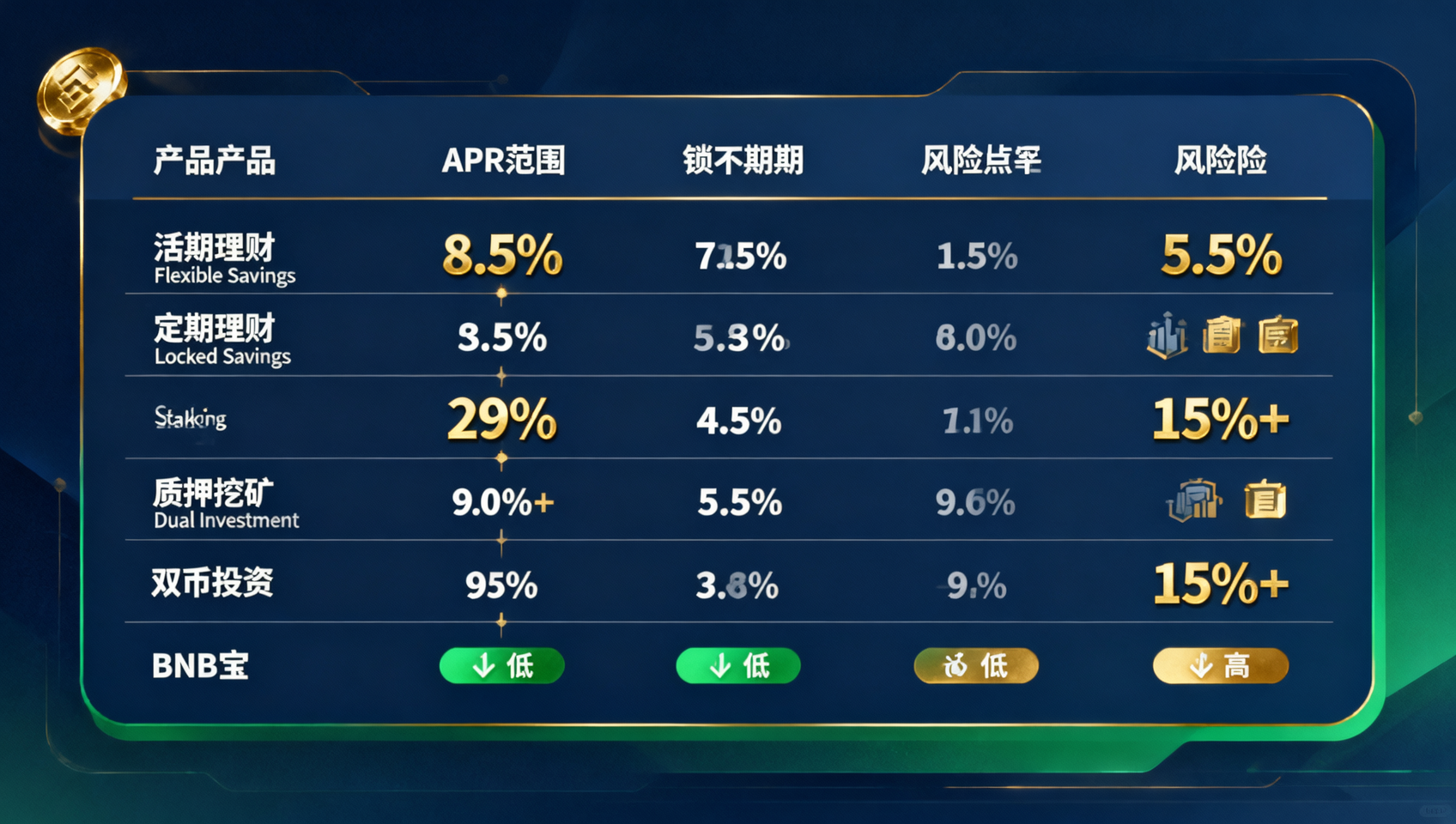
| Product | Source of yield | Liquidity | Main risk | Suited to |
|---|---|---|---|---|
| Flexible (Simple Earn) | Platform lends or market-makes the assets; real-time APR plus bonus tiered APR | Redeem anytime, subject to daily limits | Platform risk, rate falls at any time | Cash you may need soon |
| Locked (Simple Earn) | Same, with a lock-up in exchange for a higher rate | At maturity; some allow early redemption with forfeited rewards | Lock-up, rates change daily | Money idle for 1–3 months |
| Dual Investment | Premium received from selling an option | Settles at maturity; no access before | Forced conversion, wrong price view | People who understand the target price and accept conversion |
| Launchpool | Stake BNB/FDUSD to farm a new token | Usually exitable during the campaign | New token falls, rules change | People who want new tokens cheaply |
| Megadrop / HODLer | Megadrop locks BNB and requires Web3 tasks; HODLer rewards a BNB snapshot | Per campaign rules | Airdrop token depreciates, BNB price moves | Long-term BNB holders |
| On-chain Yields | Actual yield from on-chain protocols | Per product rules | Smart contract, protocol, depeg risk | People who accept on-chain risk |
| Auto-Invest | Not yield — a recurring-buy tool | Stop anytime | Price falls | Long-term accumulation |
Product names and entry points change with app versions. This reflects the October 2026 interface; the live Earn page takes precedence.
Flexible: interest every minute, but two different rates
Flexible (Simple Earn) is where most people start. Three mechanics matter:
- The real-time APR changes every minute. It is not fixed; funding conditions and campaigns move it.
- Rewards accrue to your Earn wallet every minute. No manual claiming, but the reward is paid in the coin, not in USDT cash.
- Many products have a bonus tiered APR. Only the first tranche earns the higher bonus rate; the rest earns the base rate.
The third point is the one marketing hides. An illustrative example (numbers show the structure, not a live rate):
You have 10,000 USDT and the page says "up to 7% APR". The rule: the first 500 USDT earns 7%, everything above earns 2%. Your blended APR is (500 × 7% + 9,500 × 2%) ÷ 10,000 = 2.25%, not 7%.
So when you see "up to X%", open the rate details first and check the bonus cap, the base rate and the campaign end date.
Redemption is also not unlimited: most products have a daily fast-redemption cap, with the excess going through standard redemption and taking longer. In extreme volatility or network congestion it can be delayed further. Do not put emergency money entirely into Earn.
Locked: a higher rate in exchange for time
The logic is simple: trade liquidity for yield. But several details differ from a bank term deposit:
- The rate can change daily. Unless a product explicitly offers a fixed rate, the displayed APR is today's rate and may be adjusted during the term.
- Interest starts the day after subscription. The subscription day does not earn; rewards are then paid daily to your Spot wallet.
- Early redemption is not "earning slightly less". Some locked products allow it, but all accrued rewards are forfeited, and the principal can take 48–72 hours to return.
- Watch auto-subscribe. If enabled, principal rolls into a new term at maturity; cancel ahead of time if you need the funds.
In one line: what a locked product really sells you is not the rate — it is a promise that you will not change your mind.
Dual Investment: an option dressed as savings
Dual Investment is the most misread product in Earn. It looks like a high-yield term deposit; in reality you are selling an option and receiving the premium.
There are two directions:
- Buy Low: you subscribe with USDT and set a target price below the current price. At settlement:
- Price at or above target → you get your USDT back plus yield.
- Price below target → your USDT is converted into the coin at the target price.
- Sell High: you subscribe with a coin and set a target price above the current price. At settlement:
- Price at or below target → you get your coin back plus yield.
- Price above target → your coin is converted into USDT at the target price.
An illustrative example (prices are for explanation only):
BTC is at 100,000 USDT. You choose Buy Low, target 95,000, 7-day term, and the page shows 20% APR. After 7 days:
- BTC above 95,000 → you get USDT back; actual 7-day yield ≈ 20% × 7 ÷ 365 ≈ 0.38%.
- BTC below 95,000 → you buy BTC at 95,000. If the market is at 90,000, you are immediately about 5.3% down on paper.
So the key question is not "what is the APR" but "am I willing to take delivery, or sell, at that price?" If yes, it is a yield-enhancement tool. If no, it is a product that pays you 0.38% for taking a 5% conversion risk.
In one line: the APR on Dual Investment is an annualised option premium, not annualised deposit interest.
Launchpool, Megadrop and HODLer: eligibility is the point
These three are often confused, but the requirements differ:
| Campaign | What you need | How rewards are earned | Main risk |
|---|---|---|---|
| Launchpool | Stake BNB (flexible or locked), FDUSD or another specified asset | Pro-rata share of a new token, distributed hourly or daily | New token falls, rules change |
| Megadrop | Lock BNB in Simple Earn Locked and complete Web3 tasks | Points-based airdrop allocation | BNB moves during lock-up, task thresholds |
| HODLer Airdrops | Hold BNB in Simple Earn (flexible or locked) | Retroactive airdrop based on a snapshot | Airdrop token depreciates, snapshot rules |
The common thread: you must hold BNB first. So "buying BNB for the airdrop" means taking two layers of risk at once — BNB's own price and the airdrop token's price.
Conversely, if you already hold BNB long term, parking it in flexible or locked Earn earns you airdrop eligibility without adding a new position. That is the most sensible use of these campaigns.
Note: snapshot times, lock-up requirements and allocation rules differ every campaign and can change. Read the announcement; do not apply last campaign's rules to this one.
APR, APY and what you actually receive
Earn pages show two kinds of numbers:
- APR (simple annual rate): actual return = principal × APR × days held ÷ 365.
- APY (compounded annual rate): assumes rewards are reinvested, so it is higher than APR.
Run the numbers:
10,000 USDT at 3% APR for 30 days: 10,000 × 3% × 30 ÷ 365 ≈ 24.66 USDT. If only the first 1,000 USDT earns 7% and the other 9,000 earns 2%: (1,000 × 7% + 9,000 × 2%) × 30 ÷ 365 ≈ 20.55 USDT, a blended APR of about 2.5%.

Two more details:
- Rewards may be paid in a coin. You subscribe with USDT, but if the reward is a platform token or a new token, a price drop eats the nominal yield.
- APY requires reinvestment. Flexible accrues every minute and keeps rewards in the Earn wallet, close to continuous compounding. If locked rewards go back to Spot and you do not reinvest, you are earning APR.
Risk checklist: Earn can lose money
Binance Earn is not principal-protected with interest. Six risks matter:
- Platform/custody risk. The assets sit on the exchange's books, not behind your private keys. If the exchange fails, Earn assets are exposed too.
- Issuer risk. Earning on USDT or USDC adds the stablecoin issuer's credit risk on top.
- Lock-up/liquidity risk. Locked funds cannot be withdrawn before maturity; you can only watch if you need cash.
- Exercise risk. Dual Investment can settle into a coin, or at a price, you did not want.
- Reward-token depreciation. Launchpool, Megadrop and HODLer pay in new tokens, and "listing day high" is common.
- Rule and jurisdiction risk. Rates, caps, campaign windows and eligible regions can change; yesterday's page is not today's.
In one line: the risk in Earn is not "earning a bit less" — it is being unable to withdraw when you need cash, being converted at settlement, or sharing the platform's fate.
How to choose based on how long you can leave the money
Instead of comparing headline APRs, first set a horizon for the money:
| Your situation | First choice | Why |
|---|---|---|
| Might need it anytime | Flexible, or just keep it in Spot | Liquidity first; do not lock emergency funds for a few points |
| Idle for 1–3 months | Locked | Trade a fixed term for a higher rate |
| Willing to end up in another coin | Dual Investment | Only when you would accept delivery or sale at the target |
| Long-term BNB holder | BNB flexible/locked (Megadrop needs locked) plus Launchpool/HODLer | Interest is secondary; airdrop eligibility is the main return |
| Chasing higher yield | On-chain DeFi (accept contract risk) | Higher yield, no platform backstop, higher risk |
| No platform risk at all | Self-custody cold wallet | No yield, but the assets are yours |
Five costly mistakes
- Treating "up to 7%" as 7% on the whole balance. The bonus tranche is usually small; the blended rate may be barely above 2%.
- Looking only at APR, not term or exercise conditions. A 20% Dual Investment APR is 0.38% over 7 days, and can come with a 5% conversion loss.
- Treating Dual Investment as a deposit. You only discover you sold an option when settlement hands you a coin you did not want.
- Redeeming a locked product early. All accrued rewards are forfeited, and the money takes 48–72 hours.
- Overweighting BNB for an airdrop. The airdrop token can fall on listing and BNB can fall too — two risks at once.
- Ignoring redemption limits. "Withdraw anytime" has a daily cap; a large emergency withdrawal may not clear.
💰 Binance fee rebate: invite code BINANBT
Earn yield is calculated on your principal, but trading fees leak every day — lock in 20% off at signup.
- Rebate: 20% of every trading fee is returned. The rebate cap for invited users is uniformly 20%.
- How to claim: enter BINANBT in the invite-code field at signup. If you missed it, you can still bind within 30 days of registration as long as the account has no trading history.
- Stack it: enabling "pay fees with BNB" saves about 25% on spot, which compounds with the rebate.
- Important: registering directly inside the app gets you no signup reward at all. In-app signups are not linked to any referral relationship, so the $19,800 welcome package and the 20% fee rebate will not apply — use the registration link or enter BINANBT.
👉 Sign up for Binance and claim the 20% fee rebate
FAQ
Is Binance Earn principal-protected?
No. It protects the quantity of coins (and even that can be affected in extreme conditions), not the coin's price. It is not a bank deposit and has no deposit insurance. Earning on USDT reduces price volatility but still carries platform and stablecoin-issuer risk.
What is the difference between flexible and locked?
Flexible can be redeemed anytime, pays a lower rate that changes every minute, and suits money you may need. Locked pays more in exchange for a term; its rate may change daily, early redemption forfeits accrued rewards, and funds take 48–72 hours to return.
The page says 7% APR — why did I receive less?
Most high rates are bonus tiered: only the first tranche earns the headline rate and the rest earns the base rate. Campaigns also have end dates and caps. Calculate the weighted average rather than multiplying the headline by your whole balance.
Can Dual Investment lose principal?
Yes. It is a sold option: at settlement your USDT can be converted into a coin at the target price, or your coin into USDT. The asset you receive can be worth less than the premium you earned — often far less.
How do I join Launchpool?
Stake the specified asset (usually BNB or FDUSD) on the campaign page and receive a pro-rata share of the new token. You can usually exit during the campaign, but the token's price is volatile and the reward value is not guaranteed.
What is the difference between Megadrop and HODLer Airdrops?
Megadrop typically requires locking BNB in Simple Earn Locked and completing Web3 tasks, with rewards allocated by points. HODLer Airdrops reward holding BNB (flexible or locked) at snapshot time with a retroactive airdrop. Rules differ per campaign.
Binance Earn or DeFi yield — which is better?
Neither is universally better. Exchange Earn is simpler and more liquid, but the platform holds the assets. DeFi is self-custodial with transparent yield sources, but you bear smart-contract, protocol and depeg risk and pay gas. Large balances are best diversified.
Is Earn income taxable?
Tax rules differ widely by country and this article does not provide tax advice. Consult a local tax professional and keep records of subscriptions, redemptions and rewards.
Further reading
- Stablecoin Guide 2026: Types, Reserves and Risks
- What Is USDT and How to Buy It: Choosing Between Chains
- What Is DeFi? A Beginner's Guide
- Binance Futures Guide 2026: Leverage, Margin and Liquidation Price
- How to Trade Spot on Binance 2026: Limit, Market and Stop-Loss Orders
- Cold Wallets and Hardware Wallets: How to Choose and Use One
- More Binance content: the complete guide
Disclaimer: this article is for educational purposes only and is not investment advice. Earn rates change with the market and campaigns; the rate ranges and worked examples here illustrate the calculation, not actual returns. Structured products such as Dual Investment can lose principal. Choose according to your own risk tolerance and confirm the laws and product availability in your jurisdiction1.
Footnotes
-
Sources: Binance Simple Earn FAQ (minute-by-minute accrual, bonus tiered APR, redemption limits), Locked Products documentation (accrual timing, early redemption), Dual Investment and Launchpool/Megadrop/HODLer campaign pages, checked October 2026. Rates, caps and rules are shown in the app and campaign announcements. ↩