



Table of Contents
- TL;DR: The Bottom Line First
- What an Airdrop Actually Is
- The Counterintuitive Data: Airdrops Are Not Free Money
- How to Find Airdrops: Three Reliable Channels
- Three Questions to Ask Before Claiming
- The 6 Fake-Airdrop Scams
- A 7-Step Safe-Claiming Checklist
- 3 Things to Do After You Claim
- FAQ
- Further Reading
TL;DR: The Bottom Line First
Should you claim airdrops? Yes — but fix one fatal misconception first: an airdrop is not "free money," it's a "marketing asset with risk attached" handed out by the project. The data is cold: roughly 88% of airdropped tokens lose value within months1, and 6 of 8 major airdrops fell 92%–99% from claim day2. The one that actually paid — Hyperliquid (about $130 on claim day, ~$4,700 at its high) — is the exception, not the template.
Three judgments to remember:
- The risk isn't in "claiming" — it's in the moment you click Claim and approve a contract. The most common fake airdrop doesn't fail to deliver; it tricks you into signing an unlimited allowance, then sweeps your wallet days later3.
- Find airdrops through channels, not DMs. Aggregators like DefiLlama and DappRadar, plus exchange airdrops, are the reliable entry points; any "claim tokens" link in a DM or comment is a scam4.
- You owe tax the moment you claim. The IRS taxes airdrops as ordinary income at fair market value on receipt — even if the token later goes to zero, that year's tax bill doesn't disappear5.
⚠️ This article covers how to claim safely and spot scams, not investment or tax advice. Airdrop scams are industrialized — never expose your main wallet or large funds to a link or contract you're not certain about.
Not the right article for you if: you've never used an on-chain wallet and don't know what "approval" or "gas" means. Start with Crypto Wallet Complete Guide and What Is DeFi?, then come back.
What an Airdrop Actually Is
An airdrop is a project's free distribution of new tokens to a batch of eligible wallet addresses. The usual goals: bootstrap liquidity, grow users and community, and reward early adopters. Eligibility is decided by a "snapshot" — the project records qualifying addresses at a moment in time and then sends tokens to those addresses.
Common eligibility signals include: interacting with a protocol (swapping, providing liquidity, lending, staking), holding a token until the snapshot date, completing quests, having historical volume, or simply "you used it, so you're included" in a retroactive airdrop6.
For the project, an airdrop is a marketing cost: future tokens exchanged for present attention and activity. For you, it's an asset with a price — what you pay isn't money but time, attention, and wallet exposure. Once you internalize that, most of the traps make sense on their own.
The Counterintuitive Data: Airdrops Are Not Free Money
Most people claim airdrops chasing "free money," but the real distribution looks like this:
| Airdrop | Outcome |
|---|---|
| Hyperliquid ($HYPE) | ~$130 on claim day → ~$4,700 at peak, roughly 36x, the sole outlier |
| Uniswap ($UNI) | Roughly flat after claim, about +8% |
| The other 6 major airdrops | Down 92%–99% from claim day |
Source: CoinsProbe's analysis of 8 major airdrops2.
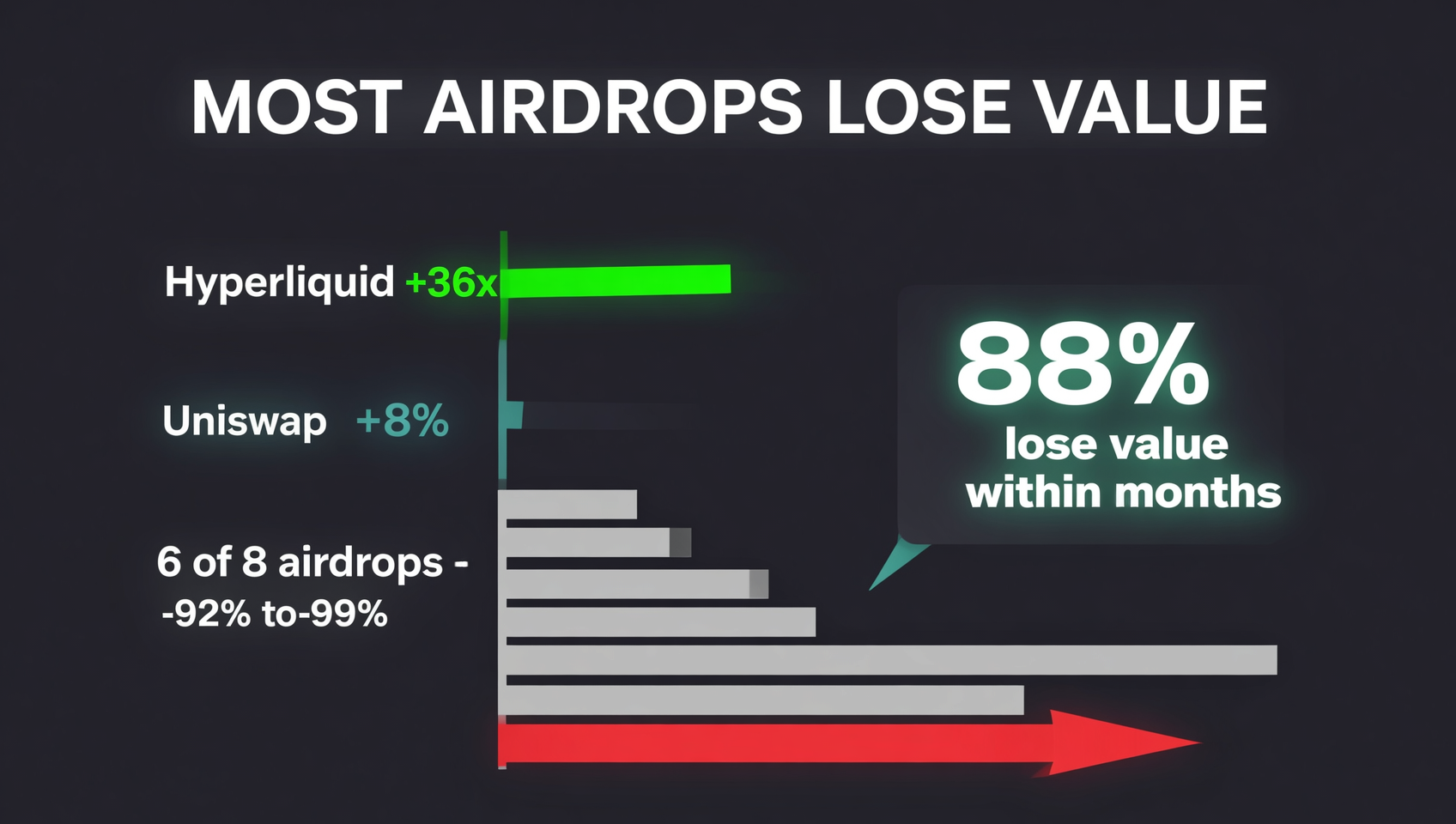
In other words, an airdrop's "paper wealth" starts shrinking the moment you claim it. Hyperliquid is a legend precisely because it's rare — a token that went from $2 to roughly $47, airdropped 31% of supply to about 94,000 early users, with zero VC allocation7. Most airdrops hand you a marketing asset that's "worth money today, worthless in three months."
The counterintuitive conclusion: the most reliable payoff from an airdrop is usually not holding for the rally, but deciding at the moment you receive it — record it for taxes or take profit early. The "free money, no worries" mindset is exactly what loses people their principal.
How to Find Airdrops: Three Reliable Channels
Channel one: aggregators (the easiest). DefiLlama's Airdrops section is free, open-source, and ranks projects by funding and TVL — ideal for filtering "real business" protocols. DappRadar has a dedicated Airdrops section and a Portfolio tool that checks whether your wallet was already snapshotted for a retroactive airdrop. Bankless Claimables shows unclaimed airdrop eligibility across your EVM addresses4.
Channel two: exchange airdrops (best for beginners). Binance's Launchpool and HODLer Airdrops usually just require holding BNB or a specific token, or doing tasks on the platform, with the exchange handling KYC and compliance — almost zero "wrong link, wallet drained" risk. If you don't have an account yet, use the official Binance signup entry to start with these lower-risk airdrops before touching on-chain claims.
Channel three: not-yet-tokenized protocols (highest reward, most effort). Watch protocols that have raised funding, have real users, but haven't launched a token yet, and do genuine interactions. This is "airdrop farming" — potentially the highest reward, but the most time-consuming and the most likely to be filtered by anti-Sybil checks (see the FAQ below)6.
Three Questions to Ask Before Claiming
Before clicking any "Claim" button, answer these three — if you can't, stop:
Question one: is this airdrop worth claiming? Check whether the project has a real product, public funding, and a token with actual utility. Roughly 88% of airdropped tokens go to zero within months1; if you can't even say what the project does, your time is probably worth more than the tokens.
Question two: is this airdrop safe? Is the link the official domain? Will claiming require signing an "unlimited allowance"? This determines whether you're claiming a token or getting drained.
Question three: will you owe tax on it? Many jurisdictions tax airdrops as ordinary income at receipt5. If you're in one of them, decide before claiming whether this "income" is worth it.
The 6 Fake-Airdrop Scams
By 2026, fake airdrops are industrialized. The six common ones:
- Fake claim sites. Pixel-perfect clones of the official page, a domain off by one letter, with countdown timers and fake "verified" badges to manufacture urgency and skip your checks3.
- Approval drainers (ice phishing). The "Claim" button doesn't send you tokens — it tricks you into approving a malicious contract that can move your tokens later. The scammer may wait days, then sweep your balance once you let your guard down.
- Poisoned airdrops. They send you real, low-value tokens whose metadata contains a phishing link, luring you to "sell or claim more" on a fake site.
- Dusting attacks. Tiny tokens sprinkled on your address to track your on-chain activity, then target you with phishing later.
- Impersonation. Fake developers, support staff, or executives DM you "congratulations, click to claim," or push fake tools like a "Rewards Scanner."
- Fake giveaways. "Send 1 BTC, get 2 back" promotions impersonating celebrities or brands.
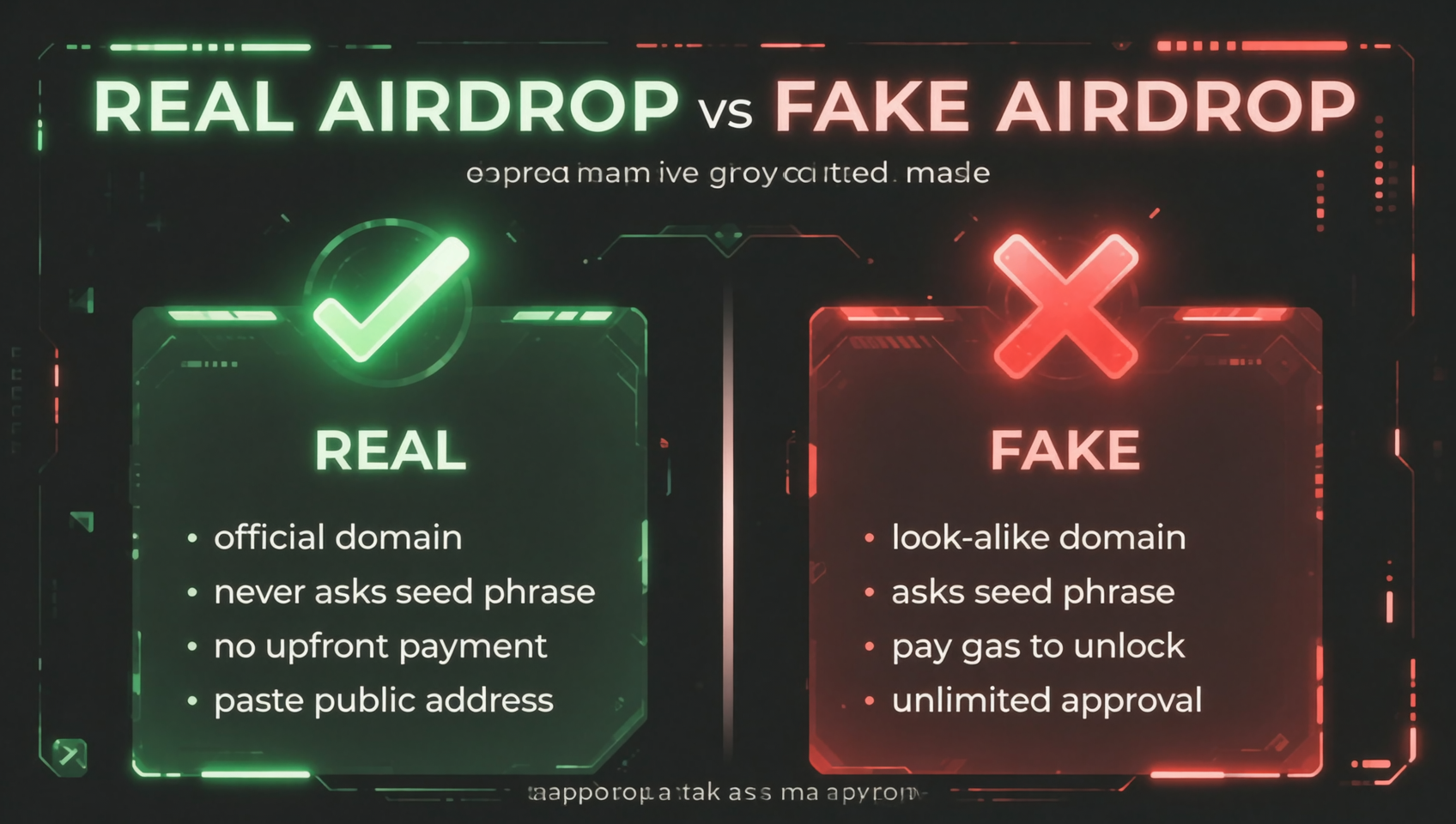
They share one red line: a real airdrop never asks you to transfer funds first, pay a fee, or reveal your seed phrase/private key. If any one of those three appears, treat it as a scam without hesitation.
A 7-Step Safe-Claiming Checklist
Keep these seven rules next to your wallet and run through them before every claim:
- Check the domain letter by letter — watch for swapped characters, added words, and hyphen placement.
- Only use official channels — project site, docs, verified accounts; ignore "claim token" links in DMs and comments.
- Never enter your seed phrase or private key — no legitimate claim ever needs them.
- Prefer "paste address" over "connect wallet" — real projects usually let you check eligibility with just a public address; treat "connect wallet required" with extra suspicion.
- Read every signature — if you see "unlimited allowance," "Set Approval for All," or an unclear amount, stop.
- Verify the contract address — character-by-character against official docs or a block explorer.
- Use a dedicated, small-balance burner wallet — only the amount you need to claim; your main assets never touch it.
Stop conditions — stop immediately if any of these appear: someone DMs you for your seed phrase or private key; a claim asks you to transfer funds or pay a gas/activation/verification fee first; the signature shows an unlimited allowance; or you're about to expose your main wallet or large funds for an uncertain airdrop.
3 Things to Do After You Claim
First, record and account for taxes. Note the token's fair market value at the moment of receipt — it's both your taxable income and your cost basis for later sales5. Don't wait until the token is worth nothing to remember you still owe tax.
Second, clean up approvals. Revoke any contract approvals you granted during claiming that you no longer use, via Revoke.cash or a block explorer's approval tool. See DeFi Approval Security: How to Revoke Unused Contract Approvals.
Third, don't chase, and don't use your main wallet on the next one. Airdrops are a probability game, not guaranteed income. "I'm fine if this goes to zero" is a mindset that outlives "all in on the next Hyperliquid."
FAQ
Are crypto airdrops actually free? Do I have to pay to claim one?
The tokens are free — the project sends them to eligible addresses without charging you. But the moment you hear "pay a gas activation fee," "send crypto first to unlock," or "pay a verification fee," it's a scam: a real airdrop never asks for an upfront transfer or payment. At most you pay your own on-chain gas fee to the network, not to the project.
How do I tell if an airdrop is real?
Three steps: check the channel (only official site/docs/verified accounts); check the ask (a real airdrop at most asks for a connected wallet or a pasted address, never a seed phrase, an upfront transfer, or a fee); check the approval (if signing shows "unlimited allowance," stop). When unsure, search "project name + scam."
Do I have to pay tax on an airdrop?
In many jurisdictions, yes. In the US, the IRS (Rev. Rul. 2019-24) treats airdropped tokens as ordinary income at fair market value when you gain dominion and control, and that amount becomes your cost basis for later sales. Even if the token crashes to zero, you still owe income tax on its value at receipt. Rules vary by country — follow your local rules.
Which wallet should I use to claim airdrops?
Never your main wallet. Set up a dedicated burner wallet with a small balance for claiming and interacting, and keep main holdings in a hardware or cold wallet. That way, an approval-draining contract can only ever reach the small amount in the burner wallet.
What's the difference between exchange airdrops and on-chain airdrops?
Exchange airdrops (Binance Launchpool, HODLer Airdrops) usually require holding a token or doing tasks, with the exchange handling KYC and compliance — lower risk, usually lower reward, best for beginners. On-chain airdrops are sent directly by the project to your address; the upside can be much higher, but fake sites, malicious contracts and seed-phrase leaks are all on you.
What if my airdropped tokens keep dropping?
That's the norm: roughly 88% of airdropped tokens lose value within months, and 6 of 8 major airdrops fell 92%–99% from claim day. Decide at receipt — record it for taxes or swap to stablecoins early — instead of holding for a recovery. Hyperliquid is the exception, not the template.
What is airdrop farming and Sybil? Will I get filtered out?
"Airdrop farming" is deliberately interacting with not-yet-tokenized protocols to chase a future airdrop; a "Sybil attack" uses dozens or hundreds of wallets with shared funding or the same IP to impersonate different users. Projects widely run anti-Sybil checks and disqualify flagged wallets. Don't farm with fake identities — genuine, natural on-chain activity is more likely to pass.
My wallet suddenly has tokens I never claimed. What do I do?
Likely a "poisoned airdrop": scammers send small amounts of real tokens and embed a phishing link in the token metadata. Leave it alone, never click its links, never swap it, and hide or ignore it. If worried about approvals, revoke them via Revoke.cash or a block explorer's approval tool.
Further Reading
- DeFi Approval Security: How to Revoke Unused Contract Approvals — cleanup after claiming
- Honeypot Token Detection: Avoid Buying Scam Coins with DEXTools — spotting scam tokens
- What Is a Rug Pull? Identifying Scam Coins and Exit Scams — recognizing projects that run away
- Anti-Phishing Guide — the phishing methods fake airdrops use most
- Binance Launchpad & Megadrop Guide — lower-risk exchange-side airdrops
- What Is DeFi? A Beginner's Guide — the ecosystem airdrops live in
- On-chain Guide — more blockchain explainers and tutorials
Data verification note: airdrop sizes, price distributions, scam patterns and tax rules were checked on 2026-10-01; see the footnotes7215436. Eligibility and token prices move in real time — verify against project sites and aggregators before acting.
This article is not investment or tax advice. Airdrops carry risks of going to zero, fraud, smart-contract approvals, and tax/regional compliance — participate carefully and follow your local laws.
Footnotes
-
Roughly 88% of airdropped tokens lose value within months. Source: Bitrue "Crypto Airdrop Guide." ↩ ↩2 ↩3
-
6 of 8 major airdrops fell 92%–99% from claim day; only Hyperliquid ~36x and Uniswap ~+8%. Source: CoinsProbe (via KuCoin). ↩ ↩2 ↩3
-
Fake-airdrop scam types: fake claim sites, approval drainers (ice phishing), poisoned airdrops, dusting, impersonation, fake giveaways; red line (never an upfront transfer / fee / seed phrase). Sources: CoinMarketCap community articles, MoonPay Help Center, HDFC SKY. ↩ ↩2 ↩3
-
Airdrop aggregators and tools: DefiLlama Airdrops (defillama.com/airdrops), DappRadar Airdrops and Portfolio eligibility checker, Bankless Claimables, Airdrops.io. Sources: DappRadar, DefiLlama official docs. ↩ ↩2 ↩3
-
US IRS Rev. Rul. 2019-24: airdrops are ordinary income at fair market value when you gain dominion and control, and that amount becomes your cost basis; receipt goes on Schedule 1 (line 8v from 2024), sales on Form 8949/Schedule D. Sources: CoinLedger, TokenTax. ↩ ↩2 ↩3 ↩4
-
Airdrop eligibility and anti-Sybil: snapshot, volume, holding, KYC, social, dapp interaction, quests, retroactive airdrops; anti-Sybil filters out flagged farming wallets. Sources: Gate Wiki, Panaprium "Airdrop Farming 2026." ↩ ↩2 ↩3
-
Hyperliquid $HYPE airdrop: ~$19.82B theoretical value (largest in crypto history), 31% of supply airdropped, ~94,000 early users, zero VC allocation, price $2 → ~$47, median allocation ~$130 on claim day → ~$4,700 (~36x). Sources: CoinTelegraph, Gate News, KuCoin/CoinsProbe analysis. ↩ ↩2