


Introduction
What is Ethereum? In one sentence, Ethereum is a decentralized global open-source computer platform that lets anyone build and run decentralized applications (DApps) through smart contracts. It was proposed by Vitalik Buterin in 2013 and launched in 2015, making it the first blockchain to support general-purpose smart contracts and the second-largest cryptocurrency ecosystem after Bitcoin.
As of July 2026, here are Ethereum's live figures:
- ETH Price: ~$3,420 (7-day trading range $3,150-$3,580) 1
- ETH Market Cap: ~$412 billion, accounting for ~19% of global crypto market cap 1
- TVL (Total Value Locked): ~$43 billion, representing ~48% of all public chain TVL 2
- ETH Staked: ~34 million ETH (~28% of circulating supply) 3
- Active Developers: 6,000+ monthly active developers, the largest smart contract developer ecosystem in the world 4
Ethereum has come a long way in 11 years, evolving from a "world computer" proof-of-concept into a decentralized economic network securing hundreds of billions of dollars in assets, tens of thousands of DApps, and millions of users. This article will walk you through five key dimensions — smart contract fundamentals, PoS staking economics, the L2 ecosystem landscape, DeFi landscape, and ETH ETF institutional adoption — to help you understand Ethereum in 2026.
Smart Contracts: Ethereum's Core Innovation
From Bitcoin to Ethereum: The Evolution of Computation
Bitcoin's scripting language is extremely limited — it can only handle basic transfer condition checks (like multi-sig or timelocks) and cannot execute complex logic. Ethereum's breakthrough was introducing a Turing-complete virtual machine (the EVM), allowing developers to run arbitrarily complex programs on the blockchain.
What is the EVM? The Ethereum Virtual Machine (EVM) is a distributed state machine — every Ethereum node around the world runs the same computer, executing the same smart contract code and arriving at the same result. This "deterministic execution" is the core of Ethereum's trust model.
How Smart Contracts Work
A smart contract is essentially self-executing code deployed on the Ethereum chain that cannot be altered once deployed. The lifecycle of a smart contract looks like this:
- Write: Developers write contract code in Solidity (the most popular language) or Vyper
- Compile: The code is compiled into EVM bytecode
- Deploy: A transaction deploys the contract to Ethereum, paying Gas fees
- Call: Users or other contracts invoke contract functions via transactions, triggering execution
- Settle: The EVM executes the code, updates the state, and the result is confirmed by all network nodes
As of now, there are over 45 million active smart contracts on the Ethereum mainnet, generating roughly 1.1 million on-chain transactions per day (excluding L2 transactions) 3.
Why Smart Contracts Are Revolutionary
| Traditional Contracts | Smart Contracts |
|---|---|
| Require lawyers, notaries, courts, and other intermediaries | Code is law, automated execution |
| Both parties must trust each other | No trust needed — trust the code |
| Long execution cycles (days to months) | Execution in seconds |
| Can be unilaterally modified or terminated | Immutable once deployed |
| High cost (legal fees, intermediary fees) | Pay only Gas fees |
| Cross-border legal conflicts | Globally uniform execution |
Ethereum's Consensus Mechanism: From PoW to PoS
The Merge: Ethereum's Most Important Upgrade
On September 15, 2022, Ethereum completed its most important upgrade — The Merge — switching from Proof of Work (PoW) to Proof of Stake (PoS). This upgrade fundamentally changed how Ethereum operates:
| Dimension | PoW (Pre-Merge) | PoS (Post-Merge) |
|---|---|---|
| Energy Consumption | Roughly equivalent to Norway's electricity usage | Reduced by 99.9% |
| ETH Issuance Rate | ~4-5% per year | ~0.5% per year |
| Block Time | ~13 seconds | ~12 seconds |
| Participation Barrier | Requires ASIC miners (tens of thousands USD) | Min 32 ETH (solo staking) or any amount (via liquid staking) |
| Security | Secured by hashrate, attacks require buying miners | Secured by economics, attacks require holding large amounts of ETH |
PoS Staking Economics
Under PoS, validators must stake ETH to participate in consensus. As of July 2026:
- Validators: ~1.1 million, distributed across approximately 8,500 independent nodes 3
- Total Staked: ~34 million ETH, representing ~28% of circulating supply 3
- Annual Yield: ~3.0-4.5% (base staking reward + MEV + priority fee income) 5
- ETH Staking Rate Comparison: Ethereum's current 28% staking rate is below Lido's target 50-60% range, and also below many PoS chains (e.g., Solana ~68%, Cardano ~63%), indicating plenty of ETH is still unstaked.
Two Ways to Stake:
| Method | Minimum | APR | Complexity | Liquidity | Risks |
|---|---|---|---|---|---|
| Solo Staking | 32 ETH (~$109K) | 3.0-4.5% | ⭐⭐⭐ | ❌ Withdrawal queue required | Low (Slashing risk) |
| Liquid Staking (Lido, Rocket Pool) | From 0.1 ETH (~$342) | 2.8-3.5% | ⭐ | ✅ Tradeable anytime | Medium (contract risk) |
| CEX Staking (Binance, Coinbase) | From 0.001 ETH | 2.5-3.2% | ⭐ | ✅ Sellable anytime | Medium-High (custody risk) |
The 2023 Shapella upgrade unlocked ETH withdrawal functionality. Since the upgrade, approximately 18 million ETH has been successfully withdrawn, while about 24 million ETH has been newly deposited — the staking pool remains in net inflow overall 3.
Layer 2 Ecosystem: Ethereum's Scaling Solutions
Why Layer 2 Is Necessary
Ethereum's mainnet throughput is roughly 15-30 TPS (transactions per second) 6 — during the 2021 DeFi/NFT boom, a simple transfer could cost $500+ in Gas fees. To support a global-level financial system, Ethereum needs to scale.
Layer 2 (L2) works by moving transaction computation off-chain and submitting only the final result to the Ethereum mainnet, dramatically increasing throughput without sacrificing security.
Mainstream L2 Comparison in 2026
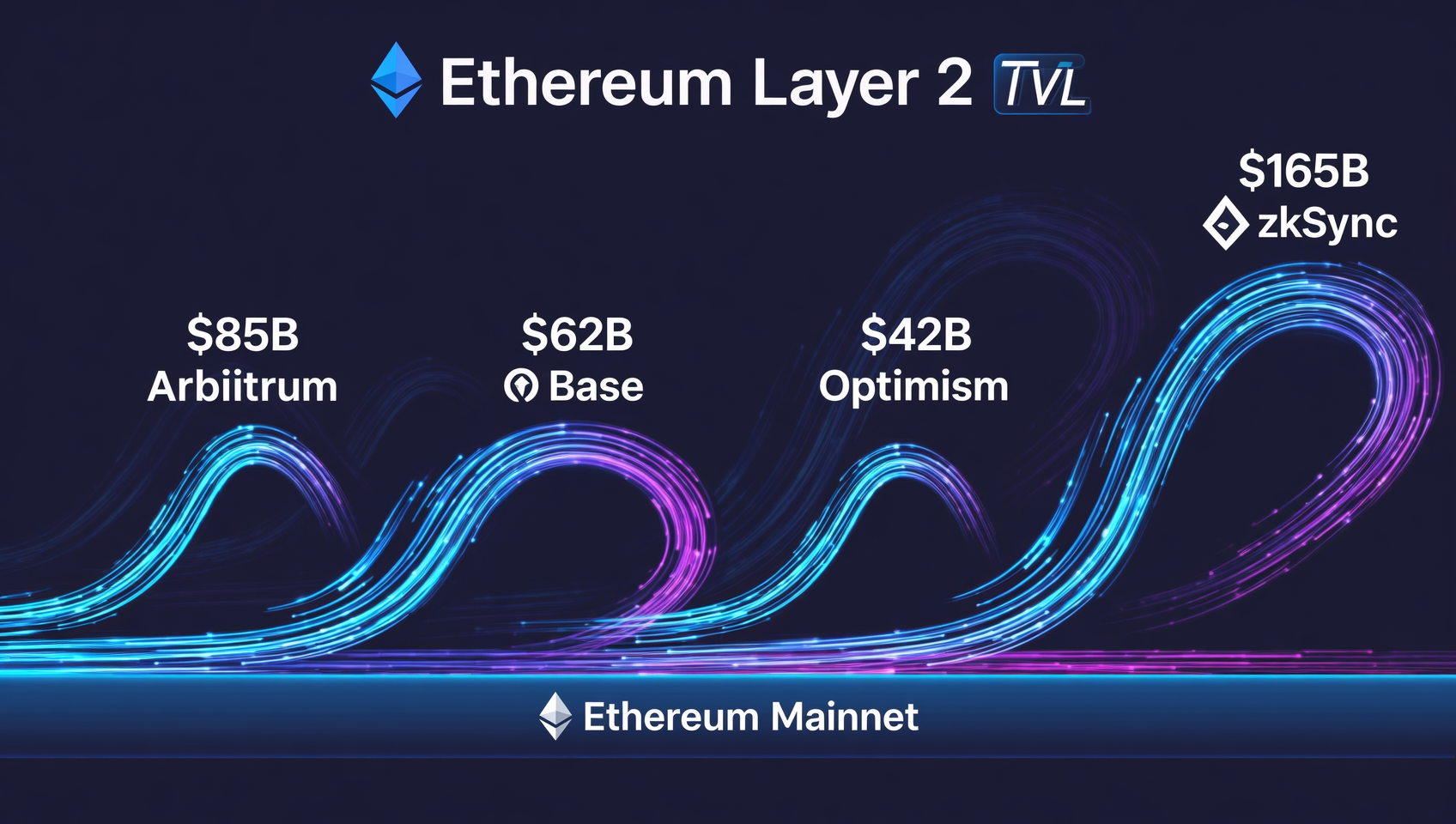
As of July 2026, the Ethereum L2 ecosystem has grown into an economic hub worth hundreds of billions of dollars:
| L2 | Type | TVL | Daily Tx | Avg Gas | Launch Date | Key Advantage |
|---|---|---|---|---|---|---|
| Arbitrum | Optimistic Rollup | $16.5B | ~2.2M | $0.01-0.03 | 2021 | Largest ecosystem, most DApps |
| Base | Optimistic Rollup | $8.5B | ~3.5M | $0.01 | 2023 | Backed by Coinbase, fastest growth |
| Optimism | Optimistic Rollup | $6.2B | ~800K | $0.02 | 2021 | OP Stack infrastructure, Superchain |
| zkSync Era | ZK Rollup | $4.2B | ~600K | $0.02 | 2023 | Cutting-edge ZK technology |
| Blast | Optimistic Rollup | $2.8B | ~300K | $0.01 | 2024 | Native yield features |
| Mantle | Optimistic Rollup | $2.4B | ~400K | $0.01 | 2023 | Modular architecture, $MNT ecosystem |
| Linea | ZK Rollup | $1.8B | ~350K | $0.01 | 2023 | Built by ConsenSys, MetaMask integration |
| Scroll | ZK Rollup | $1.2B | ~250K | $0.01 | 2023 | Best EVM equivalence |
Data sources: L2Beat | DefiLlama, July 2026
Optimistic Rollup vs ZK Rollup
Optimistic Rollup (ORU): Assumes all transactions are valid by default, with a 7-day challenge period (Dispute Period) during which anyone can submit a Fraud Proof to challenge suspicious transactions.
ZK Rollup (ZRU): Each batch of transactions includes a zero-knowledge proof (Validity Proof) submitted to the mainnet. The mainnet contract verifies the proof and confirms immediately — no challenge period needed, so withdrawals are much faster (minutes vs 7 days).
| Comparison | Optimistic Rollup | ZK Rollup | |:--------:|:----------------::|:---------:| | Withdrawal Time | ~7 days (challenge period) | ~30 minutes (proof generation + verification) | | Security Assumption | At least 1 honest node verifies | Mathematical proof (cryptographic security) | | EVM Compatibility | ⭐⭐⭐⭐⭐ (native EVM) | ⭐⭐⭐ (partial incompatibility) | | Technical Maturity | Higher (4+ years in production) | Catching up fast | | Representative L2s | Arbitrum, Base, Optimism | zkSync, Linea, Scroll |
Cross-L2 Interoperability and the Superchain
One of the biggest challenges facing the L2 ecosystem in 2026 is achieving unified user experience — moving assets between different L2s still requires bridges, and bridges have historically been a hotspot for security incidents.
Superchain (the L2 interoperability network led by Optimism) and Arbitrum Orbit are both working to solve this problem. The OP Stack allows developers to easily launch their own "OP chain" while sharing Optimism's cross-chain communication infrastructure.
What this means for users: For now, it's recommended to concentrate your main assets on 1-2 core L2s (like Arbitrum and Base). Use official bridges or top-tier cross-chain protocols (like Across) for cross-chain operations, and be mindful of bridge risk exposure.
Ethereum DeFi Ecosystem: TVL Distribution and Core Protocols
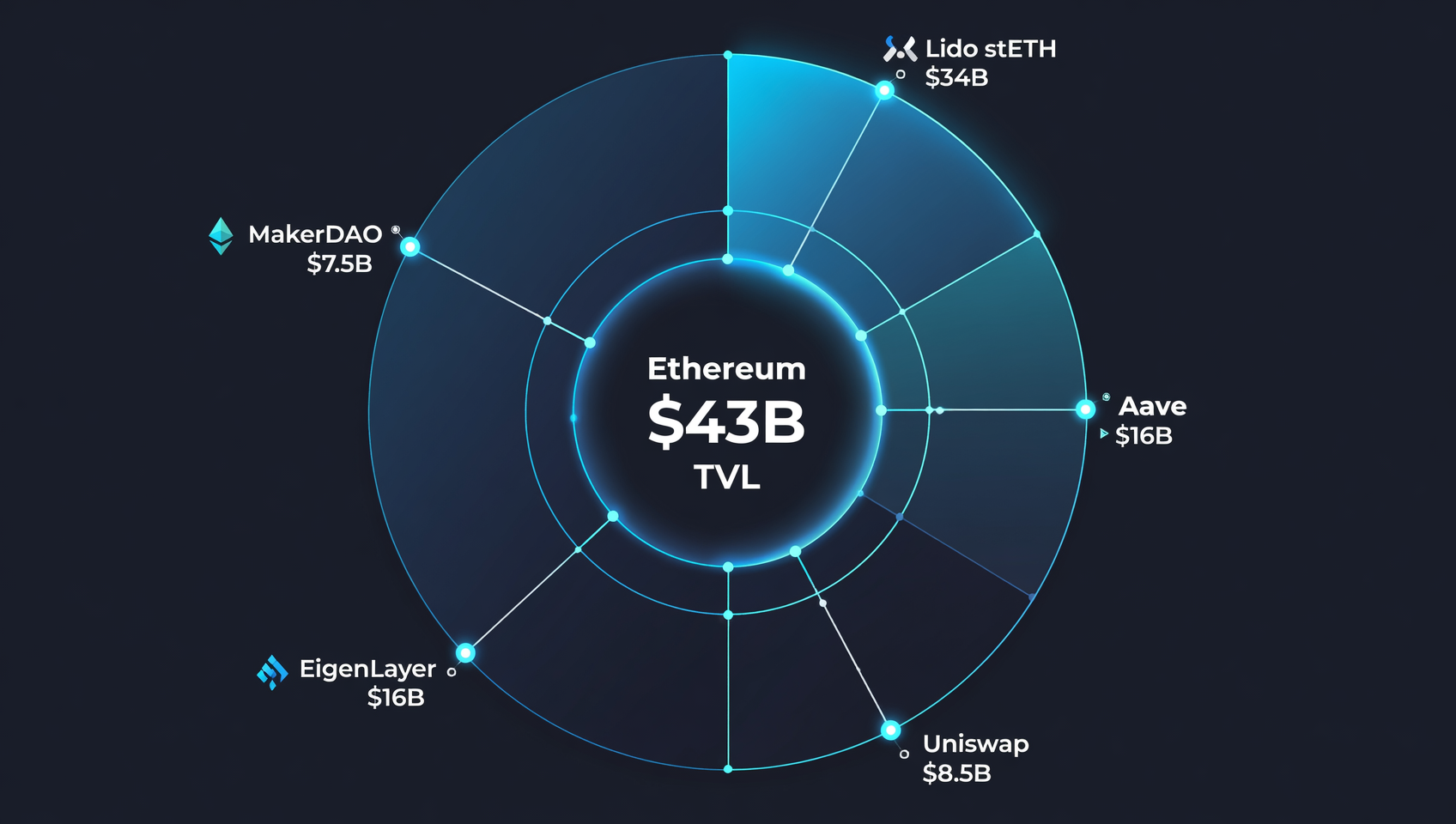
Ethereum is the birthplace and largest ecosystem of DeFi (Decentralized Finance). As of July 2026, Ethereum mainnet plus L2s hold approximately $43 billion in DeFi Total Value Locked (TVL), accounting for ~48% of all public chain DeFi TVL 2.
Top 10 Ethereum Ecosystem Core Protocols
| Rank | Protocol | Type | TVL | Annual Revenue | Key Feature |
|---|---|---|---|---|---|
| 1 | Lido | Liquid Staking | $34B | $180M | Largest ETH staking pool, stETH |
| 2 | Aave | Lending | $16B | $250M | Multi-chain deployment, GHO stablecoin |
| 3 | Uniswap | DEX | $8.5B | $120M | Largest DEX, Uniswap X aggregation |
| 4 | MakerDAO | Stablecoin | $7.5B | $150M | Issues DAI, RWA transition |
| 5 | EigenLayer | Restaking | $16B | - | AVS ecosystem, LRT foundation |
| 6 | Curve | Stablecoin DEX | $3B | $30M | Low-slippage stablecoin swaps |
| 7 | Morpho | Lending Optimization | $4.5B | $80M | Peer-to-peer lending matching |
| 8 | Compound | Lending | $2.4B | $40M | One of the oldest lending protocols |
| 9 | Pendle | Yield Tokenization | $2.8B | $50M | Future yield trading market |
| 10 | Ethena | Synthetic Dollar | $3.5B | $60M | USDe based on ETH delta-neutral strategy |
Data source: DefiLlama, July 2026
Core DeFi Use Cases
1. Lending Deposit ETH as collateral to borrow stablecoins — on Aave, depositing ETH lets you borrow up to ~75% of its value in USDC/DAI. Deposit rates are around 2-5%, borrowing rates around 4-8%.
2. Decentralized Exchanges (DEX) Uniswap processes approximately $2.5-3.5 billion in daily trading volume, second only to Binance's spot trading. LPs (Liquidity Providers) earn 0.05-0.30% in fee splits.
3. Stablecoins The total stablecoin supply on Ethereum is approximately $115 billion (USDC $38B + DAI $7.5B + native ETH protocol stablecoins) 2.
4. Liquid Staking and Restaking Lido's stETH is the most popular liquid staking token. The restaking track pioneered by EigenLayer allows stakers to simultaneously secure multiple networks (AVS), attracting over $16 billion in ETH cumulatively from 2025-2026.
Real-World Yield Examples
💡 If you have 10 ETH (~$34,200), possible yield paths on Ethereum in 2026:
- Deposit into Lido for stETH →
3.2% APR → Annual yield **$1,094**- Restake on EigenLayer → Additional
1.0% → Annual yield **$1,436**- Borrow USDC on Aave → Deposit USDC into the USDC/DAI Curve pool → ~8-12% APR → High risk but high reward
- The simplest option: $10,000 USDC deposited on Aave → ~4-5.5% APR → Annual yield $400-550
ETH ETF and Institutional Adoption
Ethereum Spot ETFs
In May 2024, the US SEC approved Ethereum spot ETFs (unlike Bitcoin ETFs which were approved in January 2024). As of July 2026:
- Cumulative Net Inflows: ~$9.8 billion 7
- Total Net Asset Value: ~$13 billion
- Largest ETF: BlackRock iShares Ethereum Trust (ETHA) — cumulative net inflows of $5.2 billion 7
| Product | Ticker | Management Fee | Cumulative Net Inflows | Issuer |
|---|---|---|---|---|
| iShares Ethereum Trust | ETHA | 0.25% | $5.2B | BlackRock |
| Fidelity Ethereum Fund | FETH | 0.25% | $2.8B | Fidelity |
| Bitwise Ethereum ETF | ETHW | 0.20% | $0.8B | Bitwise |
| Grayscale Ethereum Trust | ETHE | 1.50% | Converted from trust | Grayscale |
Key Difference: Unlike Bitcoin ETFs, the approval of ETH ETFs does not include staking rewards. This means ETF holders cannot earn the ~3-4% annual staking yield on top of ETH price appreciation — this is the biggest income gap between institutional investors and direct ETH holders.
Institutional Adoption Progress
- ETH ETF vs BTC ETF Fund Flows: ETH ETF net inflows are approximately ~19% of BTC ETF inflows, while ETH's market cap is about ~33% of BTC's — suggesting institutions are under-allocated to ETH relative to its crypto market weight, leaving room for growth.
- Growing Enterprise Interest in Ethereum's Technology Layer: More enterprises (such as JP Morgan and PayPal) are using Ethereum for tokenization experiments. JP Morgan's Onyx platform has processed over $700 billion in tokenized collateral transactions on Ethereum 8.
- RWA (Real World Asset) Tokenization: Ethereum is the leading platform for RWA tokenization. Tokenized U.S. Treasury bills on Ethereum have surpassed $3 billion 9, including BlackRock's BUIDL fund ($700M+) and Franklin Templeton's FOBXX product.
Ethereum Roadmap: Key Upgrades and Future Outlook
Completed Key Upgrades
| Upgrade | Date | EIP | Core Change |
|---|---|---|---|
| The Merge | Sep 2022 | — | PoW to PoS, 99.9% energy reduction, 90% issuance reduction |
| Shapella | Apr 2023 | EIP-4895 | Unlocked ETH staking withdrawals |
| Dencun | Mar 2024 | EIP-4844 | Introduced Blob data, L2 fees reduced by 90%+ |
| Pectra | Expected 2026 | EIP-7702 etc. | Account abstraction, validator experience improvements |
Pectra Upgrade: Ethereum's Most Important Upgrade of 2026
Pectra is the next major Ethereum upgrade progressing in 2026, including the following core EIPs:
- EIP-7702: Allows EOAs (regular addresses) to temporarily gain smart contract functionality in transactions — this is a major step toward Account Abstraction (AA), with the ultimate goal of seed phrase-free wallet experiences through ERC-4337.
- Validator Improvements: Increasing the maximum effective balance for validators (from 32 ETH to 2,048 ETH), reducing network overhead from too many validators.
- Blob Scaling: Increasing the number of blobs per block to further improve L2 data availability.
Ethereum's Long-Term Roadmap
The 5 phases of Ethereum's future development proposed by Vitalik Buterin 10:
| Phase | Goal | Key Content | Expected Timeline |
|---|---|---|---|
| The Merge ✅ | PoS Transition | Completed | Complete |
| The Surge 🚧 | Scale to 100,000+ TPS | Danksharding, EIP-4844 (one step done), data sharding | 2026-2028 |
| The Scourge | Censorship and MEV Resistance | PBS (Proposer-Builder Separation), inclusion lists | 2026+ |
| The Verge | Lightweight Verification | Verkle trees, stateless clients | 2027+ |
| The Purge | Historical Data Management | EIP-4444, history expiry, state cleanup | 2027+ |
| The Splurge | Account Abstraction | Full ERC-4337 deployment, EOA to AA transition | 2026-2028 |
Roadmap in one sentence: Ethereum is evolving from a "single performance-limited general-purpose computer" into a "highly specialized settlement and consensus layer + dozens of high-performance L2 execution layers."
How to Start Participating in the Ethereum Ecosystem
Step 1: Acquire ETH
- Buy ETH: Complete KYC on Binance or OKX, then buy ETH via bank card/P2P
- Asset Management: Small amounts can stay on the exchange; for long-term holding, transfer to a self-custodial wallet
- Transfer Channel: Strongly recommended to use L2 (Arbitrum or Base) — fees are only $0.01-0.10
Step 2: Connect a Wallet
Install MetaMask as your starter wallet, then add the Arbitrum/Base networks. For advanced users, try Rabby (auto Gas suggestions) or Rainbow (great mobile experience).
Step 3: Experience DApps
Start with these steps to explore the Ethereum ecosystem:
- Swap on Uniswap: Exchange ETH for USDC or DAI to experience decentralized trading
- Deposit on Aave: Deposit ETH to earn interest and experience DeFi lending
- Stake ETH: Stake via Lido to get stETH and experience liquid staking
- Lower-Cost Interactions: Transfer ETH to Base or Arbitrum for the above operations — Gas fees are nearly zero
💡 Beginner budget suggestion: Prepare around $500-1,000 (0.15-0.3 ETH) to experience the full ecosystem. Start with small amounts on L2 to get familiar with the flow before managing larger funds.
Frequently Asked Questions
Which is a better investment, Ethereum or Bitcoin?
Bitcoin is positioned as "digital gold," focused on scarcity (21 million cap) and store of value, with higher institutional adoption ($51.3B ETF inflows). Ethereum is positioned as the "world computer," with the largest developer ecosystem (6,000+ active developers) and the richest range of applications (DeFi, NFT, RWA). They are not in competition. Long-term investors typically hold both — Bitcoin as a store-of-value core position, Ethereum for ecosystem growth upside. As of July 2026, the ETH/BTC ratio stands at approximately 0.055 11.
Is Ethereum staking safe? Can staked ETH be withdrawn anytime?
Staking ETH is generally safe. Running your own validator node requires technical ability and at least 32 ETH. The primary network-level risk is slashing — validators who frequently go offline or act maliciously can have part of their staked funds slashed. Participating through liquid staking protocols like Lido or Rocket Pool has a low barrier to entry (from 0.1 ETH), but adds smart contract risk. Note: The 2023 Shapella upgrade activated withdrawal functionality, so staked ETH can be withdrawn. However, converting stETH/ETH obtained through protocols like Lido may incur slippage costs.
What's the difference between L2 and sidechains? Which is safer?
L2 (Layer 2) security is guaranteed by the Ethereum mainnet — L2s submit transaction data or proofs to the mainnet, and if an L2 behaves maliciously, users can force-exit using mainnet data. Sidechains (like Polygon POS) have their own consensus mechanisms and validator sets, with security independent of Ethereum. Therefore, L2s have a higher security level than sidechains. As of July 2026, Arbitrum ($16.5B TVL) and Base ($8.5B TVL) are the largest L2 ecosystems 12.
Are DeFi protocols on Ethereum safe? Have any been rugged?
Well-known large protocols (Aave, Uniswap, MakerDAO, Lido) have undergone multiple audits, hold massive TVL, and are governed by DAOs — the risk of a rug pull is extremely low. However, smaller and mid-sized DeFi projects carry higher risk — from 2024-2026, DeFi losses from contract vulnerabilities and governance attacks exceeded $1 billion 2. The golden rule: only use protocols that have been professionally audited (by at least 2-3 firms) and have TVL exceeding $100 million.
Is the ETH ETF worth buying? What's the difference from buying ETH directly?
ETH ETFs (like BlackRock ETHA, Fidelity FETH) trade on traditional exchanges like Nasdaq. Holding an ETF is equivalent to indirectly holding ETH. The difference: ETFs don't require managing private keys or wallets, can be traded in brokerage accounts, and are SEC-regulated — suitable for institutions. However, ETFs cannot participate in on-chain DeFi, earn staking yields, or be used for on-chain interactions. As of July 2026, US ETH spot ETFs have cumulative net inflows of approximately $9.8 billion 7, but the absence of staking yield in ETH ETFs is the main gap compared to holding ETH directly.
What's the future outlook for Ethereum?
Ethereum's long-term roadmap revolves around five phases: The Surge (100K+ TPS through Danksharding), The Scourge (MEV and censorship resistance), The Verge (Verkle trees for stateless clients), The Purge (historical data expiry), and The Splurge (account abstraction). The most important upgrade of 2026 is Pectra, introducing EIP-7702 account abstraction and improved validator experience. Long-term, Ethereum is evolving from a "fat protocol" toward a "settlement layer."
Is Ethereum Gas cheap now? Is it still as expensive as 2021?
Mainnet Gas fees can still be expensive during peak periods (a Uniswap swap costs $3-15), but this is massively improved compared to the 2021 NFT mania (single transactions cost $100-500). More importantly, with the widespread adoption of Layer 2, most daily transactions have moved to L2s — on Arbitrum and Base, transaction fees are only $0.01-0.10, effectively approaching free. After the 2024 Dencun upgrade introduced Blob data, L2 fees dropped by over 90% 13.
What's the difference between ERC-20 and ERC-721?
ERC-20 is the fungible token standard — every token is identical and interchangeable, like USDT, UNI, LINK. ERC-721 is the non-fungible token (NFT) standard — each token is unique and non-interchangeable, like CryptoPunk avatars or digital artwork. Simply put: ERC-20 is like "money" ($100 for $100, no difference), ERC-721 is like a "property deed" (each house has a different address and layout). ERC-1155 is a hybrid standard where a single contract supports both fungible and non-fungible token types.
Which has better technology, Ethereum or Solana?
The two have fundamentally different technical approaches. Ethereum prioritizes security and decentralization (tens of thousands of validators), with transaction speeds of about 15-30 TPS (mainnet) + L2 scaling. Solana prioritizes high performance (theoretically 65,000 TPS, around 4,000 in practice), but has suffered multiple outages (approximately 10 between 2022-2024). As of July 2026, Ethereum's TVL is approximately $43 billion versus Solana's $8 billion. Choose Ethereum for: strong security, mature ecosystem, scaling solved by L2. Choose Solana for: low fees, fast confirmations, single-layer experience.
Does Ethereum halve? Is there a supply cap for ETH?
Ethereum does not have a periodic halving mechanism like Bitcoin. ETH supply has no hard cap, but after transitioning to PoS with The Merge in 2022, ETH's annual issuance rate dropped from ~4% to about 0.5%. The EIP-1559 mechanism burns a portion of ETH — when network activity is high, the amount burned can exceed the amount issued, putting ETH into deflation. Since 2021, EIP-1559 has cumulatively burned over 4 million+ ETH (worth approximately $14 billion) 3, with some months (like November 2021) seeing a net daily decrease in ETH supply.
Further Reading
Related Articles on This Site
- Ethereum and Smart Contracts: Complete Beginner's Guide — Ethereum basic concepts explained
- What is Bitcoin? Beginner's Complete Guide — Bitcoin basics
- What is Blockchain? Learn Blockchain Fundamentals in One Article — Blockchain technology intro
- MetaMask Wallet Guide — Ethereum wallet tutorial
- What are Stablecoins on Ethereum? USDT/USDC/DAI — Ethereum DeFi building blocks
- What is DeFi? Complete Beginner's Guide to Decentralized Finance — DeFi concepts explained
- What is NFT? Is NFT Still Worth Investing in 2026 — NFT ecosystem insights
External Authoritative Resources
- Ethereum.org — Official Ethereum website
- Etherscan — Ethereum blockchain explorer
- DefiLlama — Ethereum DeFi data dashboard
- L2Beat — L2 ecosystem risk and data tracking
- Blockchain Guide - Start from Zero — More blockchain educational content
- CoinGecko Ethereum — Real-time ETH price data
Disclaimer: This content is for educational reference only and does not constitute investment advice. Cryptocurrency investment involves risk, with extreme price volatility. Please make informed decisions based on your own circumstances.
Footnotes
-
Etherscan Ethereum on-chain data, July 2026 ↩ ↩2 ↩3 ↩4 ↩5 ↩6
-
Electric Capital Developer Report, 2025-2026 ↩
-
Consensys Ethereum staking data tracker, July 2026 ↩
-
Ethereum.org official documentation ↩
-
SoSoValue, US ETH Spot ETF fund flow data, July 2026 ↩ ↩2 ↩3
-
JP Morgan Onyx platform public data, 2025-2026 ↩
-
RWA.xyz, tokenized treasury data, July 2026 ↩
-
Ethereum.org roadmap, 2026 ↩
-
CoinMarketCap ETH/BTC ratio data, July 2026 ↩
-
L2Beat L2 ecosystem data, July 2026 ↩
-
Ethereum Foundation Blog, Dencun upgrade data review, 2026 ↩