

⚠️ Read this first: if you want to try crypto futures trading, register on Binance first — only sign-ups through the registration link (e.g. "Register now") or with invite code BINANBT unlock the new-user rewards (a 20% trading fee rebate plus a welcome package worth up to $19,800). Futures fees are charged on every single trade, so that rebate makes a real difference over a long trading history.
Key takeaways (TL;DR):
- The real difference is not whether you can use leverage — it is whose side time is on. In spot you can refuse to sell and wait; in futures a liquidation price exists, and once it is hit you are out for good, no matter how far price runs afterwards.
- Leverage does not multiply your returns, it multiplies your odds of being knocked out. At 10x a move of roughly 9% liquidates you, at 20x about 4.5%, and at 100x you have only 0.5% of room.
- The "$19 billion liquidation" of October 2025 is notional volume, not money actually lost (realized losses are estimated at $950 million–$2.85 billion) — but the roughly 1.6 million accounts wiped out in 24 hours were entirely real.
- The biggest hidden cost is the funding rate: 0.01% every 8 hours is about 11% a year on notional, and around 110% a year on your margin at 10x leverage. You lose money even when you do nothing at all.
Table of contents
- Spot vs futures in one sentence
- What futures actually trade: perpetuals, mark price and funding rate
- Three things to get right in 2026
- Spot, spot margin and futures are not the same thing
- $1,000, three outcomes: the math that makes it click
- Where beginners should start
- If you must trade futures: five hard rules
- Four traps beginners fall into
- 💰 Binance rebate: invite code BINANBT
- FAQ
- Further reading
Spot vs futures in one sentence
Spot means you buy the thing. Futures means you bet on a price. Buy $1,000 of spot and you own real bitcoin — an asset you can withdraw, stake, or hold for a decade. Open a futures position and you are trading a contract settled in USDT; from open to close, not one actual coin ever passes through your hands.
That single difference sets off a chain of consequences, and most beginners only notice the first link:
| Dimension | Spot | Futures (perpetual) |
|---|---|---|
| What you own | A real asset you can withdraw | A position you can hold indefinitely |
| Leverage | None (unless you open spot margin separately) | Yes, typically 5–125x |
| Short selling | No | Yes |
| Maximum loss | What you put in | Your margin (a violent gap can exceed it) |
| Liquidation price | None | Yes, and it can trigger at any moment |
| Is time on your side | Yes, you can wait | No, holding itself costs money |
| Main cost | A one-off trading fee | Fees + funding rate + slippage |
Read that last row carefully: in spot, time is your friend; in futures, time is a cost. It is also why the idea of "just holding through the drawdown" only makes sense in spot. Spot can genuinely sit through a loss; futures gets closed out automatically at the liquidation price, and there is no second chance.
What futures actually trade: perpetuals, mark price and funding rate
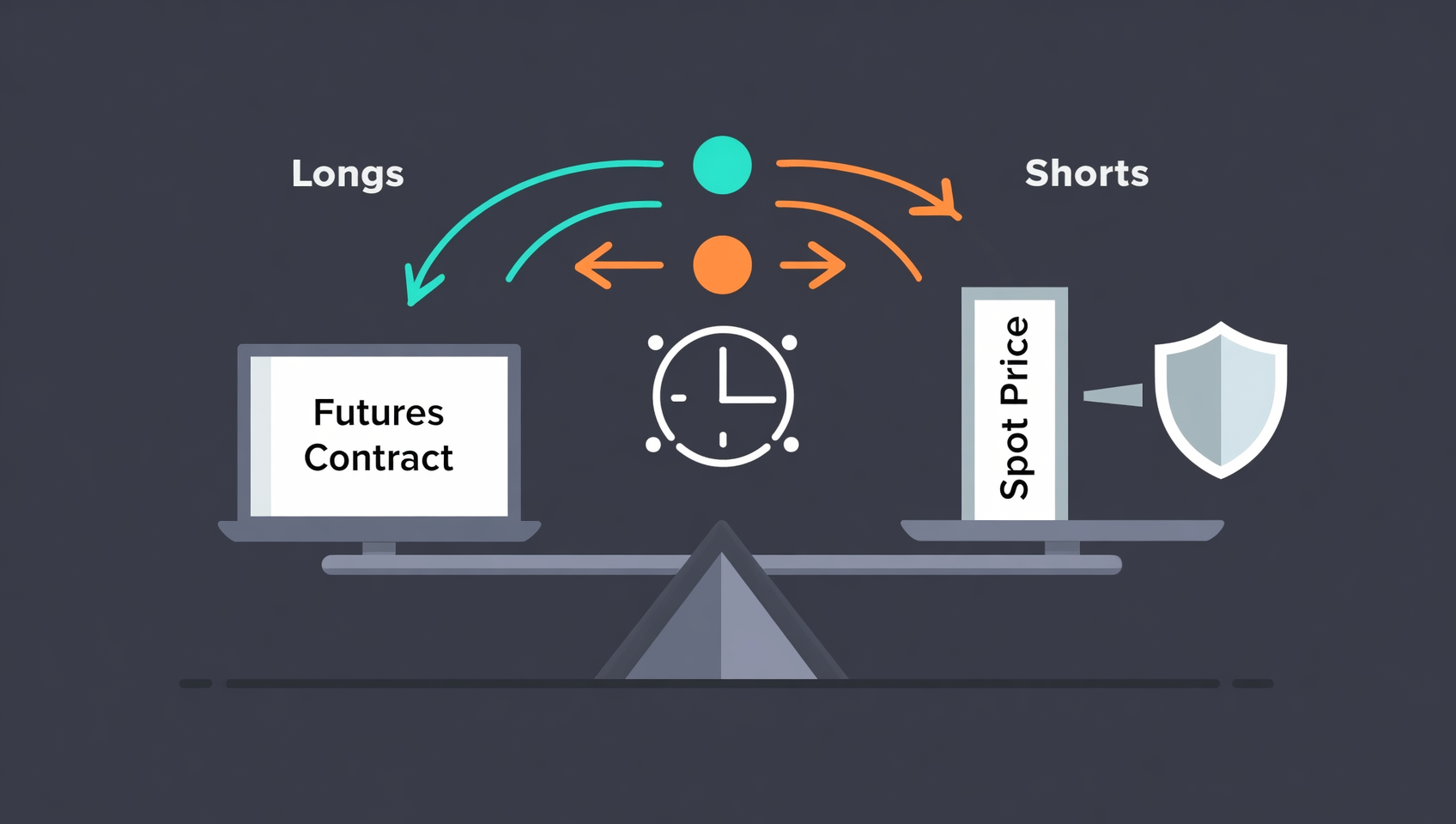
A perpetual futures contract has no expiry date, so it needs a mechanism to keep itself tethered to the spot price — that mechanism is the funding rate.
1. Why a perpetual future never expires
Traditional futures settle on a delivery date. Perpetual futures removed that date entirely: in theory you can hold one forever. The price of that convenience is the funding rate:
- It settles every 8 hours, at 00:00, 08:00 and 16:00 UTC (some contracts use 4-hour or hourly intervals).
- When the rate is positive, longs pay shorts; when negative, shorts pay longs.
- The exchange does not earn this money (Binance takes no cut of the funding rate itself). It is a pure transfer between traders, and its purpose is to stop the perpetual price drifting too far from spot.
This is the cost line beginners skip most often. People carefully price the trading fee and forget that carrying the position costs money too.
2. Liquidations are decided by mark price, not the last traded price
Exchanges decide whether to liquidate using the mark price (usually a weighted average of prices across several spot venues), not the last traded price. The point is to stop someone from pushing a huge order through thin books to wick other people's positions out. Once you understand this, the confusing sentence "the chart never reached that price but I still got liquidated" makes sense — you were watching last price while the system was watching mark price.
3. Cross versus isolated margin: can one position take down your whole account?
- Isolated margin: each position has its own margin. The worst case is losing that position's margin and nothing else.
- Cross margin: every available dollar in your account backs every position. Positions survive drawdowns better, but one bad trade can consume the rest of your balance.
If you insist on trying futures as a beginner, default to isolated margin — that locks the worst case to the exact amount you were willing to lose.
Three things to get right in 2026
Three claims about futures circulate more than any others — "leverage magnifies your profits", "the $19 billion liquidation", "fees are only a few basis points" — and all three need correcting.
First: leverage does not magnify returns, it magnifies your odds of being knocked out
How beginners picture leverage: 10x means a 10% rally earns you 100%. What leverage actually does: 10x means a 9% decline takes you to zero.
Liquidation does not trigger at exactly 1/leverage, because it fires when your margin ratio falls below the maintenance requirement — so the real liquidation price arrives slightly earlier. Rough guide:
| Leverage | Adverse move that triggers liquidation (approx.) | BTC falling from $81,239 to |
|---|---|---|
| 3x | about 32% | about $55,200 |
| 5x | about 19% | about $65,800 |
| 10x | about 9%–9.5% | about $73,700 |
| 20x | about 4.5% | about $77,600 |
| 50x | about 1.5% | about $80,000 |
| 100x | about 0.5% | about $80,830 |
(Approximations calculated from BTC at about $81,239 on October 28, 2026. Actual liquidation prices also depend on the maintenance margin rate, fees and margin mode — always check the exchange's own page.)
The right way to read that table: at 100x, a 0.5% move ends you, and bitcoin routinely moves 1%–3% within a day. That is not "high risk, high reward" — that is being nearly out the moment you enter. So the question worth asking is not "how much leverage should I use", but "how far can price move against me before I stop being in the trade at all".
Second: the "$19 billion liquidation" is notional volume, not money that vanished
On October 10, 2025, tariff headlines triggered a market-wide crash. CoinGlass counted roughly $19.1–19.3 billion of leveraged positions liquidated within 24 hours, a record (the previous record was about $10 billion, in April 2021)1. At the same time:
- about 1.6 million accounts were liquidated;
- longs accounted for about $16.69 billion of that, shorts only $2.46 billion — the vast majority were retail traders chasing the rally;
- BTC fell from about $122,000 to as low as about $102,000, while some smaller coins dropped 33% in 25 minutes;
- open interest across the market had just hit an all-time high of $235.9 billion on October 7; roughly $70 billion of it evaporated in the crash.
But there is a crucial distinction here: $19.1 billion is notional, and it is not the same as $19.1 billion actually lost. A liquidation sells a position at market price; the same money changes hands between longs and shorts. On-chain estimates put realized net losses at only about $950 million–$2.85 billion, which is 7–20 times smaller than the headline number1.
Why bother separating the two figures? Because they teach different lessons. The notional number tells you how big the leveraged market is and how fragile its structure has become. The realized loss tells you whose margin was actually destroyed. And the 1.6 million liquidated accounts are the answer.
Third: the most expensive part of futures is not the fee, it is the funding rate
Start with the visible costs (Binance standard fee tier, checked October 2026):
| Item | Rate |
|---|---|
| Spot trading | 0.1% (about 0.075% with BNB discount) |
| USDⓈ-M futures, maker | 0.02% (about 0.018% with BNB discount) |
| USDⓈ-M futures, taker | 0.05% (about 0.045% with BNB discount) |
| Funding rate | typically 0.01% every 8 hours, up to 0.1%–0.3% in extreme conditions |
On paper the futures fee looks cheaper than spot — but the cost of carrying a position compounds over time:
- 0.01% every 8 hours → three payments a day, 0.03% → about 10.95% a year relative to notional position size.
- At 10x leverage, that 10.95% becomes about 109.5% a year relative to your margin.
- Which means you can be right about direction and still lose money — as long as you hold long enough at high enough leverage.
Bottom line first: the futures cost structure is low trading fees plus high holding fees. Short-term high-frequency traders care about the fee; long-term holders care about the funding rate. Those are two entirely different games.
Spot, spot margin and futures are not the same thing
Beginners often lump spot margin and futures together, but their risk structures are not the same at all.
| Item | Spot | Spot margin | Futures |
|---|---|---|---|
| What you trade | Real coins | Real coins, bought with borrowed money | A contract for difference |
| Can you withdraw it | Yes | Not while it is pledged | No |
| Leverage | None | typically 3–10x | 5–125x |
| Interest | None | Yes (hourly borrowing interest) | No interest, but a funding rate |
| Liquidation | No | Yes | Yes |
| Best suited to | Long-term holding, DCA | Short-term bullish view without selling your coins | Shorting, hedging, short-term trading |
The one-line distinction: spot margin is borrowing money to buy coins; futures is betting on direction without buying any coins. With the first you still end up holding an asset; with the second you only ever hold a profit-and-loss number.
$1,000, three outcomes: the math that makes it click
Take the same $1,000 and the same falling market, and see how three approaches end up in completely different places.
Assume BTC is at $81,239 and then falls 30% to about $56,867:
| Approach | Position | Liquidation price | Result |
|---|---|---|---|
| A. All in spot | 0.0123 BTC | None | Worth about $700, but you still hold 0.0123 BTC — you can simply not sell and wait for recovery |
| B. 10x long (isolated) | $10,000 notional | about $73,700 (-9.3%) | Liquidated long ago, your $1,000 margin is gone, and the later recovery is irrelevant to you |
| C. 100x long (isolated) | $100,000 notional | about $80,830 (-0.5%) | Zeroed out within hours or even minutes — one ordinary move is enough |
Put those three side by side and they say only one thing: a spot loss is an unrealized markdown; a futures loss is a realized, irreversible one. A's -30% is paper, and it recovers when price does. B's and C's -100% cannot be undone — you were force-closed before the 30% decline had even finished playing out.
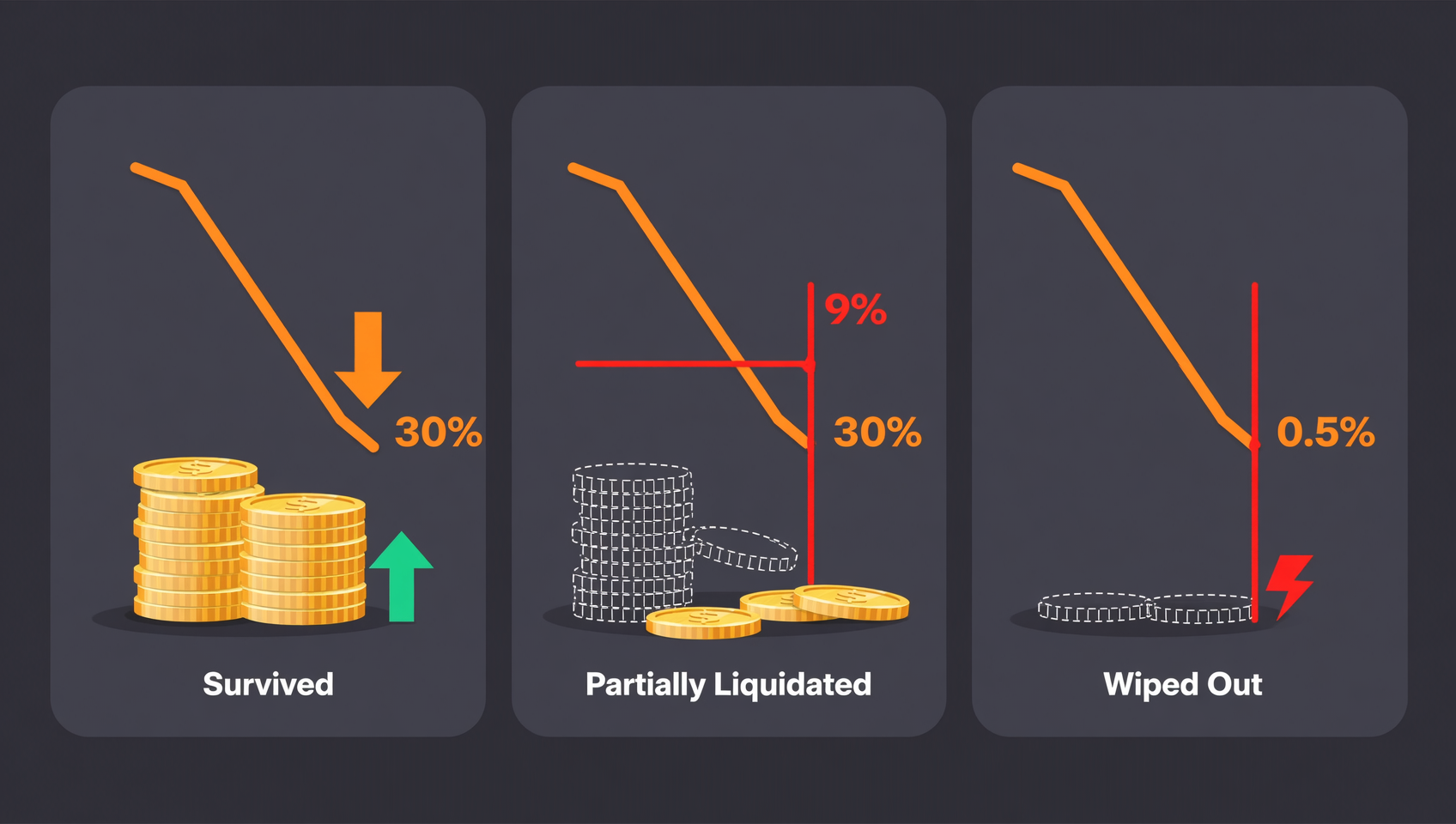
That is also why "hold through the drawdown" is a workable strategy in spot across many cycles, and simply impossible in futures: what you are holding through is not the market, it is the liquidation line.
Where beginners should start
The answer is almost always spot — not because it is more sophisticated, but because its mistakes can be repaired by time.
| Your situation | Recommendation | Why |
|---|---|---|
| Complete beginner, never bought crypto | Spot only | Build a feel for how price moves, at the lowest cost |
| Want to hold long term or DCA | Spot only | No carrying cost, no liquidation to worry about |
| Want to learn shorting or hedging | Spot as the base + small futures position | Start with small size, low leverage, isolated margin |
| Believe futures will quickly win your money back | Don't | That expectation is itself the single biggest source of losses |
| Already have a consistently profitable spot strategy | Futures for hedging | Hedging is one of the most legitimate uses of futures |
One test that settles it: if you cannot state exactly how much you would lose in the worst case and at what price you would exit, you are not ready to trade futures yet.
If you must trade futures: five hard rules
These five are not techniques that improve your win rate. They are the floor that keeps you from being eliminated in a single afternoon.
- Only use money you can lose entirely. Not money whose loss would hurt — money whose loss would not change your life.
- Start at 3–5x leverage, and stay away from 20x and above. At high leverage your room for error is smaller than a normal daily move, which is just handing the outcome to luck.
- Default to isolated margin. Cap the worst case at the exact margin you chose to commit.
- Set the stop loss when you open the position, and place it before the liquidation price. Let the stop loss decide what you lose, not the exchange's liquidation engine.
- Work out the funding rate before deciding how long to hold. Check the current rate before any long hold; with a positive rate, being long means paying rent continuously.
⚠️ One thing that has to be said: futures generate no cash flow. It is a zero-sum redistribution of money, minus fees and funding rates. Every dollar you make comes from someone else's loss plus the costs. Once you accept that, you will stop treating futures as a savings product.
Four traps beginners fall into
- "I'll just add margin and ride it out." Adding margin only pushes the liquidation price a little further away. If you are wrong on direction, all it does is make the loss bigger and the exit later. Before you top up, ask yourself honestly: am I managing risk, or refusing to admit I was wrong?
- "Small position, high leverage — if it blows up, who cares." Do the math: at 100x, a 0.5% move wipes you out, and a single day can produce several of those. The "who cares" position can blow up a dozen times a month, and the total is not small at all.
- Not seeing the long-term erosion from funding rates. Going long on something with a high positive funding rate means paying a toll every day. At 0.1% per 8 hours, that is 0.3% a day and more than 100% a year.
- Carrying spot habits into a futures account. In spot, a 50% drawdown can be waited out for three years. In futures at 10x, a 10% decline already ended your position — the recovery happens without you.
💰 Binance rebate: invite code BINANBT
Whether you start with spot or want to try futures, entering invite code BINANBT at registration saves you money on fees: you get a 20% trading fee rebate. This article contains referral links; registering through them may reward us, but it never costs you a cent extra.
- Rebate amount: 20% cashback on every trading fee; the rebate ceiling for invitees is a uniform 20%.
- How to claim: enter BINANBT in the invite-code field at registration; if you miss it, you can still link it within 30 days.
- Stacking benefit: enabling "Use BNB to pay fees" saves roughly 25% more (futures has a separate 10% discount).
- Important: signing up directly inside the app gets you no signup reward at all. An in-app registration binds to no referral, so the $19,800 welcome package and the 20% fee rebate simply don't apply — you have to use the registration link or enter invite code BINANBT.
👉 Register on Binance and claim your 20% fee rebate
FAQ
What is the most fundamental difference between spot and futures?
It is not whether you can use leverage — it is whose side time is on. Buy spot and you own a real asset: if it drops you can simply not sell, wait it out, hold for years, even stake it. A futures position carries a liquidation price, and when the market touches that line the system closes you out whether you like it or not; every later rally happens without you. Leverage only pulls that line closer.
Can futures losses exceed my deposit?
In isolated margin on a major exchange, losses are in theory capped at the margin you put into that position. In extreme conditions (a violent wick, liquidity drying up) you can get a negative balance, meaning losses beyond your margin — at which point the exchange's insurance fund or auto-deleveraging kicks in. On cross margin, one losing position can eat the rest of your account balance. That is exactly why the cross-versus-isolated question has to be settled before you trade.
At 10x leverage, how far does price have to fall to liquidate me?
Roughly a 9%–9.5% move against you, depending on the maintenance margin requirement and fees. Liquidation does not fire at exactly -10%; it fires when your margin ratio drops below the maintenance requirement, so the real liquidation price sits a little sooner than -10%. At 20x it is about -4.5%, at 50x about -1.5%, and at 100x about -0.5% — the higher the leverage, the closer your room for error gets to zero.
Is the funding rate a fee the exchange charges me?
No. The funding rate is a payment between longs and shorts; the exchange does not collect it (Binance takes no cut of the funding rate itself). When the rate is positive, longs pay shorts; when negative, shorts pay longs. Its job is to keep the perpetual contract trading close to spot. A normal level is 0.01% every 8 hours; in extreme conditions it can reach 0.1%–0.3%.
How expensive is the funding rate if I hold long term?
At 0.01% per 8 hours, three payments a day comes to 0.03%, which is about 10.95% a year relative to the notional size of your position. If you are running 10x leverage, that same cost is roughly 110% a year relative to your margin — meaning that simply sitting still can grind away more than your entire margin within a year. This is the cost most people leave out of their math.
Should a beginner start with spot or futures?
Spot, first. Learn how orders work, what fees feel like, how to read a candlestick chart, how deposits and withdrawals work, and build a real feel for how violently price moves — with real money — before you consider futures. If you insist on trying futures, use an amount you can lose entirely, low leverage (3–5x), isolated margin and a stop loss, and treat it as tuition rather than income.
What is the difference between liquidation and a negative balance?
Liquidation means losses have consumed your margin and the system force-closes the position, leaving you with zero. A negative balance means price gapped so fast that even after forced closure you still owe the exchange money. Negative balances are rare on major platforms because insurance funds and auto-deleveraging (ADL) absorb the gap, but in extreme conditions they are not impossible.
Do most futures traders actually make money?
No, only a minority. Research from the Bank for International Settlements (BIS) found that roughly 73%–81% of retail investors lost money on their first Bitcoin investment, and futures lose faster because leverage plus forced liquidation accelerates everything. In the October 10, 2025 crash, about 1.6 million accounts were liquidated within 24 hours, the overwhelming majority of them longs. That does not mean nobody profits — it means the expectation that futures are a fast road to wealth is simply wrong.
Further reading
- How much money do you need to buy crypto for the first time?
- What Is USDT? How to Buy It in 2026
- What Is Bitcoin? A 2026 Beginner's Guide
- Best Bitcoin Trading Platforms 2026: Top 8 Exchanges Ranked
- Binance Registration 2026: Sign Up, KYC and Deposit
- Binance Invite Code 2026: BINANBT 20% Fee Rebate Guide
- More beginner content: the beginner hub
Disclaimer: This content is for educational purposes only and is not investment advice. Futures trading is a high-risk activity: leverage magnifies both gains and losses and can wipe out your entire deposit or even leave you owing money. Make sure you understand liquidation mechanics, funding rates and margin modes before you trade, and size positions to your own circumstances. All fee and price figures are dated where noted; always verify against the exchange's live pages1.
Footnotes
-
Sources: CoinGecko market data (October 28, 2026); CoinGlass liquidation statistics and public reporting on the October 10–11, 2025 crash (roughly $19.1–19.3 billion in notional liquidations, about 1.6 million accounts, realized losses estimated at $950 million–$2.85 billion); Binance futures fee and funding rate documentation (checked October 2026); Bank for International Settlements (BIS) research on the share of retail crypto investors who lose money. ↩ ↩2 ↩3