

⚠️ Read this first: want to turn fiat into stablecoins before entering the market? Don't tap "sign up" inside the app — only registrations through the registration link (e.g. "Sign Up") or with invite code BINANBT unlock Binance's new-user rewards (20% fee rebate plus a welcome package worth up to $19,800).
Key takeaways (TL;DR):
- A stablecoin is a crypto token pinned to $1, but the peg is a mechanism, not a promise. In late October 2026 the market held roughly $300–304 billion, slightly below the May peak of about $322B1.
- First counterintuitive point: stablecoins do not remove risk, they swap market risk for issuer risk. You stop worrying about price and start worrying about reserves, custodial banks, compliance freezes and redemption capacity.
- Second: "stablecoins settle more than Visa" is a counting-method win. Raw onchain transfers were about $33 trillion in 2025, but adjusted organic volume is only $9–11 trillion, and true consumer payments may be just 1%–2%2.
- Third: 2026 regulation is not a crackdown, it is a fork. The GENIUS Act's rulemaking deadline passed with no final rules, MiCA's transition window closed on July 1, USDT was sidelined in the EEA, and USDC became the EU's first "significant e-money token"345.
- Bottom line: a stablecoin is an onchain claim on dollars, not risk-free cash. Check the issuer, reserves, redemption terms and your local legal status before you check market-cap rankings.
What is a stablecoin? In one sentence: a stablecoin is a crypto token that tries to hold its market price at $1 (or another fiat currency) by backing it with reserves, over-collateralization or hedged positions. It solves the most practical problem in crypto: you do not want your assets jumping around between two trades.
But "stable" is easy to misread. A stablecoin is not a bank deposit and has no deposit insurance; its dollar value rests on a mechanism that can fail. 2026 made that clear: the market grew, regulation arrived, products diverged — and the risk never disappeared, it just moved.
Contents
- What a stablecoin is: one claim, three layers of trust
- The 2026 market in four numbers
- Four types: the peg mechanism defines the risk
- Counterintuitive 1: the risk is the issuer, not the depeg
- Counterintuitive 2: beating Visa is a counting-method win
- Counterintuitive 3: regulation is forking, not tightening
- What three depegs taught us
- How to choose: four decision tables by use case
- Five checks before you deposit
- 💰 Binance rebate: invite code BINANBT
- FAQ
- Further reading
What a stablecoin is: one claim, three layers of trust
The stablecoin you hold is, in essence, an onchain IOU from an issuer. What you trust is not the token contract but the promise that someone will exchange it back for $1 when you need it. That promise rests on three layers.
The first is reserves: does the issuer actually hold matching assets, and are they cash, short-term Treasuries, or commercial paper and crypto? The second is custody: which bank or custodian holds those assets, and can it fail the way Silicon Valley Bank did in 2023? The third is rules: where is the issuer registered, who supervises it, and who can force it to redeem if things go wrong?
If any layer breaks, the dollar peg loosens. So the right question is not "how big is its market cap" but "how solid is each layer." Market cap only tells you how many people currently believe it.
There is also a distinction beginners miss: face value, market price and redemption price are three different numbers.
- Face value is the design target: $1.00.
- Market price is what you pay on an exchange: $0.998, or $0.87 in a panic.
- Redemption price is what the issuer pays out: usually $1.00, but with minimums, fees and settlement time.
The common mistake is to treat "$0.999 on the exchange" as instability and "1:1 redemption" as instant access to a dollar. Between those two statements sit eligibility, thresholds and time.
The 2026 market in four numbers
The October 2026 stablecoin market is highly concentrated, regulatorily split, and mismatched between market cap and flow. Four numbers tell the story better than any narrative.
| Metric | October 2026 | What it means |
|---|---|---|
| Total market | About $300–304B | Slightly below the ~$322B May peak1 |
| USDT size and share | About $182–184B, roughly 60% | Still dominant; flat over 30 days1 |
| USDC size and share | About $71–74B, roughly 24% | Down about 5% over 30 days in October1 |
| Combined | About 84% | Third place USDS is ~$6.8B; no other coin tops $5B1 |
The first number is scale: stablecoins are now the largest cash layer onchain, bigger than most national money-market funds. The second is concentration: USDT plus USDC exceed 80%, and no third player is above $5 billion — Sky's USDS is about $6.8B, Ethena's USDe about $4.7B, World Liberty's USD1 about $4B, PayPal's PYUSD about $2.8B, Ripple's RLUSD about $2.4B, all still second tier.
The third is a flow mismatch many miss: by market cap USDT is 2.5x USDC, but by onchain transfer volume USDC accounts for roughly 80%2. The reason is not mysterious — institutions, DeFi protocols and compliant payments prefer USDC, while USDT is more often used for savings and OTC in emerging markets. Market cap measures what people store; flow measures what people pipe.
The fourth is regulatory divergence, covered below.
Four types: the peg mechanism defines the risk
A stablecoin is not one product but four different mechanisms sharing a name. Judge the risk by which one you are holding.
| Type | Examples | How it holds $1 | Main risks | 2026 status |
|---|---|---|---|---|
| Fiat-backed | USDT, USDC, PYUSD, RLUSD, USD1 | Issuer holds cash and T-bills, redeems 1:1 | Issuer credit, reserve misuse, custodial bank, freezes | About 84% of the market1 |
| Crypto over-collateralized | USDS (formerly DAI) | ETH and other collateral, over-collateralized and auto-liquidated | Collateral crashes, oracle errors, liquidation congestion | USDS about $6.8B1 |
| Synthetic / delta-neutral | USDe | Long spot plus short perps, earning funding | Exchange counterparty, negative funding, depeg | USDe about $4.7B1 |
| Algorithmic | UST (collapsed), DJED | Algorithm balances supply and demand, partly collateralized | Death spiral, loss of confidence | Largely exited the mainstream |
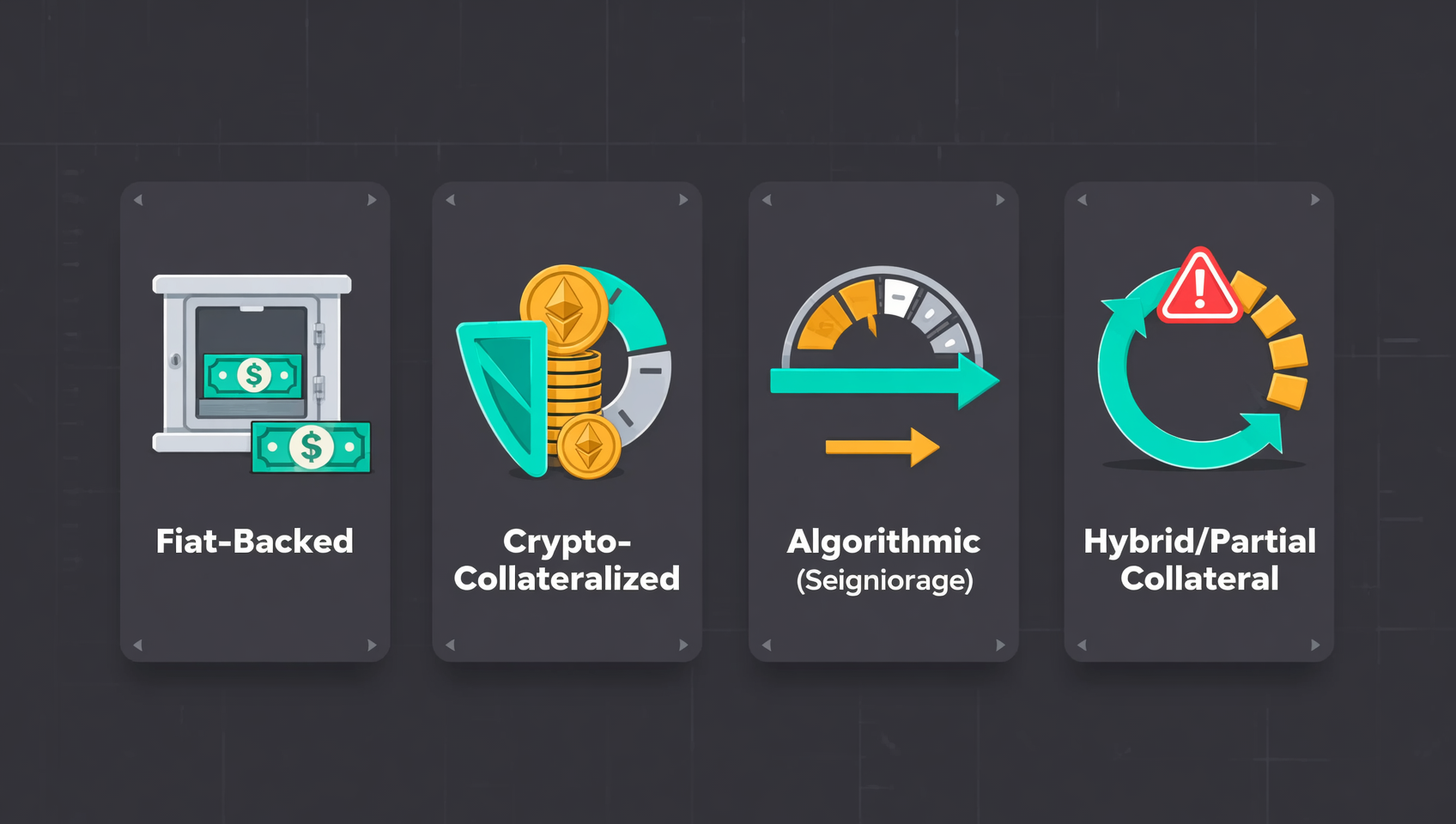
Fiat-backed is the simplest: you give it a dollar, it gives you a token, and it buys short-term Treasuries with your dollar to earn the spread. The risk sits with the issuer and the custody chain: are the reserves real, where are they, and can they be liquidated on demand? Tether's Q2 2026 attestation showed total assets of about $187.75B against liabilities of about $183.64B, leaving excess reserves of about $4.11B, or roughly 2.2% of liabilities. US Treasuries were about $114.9B, or 61.2% of assets, alongside roughly 98,900 BTC and more than 146 tonnes of gold6. The structure shows it earns mostly from T-bill interest — and that its buffer halved from about $8.2B in Q16.
Crypto over-collateralized relies on onchain collateral instead of banks. You deposit $150 of ETH and borrow $100 of USDS; if the ratio falls too low, the position is liquidated. The upside is transparency and permissionless access. The downside is that collateral and the stablecoin fall together — in a crash, collateral shrinks, liquidations get harder and the stablecoin comes under pressure. The April 2026 Kelp DAO rsETH incident already showed that even fake collateral can enter a lending protocol, leaving about $190M in bad debt.
Synthetic / delta-neutral is represented by USDe: buy spot ETH or BTC and short the same notional in perpetual futures, so price moves cancel out and the yield comes from funding rates. It works in normal markets but has two weak points: when funding stays negative, holders pay to hold it, and if the exchange or custodian fails, the hedge leg can break. This is closer to an onchain hedge-fund share than to cash.
Algorithmic stablecoins do not rely on full reserves but on algorithms and incentives. UST wiped out roughly $40 billion in days in May 2022, and the category largely left the mainstream. The algorithmic or partially collateralized coins still alive, such as DJED on Cardano, are small: fine to watch, not to treat as cash.
Counterintuitive 1: the risk is the issuer, not the depeg
Most people think the risk is the price falling to $0.90. The real risk is that the issuer cannot pay when you queue to redeem. A depeg is the symptom; the issuer is the cause.
Break the risk down and it looks exactly like a bank run:
- Maturity mismatch: you can redeem anytime, but the issuer holds short-term Treasuries and overnight repo that take time to sell in stress.
- Information asymmetry: you see monthly or quarterly attestations, not the live reserve ledger.
- First come, first served: redemptions are processed in order, and whoever is slow absorbs the residual risk.
- Changeable rules: the issuer can freeze addresses, pause redemptions or change terms, and you have no vote.
That is why "100% real reserves" does not mean "no depeg." In March 2023, part of USDC's cash sat at Silicon Valley Bank. When the bank failed, USDC fell to about $0.87 over the weekend — the reserves had not vanished, but the market could not confirm them at that moment and the redemption channel was closed. A few days later, once the funds were confirmed safe, the price recovered.
USDT also traded at a discount in 2018 and 2022, not because of one specific event but because the market was never fully comfortable with what was inside its reserves. A stablecoin's price is a live quote on trust in its issuer.
Counterintuitive 2: beating Visa is a counting-method win
"Stablecoins now settle more than Visa and Mastercard" is true, but it does not compare like with like. Treating it as proof that stablecoins have replaced cards leads to the wrong conclusion.
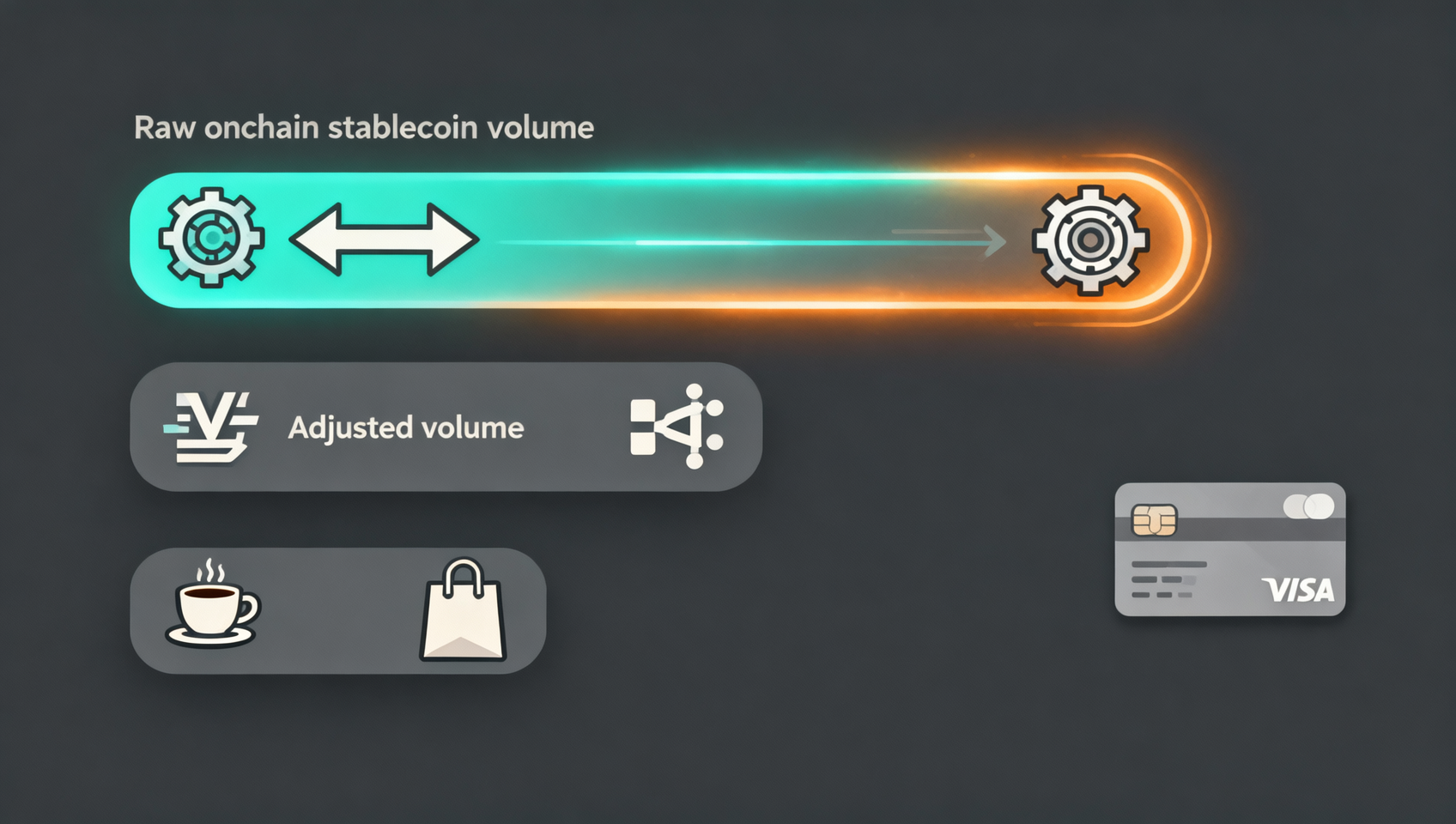
Start with the numbers. Raw onchain stablecoin transfers were about $33 trillion in 2025, with 2026 forecasts of $40–46 trillion. Visa processes about $16–18 trillion a year and Mastercard about $12.5 trillion2. On those figures, stablecoins look twice as large.
Now unpack the method:
- Raw transfer volume counts every token movement. A single dollar moved 50 times by an arbitrage bot in a day is counted as $50. Visa counts cardholder purchases, where the same dollar is not counted repeatedly.
- Visa's onchain analytics team estimates adjusted organic volume at only 25%–30% of raw, or roughly $9–11 trillion a year — comparable to Visa alone, not two or three times it2.
- More conservative estimates put true consumer payments at just 1%–2%, with the rest being exchange settlement, market making, arbitrage and DeFi loops2.
The correct conclusion: stablecoins are already the most efficient settlement layer inside crypto, but they are not yet a daily payment tool. Their main battleground is moving funds between exchanges, cross-border B2B payments and dollar substitution in emerging markets — not your morning coffee. Understanding this keeps you from overrating adoption on a headline and underrating the settlement value.
Counterintuitive 3: regulation is forking, not tightening
The most important 2026 change is not a country banning stablecoins; it is major markets defining them differently. The same USDT can have a different legal status in the US, the EU and Hong Kong.
US: the law passed, the rules did not. The GENIUS Act was signed on July 18, 2025, with a one-year deadline for agencies to finish rulemaking. By July 18, 2026, no agency had issued final rules; about ten rulemakings were still proposals3. With the rules missing, the statutory backstop becomes the key date: from January 18, 2027, unlicensed issuers may not issue payment stablecoins; the restriction on digital asset service providers offering non-compliant stablecoins takes effect on July 18, 20283. The Act also bars issuers from paying interest or yield to holders and leans toward restricting indirect subsidies too3.
EU: the transition closed and USDT was pushed out. MiCA's transition window closed on July 1, 2026, after which platforms serving the EEA must be licensed. ESMA's interim register showed about 330 authorized crypto-asset service providers, while more than 1,000 missed the deadline4. USDT, whose reserves and governance did not fully meet MiCA requirements, was delisted by major European platforms starting in 2025. USDC benefited: on October 14, 2026, the European Banking Authority designated it the first "significant e-money token," and USDC now accounts for about 56% of euro stablecoin trading5.
Elsewhere: licences first, products later. Hong Kong issued its first two stablecoin issuer licences on April 10, 2026; the UK's cryptoasset regulations passed in February 2026, with the full regime live on October 25, 2027; Japan's revised Payment Services Act took effect in June 20267.
This fork has three direct consequences:
- "Which stablecoin is safer" has no global answer. In the EU, USDC leads on compliance; in emerging markets, USDT's liquidity and acceptance still dominate. Your local regulator matters more than a market-cap ranking.
- "Earning yield on stablecoins" is closed at the issuer level in the US and EU. Both GENIUS and MiCA ban issuer-paid interest because stablecoins are meant to be payment tools. For yield you must use exchange products, lending protocols or yield-bearing stablecoins — entirely different risk structures.
- Cross-border compliance costs will rise. Issuers must identify users, screen sanctions and freeze on request. Compliant stablecoins increasingly resemble "KYC'd dollars" rather than "permissionless cash."
What three depegs taught us
Stablecoin history contains only a handful of serious depegs, and each had a different cause. Seeing them together is more useful than repeating "stablecoins carry risk."
| Event | Date | Price action | Root cause | Outcome |
|---|---|---|---|---|
| UST collapse | May 2022 | From $1 to near zero in days | Algorithmic design plus Anchor subsidy withdrawal, death spiral | About $40B of market value erased; project ended8 |
| USDC depeg | March 2023 | Briefly about $0.87 | Part of reserves at failed Silicon Valley Bank; weekend redemption closed | Recovered within days after funds confirmed8 |
| USDT discounts | 2018, 2022 | Repeatedly $0.95–$0.98 | Long-running doubts about reserve composition and transparency | Recovered with attestations and market repair |
Three different lessons:
- UST is about mechanism: a peg held up by incentives rather than full reserves accelerates once confidence flips. When you see "high yield plus algorithm," assume it can go to zero.
- USDC is about custody: real reserves can still depeg because price reflects whether safety can be confirmed now, not whether it is safe eventually. Weekends, bank holidays and redemption queues amplify panic.
- USDT is about transparency: when the market cannot independently verify reserves, any rumor becomes a discount. Tether's first full independent audit — KPMG's unqualified opinion on FY2025, confirming reserves exceeded liabilities by about $6.814B — did more for trust than any press release6.
How to choose: four decision tables by use case
The first step is not comparing market caps but deciding what you need the stablecoin to do. Different uses define "safe" differently.
| Your use case | Better choice | Why | Watch out for |
|---|---|---|---|
| Exchange trading, pairs | USDT | Deepest pairs, lowest slippage, accepted almost everywhere | May be unavailable to EU users; don't park large sums |
| DeFi collateral, lending | USDC / USDS | High protocol acceptance, mature oracle and liquidation paths | Check which collateral and oracles the pool accepts |
| Cross-border and B2B settlement | USDC or USDT, whichever the counterparty supports | Fast, cheap, broad coverage | Compliance, invoicing, tax and counterparty KYC |
| Large savings, short-term parking | Split USDC and T-bills/money funds | Cuts single-issuer and single-custodian risk | No deposit insurance; don't put all cash in one place |
| Chasing yield | Exchange savings / lending protocols | Yield comes from borrowers, not the issuer | US and EU bar issuer-paid interest; high yield is risk premium |
If you remember one line: treat stablecoins as an operating system for dollars, not a vault. An operating system is for turnover; a vault needs insurance, diversification and duration management.
Five checks before you deposit
These five checks are an actionable screening order. If any one fails, don't put money in. They cannot guarantee safety, but they filter out most obviously broken products.
- Who issues it, where is it registered, who supervises it. A US state licence, an EU EMI/ART authorization, or an offshore registration? The jurisdiction determines whether you have recourse when things go wrong.
- Reserve composition and audit frequency. What share is cash and short-term Treasuries? Is it a monthly attestation or a full audit? Who is the auditor? A "100% reserved" slogan means nothing on its own.
- Redemption terms. Who can redeem, what is the minimum, are there fees, how many days? A stablecoin that only redeems for institutions is, for retail, just something you can sell on the secondary market.
- Secondary-market depth and depeg history. Is there enough depth on major exchanges and DEXs? What was the lowest price, and how long did recovery take? Thin depth means you cannot exit in a panic.
- Chain and contract risk. Is it natively issued or a bridged wrapper? Can the contract be upgraded, frozen or paused? A bridged USDT/USDC carries an extra layer of risk over the native version.
Turn these into a table and review it quarterly. Reserve and regulatory status change fast; last year's conclusion may already be wrong.
💰 Binance rebate: invite code BINANBT
Before you turn fiat into stablecoins, cut the cost of that step: register on Binance with invite code BINANBT for a 20% fee rebate. This article contains a referral link; we may earn a reward if you register through it, and it costs you nothing extra.
- Rebate: 20% of every trading fee returned. The invitee cap is 20% across the board.
- How to claim: enter BINANBT in the invite-code field at signup. If you miss it, you can still bind it within 30 days.
- Stack it: turn on "pay fees with BNB" to save roughly another 25%, and hold BNB in Simple Earn to qualify for HODLer Airdrops snapshots.
- Important: registering directly inside the app earns you no new-user rewards at all. In-app signups are not tied to any referral relationship, so the $19,800 welcome package and the 20% rebate will not apply — you must use the registration link or enter invite code BINANBT.
👉 Register on Binance and claim the 20% fee rebate
FAQ
What is a stablecoin, and why does it stay at $1?
A stablecoin is a crypto token designed to hold a price of $1. It does that in one of three ways: the issuer holds matching cash and T-bills and redeems on demand (USDT, USDC), crypto collateral is over-collateralized (USDS), or spot holdings are hedged with shorts (USDe). The peg is a mechanism plus market confidence, not a law of physics.
Is a stablecoin really 1:1, and can it depeg?
By design the face value is 1:1, but the secondary-market price moves. A real depeg means a clear, sustained break. UST went to zero in days in 2022; USDC briefly fell to about $0.87 in March 2023 after the Silicon Valley Bank failure and recovered within days. Genuine reserves do not prevent a panic-driven depeg.
Which is safer, USDT or USDC?
It depends on which safety you mean. USDC discloses reserves more often, is regulated at the US state level and leads on EU compliance. USDT is larger, deeper and more widely accepted in emerging markets, but its reserve buffer is thinner: Tether's Q2 2026 excess reserves were about $4.1B, roughly 2.2% of liabilities, down from $8.2B in Q1.
Can stablecoins still pay interest, and why have some platforms stopped?
The US GENIUS Act and EU MiCA both bar issuers from paying interest or yield to holders, because they define stablecoins as payment instruments rather than investment products. Exchange savings, staking and lending products are a separate route, funded by borrowers or platform subsidies, so the ban does not directly apply, but the risk moves to you.
Can a stablecoin be frozen?
Yes. The contracts behind major fiat-backed stablecoins include blacklist functions, so issuers can freeze balances on an address for legal or compliance reasons; Tether has done this many times. That is a structural feature of centralized stablecoins and one of the biggest differences from cash: the money is onchain, but you do not fully control it.
Which chain is cheapest for stablecoin transfers?
In 2026 the chain name alone no longer answers that. The same USDT costs very different fees and settles at different speeds on Tron, Ethereum, BNB Chain and Base, and exchange withdrawal fees move with congestion. Confirm which chain the recipient accepts first, then compare the live fee shown on the withdrawal page.
Do I owe tax on stablecoins?
It depends on your jurisdiction. Most treat stablecoins as property, so buying crypto with them, swapping them or spending them can be a taxable disposal, and cross-border payments can be reportable income. Rules vary widely; this is not tax advice. For meaningful amounts, consult a local professional and keep full records.
Are stablecoins legal in the US, EU and mainland China?
It depends on where you are. The US is phasing in the GENIUS Act, the EU requires MiCA licensing, and mainland China restricts crypto business activity, with legal risk for offshore platforms serving residents. This article is educational and does not explain how to evade restrictions, sanctions or capital controls. Confirm your local rules before participating.
Further reading
- What Is USDT? How to Buy It and Its Real Risks
- USDT vs USDC in 2026: A Deep Comparison
- What Is DeFi? A 2026 Beginner's Guide
- Binance Deposit Guide: Buying USDT via C2C
- Binance Withdrawal Guide: Networks and Wrong-Chain Recovery
- Cold Wallets and Hardware Wallets in 2026
- What Is Cardano (ADA)? A 2026 Beginner's Guide
- More stablecoin guides
Disclaimer: This article is for educational purposes only and is not investment, legal or tax advice. Stablecoins carry issuer credit, reserve shortfall, custodial bank, regulatory freeze, redemption congestion, smart-contract and depeg risks, and in extreme cases you can lose your entire principal. Market-cap, reserve and regulatory figures are dated and change with markets and policy; rely on official disclosures and live data. Rules differ by jurisdiction — confirm your compliance status.
Footnotes
-
Sources: DefiLlama and CoinGecko stablecoin dashboards, snapshots from October 8–26, 2026 (total about $300–304B, May peak about $322B; USDT about $182–184B and roughly 60%; USDC about $71–74B and roughly 24%; USDS about $6.8B, USDe about $4.7B, USD1 about $4B, PYUSD about $2.8B, RLUSD about $2.4B). ↩ ↩2 ↩3 ↩4 ↩5 ↩6 ↩7 ↩8
-
Sources: Visa Onchain Analytics and Bessemer/Allium estimates of adjusted stablecoin volume (2025 raw about $33T, adjusted about $9–11T; 2026 raw forecast $40–46T); Visa annual volume about $16–18T and Mastercard about $12.5T; MEXC/Deutsche Bank estimates putting true consumer payments at about 1%–2%. ↩ ↩2 ↩3 ↩4 ↩5
-
Source: Legal500, "Why Does MiCA And The GENIUS Act Ban Stablecoin Interest," September 30, 2026; GENIUS Act signed July 18, 2025, rulemaking deadline July 18, 2026 passed without final rules, statutory backstop January 18, 2027, service-provider restriction July 18, 2028. ↩ ↩2 ↩3 ↩4
-
Source: WalletConnect "State of Compliance, Policy, and Regulation Report" 2026; MiCA transition closed July 1, 2026, about 330 CASPs authorized on ESMA's interim register and more than 1,000 firms unauthorized. ↩ ↩2
-
Source: CoinPaprika, "USDC Now Leads Euro Stablecoin Trading as MiCA Sidelines USDT," October 2026; the EBA designated USDC the first "significant e-money token" on October 14, 2026, with USDC at about 56% of euro stablecoin trading. ↩ ↩2
-
Source: Tether Q2 2026 BDO attestation (July 31, 2026): total assets about $187.75B, liabilities about $183.64B, excess reserves about $4.11B; US Treasuries about $114.9B (61.2% of assets), about 98,900 BTC and more than 146 tonnes of gold; Q1 excess reserves about $8.23B; KPMG's first full audit of FY2025 with an unqualified opinion and $6.814B of excess reserves. ↩ ↩2 ↩3
-
Sources: Foresight News and public reports; Hong Kong issued its first two stablecoin issuer licences on April 10, 2026; the UK's full cryptoasset regime takes effect October 25, 2027; Japan's revised Payment Services Act took effect in June 2026. ↩
-
Sources: UST collapse in May 2022 with about $40B of market value erased; USDC falling to about $0.87 on March 11, 2023 after the Silicon Valley Bank failure and recovering once reserves were confirmed. ↩ ↩2