


⚠️ Read this first: want to buy crypto before you venture onchain? Don't just tap "sign up" inside the app — only registrations through the registration link (e.g. "Register now") or with invite code BINANBT unlock Binance's new-user rewards (a 20% trading fee rebate plus a welcome package worth up to $19,800).
Key takeaways (TL;DR):
- DeFi replaces banks and brokers with smart contracts. As of late October 2026, total value locked across DeFi sits at roughly $88–92 billion — an order of magnitude below the 2021 peak1.
- Counterintuitive point one: stablecoin yields now lose to T-bills. USDC on Aave pays about 2.0%–2.6%, while the Fed's target range was still 3.50%–3.75% in March 2026. The "risk-free" rate onchain has been underperforming the actual risk-free rate2.
- Counterintuitive point two: TVL is not deposits. Stake ETH in Lido, deposit the stETH into Aave, and both protocols count it. When prices fall, TVL falls too. A 15% TVL drop does not mean 15% of the money left.
- Counterintuitive point three: 2026's biggest DeFi loss came from fake collateral, not broken code. After the Kelp DAO bridge exploit, attackers used fraudulent rsETH as collateral on Aave and walked away with real assets, leaving about $190 million in bad debt3.
- Bottom line: DeFi today is not a high-yield savings account. It is a permissionless borrowing and trading tool. Moving stablecoins onchain for an extra 1% usually does not pay in 2026 — but for borrowing without selling, or trading assets no exchange lists, it still has no substitute.
What is DeFi? In one sentence: decentralized finance (DeFi) turns lending, swapping and earning into smart contracts, so code replaces the bank and the broker. No account approval, no opening hours, no support line. You connect a wallet, sign a transaction, the contract executes the rules it was written with, and the result is recorded on a blockchain.
That definition cuts both ways. It also means nobody is responsible for your losses, nobody applies the brakes, and nobody calls to warn you before a liquidation. DeFi in 2026 no longer looks like the 2021 version that promised 20% on stablecoins. Understanding what it has become matters more than memorizing the concept.
Table of contents
- What is DeFi: one table to see the difference from a bank
- What DeFi looks like in 2026: three structural shifts
- Counterintuitive point one: stablecoin yields now trail T-bills
- Counterintuitive point two: TVL is not deposits
- Counterintuitive point three: the bad debt came from collateral
- The four sources of DeFi yield
- Impermanent loss: the $1,000 math
- Smart contract risk: AI makes closed code more dangerous
- How to start: six steps from wallet to first loan
- Should you use DeFi? A decision table
- 💰 Binance rebate: invite code BINANBT
- FAQ
- Further reading
What is DeFi: one table to see the difference from a bank
The difference between DeFi and a bank is not whether an intermediary exists. It is who absorbs the risk when something goes wrong. A bank has a licence, deposit insurance and a regulator standing behind it. DeFi replaces all three with code and incentives, and hands the responsibility back to you.
| Dimension | Bank / broker | DeFi protocol |
|---|---|---|
| Who holds the assets | The bank — you hold a claim | You — the private key is yours |
| Access | Account opening, KYC, regional limits | A wallet is enough, permissionless |
| Hours | Business days | 24/7, all year |
| How rates are set | Central bank policy plus bank pricing | Real-time supply and demand in the pool |
| If something breaks | Support, complaints, deposit insurance | No support; onchain transactions are final |
| Main risks | Bank solvency (partly insured) | Contract bugs, collateral, oracles, liquidation |
| Yield ceiling | Typically 1%–5% | Can be very high, but the excess is risk premium |
The last row is the one that matters. A DeFi yield above the market rate is never "efficiency savings". It is somebody else's risk that you have agreed to hold. Once that lands, every other judgment gets simpler.
What DeFi looks like in 2026: three structural shifts
DeFi in 2026 has shrunk in size, concentrated into lending, and settled into ordinary yields. It has not disappeared. It has changed from a sector everyone piled into to a tool a smaller group genuinely needs.
The first shift is scale. DefiLlama puts total DeFi TVL at roughly $88–92 billion through October 2026, dipping below $90 billion in late October1. Against the November 2021 peak on the same methodology (above $170 billion), that is close to a 50% contraction. Meanwhile stablecoins onchain exceed $290 billion — the money is still there, it just no longer sits inside DeFi protocols4.
The second shift is concentration. Lending accounts for more than half of all DeFi TVL, and Aave alone holds more than half of the lending segment. The late-October DefiLlama snapshot puts Lido at about $22.6 billion, Aave at about $17.6 billion and Morpho at about $11.4 billion — together nearly 60% of the market1. Aave shipped V4 on Ethereum mainnet on March 30, 2026, and became the first DeFi protocol to pass $1 trillion in cumulative loans5.
The third shift is yield — covered next, because it decides whether ordinary users should touch DeFi at all.

Counterintuitive point one: stablecoin yields now trail T-bills
The biggest change in 2026 is that parking stablecoins in Aave now pays less than buying US Treasuries. CoinDesk reported in April 2026 that Aave's flagship USDC deposit paid about 2.61%, while Interactive Brokers offered 3.14% on idle cash2. By the second half of the year, DefiLlama Pro showed the Ethereum mainnet USDC pool closer to 2.0%.
The longer-run number is more telling. Coin Metrics data shows that since January 2026, Aave's USDC rate has averaged 31 basis points below the 1-year Treasury yield and sat below it 78% of the time2. In other words, the "risk-free" onchain rate has mostly been worse than the actual risk-free rate.
Why? Because DeFi lending rates are not savings interest — they are the cost of leverage. Someone has to want to borrow USDC against ETH to buy more crypto before your deposit earns anything. In a cold 2026 market, fewer people lever up, borrowing demand falls, and rates follow. Aave's own framing is that this is cyclical rather than structural. For you, the conclusion is direct:
If your goal is "earn a bit more on stablecoins", moving them onchain in 2026 adds several layers of risk and lowers your return. Money market funds, T-bill ETFs, or even a decent brokerage cash sweep are better on both counts.
So what is left? Two things nobody else does: borrowing without selling your assets, and trading assets before exchanges list them. Those two use cases are the real test of whether DeFi belongs in your life.
Counterintuitive point two: TVL is not deposits
TVL (total value locked) measures the dollar value of assets locked in a protocol at current prices. It double-counts, and it moves with price. Read it as "how much money this protocol manages" and you will be badly wrong.
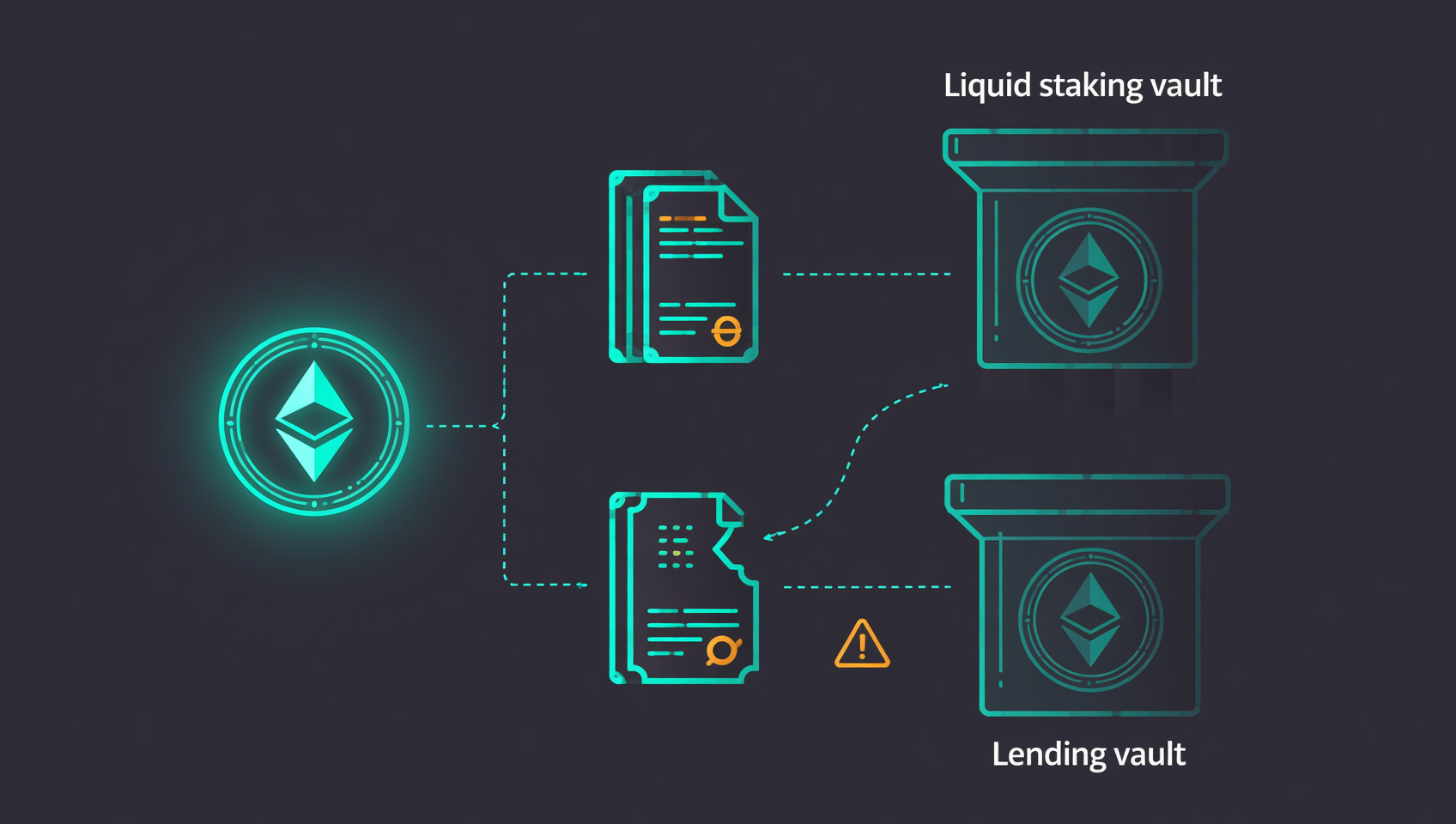
The double-counting is mechanical. You stake 1 ETH in Lido and receive 1 stETH. You deposit that stETH into Aave as collateral. Lido now counts 1 ETH of TVL, and Aave counts the stETH at roughly the same value — the same asset counted twice. The more restaking and rehypothecation layers, the more inflated the number.
Price effects are just as direct: TVL is denominated in dollars. If ETH falls 20% and every pool holds the same number of coins, TVL falls 20% automatically. After the April 2026 Kelp incident, Aave's deposits went from about $45.8 billion to $30.8 billion, and TVL from about $26.4 billion to under $14 billion — a mix of real withdrawals, falling collateral prices and bad-debt write-downs, not simply "$15 billion of users leaving"3.
So read TVL like this:
- Watch the trend, not the level. Weeks of sustained outflows signal falling confidence.
- Compare like with like. Different dashboards treat LSTs, restaking and bridged assets differently; a 2x difference between sources is normal.
- Look at the structure. A protocol with 90% of TVL in one asset is far riskier than one spread across five.
Counterintuitive point three: the bad debt came from collateral
2026's largest DeFi loss was not caused by a broken lending protocol. It was caused by a token that looked like ETH. On April 18, 2026, Kelp DAO's LayerZero-based rsETH bridge was exploited and about 116,500 rsETH (roughly $293 million) was fraudulently minted or drained; investigators pointed to North Korea's Lazarus Group3.
What hurt Aave was the next step. The attacker deposited roughly 89,567 rsETH into Aave V3 as collateral and borrowed real wETH against it. Once rsETH's price collapsed, that collateral became bad debt — early estimates ranged from $123 million to $230 million, with roughly $190 million most commonly cited. Aave's WETH market briefly hit 100% utilization, withdrawals froze, and deposits fell by about $15 billion within days3.
The lesson is not "Aave is unsafe". It is that DeFi risk does not stop at a protocol's boundary — it extends to the collateral it accepts and the bridge that collateral crossed. When you deposit USDC into Aave, you are not only taking on "does Aave's code have a bug". You are also taking on:
- Collateral risk — pools accept rsETH, stETH and similar receipts whose backing may sit in another protocol that gets exploited;
- Bridge risk — the cross-chain hop is usually the weakest link in the whole stack;
- Oracle risk — a bad price feed triggers wrong liquidations;
- Liquidity risk — in a violent market, the exit you planned may not be open.
Kelp later restored rsETH backing through a "DeFi United" coalition pledging over $300 million, and Aave liquidated the attacker's remaining positions in May, recovering about 13,000 ETH3. That was industry mutual aid, not a mechanical guarantee. Next time there may be no coalition.
The four sources of DeFi yield
Every DeFi yield comes from one of four places: borrowing interest, trading fees, staking rewards, or protocol subsidies. If a yield does not fit one of these, treat it as a scam or as unsustainable.
| Source | Who pays | Typical range (Oct 2026) | Risk you take |
|---|---|---|---|
| Borrowing interest | People borrowing against collateral | USDC ~2%–3%; volatile assets higher | Contract risk, bad debt, liquidation |
| LP trading fees | Traders swapping in the pool | 3%–15% on major pairs; extreme on long-tail | Impermanent loss, MEV, pool drained |
| Staking rewards | Chain issuance plus fees | ETH staking ~2.6%–3.5% | Slashing, LST depeg, contract risk |
| Protocol subsidies (liquidity mining) | The protocol's own token | Double digits short term | Token collapse; yield goes to zero when subsidies stop |
The fourth is where beginners get hurt. A protocol subsidises liquidity with tokens it prints. You see "80% APY", but the unit of account is that token — if the token drops 80% or the subsidy ends, your principal is still there and the yield is gone. To test durability, ask one question: if the subsidy stopped tomorrow, would anyone still pay for this liquidity?
Impermanent loss: the $1,000 math
Impermanent loss is the gap between what an AMM pool returns and what you would have if you simply held both tokens. It is not a fee and nobody takes it from you; it is the opportunity cost of the pool automatically selling the asset that goes up.
Say ETH is $2,000 and you deposit $500 of ETH plus $500 of USDC into an ETH/USDC pool. As price moves, the pool rebalances, and your withdrawal value ends up below "do nothing":
| ETH price move | Pool value | Holding both | Impermanent loss |
|---|---|---|---|
| +25% | ~$1,118 | ~$1,125 | ~0.6% |
| +50% | ~$1,225 | ~$1,250 | ~2.0% |
| +100% | ~$1,414 | ~$1,500 | ~5.7% |
| +400% | ~$2,236 | ~$2,500 | ~10.6% |
| −50% | ~$707 | ~$750 | ~5.7% |
The table is counterintuitive in both directions. In a one-way rally, providing liquidity means "earning less"; in a one-way crash, it loses slightly less than holding, because the pool sold some on the way down. The real killer is chop: price oscillates, fees do not cover the gap, and the loss becomes realised.
So LP suitability comes down to two questions: can the pool's fees cover expected volatility, and can you accept missing part of the upside? If you planned to hold ETH long term, putting it into an ETH/USDC pool means deliberately giving up part of the rally.
Smart contract risk: AI makes closed code more dangerous
A 2026 trend in smart contract attacks is AI-assisted decompilation: attackers reverse-engineer bytecode at scale, so "our code is not public" no longer works as a defence. Chainalysis reported in June 2026 that between December 2025 and May 2026, five exploited protocols all had unverified source code on block explorers; combined losses were about $36.7 million, with Truebit alone losing about $26.2 million to a long-standing integer overflow6.
For ordinary users, this is a screening rule: if a protocol will not verify its source code, it does not belong on your shortlist. Check in this order:
- Is the contract source verified on Etherscan or the relevant explorer? Unverified means skip.
- Are there multiple independent audits, and do they cover the currently deployed version rather than code from two years ago?
- Is there an active bug bounty (Immunefi and similar), sized in proportion to TVL?
- Are admin powers behind a multisig and a timelock, and how long is the delay?
- Has it been exploited before, and how transparent was the response?
None of this guarantees safety, but it filters out most projects that skipped the basics.
How to start: six steps from wallet to first loan
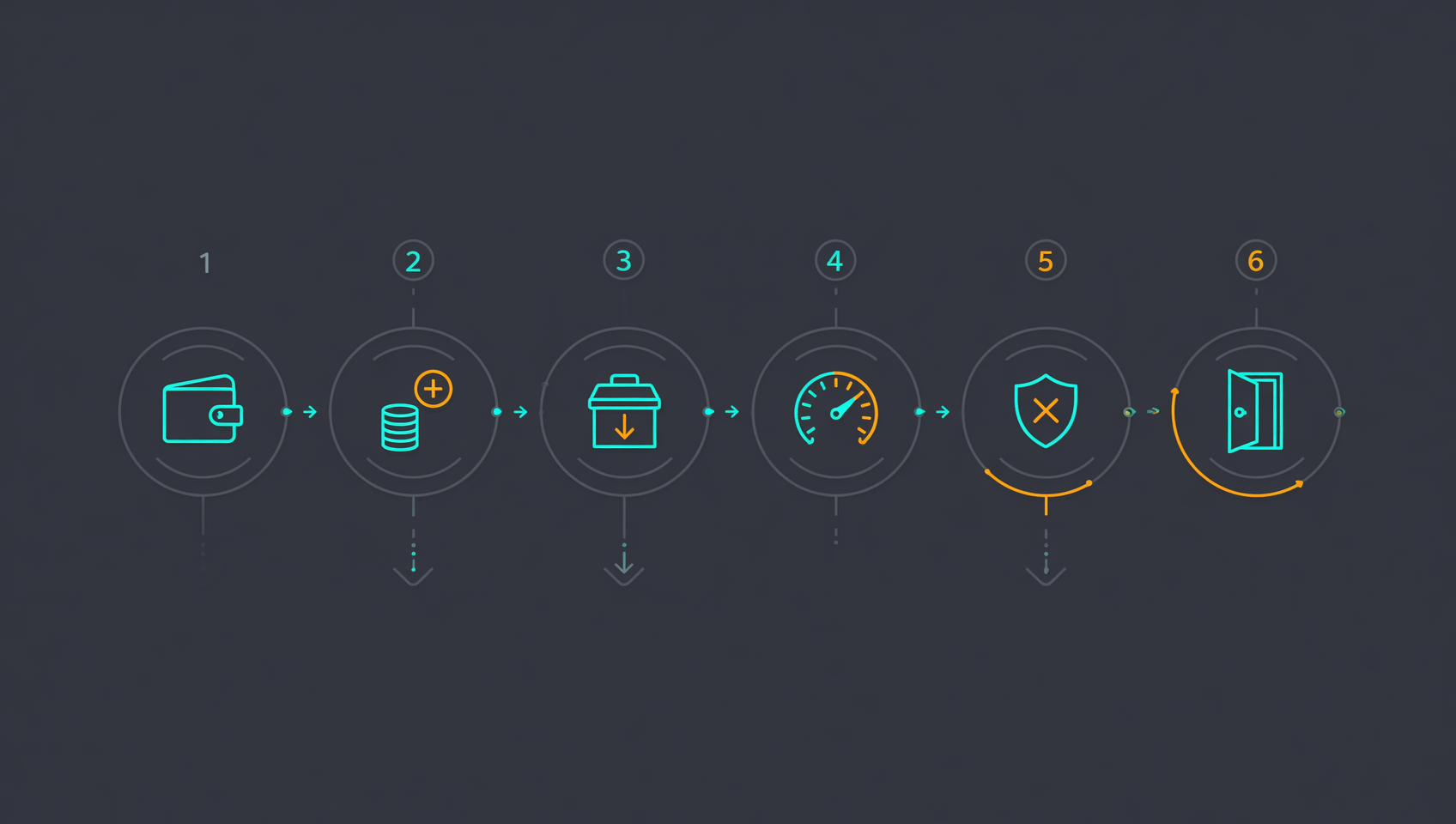
Your first DeFi position should be a small end-to-end walkthrough, not a hunt for the highest yield. The goal of these six steps is not profit. It is to experience every link in the chain without pressure.
- Use a dedicated wallet. Create a fresh address in a self-custody wallet such as MetaMask and fund it only with money you are prepared to test. Never use the wallet that holds your main assets. Write the seed phrase down offline; no cloud notes.
- Move a small test amount from an exchange. Withdraw $20–50 of USDC or ETH first, confirming the network (ERC-20 for Ethereum mainnet, the matching network for L2s), then send the rest once it arrives.
- Pick a major protocol and only deposit. Aave or Uniswap — heavily audited, long-standing TVL — is a sensible first stop. Deposit USDC, watch the rate for a week, and do not borrow yet.
- Understand three parameters before borrowing. Know your loan-to-value (LTV), the liquidation threshold, and your health factor. A health factor below 1 means liquidation; do not run it below 1.5.
- Manage approvals. Every DApp interaction can create a token approval. Check and revoke unused approvals regularly with Revoke.cash, especially unlimited ones.
- Plan the exit before entering. If collateral falls 30%, where does the top-up come from? If the network congests, how long can you wait? If you cannot answer, do not open the position.
Should you use DeFi? A decision table
The question is not whether DeFi is good. It is whether DeFi is the right tool for the problem you actually have. For most people in 2026, the answer is no — not because DeFi is bad, but because of what it realistically offers.
| Your goal | Is DeFi a fit? | Why / alternative |
|---|---|---|
| Earn more on stablecoins | ❌ No | ~2%–3% loses to T-bills and money market funds, with added contract and collateral risk |
| Need cash without selling | ✅ Best fit | Collateralised borrowing is DeFi's genuinely unique capability |
| Trade a token no exchange lists | ✅ Yes | DEXs are the only venue; learn liquidity, slippage and honeypots first |
| Chase "50%+ APY" | ⚠️ Check the source | High yields are usually token subsidies that end |
| Complete beginner without a self-custody wallet | ❌ Not yet | Start with exchange products and spot; learn keys, networks and approvals first |
| Large long-term holdings | ⚠️ Be careful | Large balances belong in cold storage and multisig, not in a yield pool |
If you remember one line: DeFi is a tool, not a savings product. A tool earns its place by solving a specific problem, not by promising a steady return.
💰 Binance rebate: invite code BINANBT
Before you go onchain, cut the cost of getting there: enter invite code BINANBT when you register on Binance and get a 20% trading fee rebate. This article contains referral links; registering through them may reward us, but it never costs you a cent extra.
- Rebate amount: 20% cashback on every trading fee; the rebate ceiling for invitees is a uniform 20%.
- How to claim: enter BINANBT in the invite-code field at registration; if you miss it, you can still link it within 30 days.
- Stacking benefit: enabling "Use BNB to pay fees" saves roughly 25% more, and holding BNB in Simple Earn qualifies you for HODLer Airdrops snapshots.
- Important: signing up directly inside the app gets you no signup reward at all. An in-app registration binds to no referral, so the $19,800 welcome package and the 20% fee rebate simply don't apply — you have to use the registration link or enter invite code BINANBT.
👉 Register on Binance and claim the 20% fee rebate
FAQ
What is DeFi, and how is it different from a bank?
DeFi (decentralized finance) replaces banks and brokers with smart contracts: lending, swapping and earning all run on a blockchain. Three differences matter. It is open 24/7 to anyone with a wallet, it has no customer service and no deposit insurance, and its interest rates are set by real-time supply and demand rather than a central bank.
Why are DeFi yields so low in 2026? Is it still worth using?
Because yields come from borrowing demand, and onchain leverage demand has been shrinking. USDC supply on Aave pays roughly 2.0%–2.6%, below the Fed's 3.50%–3.75% range in March 2026. For extra interest alone, DeFi loses to T-bills and money market funds. What it still does uniquely is let you borrow without selling, and trade assets that are not listed on exchanges.
Is DeFi safe? Can my funds be stolen?
The protocol and your own actions are separate risks. Heavily audited protocols such as Aave and Uniswap have relatively contained code risk, yet in April 2026 attackers deposited about 89,567 fake rsETH as collateral on Aave after the Kelp DAO exploit and left roughly $190M in bad debt. The protocol code was never broken. Collateral, oracles and bridges are the real attack surface.
What is impermanent loss, and how much can it cost?
Impermanent loss is the gap between what you get back from an AMM pool and what you would have if you simply held both tokens. In an ETH/USDC pool, a 100% ETH rally costs about 5.7% versus holding, and a 400% rally about 20%. Fees have to cover that gap, and the more volatile and long-lived the position, the harder that gets.
How much money do I need to start using DeFi?
Technically $10 is enough, but costs squeeze both ends. A single Ethereum mainnet transaction can cost several dollars to tens of dollars in gas, which eats small positions, and a position too small teaches you nothing about risk. A practical starting point is $100–$500 to walk through the full flow — deposit, borrow, repay, withdraw — before adding size.
DeFi or exchange savings products — which is better?
For most people, exchange products. Exchange savings, staking and Launchpool require no private-key management, no onchain signatures and no liquidation monitoring; the trade-off is that the platform custodies your assets and yields are modest too. DeFi offers permissionless access and composability, but every risk is yours. Learn on an exchange first, then move a small slice onchain.
Do I owe tax on DeFi income?
It depends on where you live. Most jurisdictions treat lending interest, LP fees and staking rewards as income, and price gains as capital gains, reportable when received or sold. Rules vary widely; this article is not tax advice. For meaningful amounts, consult a local tax professional and keep your onchain records.
Can US or mainland Chinese users use DeFi?
Access rules differ by jurisdiction. Mainland China restricts crypto-related business activity and offshore platforms serving mainland residents carry legal risk; US persons face sanctions screening and tax reporting obligations. This article is educational only and does not describe how to evade restrictions, sanctions or exchange controls. Confirm your local rules before participating.
Further reading
- Ethereum in 2026: a complete guide from smart contracts to L2s
- What is USDT? How to buy it and which chain to pick
- USDT vs USDC in 2026: which is safer
- MetaMask in 2026: setup, seed phrases and approval safety
- How to find crypto airdrops without getting drained
- Spot vs futures: what actually differs
- More DeFi content: the DeFi hub
Disclaimer: This content is for educational purposes only and is not investment or tax advice. DeFi protocols carry smart contract, collateral, bridge, oracle and liquidation risks; onchain transactions are generally irreversible and in extreme cases you can lose your entire principal. Yield figures change in real time — verify against the protocol dashboard and a data platform before acting. Rules for crypto and DeFi differ by jurisdiction; confirm your own compliance position1.
Footnotes
-
Sources: DefiLlama total DeFi TVL and protocol rankings, snapshot around October 26, 2026 (roughly $88–92 billion total; Lido ~$22.6B, Aave ~$17.6B, Morpho ~$11.4B); CryptoVibe and InsideBitcoins citing DefiLlama, October 11–23, 2026. ↩ ↩2 ↩3 ↩4
-
Sources: CoinDesk, "The era of easy money in crypto is over," April 7, 2026 (Aave USDC ~2.61% vs Interactive Brokers cash at 3.14%); Coin Metrics data on Aave USDC averaging 31 bps below the 1-year Treasury since January 2026 and below it 78% of the time; Fed target range held at 3.50%–3.75% on March 18, 2026. ↩ ↩2 ↩3
-
Sources: blockchain.news and crypto.news coverage of the Kelp DAO rsETH bridge exploit (April 18, 2026; 116,500 rsETH, ~$293M; Aave bad debt initially estimated at $123M–$230M, commonly cited around $190M; deposits fell from ~$45.8B to ~$30.8B, TVL from ~$26.4B to under $14B); Kelp completed the final rsETH restoration on May 25, 2026, with the DeFi United coalition pledging over $300M. ↩ ↩2 ↩3 ↩4 ↩5
-
Sources: DefiLlama stablecoin dashboard and industry briefs, October 2026 — onchain stablecoin supply above $290 billion. ↩
-
Sources: Aave announcements and industry research coverage; Aave V4 launched on Ethereum mainnet March 30, 2026; Aave became the first DeFi protocol to pass $1 trillion in cumulative loans, February 2026. ↩
-
Source: Chainalysis report on unverified smart contracts, June 2026 (December 2025–May 2026; five protocols, ~$36.7M combined; Truebit ~$26.2M). ↩