



Key Takeaways:
- Stablecoins are cryptocurrencies pegged 1:1 to the US dollar, forming the bridge between fiat and crypto
- USDT ($187.9B market cap) is the most liquid for trading; USDC ($76.1B) offers the highest regulatory compliance
- DAI/USDS ($10B) is the leading decentralized stablecoin — fully transparent but with minor depeg risk
- The total stablecoin market reached ~$313B in mid-2026, up over 30% from 2025
- For safety, diversify across at least two stablecoins and monitor MiCA/GENIUS regulatory developments
Introduction
What is a stablecoin? In simple terms, a stablecoin is a cryptocurrency designed to maintain a stable value relative to a reference asset — most commonly the US dollar at a 1:1 ratio. As of July 2026, the global stablecoin market capitalization stands at approximately $313 billion1, having grown more than 30% since early 2025. Stablecoins have become the most critical infrastructure in the cryptocurrency ecosystem.
Without stablecoins, crypto exchanges couldn't offer reliable trading pairs, DeFi protocols couldn't facilitate lending, and cross-border payments would lose their value guarantee. They are — quite literally — the "dollar on-ramp" for the entire crypto economy.
This guide provides a comprehensive comparison of the three dominant stablecoins — USDT (Tether), USDC (USD Coin), and DAI (Sky Protocol) — covering issuance mechanisms, safety, transparency, real-world use cases, and helping you choose the right one for your needs.
What Is a Stablecoin? Three Types and Market Overview
Stablecoins can be categorized into three types based on their collateral mechanism: fiat-collateralized, crypto-collateralized, and algorithmic. As of 2026, fiat-backed stablecoins dominate, with USDT and USDC combined controlling over 82% of total market share2.
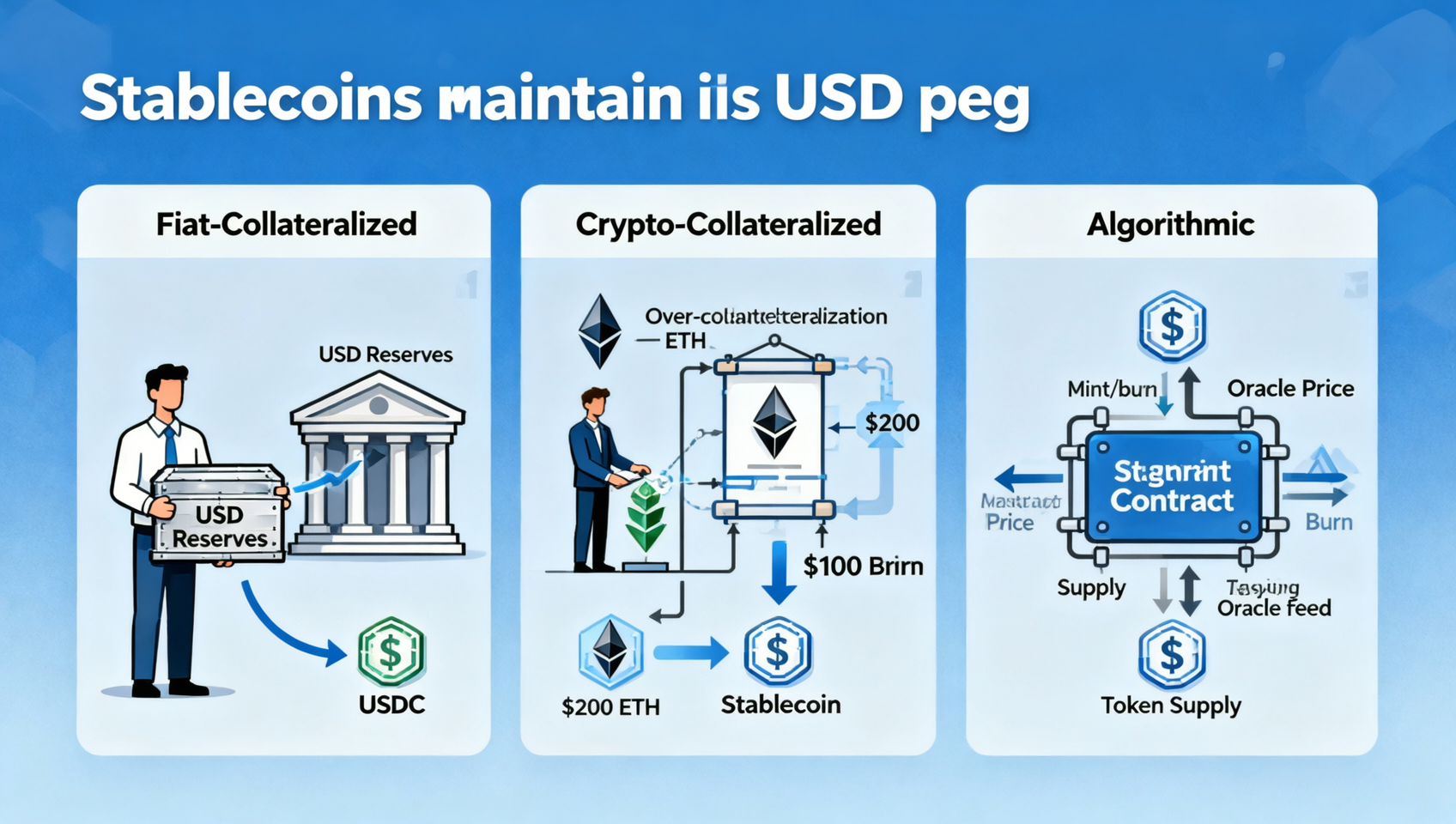
Three Stablecoin Types
| Type | Examples | Collateral | Centralization | Market Share |
|---|---|---|---|---|
| 🏦 Fiat-Collateralized | USDT, USDC | USD reserves / Treasuries | Centralized | ~82% |
| 🔗 Crypto-Collateralized | DAI/USDS | ETH and other crypto | Decentralized | ~3% |
| ⚙️ Algorithmic | UST (collapsed), FRAX | Algorithm + partial reserves | Semi-centralized | <1% |
Fiat-backed stablecoins operate on a simple principle: for every token issued, the issuer holds $1 or equivalent assets in a bank account. Crypto-backed stablecoins use over-collateralization (typically 150%+). Algorithmic stablecoins largely lost market trust after the UST collapse in 2022.
2026 Stablecoin Market Landscape
The stablecoin market saw significant growth in 2026. According to DefiLlama, total market cap rose from approximately $240 billion at the end of 2025 to over $310 billion1. The market hit an all-time high of $316 billion in late Q1 2026, followed by a ~$10 billion correction in Q23.
Top 5 Stablecoins by Market Cap:
| Rank | Stablecoin | Issuer | Market Cap (June 2026) | Share | Type |
|---|---|---|---|---|---|
| 1️⃣ | USDT | Tether | $187.9B | ~58% | Fiat-backed |
| 2️⃣ | USDC | Circle | $76.1B | ~24% | Fiat-backed |
| 3️⃣ | USDS | Sky (ex-MakerDAO) | $10B | ~3% | Crypto-backed |
| 4️⃣ | USDe | Ethena | $3B | ~1% | Synthetic |
| 5️⃣ | FDUSD | First Digital | $2.8B | ~0.9% | Fiat-backed |
USDT (Tether): The Largest Stablecoin by Market Cap
USDT is the world's largest stablecoin, issued by Tether Limited, with a market cap of $187.9 billion as of June 2026. It supports over 20 blockchain networks including Ethereum (ERC-20), TRON (TRC-20), BNB Chain, and Solana, making it the most widely accepted stablecoin across all exchanges4.
Reserve Composition
Tether's reserve quality has improved significantly since 2024. According to Tether's Q2 2026 attestation report:
- US Treasury Bills: over 80% of reserves
- Money Market Funds: approximately 9%
- Cash and Bank Deposits: approximately 3%
- Other (Gold, Bitcoin, etc.): approximately 5%
For every USDT token issued, Tether must hold $1 in equivalent reserves. In May 2026 alone, Tether issued over $5 billion in net new USDT supply, reflecting strong market demand4.
Pros and Cons
| ✅ Pros | ❌ Cons | |---------|--------| | Highest liquidity — supported everywhere | Reserve audit less frequent than USDC | | Most blockchain support (20+ networks) | Past NYAG investigation | | Deepest trading pair availability | Less regulatory transparency | | Fast, low-cost transfers on TRC-20 | Single point of centralization risk |
USDT's greatest advantage is ubiquity — it's always the first stablecoin supported on any platform. Using a Binance referral code can give you up to 40% trading fee discount on USDT pairs, making regular trading significantly cheaper.
USDC (USD Coin): The Compliance Gold Standard
USDC, issued by Circle, is widely regarded as the most transparent and regulation-compliant stablecoin on the market. As of June 2026, USDC's market cap stands at approximately $76.1 billion, ranking second among all stablecoins. While its market cap is about 40% of USDT's, USDC actually surpasses USDT in certain DeFi metrics.
Regulatory Compliance
USDC's key differentiator is regulatory compliance. Circle holds:
- NYDFS (New York Department of Financial Services) regulatory license
- MiCA compliance as one of the first authorized stablecoin issuers in the EU (obtained 2025)
- Monthly reserve attestation reports published by Deloitte
These credentials give USDC an unmatched advantage in institutional and compliance-sensitive scenarios. Major traditional finance players like BlackRock and Fidelity prefer USDC as their stablecoin of choice for crypto products.
Transparency
Circle's reserves are publicly verifiable:
- US Treasury Bills: ~85%
- Cash and Cash Equivalents: ~12%
- Overnight Repurchase Agreements: ~3%
Unlike USDT, Circle maintains a real-time reserve verification page where anyone can verify the current reserve status5.
| Use Case | USDC Advantage |
|---|---|
| 📦 DeFi Lending | Highest deposit volume on Aave and Compound |
| 💳 Crypto Cards | Preferred settlement currency for Visa crypto cards |
| 🏦 Institutional Services | Circle's complete enterprise API and banking partnerships |
| 🌍 European Market | MiCA-compliant, first-mover advantage in EU |
DAI: The Evolution of Decentralized Stablecoins
DAI (and its upgraded version USDS) is a decentralized stablecoin issued by the Sky Protocol (formerly MakerDAO), maintaining its dollar peg through over-collateralization of crypto assets. As of 2026, DAI + USDS has a combined market cap of approximately $10 billion, making it the largest decentralized stablecoin6.
How It Works: Over-Collateralization
DAI's innovation is that it requires no central issuer. Users lock crypto assets (primarily ETH and stETH) as collateral at a 150%-200% collateralization ratio to generate DAI:
- User deposits $2,000 worth of ETH into a Sky Protocol vault
- The smart contract allows minting up to 1,333 DAI (~67% loan-to-value)
- If collateral value drops near the liquidation threshold, automated liquidators repay DAI and claim discounted collateral
- This mechanism ensures DAI always has over-collateralized backing
Sky Protocol Upgrade (2025-2026)
In 2025, MakerDAO underwent a major rebranding to Sky Protocol, launching USDS as DAI's upgrade:
- DAI can be converted 1:1 to USDS
- USDS introduces a Savings Rate feature (similar to traditional bank interest)
- Governance token renamed from MKR to SKY
- Enhanced risk management mechanisms in new smart contracts
| ✅ Pros | ❌ Cons |
|---|---|
| Fully decentralized — no single point of failure | Brief depeg to $1.03 during March 2020 crash |
| Code open-source, on-chain auditable | Includes some centralized collateral (USDC) |
| Sky Protocol governance buybacks | Higher user complexity (requires understanding collateral ratios) |
| Widely integrated in DeFi protocols | Market cap far below USDT and USDC |
Full Comparison: USDT vs USDC vs DAI
After a thorough comparison, there is no single "best" stablecoin — only the best choice for your specific use case.
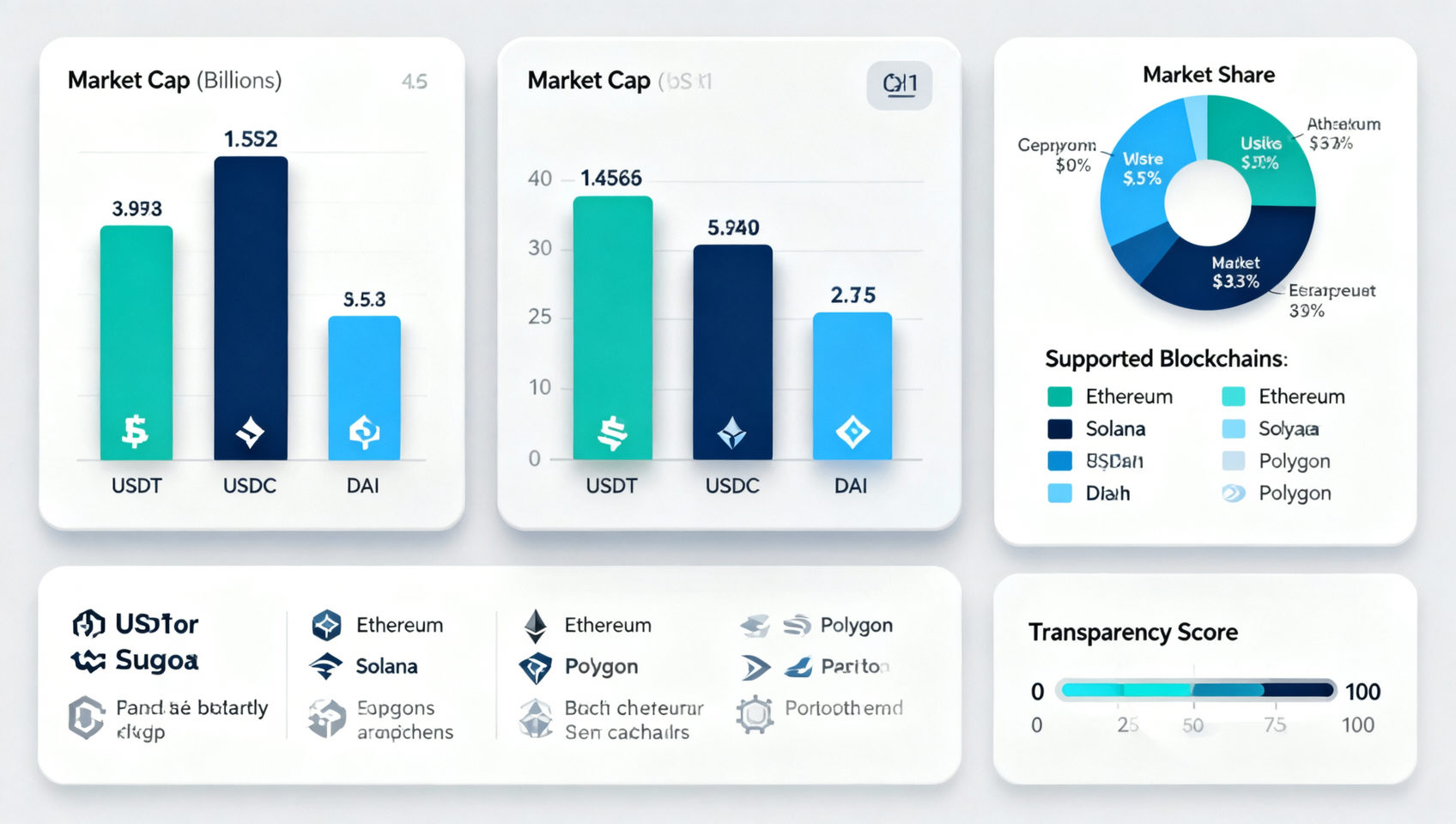
| Dimension | ⭐ USDT | ⭐ USDC | ⭐ DAI/USDS |
|---|---|---|---|
| 💰 Market Cap | $187.9B | $76.1B | $10B |
| 🏛️ Type | Fiat-backed | Fiat-backed | Crypto-backed |
| 🔒 Decentralization | ❌ Centralized | ❌ Centralized | ✅ Decentralized |
| 📋 Audit Frequency | Quarterly | Monthly | On-chain real-time |
| 🏦 Regulation | VARA licensed | NYDFS + MiCA | None specific |
| 🔗 Supported Chains | 20+ | 15 | 10+ |
| 📊 Exchange Support | Widest | Broad | Moderate |
| 🏗️ DeFi Ecosystem | Broad | Strongest | Core protocols |
| ⚡ Transfer Speed | TRC-20 very fast | L2 very fast | L2 very fast |
| 💸 Transfer Fees | TRC-20 ~$0.80-1 | L2 ~$0.01-0.10 | L2 ~$0.01-0.10 |
Stablecoin Regulation in 2026
2026 marks a pivotal year for stablecoin regulation with MiCA's full implementation in the EU and the proposed GENIUS Act advancing in the US.
MiCA (EU)
MiCA (Markets in Crypto-Assets) took full effect in late 2025, establishing strict rules for stablecoins:
- Issuers must register in the EU and hold an e-money license
- At least 60% of reserves must be held as cash deposits at independent credit institutions
- Stablecoins exceeding 1 million daily transactions or €200 million daily volume face additional restrictions
- Circle was among the first to achieve full MiCA compliance, significantly boosting USDC adoption in Europe7
GENIUS Act (US)
The GENIUS (Guiding and Establishing National Innovation for US Stablecoins) Act, proposed by Senators Cynthia Lummis and Kirsten Gillibrand:
- Requires 1:1 high-liquidity asset reserves
- Issuers over $10 billion must submit to Federal Reserve oversight
- Mandates monthly audits and public disclosures
- Offers dual state-federal regulatory options
Stablecoin Use Cases
Stablecoins have expanded far beyond simple trading into payments, cross-border transfers, and DeFi yield generation:
- DeFi: Deposit on Aave/Compound for 3%-8% APY
- Cross-border payments: Minutes instead of days, under $1 instead of 5%-7%
- Corporate treasury: Web3 companies increasingly pay salaries in USDC
- Trading: USDT remains the dominant base pair on all major exchanges8
How to Choose the Right Stablecoin
| Use Case | Recommended | Why |
|---|---|---|
| 💱 Exchange Trading | USDT | Best liquidity, most pairs |
| 🔗 DeFi Yield | USDC + DAI | Best protocol support |
| 💳 Crypto Cards | USDC | Preferred settlement currency |
| 🌍 Remittances | USDT (TRC-20) | Lowest fees, fastest |
| 🏦 Institutional | USDC | Highest compliance |
| 🔐 Decentralized | DAI/USDS | No central risk |
Diversification Strategy
Don't put all your funds in one stablecoin:
- Core (60%-70%): USDC or USDT based on use case
- Secondary (20%-30%): The other centralized stablecoin for issuer diversification
- Exploratory (10%): DAI/USDS for DeFi participation
FAQ
Is USDT or USDC better for beginners?
Start with USDT. It supports 20+ blockchains, is available on all exchanges, and TRC-20 transfers are fast and cheap ($0.80-1). As you gain experience, add USDC for regulatory safety and DAI for decentralized exposure.
Have stablecoins ever lost their peg?
Yes. UST collapsed to zero in 2022. USDT dropped to $0.95 during the same event. USDC fell to $0.88 during the SVB crisis (2023). DAI rose to $1.03 during the March 2020 crash. The key difference: USDT, USDC, and DAI always recovered — unlike UST, which had no real asset backing.
What's the best way to earn yield on stablecoins?
Deposit on centralized exchanges (Binance Earn, OKX Earn) for 2%-8% APY, or use DeFi protocols (Aave, Compound) for 3%-12% APY. The Binance referral code gives permanent fee discounts on all stablecoin trading.
How does the Binance referral code work with stablecoins?
Using a Binance referral code (like BINANBT) when registering gives you up to 40% permanent fee discount on all trading pairs including USDT, USDC, and other stablecoin pairs. This is significant for frequent traders who primarily use stablecoins as their base currency.
Can stablecoins be sent to any blockchain?
Not all blockchains are compatible. USDT on TRC-20 (TRON) cannot be received on an ERC-20 (Ethereum) address. Always select the correct network when withdrawing from or depositing to an exchange. Sending to the wrong network may result in permanent loss.
Further Reading
- What Is a Stablecoin? Beginner's Guide (Chinese) — Stablecoin basics
- Binance 2026 Review: Complete Analysis — Full exchange review
- OKX 2026 Review: Fees & Safety — Exchange comparison
- DeFi 2026 Beginner Guide — DeFi ecosystem intro
- CoinMarketCap Stablecoins — Real-time market data
- Circle Transparency Page — Live USDC reserves
Data current as of July 17, 2026. Cryptocurrency markets are highly volatile. This article is for informational purposes only and does not constitute investment advice.
Footnotes
-
DefiLlama, Stablecoins Overview, accessed July 17, 2026. ↩ ↩2
-
KuCoin Research, Top 5 Stablecoins Hold 88% of $323B Market, May 2026. ↩
-
CoinMarketCap, Stablecoin Market Cap Data Snapshot, June 2026. ↩
-
CoinGecko, Tether (USDT) Market Data, accessed July 2026. ↩ ↩2
-
Circle, USDC Transparency Report, June 2026. ↩
-
DefiLlama, Sky Protocol (MakerDAO) TVL Data, accessed July 2026. ↩
-
Circle Blog, MiCA Compliance Update, December 2025. ↩
-
KuCoin, Stablecoin Monthly Transfer Volume Report, June 2026. ↩