
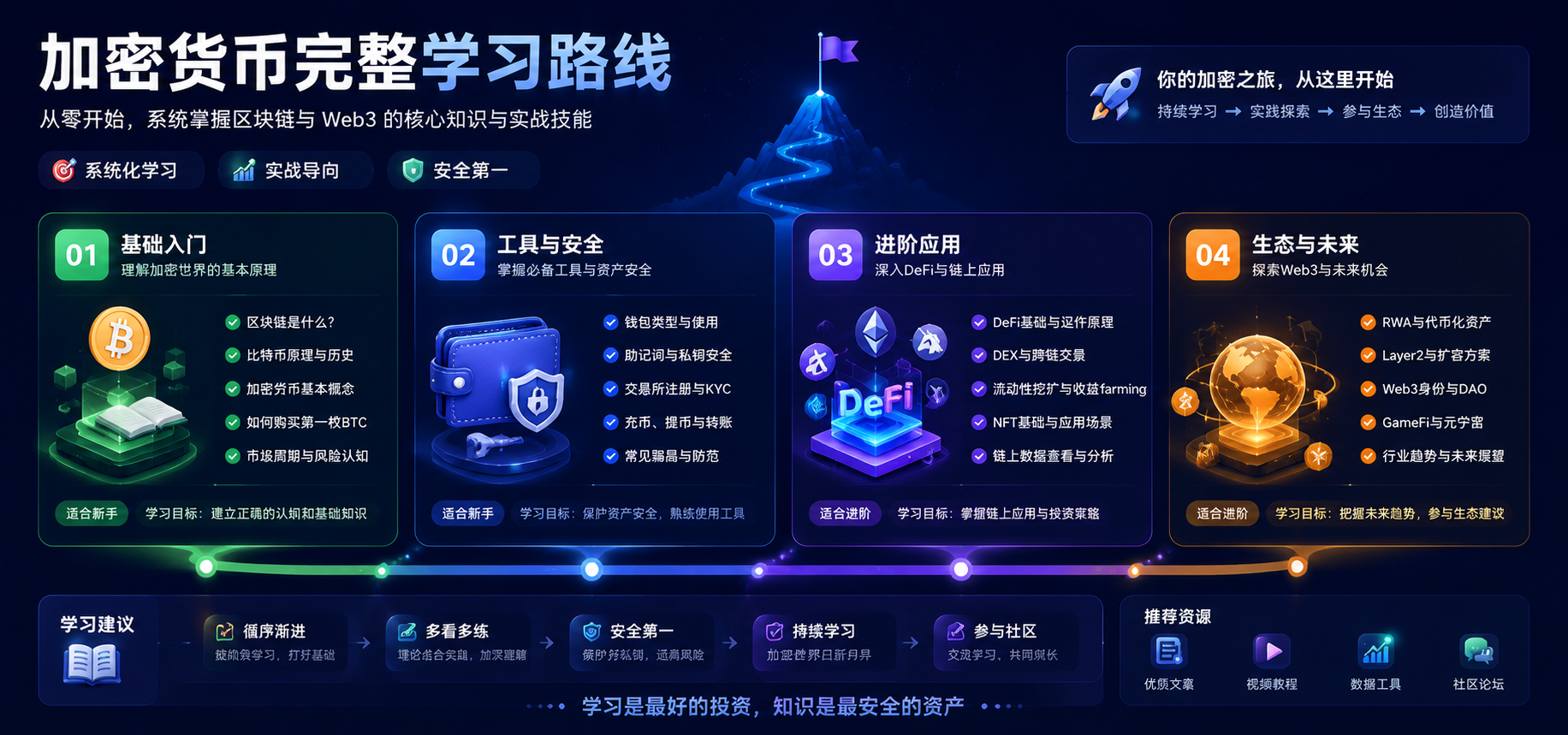
Complete Crypto Learning Path
A systematic four-stage crypto learning roadmap — from blockchain and Bitcoin fundamentals to wallet security, DeFi, RWA and Web3.
Welcome to CoinVado’s Complete Crypto Learning Path! This is a systematic learning route designed in four stages: Understanding Crypto → Getting Started → Asset Security → Web3 Exploration. It will guide you from absolute beginner to a confident crypto user.
Whether you’re completely new to cryptocurrency or have some basic knowledge and want to deepen your understanding, this roadmap points you in the right direction.
Stage 1: Understanding Crypto
For absolute beginners — learn the fundamental concepts of Bitcoin, blockchain, and stablecoins.
The goal of this stage is to build a basic understanding framework of the crypto world — no technical background required.
- Crypto Basics Hub — Blockchain technology principles, Ethereum smart contracts, USDT stablecoin mechanics and other core concepts
- Bitcoin Guide — Bitcoin’s origin, how it works, mining mechanics and why it’s called “digital gold”
- Beginner’s Guide — One-stop learning path covering cryptocurrency and blockchain fundamentals from scratch
Learning Goal: Understand what blockchain, Bitcoin, Ethereum, and stablecoins are — build the theoretical foundation for practical operations.
Stage 2: Getting Started
Register on an exchange and buy your first cryptocurrency — time for action!
Now that you understand the theory, it’s time to get hands-on. This stage guides you through the full process from registration to your first crypto purchase.
- Beginner’s Guide — Includes complete practical tutorials for buying crypto, registration, and KYC verification
- Exchange Guide — Exchange comparison and selection advice for different needs
- Binance Tutorials — Complete registration, trading, and earning tutorials for the world’s largest exchange
- OKX Tutorials — Complete registration, trading, and copy trading tutorials for the global Top 3 exchange
Learning Goal: Successfully register on an exchange, complete identity verification, and buy your first cryptocurrency.
Stage 3: Asset Security
Learn to protect your digital assets — this is more important than making profits.
In the crypto world, asset security comes first. This stage teaches you how to securely manage and protect your cryptocurrency.
- Wallet Guide — Hot wallets, cold wallets, hardware wallets comparison — private key and seed phrase security
- Scam Guide — How to identify common crypto scams and protect your assets
- Web3 Security — Private key management, smart contract approvals, phishing prevention and Web3 security best practices
Learning Goal: Master wallet creation and usage, understand private key and seed phrase backup principles, and learn to identify common scams.
Stage 4: Web3 Exploration
Dive into DeFi, on-chain assets, and the Ethereum ecosystem — enter the Web3 world.
You’ve mastered the basics of operations and security — now it’s time to explore the broader Web3 world.
- Ethereum In-Depth — Smart contracts, EVM, L2 scaling, ERC token standards comprehensive guide
- DeFi Decentralized Finance — Lending protocols like Aave, DEXs like Uniswap, yield farming and strategies
- On-Chain Assets & RWA — Real-world asset tokenization and on-chain investment opportunities
- Stablecoin Mechanics — USDT/USDC/DAI issuance mechanisms, peg principles and risk comparison
Learning Goal: Understand core DeFi protocol mechanics, learn about RWA tokenization trends, and build a comprehensive Web3 knowledge system.
Learning Tips
💡 Recommended Learning Order: Follow Stages 1 through 4 in sequence. If you already have some foundation, feel free to jump to the stage that interests you most.
Every article is also available in Chinese and Spanish. If you encounter questions during your learning journey, feel free to join our Telegram Community to interact with fellow learners.
Frequently Asked Questions (FAQ)
Is cryptocurrency safe?
Cryptocurrency itself is built on cryptography and blockchain technology, making it fundamentally secure. Risks primarily come from user operational errors (e.g., private key leaks, clicking phishing links) and project-level risks (e.g., Rug Pulls). That’s why learning security knowledge is crucial — we recommend starting with Stage 3: Asset Security.
How much money do I need to start?
Not much at all. You can start buying cryptocurrency on exchanges with as little as a few dozen dollars. We recommend starting with a small amount to practice the process before considering larger investments.
What’s the difference between Bitcoin and Ethereum?
Bitcoin primarily serves as a decentralized digital currency and store of value — often called “digital gold.” Ethereum is not just a cryptocurrency but also a smart contract platform that supports decentralized application development with a richer ecosystem. They serve different positioning in the crypto world.
What is DeFi?
DeFi (Decentralized Finance) refers to blockchain-based financial services that operate without traditional financial intermediaries. Smart contracts automatically execute lending, trading, and asset management operations. Think of it as “financial services without banks.”
What is RWA?
RWA (Real World Assets) tokenization refers to the process of digitizing and tokenizing traditional assets like real estate, bonds, and commodities using blockchain technology. This allows these assets to circulate and trade more efficiently on-chain. It’s one of the most important crypto industry trends of 2024-2026.
How do I choose an exchange?
Key factors to consider: security (security audits, insurance funds), compliance (local licenses), market depth and liquidity, fee structure, user experience, and available features. For a detailed comparison, check the Exchange Guide.
What’s the most important principle of wallet security?
Three golden rules: Never share private keys online, always back up seed phrases physically, and regularly revoke unnecessary approvals. Never enter your seed phrase or private key on any website, back up your seed phrase using physical methods (paper, metal plates), and periodically review and revoke unnecessary contract approvals.