


📋 Table of Contents
- TL;DR Summary
- Starting from Bitcoin: Why Do We Need Ethereum?
- What is Ethereum?
- What Exactly Are Smart Contracts?
- What is ETH Used For?
- What is Gas Fee? Why Is It So Expensive?
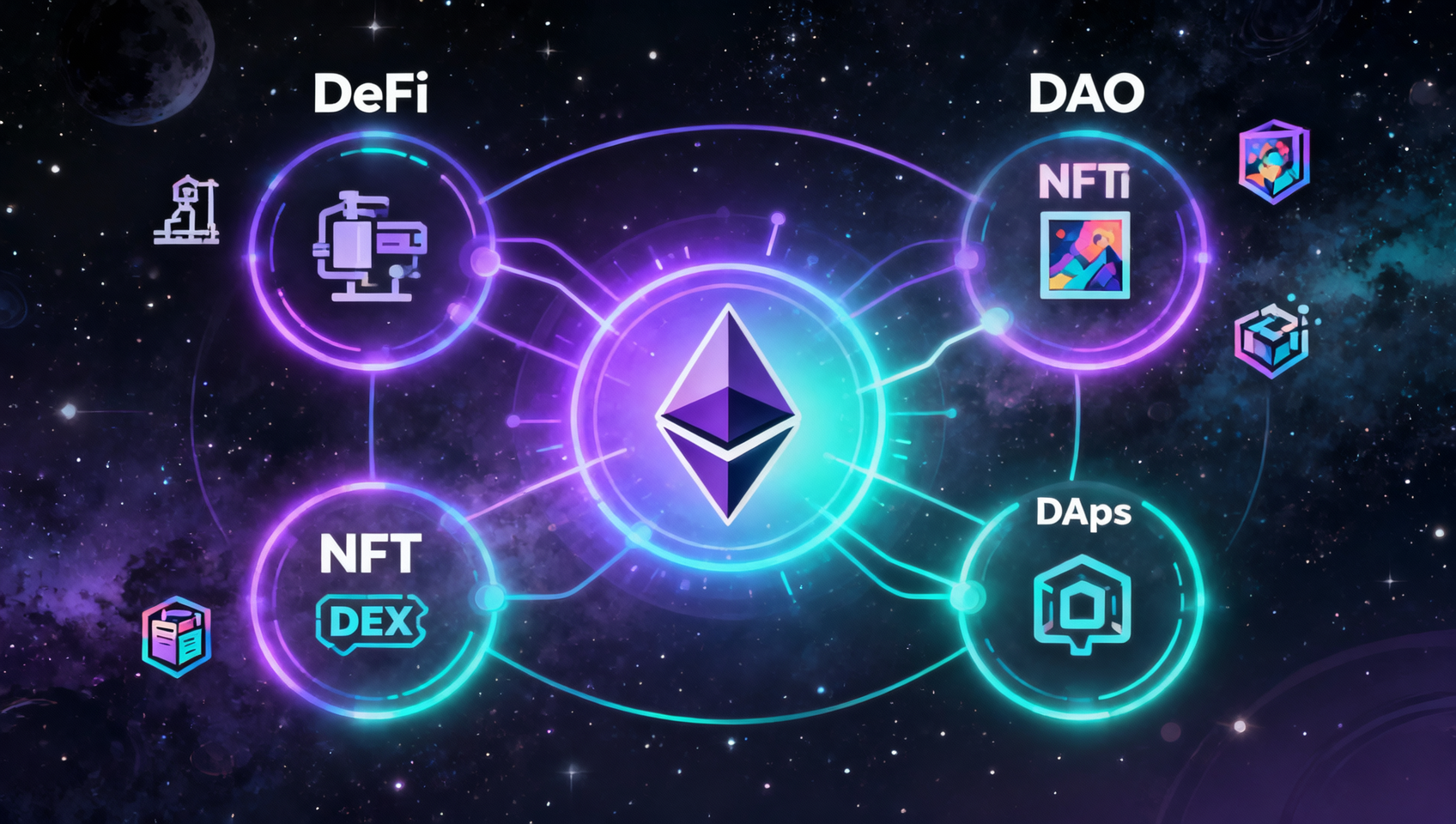
- The Ethereum Ecosystem: DApps, DeFi, NFTs
- Ethereum 2.0 and Layer 2 Explained
- How to Get Started as a Beginner
- Conclusion
- FAQ
- About the Author
TL;DR Summary
Ethereum is a "world computer" that can not only transfer value but also run programs (smart contracts). ETH is its "fuel," and its ecosystem includes DeFi, NFTs, and various decentralized applications. In 2022, it switched from "mining" to "staking" — more efficient and environmentally friendly.
Starting from Bitcoin: Why Do We Need Ethereum?
If you've read our What is Bitcoin article, you know Bitcoin is like "digital gold" — mainly for storing value and transferring money.
But here's the question: would you rather have a computer that can only do addition and subtraction, or one that can run all kinds of software?
Bitcoin is the calculator. Its design is intentionally simple:
| Can Do | Cannot Do |
|---|---|
| ✅ Transfer value | ❌ Run programs |
| ✅ Store value | ❌ Auto-execute contracts |
| ✅ Verify transactions | ❌ Issue other assets |
People wondered: could we build a blockchain that not only transfers value but also runs programs on it?
In 2015, a天才 programmer named Vitalik Buterin (everyone calls him "V God") made this a reality — it's called Ethereum.
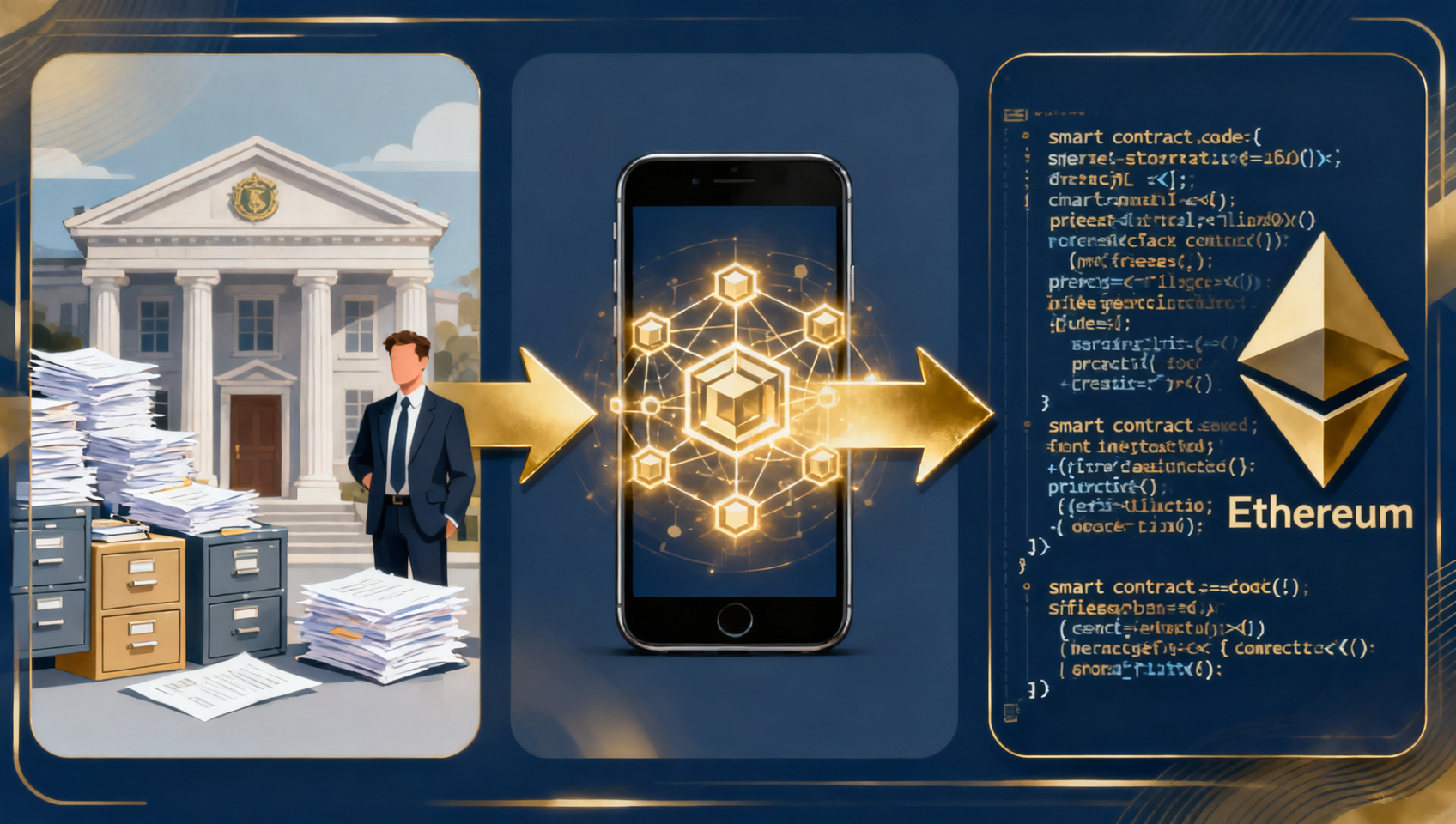
The first time I heard this analogy, it clicked: Bitcoin is a calculator; Ethereum is a smartphone.
What is Ethereum?
In Simple Terms: A "Global Shared Computer"
Ethereum is an open-source blockchain platform with smart contract functionality. Its native cryptocurrency is called Ether (ETH).
It sounds abstract, so let's break it down into three layers:
Layer 1: Ledger (Same as Bitcoin)
Like Bitcoin, Ethereum is a blockchain — all transactions are recorded on-chain, transparent and immutable.
Layer 2: Program-Running Platform (Unique to Ethereum)
But it's more than just a ledger — it can run programs. Once deployed on Ethereum, no one can shut these programs down, and no one can tamper with their logic.
Layer 3: Global Consensus Machine
This means strangers anywhere in the world can reach "consensus" through Ethereum — no need to trust each other, only the code.
Ethereum's History at a Glance
| Year | Event | Significance |
|---|---|---|
| 2013 | Vitalik publishes Ethereum whitepaper | The "world computer" vision is born |
| 2015 | Ethereum mainnet launches | First smart contract blockchain goes live |
| 2021 | EIP-1559 upgrade | Starts burning some Gas fees; ETH is no longer purely inflationary |
| 2022 | The Merge | Switched from "mining" to "staking"; energy use drops 99.9% |
| 2024 | Dencun upgrade | Drastically reduces Layer 2 fees; introduces Blob data |
| 2026 | Ongoing upgrades... | Still pursuing greater scalability |
Key point: The Merge in 2022 was Ethereum's most important milestone. Before, Ethereum used "mining" (Proof of Work), consuming as much energy as Bitcoin. Now it uses "staking" (Proof of Stake), cutting energy use by 99.9%. ETH's annual issuance also dropped from ~4% to ~0.5% — in some periods it's even deflationary.
What Exactly Are Smart Contracts?
The Most Intuitive Explanation
A smart contract is a self-executing program that automatically enforces an agreement. No judge, no middleman, no trust required.
A Down-to-Earth Example: A Vending Machine
Traditional contract: You sign a contract, wait for the other party to perform, and if they don't, you have to sue them.
Smart contract: A vending machine.
- You put in $3
- It automatically drops a soda
- No one can stop this process
- No one can cheat
That's the simplest form of a smart contract. Except on Ethereum, they're far more powerful — they can handle lending, trading, creating digital art, and even issuing cryptocurrencies.
Smart Contract Features
| Feature | Explanation |
|---|---|
| 🔒 Immutable | Code can't be changed after deployment, ensuring fairness |
| 🤖 Auto-executing | Executes automatically when conditions are met |
| 🌍 Globally accessible | Deployed on-chain; anyone worldwide can interact |
| 👻 Permissionless | No approval needed; just use a wallet |
Code is Law
You might have heard "Code is Law." It means: however the program is written, that's how it executes — no exceptions, no backdoors.
This is very different from the traditional world. If you want to borrow $1M from a bank, the bank manager can approve or reject you. But in a DeFi protocol on Ethereum, as long as you have sufficient collateral, the protocol automatically lends to you — no one can refuse.
Of course, this also means if your code has a vulnerability, hackers can exploit it — and no one can "manually stop" the program to save you. That's why smart contract security audits are critically important.
What is ETH Used For?
You might wonder: does Ethereum need a coin? The answer is absolutely.
ETH has three core uses:
1. Gas Fuel
Every operation on Ethereum — transferring, trading, calling contracts — requires a small amount of ETH as a fee. This is called Gas.
2. Staking as a Validator
After The Merge in 2022, you can stake your ETH on the network to become a validator. Validators package and verify transactions, earning ETH rewards in return.
Current staking APY is around 3-5%. You need at least 32 ETH to run your own validator, but you can participate through liquid staking protocols like Lido or Rocket Pool with just a few dollars.
3. Store of Value in the Ecosystem
ETH is the ecosystem's "fuel" and "hard currency." You need to borrow stablecoins in DeFi? Collateralize ETH. Want to buy an NFT? Pay in ETH. Need to pay Gas? Must be ETH.
Simply put: ETH is the lifeblood of the Ethereum ecosystem. Without it, the whole system grinds to a halt.
2026 ETH Latest Data
| Metric | Data |
|---|---|
| 💰 Current Price | $3,420 |
| 📊 Market Cap | $412 billion (2nd largest cryptocurrency) |
| 🔄 Circulating Supply | 120 million ETH |
| 📈 All-Time High | $5,489 (March 2024) |
| 📉 All-Time Low | $0.42 (2015) |
| 🔗 Staked Amount | ~34 million ETH (~28% of circulating supply staked) |
Data source: CoinGecko | CoinMarketCap
What is Gas Fee? Why Is It So Expensive?
What Gas Actually Is
Gas is the "transaction fee" you pay for any operation on Ethereum. It's not fixed — it changes dynamically based on network congestion.
How Gas Is Calculated
Gas Fee = Gas Used (units) × Gas Price (Gwei)
- Gas Used: Each operation consumes a fixed amount of Gas. A simple ETH transfer uses 21,000 Gas; a complex smart contract call might use 100,000-500,000 Gas
- Gas Price: How much Gwei you "bid" for validators to prioritize your transaction. The more congested the network, the higher you need to bid
- 1 Gwei = 0.000000001 ETH
Why Is Gas Sometimes So Expensive?
During the NFT craze of 2021, a simple transaction could cost $100-$500 in Gas. The reason is simple:
Ethereum's mainnet throughput is limited — about 15-30 transactions per second. When everyone is using it, you have to bid in a queue.
Think of it as: There's only one highway during rush hour — whoever pays more tolls goes first.
How to Save on Gas
| Method | Savings | Explanation |
|---|---|---|
| 🕐 Off-peak hours | 30-50% | Weekends or UTC night time (early morning Beijing time) are cheapest |
| ⚡ Use Layer 2 | 90-99% | Trade on Arbitrum, Optimism, Base — fees drop to a few cents |
| 📊 Track Gas | - | Use Etherscan Gas Tracker to monitor real-time prices |
| 🎯 Set max Gas | Flexible control | Set a lower Gas limit and wait if you're not in a hurry |
The Ethereum Ecosystem: DApps, DeFi, NFTs
This is the most exciting part of Ethereum.
DApps (Decentralized Applications)
A DApp is a "decentralized app" that runs on the blockchain.
| Traditional App | DApp |
|---|---|
| Data stored on company servers | Data stored on blockchain |
| Company can shut down service, ban your account | No one can shut it down |
| Code is closed-source | Code is open-source |
| Requires registration, login, KYC | Just needs a wallet |
DeFi (Decentralized Finance)
DeFi is finance on Ethereum.
Most Popular DeFi Apps:
| Type | Projects | What It Does |
|---|---|---|
| 🏦 Lending | Aave, Compound | Collateralize ETH to borrow stablecoins, or deposit funds for interest |
| 🔄 DEX | Uniswap, Curve | Swap tokens directly from your wallet — no registration, no deposit |
| 💰 Yield Aggregator | Yearn, Lido | Auto-allocates your funds to the highest-yield opportunities |
| 🪙 Synthetic Assets | MakerDAO | Collateralize ETH to mint DAI stablecoins |
Real scenario: You deposit 1 ETH (~$3,400) into Aave and can borrow
75% in stablecoins ($2,550) to buy other assets. You get liquidity without selling your ETH. In traditional finance this is called a "collateralized loan," but in DeFi — no bank, no paperwork, done in minutes.
NFTs (Non-Fungible Tokens)
An NFT is a unique digital asset on the blockchain. It can represent a painting, a song, a game item, or even a house.
NFT's core value: proof of digital ownership. You truly "own" a digital item, not just "view" it.
At its peak in 2021, a single CryptoPunk sold for $20M. By 2026, NFTs have evolved into "digital identity" and "real-world asset tokenization" (RWA) — much more than just profile pictures.
Other Ecosystem Components
| Area | Description |
|---|---|
| 🌉 Cross-chain bridge | Move assets between different blockchains |
| 🆔 DID (Decentralized Identity) | Use ENS (e.g., yourname.eth) as your Web3 identity |
| 🏛️ DAO | Decentralized Autonomous Organizations — vote on project direction with tokens |
| 🔮 Prediction Markets | Augur, Polymarket — bet on event outcomes |
Ethereum 2.0 and Layer 2 Explained
The Blockchain Trilemma
Every blockchain faces an impossible triangle: Security, Decentralization, Scalability — you can only have two at once.
Ethereum chose security and decentralization, so it's slow.
The solution has two parts:
1. Ethereum 2.0 Upgrade (Already Done)
The Merge in 2022 was the first step of Ethereum 2.0. It switched consensus from "mining" to "staking." Key benefits:
- ⚡ 99.9% energy reduction (from consuming as much power as Norway to almost nothing)
- 📉 90% reduction in ETH issuance
- 🔐 Prepared for future scalability
2. Layer 2 (L2 for short)
This is the main solution for Ethereum's congestion problem.
Core idea: Build another network "on top" of Ethereum to handle transactions, then "report" the results back to the main chain.
Main Layer 2s:
| L2 | Type | Features |
|---|---|---|
| Arbitrum | Optimistic Rollup | Largest ecosystem, most users |
| Optimism | Optimistic Rollup | Second largest, influential OP Stack |
| Base | Optimistic Rollup | Built by Coinbase, fastest growing |
| zkSync | ZK Rollup | Cutting-edge tech, zero-knowledge proofs |
| StarkNet | ZK Rollup | Uses STARK tech, great for high-computation tasks |
✅ Most important tip for beginners: Only use Ethereum on Layer 2 for transactions. Transfer fees go from $1-50 to $0.01-0.10, and speed improves from minutes to seconds. Most wallets (like MetaMask) have built-in L2 switching.
How to Get Started as a Beginner
Step 1: Understand the Risks
Like all crypto, Ethereum is highly volatile. In 2024, ETH went from $5,489 to $2,800 and back up.
Golden rule: Only invest what you can afford to lose entirely.
Step 2: Buy ETH
Buy ETH on compliant exchanges like Binance, OKX:
- Register on an exchange → Complete KYC
- Deposit fiat (bank card, transfer)
- Buy ETH
- Transfer to your own wallet (e.g., MetaMask)
Step 3: Try Ethereum DApps
- Install MetaMask wallet
- Send a small amount of ETH to your wallet (use Arbitrum or Base L2 for low Gas)
- Try swapping tokens on Uniswap
- Try depositing a tiny amount into Aave to earn interest
Step 4: Save Your Seed Phrase
This is the most important step. If you use a self-custody wallet (not an exchange wallet), losing your seed phrase means losing your coins forever.
Personal lesson: The first time I used MetaMask, I took a screenshot of my seed phrase and saved it on my phone. I later realized this is the most dangerous thing you can do — losing your phone means losing your wallet. Write it down on paper and keep it in a safe place. No screenshots, no cloud storage, no messaging apps.
Conclusion
Ethereum isn't just "the second cryptocurrency" — it's a complete decentralized digital ecosystem:
- 🧱 Base layer: Ethereum blockchain — a global shared "world computer"
- 📄 Middle layer: Smart contracts — self-executing programs
- 🏗️ Application layer: DApps, DeFi, NFTs, DAOs — various decentralized applications
- 🔋 Fuel: ETH — the "gas" powering the entire ecosystem
Ethereum vs Bitcoin:
| Bitcoin | Ethereum | |
|---|---|---|
| ⚡ Purpose | Digital Gold | World Computer |
| 💻 Function | Transfer, store value | Smart contracts, DApps |
| 🔄 Consensus | Proof of Work (mining) | Proof of Stake (staking) |
| 📦 Block time | ~10 minutes | ~12 seconds |
| 🔗 Daily transactions | ~300k | ~1.1M (mainnet) + tens of millions on L2 |
| 💵 Market cap rank | #1 | #2 |
| 🌟 Core narrative | Monetary sovereignty | Decentralized computing |
For beginners:
- ✅ Bitcoin and Ethereum complement each other — they're not competitors
- ✅ Learn MetaMask first, then try DApps
- ✅ Layer 2 is 100x cheaper than mainnet — use it
- ❌ Never store your seed phrase online
- ❌ Avoid mainnet transactions during high Gas hours
Ethereum has no "admin." Your money is truly your money. That's its most appealing quality — and also why you need to be responsible for yourself.
FAQ
Q: Should I buy Bitcoin or Ethereum?
As a pure beginner wanting stability, Bitcoin. If you want to experience blockchain's true potential, Ethereum. Many people hold both (e.g., 60% BTC + 40% ETH). They're not rivals; each has unique value.
Q: Is it too late to buy ETH?
No one can predict prices. But Ethereum has the largest developer ecosystem of any blockchain — over 6,000 active developers, and 60%+ of all DeFi TVL is on Ethereum. As long as blockchain exists, Ethereum is critical infrastructure. Always DYOR before investing.
Q: Are smart contracts risky?
Yes. If smart contract code has vulnerabilities, hackers can steal funds. Major incidents include:
- 2016: The DAO hack — 3.6M ETH lost
- 2022: Ronin bridge hack — $620M lost
- 2023: Multiple DeFi protocol exploits
Recommendation: Use well-audited, established protocols (Aave, Uniswap, MakerDAO) — avoid unknown DApps.
Q: Why is my transaction stuck for hours?
You set your Gas price too low. If the network suddenly gets congested, no validator will pick up your transaction. Either wait (could take days) or use your wallet's "speed up" feature to increase Gas.
Q: Which wallet should I use?
| Wallet | Best For | Why |
|---|---|---|
| MetaMask | 🆕 Beginners | Most popular, most plugins, most tutorials |
| Rabby | 🆕 Beginners | Better UX than MetaMask, auto Gas suggestions |
| Ledger | 💰 Large holders | Hardware wallet, most secure (offline) |
| Trust Wallet | 📱 Mobile users | Clean interface, multi-chain support |
Q: Are Layer 2 assets safe?
As safe as the main chain. Layer 2's security is ultimately backed by Ethereum mainnet. Major L2s like Arbitrum, Optimism, and Base have billions in TVL and years of operation without major issues.
Q: What are ERC-20 tokens?
ERC-20 is the standard for issuing tokens on Ethereum. Like USB-C is the universal standard for charging cables, ERC-20 ensures tokens work seamlessly in the Ethereum ecosystem. Most tokens (USDT, USDC, UNI, LINK, etc.) are ERC-20 tokens.
Q: Is staking ETH safe?
Running your own validator with 32 ETH is relatively safe — the worst penalty for misbehavior is getting your stake slashed. Liquid staking through Lido is also reasonably safe, though it carries smart contract risk. APY is typically 3-5%, but staked ETH has reduced liquidity.
Q: Which is better — Ethereum or Solana?
They solve different problems. Ethereum prioritizes security and decentralization — slower but most secure. Solana prioritizes performance (thousands of TPS) but has experienced multiple outages. Your choice depends on what matters to you: security over efficiency → Ethereum; speed first → consider Solana.
Q: Any tips to save on transaction costs?
- Use Layer 2: Fees are ~1% of mainnet
- Use "speed up": Set higher Gas when in a hurry, lower when you can wait
- Batch operations: Approve once, use multiple times
- Monitor Gas: Use Etherscan Gas Tracker to time your transactions
📚 Continue Learning:
Disclaimer: This article is for educational purposes only and does not constitute investment advice. Cryptocurrency investment involves risk. Please make your own informed decisions.