

⚠️ Before anything else: if you do not have an account yet, sign up through the registration link (e.g. "Sign up now") or enter invite code BINANBT — registering directly inside the app gets you none of the new-user rewards, and both the $19,800 welcome package and the 20% fee rebate will not apply. You must complete KYC before C2C and spot pages open.
Key takeaways (TL;DR):
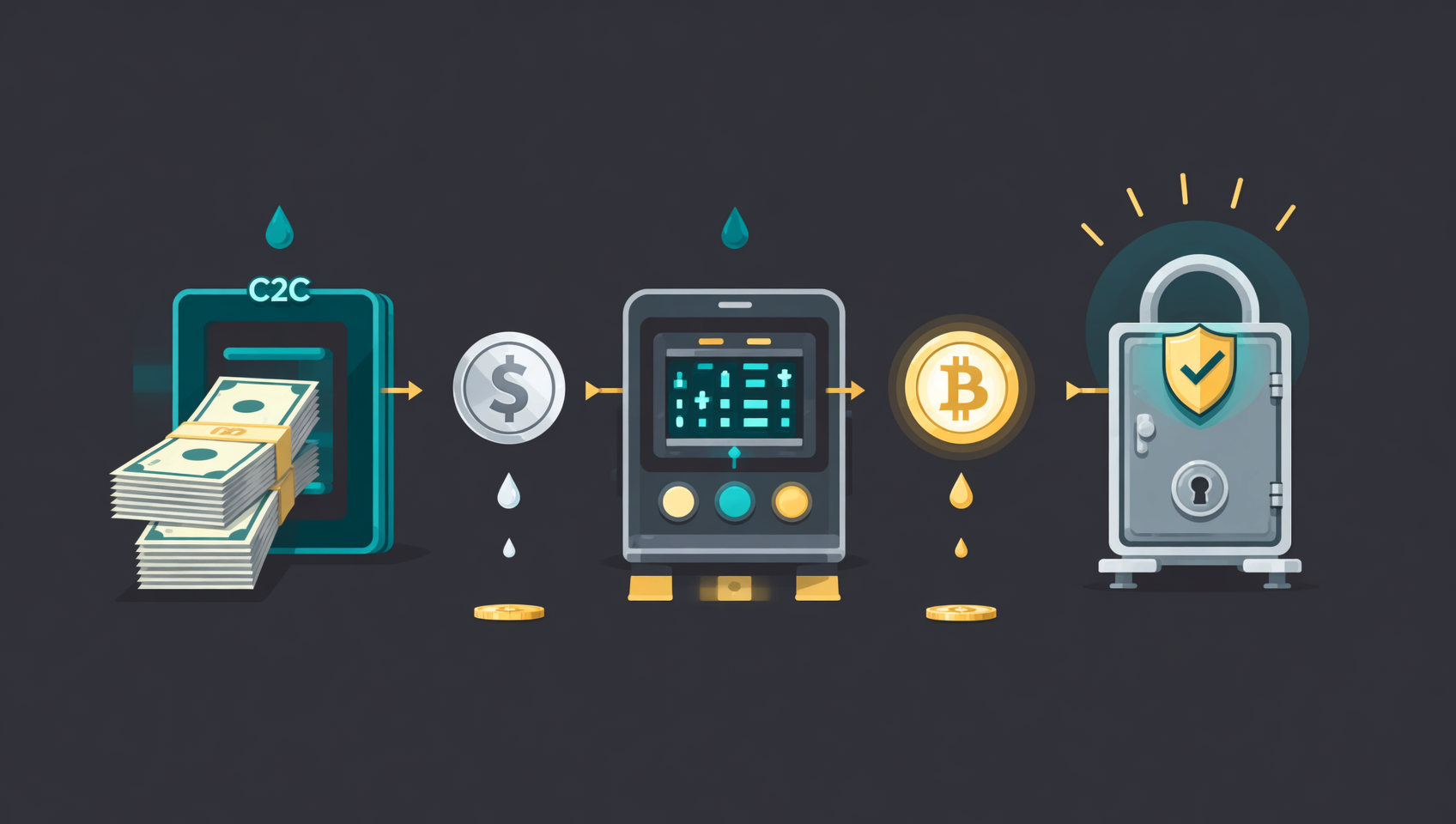
- Buying crypto is a three-step chain, not a single order: fiat → USDT → target coin → storage. Most beginner problems happen at step one (how much fiat to convert) and step three (where to keep the coins), not at the Buy button.
- The biggest cost is not the 0.1% trading fee; it is the on-ramp spread. C2C merchants typically quote 0.5%–2% above market, while instant buy charges 1.8%–3.5%. On a 1,000 CNY purchase, the difference can exceed 20 CNY.
- A rebate reduces trading fees, not the on-ramp spread. A 20% rebate applies to that 1 CNY trading fee and saves about 0.2 CNY; it does not make merchant quotes cheaper.
- Start with 100–300 CNY. Binance spot requires about 5 USDT minimum per order, and C2C merchants commonly require 80–100 CNY. That amount completes the full loop and is small enough to lose.
- Buy BTC, ETH or USDT first, not a "cheap-looking" altcoin. A $0.001 unit price means large supply, not value.
- Keeping coins on the exchange is acceptable at first, but enable 2FA. Consider a hardware wallet above roughly $1,000; never screenshot your seed phrase.
Table of contents
- The short answer: buying crypto is a three-step chain
- Three legitimate routes: how money gets into the exchange
- The real cost of a 1,000 CNY purchase
- Step 1: registration, KYC and security
- Step 2: converting fiat into USDT
- Step 3: buying your first coin with USDT
- What to buy: three questions before you order
- Step 4: where to keep the coins
- Six beginner mistakes
- First-purchase checklist
- 💰 Binance rebate: invite code BINANBT
- FAQ
- Further reading
The short answer: buying crypto is a three-step chain
The complete action is: convert fiat into a stablecoin, use the stablecoin to buy the target asset, then decide where to hold it. Placing the order is only the middle step; the first and last steps determine what you actually pay and what risks you take.
Each step has its own cost and failure point:
- On-ramp (fiat → USDT). Cost: merchant spread or platform fee. Failure points: paying without clicking "I have paid", paying from someone else's bank account, or meeting a merchant who will not release the coins.
- Trade (USDT → target coin). Cost: 0.1% spot fee. Failure points: market-order slippage, wrong trading pair, or treating an altcoin as a bargain.
- Storage (exchange → wallet). Cost: withdrawal fee. Failure points: wrong network, wrong address, or handing your seed phrase to someone.
So the correct answer to "how to buy crypto" is not "open the app and tap Buy". It is: convert fiat into USDT at the lowest reasonable cost, buy the asset you actually intend to hold with a limit order, then choose storage based on the amount. The rest of this guide follows that order.
Three legitimate routes: how money gets into the exchange
For someone with only local fiat and a freshly verified account, there are three realistic on-ramps: C2C, instant buy and on-chain deposit. Their costs, minimums and audiences differ sharply.
| Route | How it works | Cost | Minimum | Best for |
|---|---|---|---|---|
| C2C | The platform matches you with another user; you buy USDT and pay the seller's personal account | 0.5%–2% spread baked into the quote; no C2C platform fee | Commonly 80–100 CNY; small merchants may accept 20–50 CNY | First purchase, 100 CNY or more |
| Instant buy | Buy crypto directly from the platform with a bank card or credit card | 1.8%–3.5% fee | About $10 | Convenience, very small amounts, no merchant interaction |
| On-chain deposit | Transfer crypto in from another exchange or wallet | Network fee + the sending platform's withdrawal fee | Coin-specific minimum deposit | People who already hold crypto |
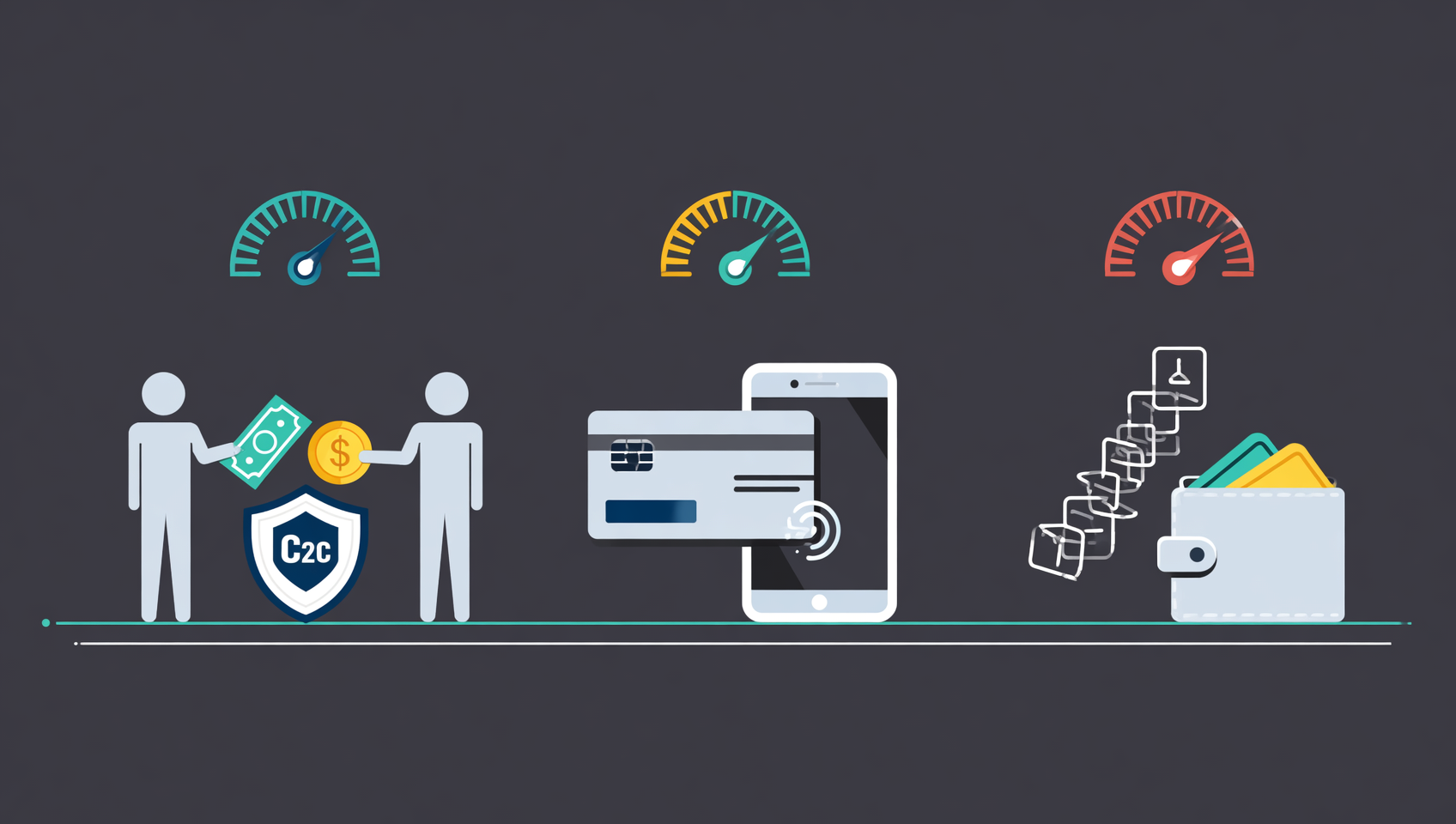
The last column makes the choice clear: C2C is the only route that uses local fiat, keeps cost controllable and accepts flexible amounts. Instant buy is expensive up front; on-chain deposit requires you to already own crypto.
Two "convenient" options are best avoided:
- Asking a friend to buy for you, or trading privately. There is no platform escrow and no appeals process if the other side does not deliver.
- Trusting "signal teachers", "internal channels" or "discounted USDT". Cheap USDT often comes from flagged funds and can trigger a bank freeze.
In one sentence: use C2C for your first purchase not because it is perfect, but because the other two do not work for a beginner and the remaining options should be avoided.
The real cost of a 1,000 CNY purchase
On a 1,000 CNY purchase, C2C and instant buy can differ by more than 20 CNY in effective cost. Break the fees down and you can see where the money leaks.
Assume a C2C quote 1% above market, a 2.5% instant-buy fee and a 0.1% spot trading fee:
| Cost item | C2C route | Instant-buy route |
|---|---|---|
| On-ramp spread/fee | About 10 CNY (1%) | About 25 CNY (2.5%) |
| USDT → BTC trading fee | About 1 CNY (0.1%) | Usually included in the quote |
| Total explicit cost | About 11 CNY (1.1%) | About 25 CNY (2.5%) |
| After BNB fee discount | Fee drops to 0.075%; total about 10.75 CNY | Not applicable |
| After the 20% rebate | Trading fee about 0.8 CNY; total about 10.8 CNY | Not applicable |
The important conclusion is not the 0.2 CNY saved. It is that a rebate and the BNB discount only optimize the 1 CNY trading fee; they cannot touch the 10 CNY on-ramp spread. To lower real cost, compare merchant quotes and funding routes, not rebate percentages.
Two more costs are easy to miss:
- Withdrawal fees. Charged per transaction, not as a percentage. Moving $20 of crypto can cost $1–5, which is a large share. Keep small amounts on the exchange.
- Spread and slippage. A market order fills at the current book, and thin coins can fill 0.5% or more above the price you saw. Beginners should use limit orders.
In one sentence: the big cost is how the money gets in, not how the order is placed.
Step 1: registration, KYC and security
Buying on Binance requires three things first: an account, a passed KYC review and 2FA enabled. Without them, C2C and spot pages will not function normally.
- Register. Use an email or phone number and enter invite code BINANBT in the invite-code field (or use the registration link). The referral relationship is fixed at registration; Binance does not officially support adding it manually afterwards, so do not wait until after your first purchase.
- Complete KYC. Upload your ID and pass the liveness check. The name on the ID, the account and the bank card must match, or C2C payments will fail later.
- Enable 2FA. Use Google Authenticator or a similar app, not SMS alone. SMS can be intercepted; 2FA is the last door.
- Set an anti-phishing code. Binance adds a personal code to its emails; check for it before trusting any "Binance" message.
- Prepare a bank account or payment app in your own verified name. C2C requires the payer to match the verified identity. Using a family member's card is a common reason appeals fail.
For screen-by-screen steps, see the Binance registration guide 2026. If you have not installed the app yet, read the Binance download and registration guide first so you do not install a fake package from a search ad.
Step 2: converting fiat into USDT
C2C is an escrowed person-to-person market: the coins are held by the platform, but your money goes directly to the seller. Understanding this makes every later action make sense.
The full flow takes about ten minutes:
- Open Buy Crypto → C2C, select USDT, choose your fiat and enter an amount. Start with 100–500 CNY or the local equivalent.
- Filter merchants. Do not sort by price alone. Check completion rate, number of orders, average release time and account age. A quote far below market often has another motive.
- Place the order and verify three things: the seller's receiving account, the exact amount (to the cent), and the payment countdown (often 15 minutes).
- Pay from your own verified account. Match the amount exactly and confirm the recipient name. Follow the page's memo instructions; do not add "USDT", "Bitcoin" or "buy crypto" to the transfer note — such notes can trigger bank risk controls.
- Return to the order page and click "I have paid". This is the most common failure: the money is sent but the order times out because the confirmation was never clicked, and the seller will not release the coins.
- Wait for release. The USDT arrives in your funding wallet, not the spot wallet. Many beginners think it never arrived.
- Transfer to the spot wallet. Use Assets → Transfer to move USDT from funding to spot before you can trade.
- Keep records. Order number, payment receipt and chat history, at least until the funds are fully settled.
If the seller does not release, click Appeal on the order page and upload proof showing the amount, time and recipient. Do not move to WeChat, do not pay privately, and do not cancel the order first.
Card-freeze risk comes from person-to-person transfers, not from Binance itself. Using your own everyday card, keeping each transfer modest and avoiding suspicious merchants reduces the probability but cannot eliminate it. For merchant screening and freeze handling, see the Binance C2C deposit guide.
Step 3: buying your first coin with USDT
Once USDT is in the spot wallet, buying a coin is an ordinary spot order: choose the pair, enter price and quantity, confirm. Beginners only need to understand two order types to avoid most mistakes.
- Limit order. You set the price; it fills only when the market reaches it. If it does not fill, you simply wait, and you never overpay. Use this first.
- Market order. Fills immediately at the best available price. Convenient, but subject to slippage, especially in thin markets.
Steps:
- Search for the coin on the spot page and confirm the pair. To buy bitcoin, choose BTC/USDT, not BTC/USDC or another quote currency.
- Enter the USDT amount or the coin quantity. The order value must be at least about 5 USDT, or the page will reject it for falling below the minimum notional.
- Choose a limit order, enter a price near the book and wait for the fill.
- After the fill, the coin sits in your spot wallet. Keep it there or withdraw it to self-custody.
Fees: Binance spot charges 0.1% by default; enabling "pay fees with BNB" cuts it to 0.075%; if you registered with an invite code, the 20% rebate applies to the fee you actually pay, bringing the effective rate to about 0.06%. This is small next to the on-ramp spread, but it compounds over many trades.
In one sentence: use a limit order, confirm the pair is XXX/USDT, and keep the order above 5 USDT.
What to buy: three questions before you order
The most important thing about a first purchase is not finding a coin that will rise, but choosing a position you can afford to lose. If you cannot answer one of these questions, wait.
- If this money went to zero, would your life change? If yes, reduce the amount. Crypto has no daily price limit; a 20% drop in a day is routine.
- Can you explain what creates demand for it? Bitcoin relies on the consensus around decentralized value storage; Ethereum on smart contracts and on-chain applications; stablecoins on issuer reserves. If you cannot explain it, you are buying someone else's mood.
- How long do you plan to hold? Three days and three years are different strategies and require different storage.
A sensible default for beginners:
- Most of the position in BTC and ETH. They have the deepest liquidity and broadest consensus, and their volatility is already high enough.
- A small slice for learning. If you want to try altcoins, cap them at 10%–20% of the portfolio and read spot vs futures before touching leverage.
- Do not buy because the unit price is low. DOGE, SHIB and PEPE are cheap per unit because supply is large, not because they are undervalued. See the Dogecoin beginner guide.
- Never use rent, tuition or borrowed money. This is not conservatism; it is what lets you hold through a drawdown.
Step 4: where to keep the coins
Where coins should live depends on the amount, holding period and how often you trade. There is no rule that you must move everything to a wallet immediately. For a beginner, securing the exchange account matters more than rushing to buy hardware.
| Portfolio size | Recommended storage | Why |
|---|---|---|
| Under $1,000 | Exchange with 2FA | Withdrawal fees are a large share; self-custody is not worth it yet |
| $1,000–$10,000 | Split between exchange and hardware wallet | Reduces single-point risk while keeping liquidity |
| Above $10,000 | Mostly hardware wallet | Exchange counterparty risk becomes material |
| Long-term, untouched | Hardware wallet | Less frequent logins and approvals |
The most common withdrawal error is the network. The same coin can exist on several chains, and address formats can look identical; choosing the wrong network can mean permanent loss. Test with a small amount first. See the Binance withdrawal network guide and the cold wallet guide.
In one sentence: keep small amounts on the exchange with 2FA, move larger amounts to a hardware wallet, and confirm the network before every withdrawal.
Six beginner mistakes
- Paying without clicking "I have paid". The order times out, the seller does not release, and the money is already gone. Confirm on the order page immediately after paying.
- Thinking USDT never arrived. C2C deposits land in the funding wallet and must be transferred to spot before trading.
- Paying from a family member's card. The payer does not match the verified identity, so the platform cannot confirm you paid when a dispute arises.
- Chasing a pump with a market order. The fill can be well above the price you saw, especially in small caps.
- Treating an altcoin as a bargain. A low unit price reflects large supply, not upside; many coins are so thin that you cannot exit when you want.
- Choosing the wrong withdrawal network. Identical address formats do not mean the same network. Check the network name and test small.
First-purchase checklist
- Account registered, invite code entered at sign-up
- KYC passed; ID, name and bank card all match
- 2FA enabled and anti-phishing code set
- First deposit between 100 and 500 CNY (or local equivalent)
- C2C merchant has a healthy completion rate and release time; you did not chase the lowest price
- Clicked "I have paid" and kept the order and payment records
- USDT transferred from funding to spot wallet
- Limit order used; pair confirmed as XXX/USDT
- Order value at least 5 USDT
- You know which wallet holds the coin and whether a withdrawal is needed
- If withdrawing, network checked and a small test sent first
- Losing this money would not affect your life
💰 Binance rebate: invite code BINANBT
Most of the cost is in the on-ramp spread, but the 20% fee rebate locked in at registration lasts, and it grows with trading volume. This article contains a referral link; we may receive a reward if you register through it, but it costs you nothing extra.
- Rebate: 20% of trading fees, ongoing.
- Welcome package: up to $19,800, unlocked through tasks, not cash on signup.
- How to claim: enter BINANBT in the invite-code field during registration; this is the most reliable route.
- Stack it: enable "pay fees with BNB" for another 25% off spot fees; combined, spot effectively costs about 0.06%.
- Important: registering directly inside the app gets you none of the new-user rewards. In-app registration does not create a referral relationship, so the $19,800 welcome package and the 20% fee rebate will not apply — you must use the registration link or enter invite code BINANBT.
👉 Sign up on Binance and claim a 20% trading fee rebate
FAQ
Is buying crypto legal?
It depends on where you live. Some countries regulate exchanges and tax gains; others restrict or ban trading and fiat on-ramps. Mainland China treats virtual-currency business activities as illegal financial activities and restricts related trading. This guide explains mechanics only; it is not legal advice and does not show how to evade local rules. Confirm your local law before participating1.
What is the minimum amount needed to buy crypto?
Binance spot orders generally require about 5 USDT; C2C merchants commonly require 80–100 CNY, and instant buy starts around $10. A first deposit of 100–300 CNY (or the equivalent) is enough to complete deposit, purchase and withdrawal while keeping the amount small. See the minimum amount guide.
Do I have to buy USDT first?
With C2C, yes: local fiat becomes USDT, then USDT buys the target coin. That is the most flexible route. Instant buy lets you purchase BTC or another asset directly with fiat, but the fee is higher. On-chain deposit is for people who already hold crypto elsewhere.
What fees will I pay?
Binance spot charges 0.1%; paying with BNB cuts it to 0.075%, and a 20% referral rebate brings the effective rate to about 0.06%. The larger cost is the on-ramp: C2C spreads of 0.5%–2%, or instant-buy fees of 1.8%–3.5%.
Can I withdraw immediately after buying?
Usually yes, but withdrawal fees are charged per transaction and loom large on small amounts. Newly purchased assets may also be subject to order processing or risk checks; follow the page status. Test with a small withdrawal first.
Is Binance safe? Can I lose coins held on an exchange?
Binance is one of the largest exchanges by volume and maintains the SAFU user-asset fund and proof-of-reserves reports, but "large" is not "risk-free". Exchanges face hacking, account theft, regulatory restrictions and withdrawal pauses2. Small balances can stay on the exchange with 2FA; larger balances belong in a hardware wallet you control.
How do I sell crypto later?
Sell the coin for USDT on the spot market, then sell USDT for local fiat through C2C. Check merchant quotes, payment method and release process; do not go off-platform for a "better rate". Freeze risk applies to selling too, so keep complete records.
Further reading
- Binance registration guide 2026: account, KYC and deposit
- Binance C2C deposit guide: buying USDT and getting it credited
- Binance spot trading guide: limit orders, market orders and fees
- Minimum amount to buy crypto: the real thresholds
- What is USDT and how do you buy it?
- Spot vs futures: what beginners need to know first
- CoinGecko vs CoinMarketCap: which data site should you use?
- More beginner guides
Disclaimer: this article is for educational purposes only and is not investment or legal advice. Fees, spreads, minimum order sizes and withdrawal rules are reference values checked on 2 November 2026 and may change by platform, region and asset; always follow the live Binance page. Crypto prices are volatile and you can lose your entire principal; C2C trades also carry counterparty, bank-risk-control and local-compliance risks. Use only money you can afford to lose, and confirm the law where you live first1.
Footnotes
-
Source: the People's Bank of China and nine other authorities, "Notice on Further Preventing and Handling the Risks of Virtual Currency Trading and Speculation" (September 2021), which classifies virtual-currency business activities as illegal financial activities; this article explains mechanics only and is not legal advice. ↩ ↩2
-
Source: Binance official pages on the Secure Asset Fund for Users (SAFU) and Proof of Reserves, accessed 2 November 2026; historical security incidents and regional restrictions follow official announcements. ↩