


Table of Contents
- What Is Grid Trading?
- Spot Grid vs Futures Grid
- Core Parameter Settings Explained
- Three-Step Grid Trading Setup
- Three Classic Grid Strategies
- Risk Control and Common Issues
- Further Reading
What Is Grid Trading?
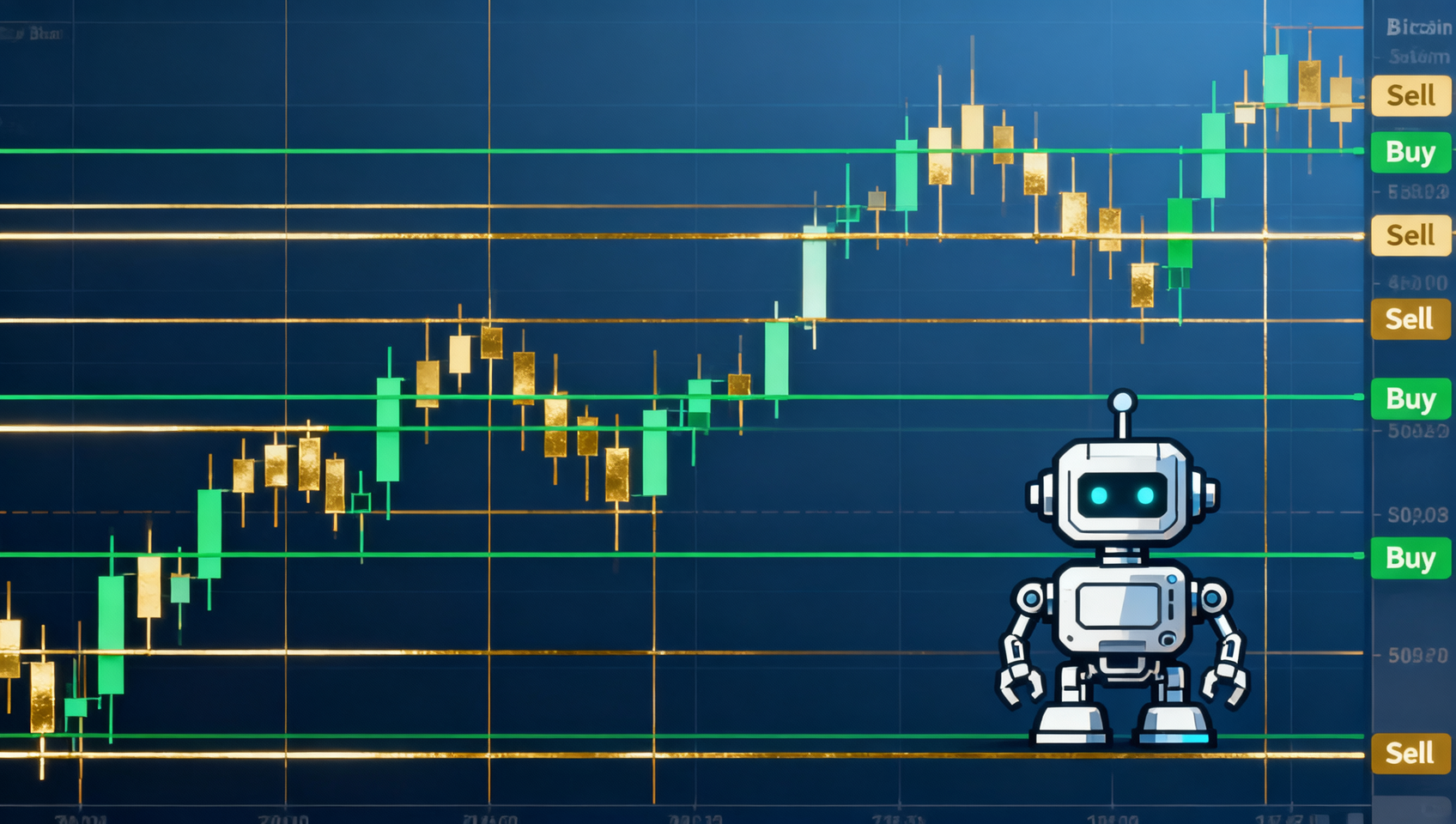
Grid trading is an automated quantitative strategy where you divide your funds into equal parts within a set price range, and the bot automatically places buy orders at lower price levels and sell orders at higher levels. Each time a price oscillation triggers an execution, it locks in a spread profit.
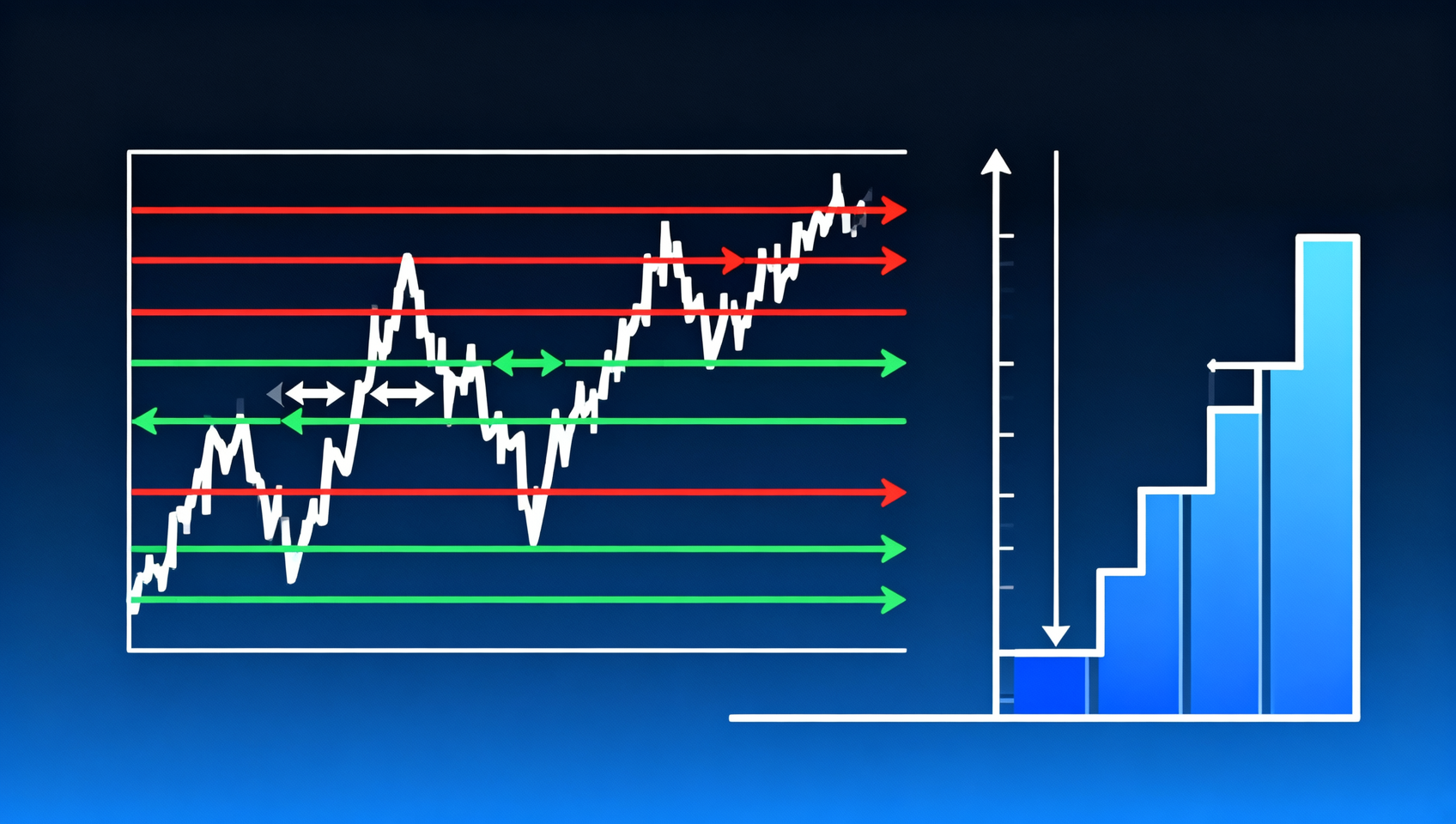
Grid Trading Core Logic
| Market Condition | Grid Performance | HODL Comparison |
|---|---|---|
| Range-bound market ✅ | 🟢 Optimal — repeated buy-low-sell-high | 🟡 Zero profit |
| Strong uptrend | 🟡 Underperforms — sells out early | 🟢 Maximum profit |
| Strong downtrend | 🔴 Loses money (continuously buying) | 🔴 Loses money (but no fees) |
Simply put: Grid trading automates the "buy low, sell high" operation. You don't need to watch charts or predict direction — just set the parameters and let the bot execute.
Why Learn Grid Trading in 2026?
The 2026 crypto market shows several grid-friendly characteristics:
- High volatility: BTC oscillates frequently in the $58K-$65K range — grid trading's "sweet spot"
- Strong liquidity: BTC/USDT, ETH/USDT pairs have excellent depth and low slippage
- Mature exchange tools: Binance's grid trading system is now highly refined with AI parameter recommendations
💡 Don't have a Binance account yet? Take 5 minutes to complete the Binance Registration Guide first.
Spot Grid vs Futures Grid
Binance offers two grid trading types for different risk preferences.
| Feature | Spot Grid | Futures Grid |
|---|---|---|
| Trading Asset | Real spot assets | USDT-margined perpetuals |
| Leverage | 1x (none) | Supports 1x-125x |
| Shorting | ❌ Long only | ✅ Long/Short/Neutral |
| Liquidation Risk | ❌ None | ✅ Yes |
| Funding Rate | ❌ None | ✅ Every 8 hours |
| Fees | 0.1% (Maker 0.08%) | 0.02%-0.05% |
| Min Profit per Grid | >0.3% | >0.1% |
| Min Investment | ≥500 USDT recommended | Lower (leverage amplifies) |
| Best For | Beginners, conservative investors | Experienced traders |
Recommendation
- Crypto beginners → Spot grid. No liquidation risk, practice with real assets
- Advanced traders → After mastering spot grid, try futures grid neutral strategy (both long and short simultaneously)
- Large capital → Spot grid as main strategy, futures grid for small positions
If you're not familiar with futures basics, read Binance Perpetual Futures Tutorial first.
Core Parameter Settings Explained
Parameter settings determine whether your grid strategy profits — the same coin, same capital, different parameters produce completely different results.

1️⃣ Price Range — The Grid's "Safety Boundary"
The price range is the most important parameter. Too narrow and you'll break out easily; too wide and capital efficiency drops.
Recommended Settings:
| Coin | Recommended Range Width | Method |
|---|---|---|
| BTC/USDT | Current price ±10%-15% | Reference 90-day high/low |
| ETH/USDT | Current price ±12%-18% | ETH more volatile, wider range |
| Major altcoins | Current price ±15%-25% | Adjust based on historical volatility |
Practical Steps:
- Open Binance chart, switch to 4-hour or daily timeframe
- Check the highest and lowest prices in the last 90 days
- Lower bound = highest of three recent lows × 1.05 (5% buffer)
- Upper bound = lowest of three recent highs × 0.95 (5% buffer)
- Ensure current price is in the lower 1/3 of the range
💡 AI Smart Parameters: Binance offers AI parameter recommendations based on the last 7 days of price action. Beginners can start with AI parameters and manually fine-tune later.
2️⃣ Grid Count — Attack vs Defense
| Style | Grids | When to Use |
|---|---|---|
| Conservative (Sparse) | 10-15 | Wide range, trend may continue |
| Balanced (Recommended) | 20-30 | Standard ranging, direction uncertain |
| Aggressive (Dense) | 30-50 | Narrow range, extended sideways expected |
Key Principle:
- More grids → Higher trade frequency → Thinner profit per grid
- Profit per grid must > double the trading fee (spot ~0.2%, futures ~0.04%-0.1%)
- BTC/USDT recommended grids: 15-25 (geometric mode)
3️⃣ Arithmetic vs Geometric — Choose Your Spacing
| Mode | Principle | Feature | Best For |
|---|---|---|---|
| Arithmetic | Fixed price gap per grid | Denser at low prices (more buys), sparser at high prices | Narrow range, clear boundaries |
| Geometric | Fixed percentage per grid | Lower prices = denser grids (more buys), higher = sparser | BTC/ETH recommended |
Recommendation: Use Geometric mode for BTC/USDT and ETH/USDT, with 0.3%-0.5% per grid.
4️⃣ Investment Amount and Allocation
| Total Capital | Grid Investment | Grids | Per Grid |
|---|---|---|---|
| 500 USDT | 400 USDT (80%) | 20 | ~20 USDT |
| 1,000 USDT | 800 USDT (80%) | 25 | ~32 USDT |
| 5,000 USDT | 4,000 USDT (80%) | 30 | ~133 USDT |
| 10,000 USDT | 8,000 USDT (80%) | 30 | ~266 USDT |
Golden Rules of Fund Management:
- Single grid bot ≤ 25%-30% of total portfolio
- All grid strategies combined ≤ 50% of spot account
- Always keep emergency reserves
Three-Step Grid Trading Setup
Step 1: Enter Grid Trading
| Platform | Path |
|---|---|
| Web | Login Binance → Top menu「Trade」→「Trading Bots」→「Spot Grid」 |
| App | Open Binance App → Bottom「Trade」→ Switch to「Trading Bots」→「Grid」 |
Step 2: Choose Parameter Mode
| Mode | Description |
|---|---|
| AI Mode | Binance AI analyzes last 7 days, recommends range and grids — Beginner recommended |
| Custom Mode | Manual parameter settings — Advanced users |
Step 3: Configure and Launch
| Parameter | Recommended Value | Notes |
|---|---|---|
| Trading Pair | BTC/USDT | Beginners: choose most liquid coin |
| Upper Price | Current × 1.10~1.15 | Reference 90-day high minus 5% |
| Lower Price | Current × 0.85~0.90 | Reference 90-day low plus 5% |
| Grid Count | 20-25 | BTC/USDT example |
| Spacing Mode | Geometric | Best for major coins |
| Total Investment | ≤80% of account | Don't go all-in |
| Profit/Stop-Loss | Optional | TP at 5%-8% recommended |
Click 「Create」 after confirming. The bot runs automatically.
Three Classic Grid Strategies
Strategy 1: BTC Mainstream Range (Beginner Recommended)
| Parameter | Setting |
|---|---|
| Pair | BTC/USDT |
| Range | $58,000-$68,000 (±12% of current) |
| Grids | 20 |
| Spacing | Geometric (~0.48% per grid) |
| Investment | 30% of available funds |
| Take Profit | Auto-stop at +5% |
| Stop Loss | -12% (if price breaks below range) |
Best for: All grid trading beginners. BTC has the best liquidity and most moderate volatility.
Strategy 2: ETH High-Volatility (Advanced)
| Parameter | Setting |
|---|---|
| Pair | ETH/USDT |
| Range | $1,500-$2,000 (±15% of current) |
| Grids | 30 |
| Spacing | Geometric (~0.4% per grid) |
| Investment | 25% of available funds |
| Take Profit | +8% |
Best for: Traders with existing BTC grid experience. ETH has higher volatility — more grid triggers but needs wider range.
Strategy 3: Multi-Coin Portfolio (Expert)
Run 2-3 grid strategies simultaneously:
| Grid | Coin | Allocation | Style |
|---|---|---|---|
| Grid A | BTC/USDT | 50% | Conservative (wide range, fewer grids) |
| Grid B | ETH/USDT | 30% | Standard |
| Grid C | SOL/USDT | 20% | Aggressive (narrow range, more grids) |
Portfolio advantage: BTC provides stability, ETH provides volatility returns, SOL provides high beta. Their imperfect correlation reduces overall risk.
Risk Control and Common Issues
⚠️ Five Major Grid Trading Risks
| Risk | Description | Mitigation |
|---|---|---|
| Range Breakout | Price breaks range, strategy fails | Leave 5%-10% buffer; set stop-loss |
| Trending Market | Grid underperforms holding | Start in ranging markets; use geometric mode |
| Fee Erosion | High-frequency fees accumulate | Ensure per-grid profit >0.3%; use BNB for fee discounts |
| Capital Inefficiency | Idle + locked capital | Set reasonable range; use geometric mode |
| Event Shocks | FOMC, CPI volatility spikes | Pause grid before major events; widen range |
Realistic Expectations
Grid trading ≠ money printer. It's a "smart enhancement" for ranging markets, not "risk-free arbitrage."
Estimated monthly returns:
| Market Type | Monthly Return (estimated) |
|---|---|
| Ideal range-bound | 2%-8% |
| Average | 0%-3% |
| Adverse (trending) | -5% to -15% |
Common Beginner Mistakes
| Mistake | Consequence | Correct Approach |
|---|---|---|
| Too many grids + too narrow range | Frequent breakouts, high fees | 20-30 grids, leave buffer |
| Investing all funds | No capital to adjust after breakout | Max 30% per grid |
| Choosing obscure coins | Poor liquidity, high slippage | BTC/ETH/BNB only |
| No stop-loss | Heavy losses in downtrend | Always set stop-loss 5% below range |
| Frequent parameter changes | Strategy disruption, extra fees | Run 1-2 weeks before adjusting |
Further Reading
- Binance Spot Trading Guide: Limit, Market, and Stop-Limit Orders
- Binance Perpetual Futures Trading Tutorial: Leverage, Margin, and Risk Control
- Crypto Beginner Guide: First Steps from Zero
Disclaimer: This article is for educational purposes only and does not constitute investment advice. Cryptocurrency investment carries risk. Grid trading does not guarantee profits. Please make decisions based on your own circumstances.
📚 Learning Resource: On-Chain Guide - Blockchain from Zero