
July 28: ETH ETF Inflows Beat BTC for Second Straight Week — BlackRock Rotates $96M from IBIT to ETHA, Institutional Rotation Accelerates
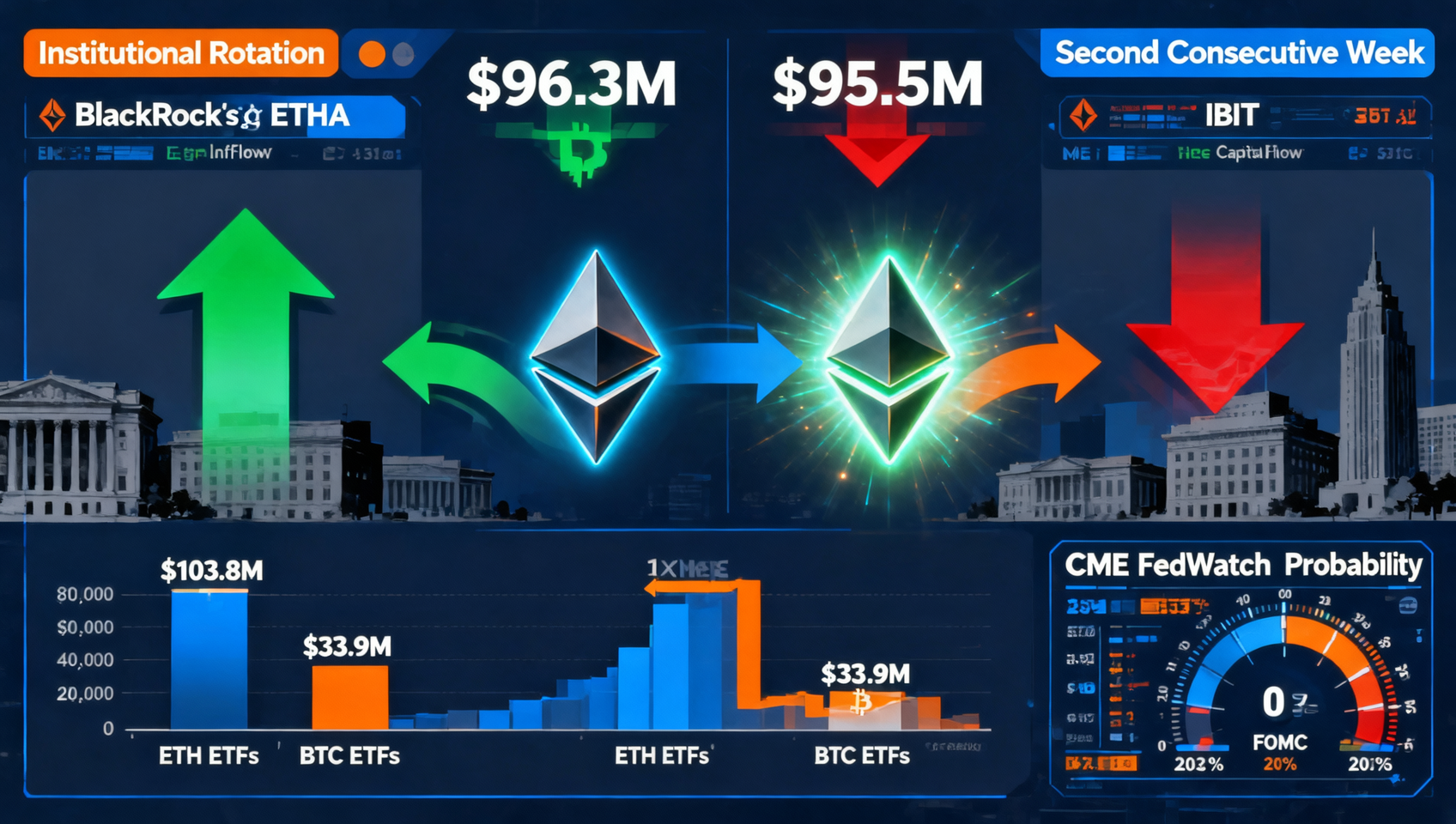
ETH spot ETFs recorded $103.8M in weekly inflows vs BTC's $33.9M — three times more, for the second consecutive week. BlackRock's ETHA absorbed $96.3M while its own IBIT bled $95.5M, signaling clear internal capital rotation from BTC to ETH within the world's largest asset manager. Three structural advantages drive sustained ETH inflows: Robinhood L2 processing $800M+ daily in gas fees, $20B+ in tokenized RWAs on Ethereum, and ETH/BTC breaking above the 200 DMA for the first time since January 2026. SEC Chair Paul Atkins endorses CLARITY Act with SEC potentially issuing crypto rules before Congressional vote. FOMC rate decision uncertainty accelerating capital rotation from BTC to ETH.
ETH ETF Inflows Beat BTC for Second Straight Week — Institutional Rotation to Ethereum Accelerates
TL;DR
- ETH spot ETFs logged $103.8M in weekly inflows vs BTC's $33.9M — ETH ETFs now pulling in 3× more than Bitcoin funds
- BlackRock ETHA absorbed $96.3M while IBIT bled $95.5M — capital rotating within the same asset manager from BTC to ETH
- Second consecutive week ETH ETFs outperformed BTC ETFs — gap widening from $30M (week July 17) to $70M (week July 24)
- SEC Chair Atkins endorses CLARITY Act — SEC may issue its own crypto rules before Congressional vote, a regulatory tailwind for ETH
- Robinhood L2 generates $800M+ daily in ETH gas fees — real economic demand improving Ethereum fundamentals
- $20B+ in tokenized RWAs on Ethereum — institutional adoption pathway clear, ETH as the compliant capital gateway
Full Analysis
I. ETF Flows: A Historic Inflection Point
The final week of July 2026 delivered ETF flow data that demands attention: institutional capital is systematically rotating from Bitcoin to Ethereum.
According to SoSoValue, U.S. Ethereum spot ETFs recorded $103.8M in net inflows for the week ending July 24, while Bitcoin spot ETFs managed just $33.9M. This means ETH ETFs pulled in more than triple the weekly inflows of BTC ETFs. More significantly, this marks the second consecutive week ETH ETFs have outperformed BTC ETFs — the prior week (ending July 17) saw $105.5M flowing into ETH products versus $75.5M into BTC products.
The rotation's epicenter is BlackRock. Its iShares Ethereum Trust (ETHA) added $96.3M in a single week, while BlackRock's own iShares Bitcoin Trust (IBIT) simultaneously shed $95.5M. The signal of internal capital rotation within the world's largest asset manager could not be clearer.
| Period | ETH ETF Inflows | BTC ETF Inflows | ETH/BTC Ratio |
|---|---|---|---|
| Week ending July 24 | $103.8M | $33.9M | 3.1x |
| Week ending July 17 | $105.5M | $75.5M | 1.4x |
| Week ending July 10 | $84M | $197M | 0.4x |
| July Month-to-Date | $338M | $234M | 1.4x |
On a monthly basis, July becomes the first month since April 2026 where both BTC and ETH ETFs recorded net positive inflows. But the divergence in growth rates is stark: ETH ETFs accumulated $338M month-to-date, versus BTC ETFs at $234M — marking the first time ETH has surpassed BTC in monthly aggregate ETF flows.
II. Fundamental Drivers: Ethereum's Three Structural Advantages
The sustained ETH ETF inflows are not coincidental but driven by three structural shifts:
1. Robinhood L2 Ignites On-Chain Economics
Robinhood's Layer-2 network, launched July 1, is transforming Ethereum's economic fundamentals. The L2 processes over $800M in daily ETH gas fees, dramatically expanding ETH's consumption base. Surging gas burn rates have pushed ETH's net issuance toward deflationary territory during peak usage periods — a supply-side catalyst that directly benefits ETH holders.
2. RWA Tokenization Surpasses $20B on Ethereum
Real-world asset (RWA) tokenization is ETH's core institutional adoption thesis. Ethereum now hosts over $20 billion in tokenized assets, including U.S. Treasuries, private credit, commodities, and real estate. Major issuers include BlackRock's BUIDL fund, Franklin Templeton, and Ondo Finance. RWA's compliance-friendly profile makes it the preferred entry point for traditional financial institutions entering crypto — and Ethereum, as the underlying settlement layer, captures the value directly.
3. ETH/BTC Technical Breakout Above 200 DMA
On July 28, the ETH/BTC ratio broke above its 200-day moving average for the first time since January 2026. Technical analysts widely interpret this as a key signal for altcoin rotation. Historical patterns suggest that ETH/BTC breaking above the 200 DMA often precedes capital rotation from Bitcoin into Ethereum and subsequently into the broader altcoin market.
III. Macro Context: FOMC Uncertainty Accelerates Rotation
The acceleration of capital flows from BTC to ETH comes on the eve of the FOMC rate decision (July 28-29) — and this timing is no coincidence.
With the market split between a 36.3% probability of a hike and 63.7% probability of a hold, institutional capital has favored ETH over BTC for its superior narrative positioning and clearer regulatory pathway. Specific factors include:
- ETH's clearer regulatory status: The CLARITY Act, if passed, would formally distinguish security tokens from commodity tokens. ETH's classification as a commodity has already received tacit CFTC recognition, while BTC's regulatory categorization is paradoxically less settled in certain contexts.
- ETH offers a quantifiable cash-flow model: EIP-1559's burn mechanism and staking yields provide ETH with a fundamentals-based valuation framework that aligns better with institutional FICC (Fixed Income, Currency, Commodity) analysis models.
- SEC Chair Paul Atkins, in a CNBC interview, expressed optimism that Congress would pass the CLARITY Act and pledged to make the U.S. the "crypto capital of the world." This regulatory push directly benefits ETH — the compliance framework offered by CLARITY would pave the way for deeper institutional participation in ETH ETFs and the broader Ethereum ecosystem.
IV. SEC's Dual-Track Strategy: Rules Before the Bill?
The CLARITY Act has cleared the House and the Senate Banking Committee (15-9 vote) but has not yet been scheduled for a full Senate floor vote. Meanwhile, the SEC plans to publish its 2026 regulatory agenda in July, including:
- Proposed rules for token offerings (Token Offering NPRM)
- Broker-dealer custody rules
- Trading venue market structure amendments
This "dual-track" strategy means that even if CLARITY stalls in Congress, the SEC could complete substantive crypto regulatory framework within months. For ETH ETFs, both paths — legislation and regulation — constitute ongoing positive catalysts, as each provides the compliance infrastructure needed for large-scale institutional capital entry.
The timeline is tight: CLARITY needs to pass before the August Congressional recess to land before the November midterm elections; otherwise, it faces a new cycle of political uncertainty.
V. Risk Factors: Rotation Still in Early Stages
Despite the impressive ETH ETF flow data, caution is warranted:
- July's net inflows for both ETF categories only recovered ~5% of BTC's June losses (BTC ETFs bled $4.5B in June alone)
- ETH ETFs' $338M July inflow repaired approximately two-thirds of June's $529M outflow, leaving a net deficit
- A surprise FOMC rate hike would risk-price all crypto assets, with ETH's higher beta likely causing deeper drawdowns than BTC
- Flow concentration risk: $96.3M of the $103.8M weekly inflows came from a single product (BlackRock ETHA), with other ETH ETF products seeing marginal flows
VI. Key Events This Week
- July 29: FOMC rate decision + Kevin Warsh press conference (most critical macro event)
- July 30: Q2 GDP initial print + June PCE inflation data
- July 30-31: Mega-cap tech earnings (MSFT, META, AAPL, AMZN)
- July 31: BTC monthly close + $13-14B options expiry
- August 7: CLARITY Act Senate vote window
Key Levels to Watch
ETH currently trades at $1,873 (-3.6%), suppressed by short-term FOMC risk aversion, but ETF inflow trends provide structural support. The $2,000 psychological level is the next major target — a dovish FOMC signal or soft PCE data could trigger an ETH-led relief rally.
BTC at $63,157, with $62,000 as the dense ETF accumulation zone. A breakdown below this level would test the $60,000 round number. However, the ETH/BTC breakout above the 200 DMA suggests that even if BTC continues to consolidate, ETH relative strength may persist.
Recommended Exchanges: