
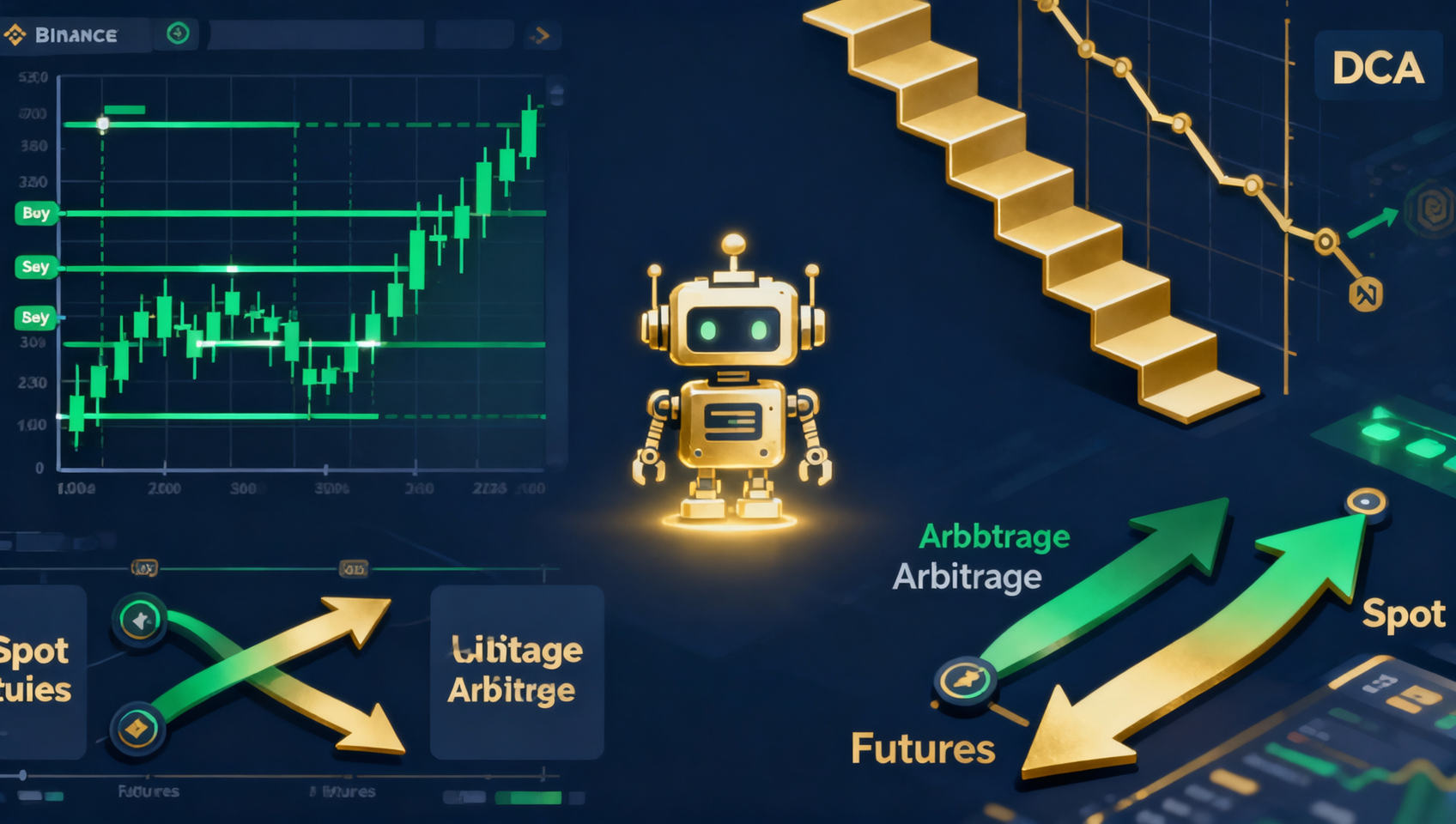


What Are Binance Trading Bots? The Answer First
In one sentence: a Binance trading bot is a program that executes your pre-set trading strategy automatically, 24/7 — it watches the market, places orders, and takes profit or cuts losses for you, but it does not decide whether you make money.
As of September 2026, Binance's built-in bots cover nine types: spot grid, futures grid, arbitrage (funding rate), rebalancing (auto-balance), spot DCA, futures DCA, auto-invest, futures TWAP, and futures VP1.
This guide is not a flat walkthrough of each bot like the official docs. It answers three practical questions: Which bot should I actually use? Can each one lose money, and how? And should I use a native bot or a third-party one?
By the end you'll have a decision table you can use immediately, plus a reusable standard for judging whether any bot is worth your money.
TL;DR
📺 Prefer to watch? This article has a companion video — the core conclusion in 5 minutes: Binance's 9 Auto Trading Bots: Pick Wrong and You Could Get Liquidated — 2026 Guide
- Bots don't create profit — they automate a strategy. A bad strategy just loses money faster and more consistently. Binance explicitly states bots "cannot guarantee returns"1.
- Beginners should start with three low-risk bots: Auto-Invest → Spot DCA → Spot Grid. Futures grid, arbitrage, and TWAP/VP involve leverage or hedging and are for experienced traders.
- Binance native bots are free (normal trading fees only) and require no third-party API key. Third-party bots earn their keep with backtesting and multi-exchange support, at the cost of subscription fees + API security risk.
- The API red line: never enable withdrawals. Funds stay on Binance; a third party can place orders but can't move your money.
- Whether you lose depends on the market and your parameters — not on whether it's "a bot." Grid fears trends, DCA fears prolonged dips, and leveraged bots fear liquidation.
Binance's 9 Auto Trading Bots at a Glance
Here's the full picture before we talk about how to choose. Binance currently offers these nine bot types1:
| Bot | What it does | Risk level | Who it's for |
|---|---|---|---|
| Auto-Invest | Buys a chosen coin on a fixed schedule | 🟢 Low | Everyone, passive accumulation |
| Spot DCA | Buys in steps as price falls to average down | 🟢 Low-Med | Long-term buyers |
| Spot Grid | Auto buy-low-sell-high within a range | 🟡 Med | Spot users who want to auto-trade sideways markets |
| Futures Grid | Grid trading with leverage, can short | 🔴 High | Experienced futures traders |
| Arbitrage | Hedges spot vs futures to earn funding fees | 🟡 Med | Users with both spot and futures accounts |
| Rebalancing | Auto-adjusts holdings back to target ratios | 🟡 Med | Multi-coin long-term holders |
| Futures DCA | DCA in the futures market, with take-profit | 🔴 High | Futures traders (launched Nov 2025) |
| Futures TWAP | Splits a large order over time to reduce impact | 🟡 Med-High | Large accounts / whales |
| Futures VP | Splits an order by volume participation | 🟡 Med-High | Large accounts / whales |
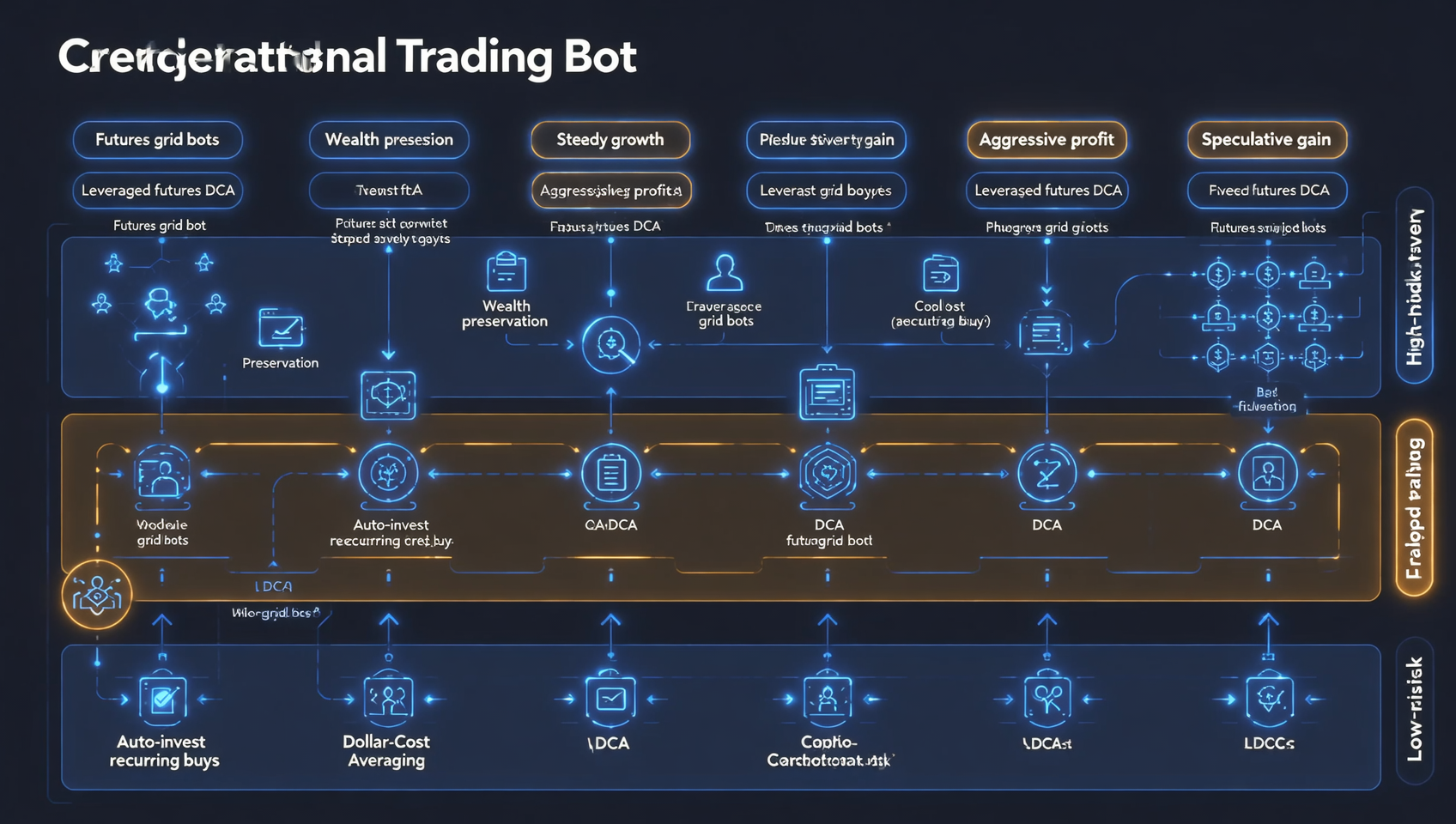
One line to remember: the "buy" bots (Auto-Invest, DCA) are the lowest risk; the "range-trading" bots (grid, arbitrage) sit in the middle; the "leverage" bots (futures grid, futures DCA) are the highest. TWAP/VP are order-splitting tools for large capital — most retail users never need them.
Choose a Bot by Your Goal: Decision Table for 5 Personas
This is the most important table in this guide. Don't choose by "bot type" — choose by "what you want to achieve."
| Your goal | Recommended bot | Notes |
|---|---|---|
| Hands-off long-term stacking | Auto-Invest | Set amount and frequency, then forget it. Dips don't scare you — time does the work. |
| Buy the dip | Spot DCA | Averages down as price falls, but never use leverage. |
| Earn the spread in a sideways market | Spot Grid | Auto buy-low-sell-high within a range; fails in a trend. |
| Earn funding fees / hedged arbitrage | Arbitrage | Spot long + futures short hedge, earning positive funding rates. |
| Have futures experience, want to short or leverage | Futures Grid / Futures DCA | Both gains and losses are amplified — always set a stop-loss. |
The judgment standard (reusable for any bot or third-party platform):
- Where does the profit come from? Spread (grid), time (auto-invest/DCA), or funding fees (arbitrage) — if you can't explain the profit source, don't touch it.
- What's the worst case? Spot bots at worst leave you "bag-holding"; futures bots at worst liquidate you to zero. Ask yourself whether you can survive the worst case first.
- In what market does it lose? Grid fears trends, DCA fears prolonged dips, arbitrage fears a funding-rate flip. If you can't read the current market, choose Auto-Invest, which doesn't care.
The Three Bots Worth Using as a Beginner
1. Auto-Invest: the most hands-off starting point
Auto-Invest buys a fixed amount on a fixed schedule. It doesn't predict price — it hands the whole "timing" problem to time itself.
Fits: people who want to accumulate BTC or ETH long-term without watching charts.
Worst case: the price grinds down during the period and you're at a paper loss, but the lower average cost lets you recover faster on any rebound.
2. Spot DCA: staged buying into dips
Spot DCA differs from Auto-Invest in that it layers a single position by price — for example, if you plan to buy BTC with 1,000 USDT, the DCA bot buys a slice every time price drops by a set percentage, instead of buying the top all at once.
Fits: people who like a coin but aren't sure this is the bottom.
Key warning: DCA only averages your cost — it doesn't guarantee profit. If the asset's fundamentals deteriorate, buying more just means a deeper bag. Use DCA only on coins you're willing to hold long-term, never to "catch a falling knife" on junk.
3. Spot Grid: auto buy-low-sell-high in sideways markets
A spot grid splits your funds into multiple levels within a price range you set — it buys at lower levels and sells at higher levels. It profits from sideways volatility, not from price appreciation.
Fits: people who judge the market is ranging and are willing to lock up funds for a while.
The market it fears: a strong uptrend (sells out and misses the run) or downtrend (keeps buying into a falling knife). So before starting a grid, first ask "is this ranging or trending?"
For spot grid parameters, three classic strategies, and how to handle a broken range, we wrote a separate deep dive — see the Binance grid trading tutorial in Further Reading below.
Advanced Bots: Who They Fit and Where the Risk Is
Futures Grid / Futures DCA: gains and liquidation both amplified
Futures grid adds leverage + shorting on top of spot grid; futures DCA does dollar-cost averaging in the futures market. What they share: they can liquidate you.
Fits: people already comfortable with spot grid who understand margin and liquidation price and accept liquidation risk.
Risk: if price breaks below the range's lower limit one-sidedly with no stop-loss, the account can be force-liquidated. So leveraged bots must have a stop-loss, and only use money you can afford to lose.
Arbitrage bot: earns funding fees, but watch the sign
The arbitrage bot runs a market-neutral "spot long + futures short" hedge, and the return mostly comes from the futures funding rate (shorts collect when the rate is positive). It's not betting on direction, so it's lower risk than naked long/short — but it is not risk-free.
Risks: ① when the funding rate flips from positive to negative, the arbitrage return becomes a cost; ② the two hedge legs must be managed well, otherwise you still carry basis risk; ③ you need to fund both a spot and a futures position at once.
Futures TWAP / VP: order-splitting tools for big money
TWAP (time-weighted average price) and VP (volume participation) split one large order into many small ones and execute them gradually, to reduce the price impact (slippage) of a single big order — they are not "profit strategies."
Fits: whales buying or selling hundreds of thousands or millions of USDT at once, to avoid moving the price with their own order. A retail-sized order doesn't need them.
Native vs Third-Party Bots: How to Choose, and the Red Line
This is the question most people searching "Binance trading bot" actually wrestle with — and it's the blind spot where the official docs stay silent and third-party listicles have an agenda.
| Dimension | Binance native bots | Third-party bots (3Commas/Cryptohopper etc.) |
|---|---|---|
| Cost | Free, trading fees only2 | $19–$99/month subscription + trading fees |
| API key required | No, opened in-app | Yes — "Read + Trade" API |
| Backtesting | ❌ No user-facing backtest | ✅ Most support it |
| Multi-exchange | ❌ Binance only | ✅ Most support multi-exchange |
| Custom strategy / TradingView signals | ❌ None | ✅ Most support them |
| Security risk | Very low (official) | Depends on third-party API custody, leak history3 |
| Fits | Most retail users | Users who need backtesting, multi-exchange, or signal automation |
Conclusion: for 90% of retail users, start with Binance's native bots — free, safe, and sufficient. Only consider a third-party platform when you concretely need one of three things: backtesting to validate a strategy, managing multiple exchanges in one place, or auto-executing TradingView signals.
Three API red lines for third-party bots (memorize these):
- Never enable the "Withdraw" permission — only "Read + Trade." That way your funds stay on Binance and the bot can place orders but can't move your money out.
- Bind an IP whitelist so only your server or fixed IP can call the key.
- Only hand the key to a verified, reputable platform. In December 2022, third-party platform 3Commas had its API keys leaked — about 15,000 users affected and roughly $22 million lost3. This isn't a "could it happen" — it already has.
The Real Risk: Do Trading Bots Actually Lose Money?
Yes — and most losses come from the mistaken belief that "the bot makes money."
Myth-buster 1: a bot can't turn a bad strategy good
A bot does exactly one thing — faithfully and quickly execute your strategy. If the strategy has no edge, the bot just makes you lose faster and more consistently. Binance itself states plainly: bots "cannot guarantee returns"1. Strategy first, automation second — never reverse the order.
Myth-buster 2: grid underperforms "doing nothing" in trends
Grid trading repeatedly captures the spread in a range, but in a strong uptrend it sells more and more, getting left behind; in a strong downtrend it buys more and more, ending up fully bag-holding. In other words, in a trending market, a grid bot underperforms simply holding (HODL). That's not the bot's fault — it's the grid strategy's inherent fear of trends.
The fee math: the hidden cost of high-frequency grids
Grid bots trade frequently, so fees eat into profit. Binance spot fees are about 0.1% (about 0.075% with BNB discount); futures are about 0.05% taker / 0.02% maker2. One hard rule: the per-grid price spread must exceed the round-trip fee of one buy plus one sell — about 0.2% for spot, about 0.04%–0.1% for futures. Otherwise you're "paying the exchange to work."
Three risk categories ranked
| Risk type | Which bots | How to defend |
|---|---|---|
| Strategy failure (market doesn't cooperate) | Grid, DCA, arbitrage | Read the market first, then pick the matching strategy |
| Liquidation (leveraged) | Futures grid, futures DCA | Set stop-loss, lower leverage, small position |
| Fee erosion | High-frequency grid | Ensure per-grid profit > round-trip fee |
| API / third-party security | Third-party bots | No withdrawal permission + IP whitelist |
Setting Up a Binance Bot in Three Steps (Spot Grid Example)
- Enter: Log in to Binance → "Trade" → "Trading Bots," and accept the terms.
- Pick type + parameters: choose "Spot Grid." Beginners should just tap AI parameters (the system auto-generates the price range and grid count from the last 7 days), or manually set the range, grid count, and investment amount.
- Launch + monitor: tap "Create" to start, then check profit/loss under "Running." Automated ≠ set-and-forget — when the market shifts sharply, stop or adjust it manually.
💡 If you don't have a Binance account yet, spend 5 minutes on the Binance registration & KYC guide and use referral code BINANBT for a 20% trading-fee rebate.
Further Reading
- Binance Grid Trading Tutorial: Auto Buy-Low-Sell-High in Sideways Markets — grid parameters, three strategies, handling a broken range
- Crypto DCA Guide: The Right Way to Average Down — the math and mechanics of DCA and auto-invest
- Binance Funding Rate Explained: When You Pay and How to Arbitrage — where the arbitrage bot's profit actually comes from
- Binance Futures Leverage: How Much Is Safe? — calculating liquidation price before a futures grid blows up
Disclaimer: This article is for educational purposes only and does not constitute investment advice. Cryptocurrency involves risk, automated trading bots cannot guarantee profit, and leveraged bots carry liquidation risk. Please decide based on your own situation.
Recommended: Binance Registration | OKX Registration
📚 Further learning: On-Chain Guide — blockchain from zero
Footnotes
-
Binance Academy, "Your Guide to Binance Trading Bots," accessed 2026. ↩ ↩2 ↩3 ↩4
-
Binance fee schedule — spot base 0.1% (about 0.075% with BNB discount); USDT-M perpetual futures 0.05% taker / 0.02% maker, accessed September 2026. ↩ ↩2
-
3Commas December 2022 API key leak, multiple industry reports (about 15,000 users, about $22 million in losses). ↩ ↩2