

Cross-Chain Bridge Security 2026: How Bridges Work & Safety Tips
A complete cross-chain bridge security guide for 2026. Learn how blockchain bridges work (Lock-Mint, Burn-Mint, Liquidity Networks), explore major bridge hacks including Ronin ($626M), Wormhole ($326M), Nomad ($190M), and Allbridge, and get actionable safety tips for secure cross-chain transfers.
TL;DR
A cross-chain bridge (blockchain bridge) is a protocol that enables asset and data transfers between different blockchain networks. As of July 2026, over 80 active blockchains exist with a combined TVL exceeding $75 billion1, and bridges are the critical infrastructure connecting them.
However, cross-chain bridges are also the most attacked component in DeFi — cumulative losses from bridge exploits have exceeded $3 billion2, representing over 35% of all DeFi attack losses.
✅ Three core principles for safe bridge usage:
- Choose well-audited bridges with insurance — LayerZero, Chainlink CCIP, Across, and Stargate have the strongest safety records
- Use centralized exchanges for large transfers — Binance/OKX assume the cross-chain risk
- Revoke unused bridge contract approvals monthly — Use tools like Revoke.cash regularly
Table of Contents
- What Is a Cross-Chain Bridge?
- How Cross-Chain Bridges Work: Three Mechanisms
- Why Bridges Are the Number One DeFi Attack Target
- Major Cross-Chain Bridge Hacks — Timeline and Analysis
- Bridge Security Comparison: Popular Bridges Rated
- How to Use Cross-Chain Bridges Safely: A Practical Checklist
- Alternative: Cross-Chain via Centralized Exchanges
- The Future of Bridge Security Technology
- FAQ
- Conclusion
What Is a Cross-Chain Bridge?
A cross-chain bridge is a protocol that enables the transfer of assets and data between two independent blockchain networks. Think of it as a tunnel connecting two separate ecosystems — such as Ethereum and Solana, or BNB Chain and Arbitrum — allowing them to communicate and exchange value.
The fundamental problem bridges solve is blockchain interoperability. Each blockchain operates as an isolated system with its own consensus rules, token standards, and smart contract environments. Without bridges, assets on Ethereum cannot be used on Solana, and vice versa.
Bridges serve three key functions:
- Asset portability — Move ETH from Ethereum to Arbitrum, or USDC from Solana to Ethereum
- Data transmission — Pass oracle price feeds, NFT metadata, or verification proofs across chains
- Liquidity aggregation — Let one pool of capital serve users across multiple chains
But bridges are also DeFi's Achilles' heel. At their peak, cross-chain bridges held over $30 billion in total locked value3, making them the most lucrative target in crypto. Their complex architecture — spanning cross-chain verification, lightweight clients, and multi-signature schemes — creates an unusually large attack surface.
How Cross-Chain Bridges Work: Three Mechanisms
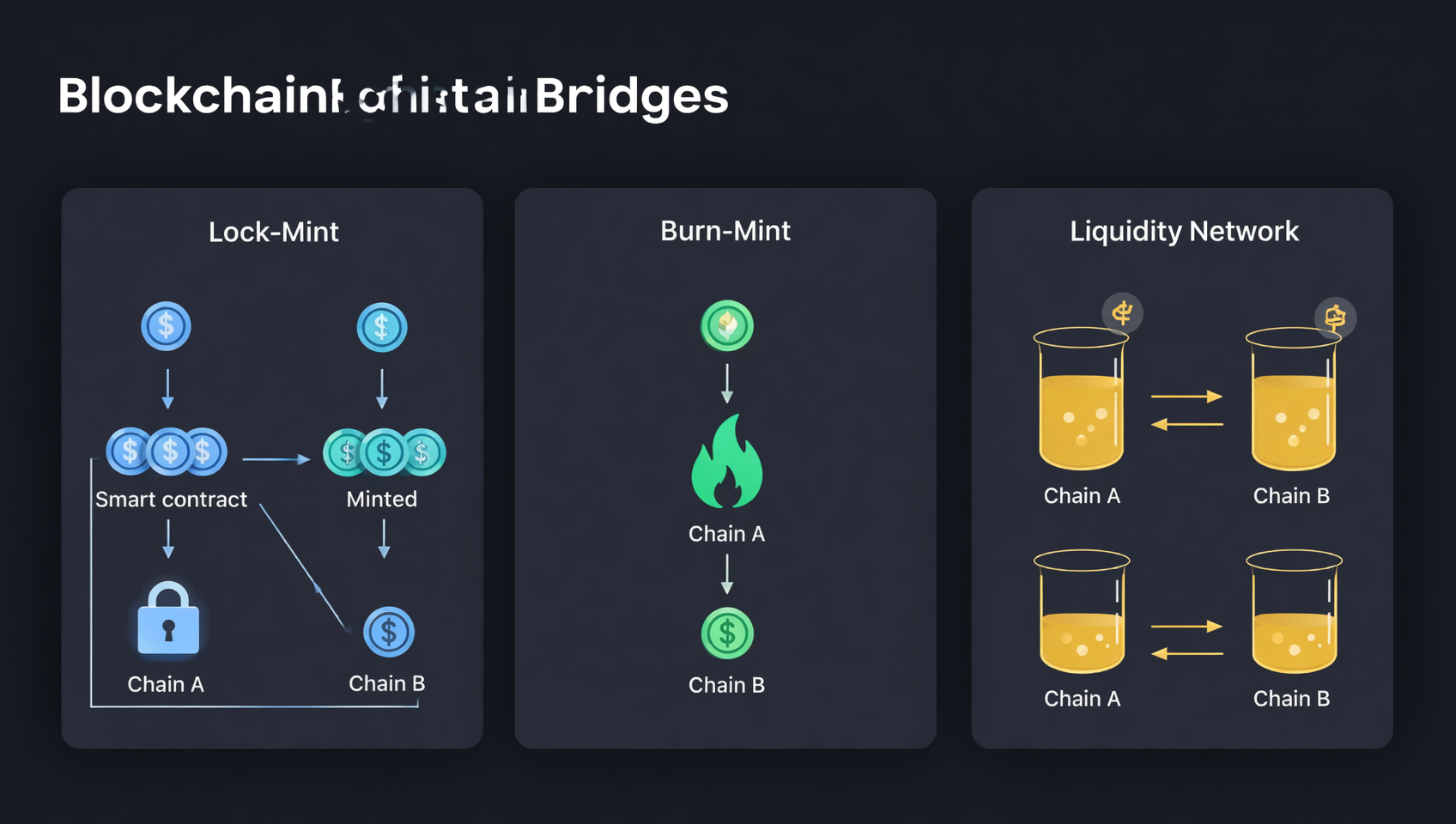
Cross-chain bridges can be categorized into three core technical models based on how they facilitate asset transfers:
1. Lock-Mint (Lock and Mint)
Lock-Mint is the most common bridge model: users lock their assets in a smart contract on the source chain, and the bridge mints equivalent wrapped tokens on the destination chain.
| Phase | Action | Chain |
|---|---|---|
| 🔒 Lock | User sends ETH to the bridge contract | Ethereum |
| 🖥️ Verify | Validators confirm the lock event | Off-chain / relay chain |
| 🪙 Mint | Bridge mints equivalent WETH | Arbitrum |
| ✅ Complete | User receives WETH, usable on Arbitrum | Arbitrum |
Return trip: The bridge burns the wrapped token on the destination chain and releases the original locked asset on the source chain.
Representative bridges: Wormhole, Multichain, Poly Network, WBTC
Security profile: The core security depends on the validator network. If validators are compromised or collude, they can mint fake tokens without a corresponding lock event occurring.
2. Burn-Mint (Burn and Mint)
In the Burn-Mint model, users burn (destroy) the original tokens on the source chain, and the bridge mints equivalent native tokens on the destination chain.
| Phase | Action | Chain |
|---|---|---|
| 🔥 Burn | User sends bridge-native tokens to a burn address | Ethereum |
| 🖥️ Verify | Validators confirm the burn event | Off-chain / relay chain |
| 🪙 Mint | Bridge mints equivalent native tokens | BNB Chain |
| ✅ Complete | User receives native tokens on BNB Chain | BNB Chain |
Key difference from Lock-Mint: Original tokens are permanently destroyed rather than locked, so the destination chain receives truly native tokens instead of wrapped derivatives. This eliminates liquidity fragmentation but requires the bridge to control the token supply on each chain.
Representative bridges: Chainlink CCIP, Axelar
3. Liquidity Network
Liquidity Network bridges do not lock or mint tokens. Instead, they use cross-chain liquidity pools to facilitate direct swaps between native assets on different chains.
| Phase | Action |
|---|---|
| 🏊 Initiate | User deposits DAI into a pool on Chain A |
| 📡 Relay | The protocol relays the message via an off-chain relayer/validator network |
| 🏊 Complete | User receives USDC from a pool on Chain B |
Security profile: Liquidity networks don't rely on large locked asset pools vulnerable to single-point compromise. The primary risks are oracle manipulation and AMM-based price attacks.
Representative bridges: Stargate (built on LayerZero), Across Protocol, Synapse
Three-Mechanism Comparison
| Dimension | Lock-Mint | Burn-Mint | Liquidity Network |
|---|---|---|---|
| Asset Type | Wrapped Token | Native Token | Native Token |
| Capital Locked | ✅ Large locked TVL | ❌ Minimal locked capital | ❌ Minimal locked capital |
| Liquidity Fragmentation | 🔴 High | 🟢 Low | 🟢 Low |
| Attack Surface | Validators + Contracts | Validators + Contracts | Oracles + AMM |
| Representative | Wormhole, Poly Network | Axelar, CCIP | Stargate, Across |
| Speed | Medium | Medium | Fast (instant liquidity) |
Why Bridges Are the Number One DeFi Attack Target
Cross-chain bridges are the highest-risk component in DeFi due to three fundamental challenges that are inherent to their design:
1. The Cross-Chain Trust Problem
No blockchain can "natively" verify events that occur on another chain. Bridges must rely on third-party mechanisms to solve this trust problem:
| Verification Mechanism | How It Works | Security Risk |
|---|---|---|
| External Validators / Multi-sig | N signers confirm the event | Private key compromise / validator collusion (e.g., Ronin $626M) |
| Light Client | Verify source chain block headers on the destination chain | Oracle dependency for block header data |
| Optimistic Verification | Assume valid, with a challenge window (Across Protocol) | Funds can be extracted during challenge window |
| Zero-Knowledge Proof | Prove cross-chain events via ZK proofs | Complex proof generation, still evolving |
2. Smart Contract Complexity
Bridge contracts typically include cross-chain communication, signature verification, and light client verification — logic far more complex than standard DeFi protocols. Multiple major bridge exploits were caused by signature verification flaws:
- Wormhole's $326M loss — the contract failed to check if signatures came from authorized validators
- Nomad's $190M loss — default messages were incorrectly marked as verified
3. The TVL Magnet Effect
Bridges accumulate enormous TVL — at the peak in 2025, bridges on Ethereum alone held over $20 billion3. Wormhole alone had over $1 billion locked before its exploit. This creates a "one hack, massive payoff" dynamic that attracts the most sophisticated attackers. Cumulative bridge attack losses have exceeded $3 billion2.
Major Cross-Chain Bridge Hacks — Timeline and Analysis
Complete Attack Timeline
| Date | Bridge | Loss | Attack Type | Chains Affected |
|---|---|---|---|---|
| Feb 2022 | Wormhole | $326M | Signature verification bypass | Solana ↔ Ethereum |
| Mar 2022 | Ronin Bridge | $626M | Validator private key compromise | Ronin ↔ Ethereum |
| Jun 2022 | Harmony Horizon | $100M | Multi-sig key compromise | Harmony ↔ Ethereum |
| Aug 2022 | Nomad Bridge | $190M | Default message verified bug | Multi-chain |
| Jul 2023 | Multichain | $130M | Team/validator collusion | Multi-chain (Fantom mainly) |
| Aug 2023 | Curve cross-chain | $52M | Vyper compiler reentrancy | Ethereum ↔ Multi-chain |
| Apr 2024 | Stargate/Polygon | $4M | Cross-chain message forgery | Polygon ↔ Multi-chain |
| Mar 2025 | Across Protocol | $11M | Oracle delay attack | Ethereum ↔ Multi-chain |
| Jul 2026 | Allbridge Core | $1.1M | Flash loan oracle manipulation | Solana |
Deep Dive: Major Incidents
Ronin Bridge ($626M) — March 2022
Ronin Bridge was the critical infrastructure for the Axie Infinity gaming ecosystem, connecting the Ronin sidechain to Ethereum mainnet. The attacker compromised a gasless RPC node operated by Sky Mavis (the company behind Axie Infinity) and used it to control 5 of the 9 validator nodes — only 4 signatures were required to approve withdrawal transactions.
The attack flow: Social engineering → RPC node compromise → forge 5 validator signatures → submit fake withdrawal → drain 173,600 ETH and 25.5M USDC.
Outcome: Binance and the Axie Infinity team recovered ~$30M through negotiations. The bridge was completely rebuilt with enhanced validation.
Wormhole ($326M) — February 2022
Wormhole was the dominant bridge on Solana. The exploit exploited a signature verification bug — just 2 lines of code — where the contract failed to properly verify that signatures came from authorized Guardians.
The critical bug: The verify_signatures function failed to correctly update guardian_set_index, allowing attackers to pass verification using any public key. This bug remained undetected in the contract for over 6 months.
Outcome: Jump Crypto (Wormhole's parent company) re-funded the bridge with $326M in ETH within hours. All user funds were protected.
Nomad Bridge ($190M) — August 2022
Nomad's exploit had the lowest technical barrier of any major bridge hack. Attackers simply had to copy a legitimate transaction and modify the destination address to steal funds. The root cause: the contract initialized default messageHash to 0, meaning all messages were automatically marked as verified.
Unique aspect: The Nomad hack was a "crowd event" — dozens of imitators (both white-hat and black-hat) copied the exploit transaction and extracted funds simultaneously. The team recovered ~$37M through white-hat bounties.
Allbridge Core ($1.1M) — July 2026
This is the most recent cross-chain bridge hack. On July 20, 2026, the Solana-based Allbridge Core bridge was exploited via a flash loan attack:
| Phase | Action |
|---|---|
| 📥 Borrow | Attacker flash-loaned 1.12M USDC from Kamino |
| 🔄 Manipulate | Manipulated Allbridge's stablecoin pool exchange rate |
| 💰 Extract | Withdrew USDC and other stablecoins at favorable rates |
| 🔄 Repay | Repaid the Kamino flash loan in the same transaction |
While the $1.1M loss was relatively small, it demonstrated a persistent vulnerability: bridge designs that rely on on-chain liquidity pools remain susceptible to oracle manipulation and flash loan attacks.
Bridge Security Comparison: Popular Bridges Rated
Top Bridges Security Scorecard
| Bridge | Safety Score | Verification | Audits | Insurance | Past Incidents |
|---|---|---|---|---|---|
| LayerZero | ⭐⭐⭐⭐⭐ | Oracle+Relayer (dual) | 8+ (Trail of Bits etc.) | None | None |
| Chainlink CCIP | ⭐⭐⭐⭐⭐ | DON (Decentralized Oracle Network) | 10+ (CERTIK etc.) | $50M pool | None |
| Wormhole | ⭐⭐⭐⭐ | 19-guardian multi-sig | 7+ (Neodyme etc.) | $326M Jump Crypto backstop | ✅ $326M (refunded) |
| Stargate | ⭐⭐⭐⭐ | LayerZero-based | 6+ (aligned with LayerZero) | None | None |
| Across | ⭐⭐⭐⭐ | Optimistic Oracle | 5+ (OpenZeppelin etc.) | UMA dispute mechanism | ✅ $11M (fixed) |
| Axelar | ⭐⭐⭐⭐ | 75-validator PoS network | 6+ | Staked validators | None |
| Synapse | ⭐⭐⭐ | Multi-sig + validators | 4 | None | None |
| Multichain | ⭐ | Multi-sig (defunct) | 3 | None | ✅ $130M (team exodus) |
How safety scores are determined: Based on verification decentralization, audit frequency and quality, insurance reserves, and historical security track record. LayerZero and CCIP lead in architectural safety, but no bridge is 100% secure.
Bridge Type Security Profiles
| Bridge Type | Main Security Strengths | Main Security Weaknesses |
|---|---|---|
| Multi-sig Bridge (Ronin, Harmony) | Simple architecture, low audit cost | Validator keys are single points of failure |
| Light Client Bridge | Trustless (no validators needed) | Complex implementation, high gas costs |
| Oracle+Relayer Bridge (LayerZero) | Decentralized verification, no single point of failure | Relies on oracle correctness |
| Optimistic Bridge (Across) | No active validators needed | Challenge window delay (typically 1-3 hours) |
| Liquidity Network (Stargate) | No locked TVL, fast | AMM-dependent, price manipulation risk |
How to Use Cross-Chain Bridges Safely: A Practical Checklist
Before every cross-chain transfer, run through this checklist:
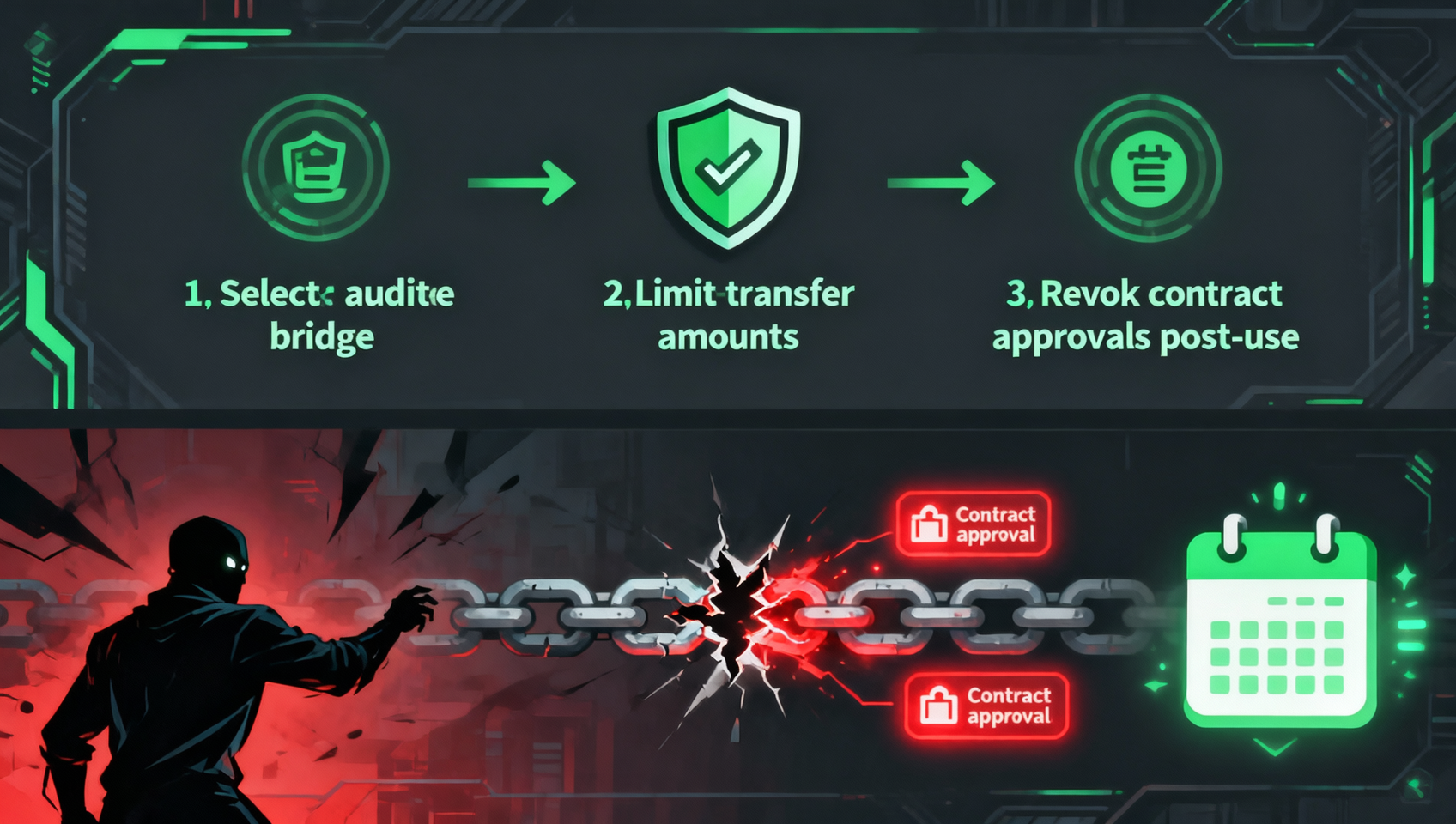
✅ 1. Choose a Well-Audited Bridge
Prefer bridges with at least 3 independent audits from top-tier firms (Trail of Bits, OpenZeppelin, CERTIK, Code4rena). Audit reports should be publicly available on the project's website or GitHub.
Recommended bridges by safety tier:
- 🥇 Chainlink CCIP — Gold standard (DON + $50M insurance)
- 🥇 LayerZero — Highest decentralization, most audited
- 🥈 Wormhole (post-exploit upgraded) — Jump Crypto backstop
- 🥈 Across Protocol — Optimistic verification with UMA arbitration
- 🥉 Stargate — LayerZero-based liquidity network
✅ 2. Verify You're on the Official Website
Frontend phishing is the #1 bridge attack vector. Attackers create near-identical fake domains to trick users into approving malicious contracts.
Safe practices:
- Bookmark the URL on your first legitimate visit
- Verify the domain: layerzero.network, wormhole.com, stargate.finance
- Never click bridge links from search engine ads — phishing sites buy ad placements
✅ 3. Control Your Transfer Amount
- Test with a small amount first ($10–$50 for first-time bridge use)
- Split large transfers into multiple smaller batches
- Never bridge your entire portfolio — only transfer what you need on the destination chain
✅ 4. Revoke Approvals After Bridging
This is the most overlooked but critical security step. After using a bridge, its contract holds approval to spend your tokens. If the bridge is later compromised, that unused approval becomes a vulnerability.
Use Revoke.cash monthly to check and revoke unused approvals:
- Single-use bridge → revoke immediately
- Frequent use → keep approval but check bridge security status monthly
- Bridge reported as compromised → revoke all approvals immediately and move funds to a fresh wallet
See our detailed guide: How to Revoke DeFi Contract Approvals
✅ 5. Enable Security Notifications
- Follow official bridge team channels (Discord, Twitter/X, Telegram)
- Set up security alerts via DefiLlama or ChainAware
- For Wormhole users, monitor Guardian node status updates
Alternative: Cross-Chain via Centralized Exchanges
For transfers over $5,000, using a centralized exchange (CEX) is often safer than any bridge.
CEX Cross-Chain vs. DeFi Bridge
| Dimension | Centralized Exchange | Decentralized Bridge |
|---|---|---|
| Safety | 🟢 High (exchange assumes risk) | 🟡 Medium (contract-dependent) |
| Fund Control | ❌ Exchange holds custody | ✅ Self-custody at all times |
| KYC Required | ❌ Yes | ✅ No |
| Fees | Low or free (internal transfers) | Gas fees + bridge fees |
| Speed | Fast (internal ledger settlement) | Medium (block confirmations) |
| Primary Risk | Exchange security | Smart contract vulnerability |
Using Binance for Cross-Chain
- Deposit assets on Chain A to Binance
- Withdraw from Binance to your address on Chain B
Binance supports 50+ blockchain networks for deposits and withdrawals with transparent fee structures. Check our guide: Binance Registration & KYC Guide 2026
Using OKX for Cross-Chain
- Deposit assets on Chain A to OKX
- Select the target chain and withdraw
OKX supports 60+ blockchains and its Web3 Wallet enables one-click cross-chain transfers without the separate deposit/withdrawal workflow. Learn more: OKX Web3 Wallet Complete Guide
The Future of Bridge Security Technology
Cross-chain bridge security is evolving rapidly. Key trends to watch in 2026 and beyond:
1. Zero-Knowledge Cross-Chain (ZK Bridges)
ZK bridges generate a zero-knowledge proof on the source chain proving an event occurred; the destination chain verifies the proof without trusting any third-party validators.
- Pros: Fully trustless, cryptographic security guarantees
- Progress: Polygon zkBridge is live on mainnet; LayerZero is integrating ZK verification
- Challenges: Proof generation time (currently 5–10 minutes) and gas costs
2. Intent-Centric Cross-Chain
Users simply declare their intent ("move 10 ETH from Ethereum to USDC on Arbitrum"), and a solver network competitively executes the cross-chain transfer.
- Pros: Better UX, solver competition ensures fair pricing
- Progress: UniswapX, Across+, Everclear
- Challenges: Solver network decentralization and capital efficiency
3. Cross-Chain Security Standards
- CCIP (Cross-Chain Interoperability Protocol) by Chainlink — adopted by traditional finance institutions including Swift
- ERC-7683 — Cross-chain intent standard co-proposed by Uniswap and Across, now supported by multiple bridges
- Cross-Chain Security Alliance — Formed in 2025, establishing unified audit standards and insurance frameworks
FAQ
How is a cross-chain bridge different from a sidechain?
A bridge connects two independent blockchains, while a sidechain runs in parallel to a main chain and inherits its security. A bridge connects Ethereum and Solana — two completely separate chains. A sidechain (like Polygon PoS) has its own validators but connects to the main chain via a bridge. Think of sidechains as participants and bridges as connectors.
What fees do cross-chain bridges charge?
Fees consist of three parts: source chain gas + bridge service fee + destination chain gas. For a $1,000 ETH transfer from Ethereum to Arbitrum, total fees are ~$10–$30 on Ethereum mainnet or ~$0.10–$1 on Layer-2 bridges. Liquidity network bridges (Stargate) charge 0.03%–0.1% protocol fees. Centralized exchange cross-chain is typically the cheapest — just the withdrawal gas fee.
How do I migrate from an unsafe bridge to a safer one?
Execute a reverse bridge operation back to the source chain, revoke the old bridge's token approval, then use a recommended bridge. Steps: ① Perform a reverse bridge (return assets to the source chain); ② Revoke the old bridge's contract approval; ③ Bridge via a recommended option (LayerZero or CCIP); ④ Check and revoke new approvals after use. For funds stuck in a paused bridge, monitor official channels for recovery plans.
Does the average crypto user need to understand bridge technology?
No — but you need to understand three things: bridges aren't "magic teleportation" (assets are locked and minted), bridges carry risk, and you should revoke approvals after use. Just as you don't need to understand SSL/TLS to use a credit card, you don't need to be a cryptography expert to use bridges. Following basic safety rules (choose major bridges, limit single-transfer amounts, check approvals) prevents 99% of common problems.
Is Stargate a bridge?
Yes, Stargate is a cross-chain bridge based on the Liquidity Network model, built on top of LayerZero. Unlike Lock-Mint bridges, Stargate enables native asset transfers without wrapped tokens. It uses a unified liquidity pool algorithm that rebalances across chains. Stargate was one of the first bridges to solve the "bridged asset fragmentation" problem and remains one of the most popular bridges by daily volume.
What happens if I bridge to the wrong chain?
If you bridge to a chain that doesn't support the destination asset, your funds may become inaccessible. Always verify that the destination chain supports the token you're bridging. If the bridge supports it, you can typically perform a reverse bridge. If not, you may need to use a different bridge or contact the destination protocol's support. For CEX bridging (Binance/OKX), customer support can often help recover funds sent to unsupported chains, though a fee may apply.
Conclusion
Cross-chain bridges are the most critical infrastructure in DeFi — and also the most dangerous attack surface. With over $3 billion lost to bridge exploits as of July 2026, they represent both the greatest innovation and the greatest risk in the multi-chain ecosystem.
| Safety Level | Recommended Solution | Best For |
|---|---|---|
| 🥇 Safest | Centralized exchange cross-chain | Large transfers (>$5,000) |
| 🥇 Most decentralized | Chainlink CCIP / LayerZero | Medium amounts ($100–$5,000) |
| 🥈 Fast & convenient | Stargate / Across | Frequent cross-chain users |
| ❌ Avoid | Defunct/exploited bridges (Multichain, legacy Nomad) | Any scenario |
The three golden rules of bridge safety: choose established bridges, split your transfers, and revoke approvals after use. No matter which bridge you choose, regular approval audits and a disciplined approach to cross-chain transfers are essential habits for every DeFi user.
📚 Further reading: On-Chain Guide — Blockchain from Zero — Blockchain basics and on-chain data analysis
📖 Related articles:
- How to Revoke DeFi Contract Approvals
- Web3 Security Complete Guide 2026
- Seed Phrase & Private Key Security Guide
Disclaimer: This article is for educational purposes only and does not constitute investment advice. Bridge security profiles may change with protocol upgrades and evolving attack techniques. Always verify the latest security status before use. Cryptocurrency investing carries high risk — make your own informed decisions.