
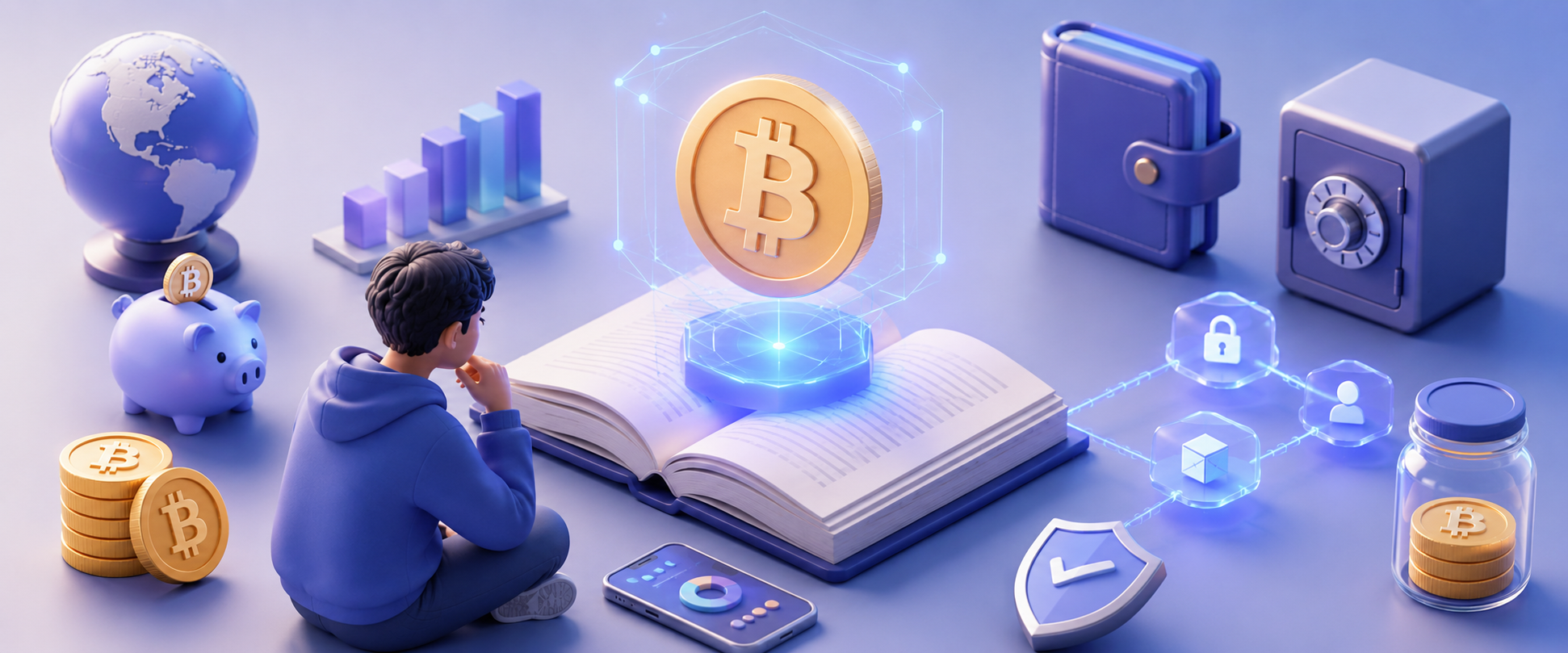
Complete Bitcoin Guide
Everything about Bitcoin — from its origins to buying, storing and securing BTC. A beginner-friendly guide with step-by-step tutorials.
Welcome to the Complete Bitcoin Guide! Whether it’s your first time hearing about Bitcoin or you want to learn how to buy and store BTC systematically, this guide has you covered. We’ve organized CoinVado’s best Bitcoin articles into a structured learning path.
Bitcoin Basics
Start by understanding what Bitcoin is and why it’s called “digital gold.”
- Bitcoin Complete Guide 2026: Mining & Layer 2 — From Bitcoin’s origin, how it works, mining, to Ordinals protocol
- What is Bitcoin? Beginner’s Guide — Bitcoin core concepts, perfect for absolute beginners
Goal: Understand Bitcoin’s origin, core technology, and why it has value.
How to Buy Bitcoin
Put theory into practice and buy your first Bitcoin.
- How to Buy Bitcoin 2026: Exchange Comparison — Complete process and fee comparison across exchanges
- Crypto Beginner’s First Step 2026 — Step-by-step guide to buying your first cryptocurrency
Goal: Successfully register on an exchange and buy your first Bitcoin.
Bitcoin ETF Investing
Don’t want to manage private keys? Spot bitcoin ETFs are the main institutional entry point in 2026, with about $78 billion in assets.
- Bitcoin Spot ETF Guide 2026: How to Buy BTC Through a Broker — IBIT, FBTC and GBTC compared, fees from 0.19% to 1.50%, and a 6-step broker buying guide
Goal: Understand how a spot ETF differs from buying bitcoin directly and how to own BTC through a traditional broker at low cost.
Bitcoin Security & Storage
Learn to keep your Bitcoin safe — in crypto, security matters more than returns.
- Crypto Wallet Complete Guide 2026: Hot vs Cold — Compare hot wallets, cold wallets, and hardware wallets
- Seed Phrase & Private Key Security Guide — How to safely back up your private keys and seed phrases
- MetaMask Wallet Installation & Security Guide — Complete MetaMask tutorial
Goal: Learn to use a wallet, understand seed phrase backup principles, and keep your BTC safe.
Continue Learning
Bitcoin is just the beginning. After this guide, continue with:
- Crypto Beginner’s Complete Guide — Full learning roadmap
- Wallet Security Guide — Deep dive into wallet security
- Web3 Exploration Guide — DeFi, RWA, on-chain assets and more
Frequently Asked Questions (FAQ)
Can Bitcoin fully replace traditional money?
Theoretically Bitcoin has some monetary functions (store of value, transfer), but as everyday money it has limits: high price volatility, limited transactions per second, and no stable unit of account. So today it’s better positioned as “digital gold” — a store of value and asset rather than a daily payment tool.
How much capital does a beginner need to buy Bitcoin?
There’s no minimum. You can start with a few dozen dollars or less on an exchange (Bitcoin’s smallest unit is 1 satoshi = 0.00000001 BTC). Start with a small amount to practice the full flow (register → deposit → buy → withdraw to a wallet), then scale up gradually once familiar.
Is it safe to keep Bitcoin on an exchange?
Keeping funds on an exchange is convenient for short-term trading, but carries platform risk (hacks, insolvency, freezes). For long-term holding, move to a self-custody wallet, ideally a hardware wallet for larger amounts. Remember: not your keys, not your coins.
What is dollar-cost averaging (DCA) and why is it recommended for beginners?
DCA means buying a fixed amount at regular intervals regardless of price. It avoids the problem of “timing the market,” averages out your cost, and reduces the impact of short-term volatility. For beginners without the time or experience to watch the market, DCA is one of the most robust ways to participate in Bitcoin.
How do I safely back up Bitcoin private keys and seed phrases?
Core principles: back up offline, back up multiple copies, store separately. Write your seed phrase by hand on paper or a metal seed plate, kept in a fireproof/waterproof safe place. Never screenshot, photograph, or upload to cloud storage. Don’t record on any internet-connected device. After backing up, test a small recovery to confirm the backup works. See the seed phrase & private key security guide.
Could Bitcoin go to zero?
Bitcoin has survived multiple drawdowns of over 50% throughout history and has grown from a niche experiment into a global asset with a market cap above $1.5 trillion. But any investment carries the extreme possibility of going to zero. The rational approach is to invest only what you can afford to lose and use risk-spreading strategies like DCA rather than betting everything.