


TL;DR
- Choosing an exchange isn't about "which is best" — it's about "which fits you." Region, use case, experience and capital decide the answer
- Direct answer for beginners: non-U.S. users → Binance as primary + OKX as backup; U.S./EU users → Coinbase or Kraken; register two and spread your funds
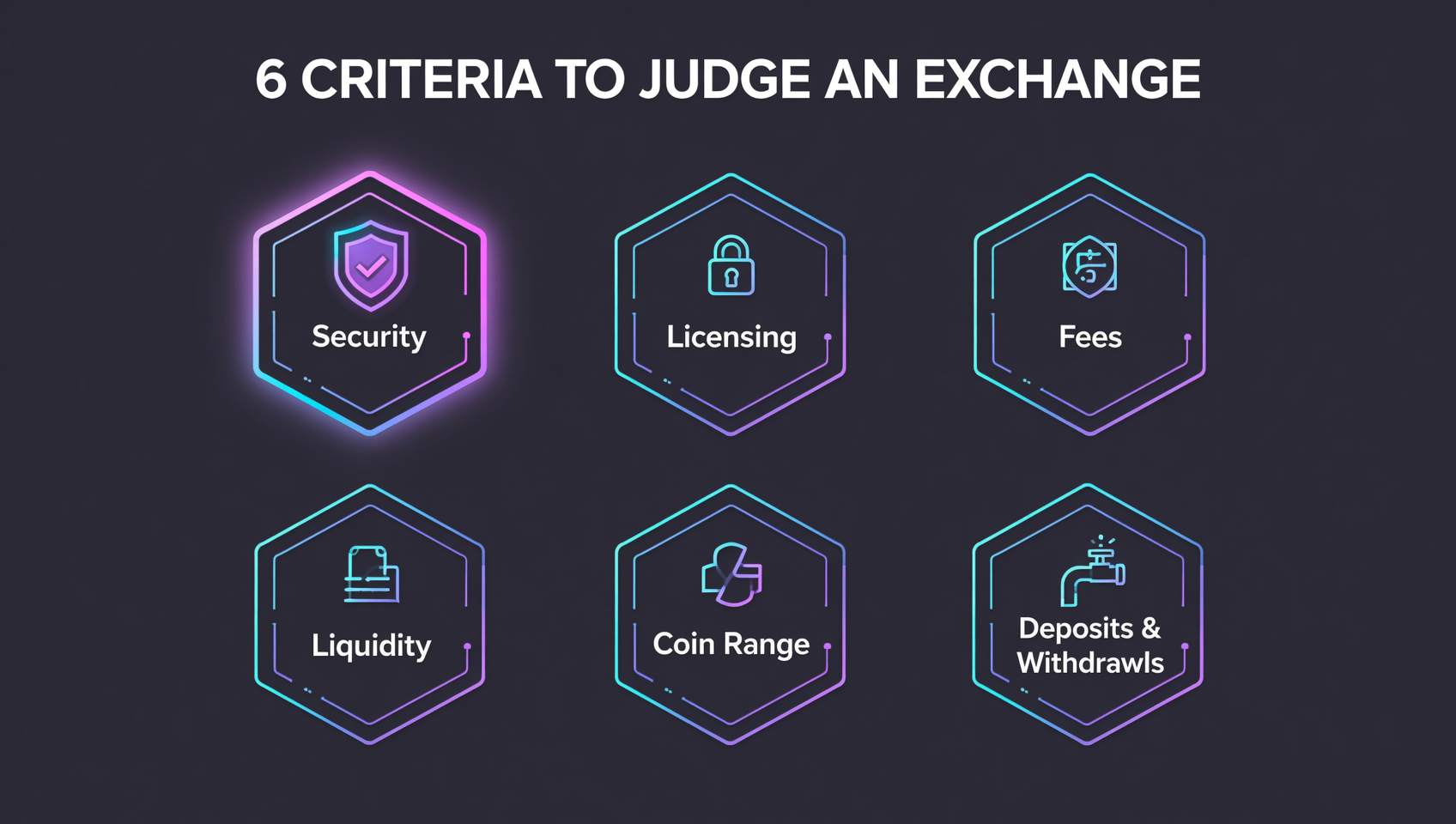
- Judge any exchange on 6 criteria: proof of reserves, licensing, fees, liquidity, coin range, deposit/withdrawal experience
- The biggest hidden cost is the two-tier fee trap: "simple" vs Pro modes can differ by 10×+, the same $10,000 trade can cost $184 or $8
Bitcoin is the most-searched cryptocurrency, and "Bitcoin exchange" is really just a colloquial name for a crypto exchange — to buy Bitcoin, you need a licensed, safe exchange that lists BTC.
There are hundreds of exchanges, but only a handful are truly trustworthy. Pick wrong and you'll overpay on fees at best, or get scammed, frozen or wiped out by a collapsing platform at worst. This article won't hand you a hollow ranking — it gives you a framework you can reuse. After reading it, you'll be able to pick your first exchange and judge any new one that appears.
Want to just open an account fast? See this top-5 exchanges for beginners comparison. Already decided and want the full buy flow? See how to buy Bitcoin step by step.
Table of Contents
- First, Untangle Four Confusing Concepts
- 6 Criteria: Judge Any Exchange at a Glance
- Region: The #1 Factor
- Find Your Match: The Decision Table
- Real Fee Math: How the Two-Tier Trap Costs You
- The Four Exchanges in Detail: Binance / OKX / Coinbase / Kraken
- Red-Flag Checklist: The 5 Most Common Traps
- FAQ
- Summary: How to Choose in One Sentence
First, Untangle Four Confusing Concepts
Before you choose, clear up the four confusions that trip up beginners most:
- A "Bitcoin exchange" is just a crypto exchange. In Chinese the two terms are used interchangeably. There is no reputable "Bitcoin-only" exchange — Binance and OKX sell BTC, ETH and hundreds of altcoins.
- Centralized exchange (CEX) ≠ decentralized exchange (DEX). CEXs are companies like Binance or OKX — you open an account and the platform custodies your assets. DEXs are on-chain protocols like Uniswap or PancakeSwap — you connect a wallet and trade, but the bar is higher and mistakes are hard to undo. Beginners should start with a CEX.
- An exchange ≠ a broker / ETF. U.S. investors can also get BTC exposure via spot Bitcoin ETFs (IBIT, FBTC) in a regular brokerage account, but you own a "fund share," not real Bitcoin you can withdraw to your own wallet. That's a big difference.
- "Low fees" ≠ "cheap." This is the trap this article digs into — many exchanges advertise "zero fee" while burying the cost in the spread. Real math below.
6 Criteria: Judge Any Exchange at a Glance
Run any exchange through these six checks and you'll dodge most big mistakes. The first three (security, licensing, fees) are hard metrics; the last three are experience metrics.
① Security: Proof of Reserves + Insurance Fund + Track Record
An exchange isn't safe because it says so — it's safe if three things are verifiable:
- Proof of Reserves (PoR): can it prove via a Merkle tree that user deposits are fully backed, and can you verify it yourself? Binance, OKX and Kraken publish this regularly and let users self-check.
- Insurance fund: is there a backstop for extreme events? Binance runs a $1B SAFU fund; OKX has its own risk-reserve fund.
- Security history: no exchange is zero-risk; the question is whether it made users whole after an incident. Binance reimbursed users in full after a 7,000 BTC hack in 2019; Kraken has never suffered a major platform-level breach.
In one line: an exchange with no proof of reserves, no insurance fund and an opaque history — skip it.
② Licensing: Is It Legal in Your Region?
This is the #1 factor, more important than fees. An unlicensed exchange can be shut down or freeze your funds at any time, no matter how cheap it is.
- U.S. users: stick to Coinbase, Kraken, Gemini — exchanges that hold state licenses (e.g. the NY BitLicense) and MSB registration. Binance.US is unavailable in many states.
- Chinese mainland users: onshore exchanges are all shut down, so you buy USDT via the P2P/C2C rails on offshore exchanges like Binance or OKX.
- EU users: from 2026 the MiCA regime applies — confirm the exchange has EU authorization.
③ Fees: Spot + Futures + Withdrawals — Watch the Two-Tier Trap
Base spot fees are close (0.08%–0.10%). The real difference is in two places: the hidden high spread in "simple" modes and withdrawal fees. See the real math below.
④ Liquidity Depth: No Slippage on Large Orders
The more volume and the thicker the order book, the smaller the gap between the price you want and the price you get (slippage). Among top exchanges, Binance has the deepest BTC/USDT book. For small trades it barely matters; for large trades (tens of thousands of dollars+) it's a hard metric.
⑤ Coin & Product Range: Does It Cover What You Need?
Buying only BTC/ETH? Any major exchange works. But if you also want altcoins, futures, staking or launchpad sales, check the product line. Binance has the most coins (600+); OKX is strong on futures and its Web3 wallet; Coinbase and Kraken are more selective (which actually reduces your risk of getting burned by junk coins).
⑥ Deposits & Withdrawals: Smooth, and No Frozen Cards
For fiat users this directly hits your pocket. Check three things: the on-ramp (does P2P/C2C support your local currency and payment methods?), whether withdrawals are smooth, and how fast KYC clears. Card-freezing risk mostly lives in the P2P step — see the red-flag checklist.
Region: The #1 Factor
Pick your exchange by where you are first, then by what you need. Region decides your shortlist; your use case decides the priority within it.
| Region | Main available exchanges | Funding | Notes |
|---|---|---|---|
| 🇨🇳 China (mainland) | Binance, OKX, Gate, Bitget (offshore) | P2P/C2C: fiat → USDT | Needs a VPN; watch for card freezes |
| 🇭🇰 Hong Kong | Binance, OKX, HashKey, OSL | Bank transfer, P2P | Prefer licensed venues |
| 🇺🇸 United States | Coinbase, Kraken, Gemini, Robinhood | Bank ACH / wire | Use licensed venues; Binance.US limited |
| 🇪🇺 Europe | Binance, Kraken, Coinbase, Bitstamp | SEPA, card | Check MiCA authorization for 2026 |
| 🌏 SEA / other | Binance, OKX, Bybit, KuCoin | P2P, card | Prefer global top exchanges |
In one line: the few exchanges you can legally use and fund smoothly are your real shortlist. Don't agonize over fees on an exchange you can't even use.
Find Your Match: The Decision Table
After region, match your use case, experience and capital:
| Your situation | Best pick | Why |
|---|---|---|
| Newcomer in China, first buy | Binance (primary) + OKX (backup) | Mature P2P CNY rails, best Chinese support, deepest liquidity |
| Long-term BTC holder | Binance/OKX + withdraw to hardware wallet | Buy and move out — don't leave it on the exchange |
| High-frequency spot, fee-sensitive | OKX | Spot maker 0.08%, slightly below Binance's 0.10% |
| Mostly futures / derivatives | OKX or Bybit | Good depth, friendly funding rates |
| U.S. / European user | Coinbase or Kraken | Full licensing, smooth fiat on-ramp |
| Hunting niche altcoins | Gate / KuCoin | Fast listings, wide selection (but higher risk) |
| Extremely cost-sensitive | MEXC, with caution | Low fees (0.05% spot taker), but 2026 notices from Seychelles FSA and Dubai VARA, no MiCA authorization |
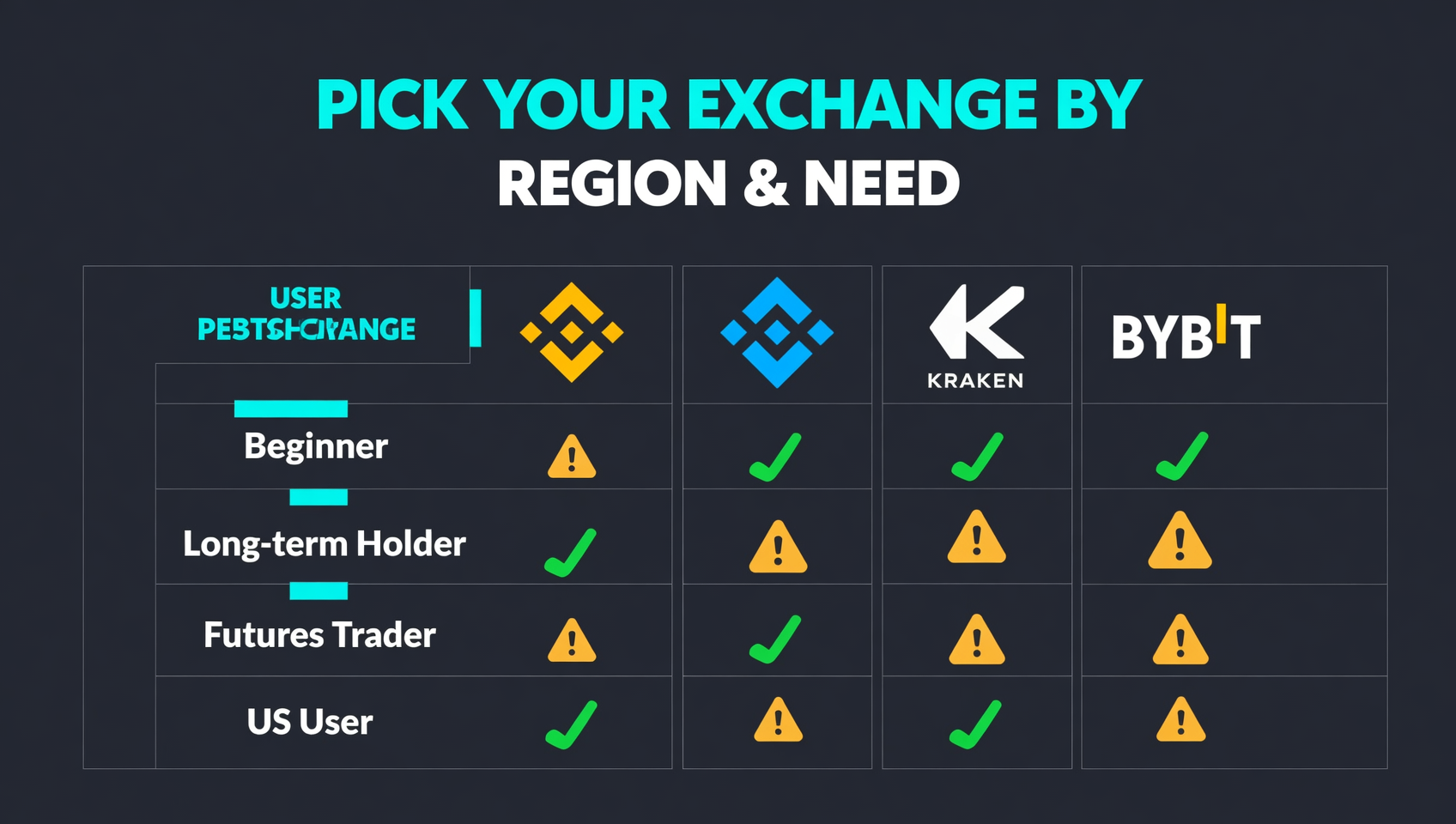
One-line summary: mainland users: "Binance + OKX" is the optimal answer. Overseas users: rank by "compliance > fees > experience" — Coinbase/Kraken are the safe picks, Binance when you want the lowest fees.
Real Fee Math: How the Two-Tier Trap Costs You
This is where beginners overpay the most. Many exchanges run two fee schedules: a "simple" mode for casual users and a "Pro/Advanced" mode for power users. The former buries the cost in the buy/sell spread; the latter is the true market fee.
Buying $10,000 of Bitcoin as an example (spot, data as of Oct 2026 — always check the live quote shown on the platform):
| Exchange / mode | Fee | Cost on a $10,000 trade |
|---|---|---|
| Binance spot | 0.10% (0.075% with BNB) | $10 ($7.5 with BNB) |
| OKX spot | 0.08% | $8 |
| Coinbase simple mode | ~1.84% (incl. spread) | ~$184 |
| Coinbase Advanced | 0.40% / 0.60% | $40–$60 |
| Kraken Pro | 0.25% / 0.40% | $25–$40 |
| Gemini simple mode | 1.49% (over $200) | ~$149 |
| Gemini ActiveTrader | 0.20% / 0.40% | $20–$40 |
See the gap? The same $10,000 buy costs $184 on Coinbase's simple mode but just $10 on Binance — an 18× difference. Even within Coinbase, switching to Advanced drops it from $184 to $60.
How to dodge this trap:
- Switch to Pro / Advanced / ActiveTrader mode before trading (same thing under different names)
- Pay with the platform token: Binance's BNB gives another 25% off; OKX's OKB discounts fees
- Use limit orders (maker) instead of market orders (taker) — maker fees are usually lower
- Register with a referral code for a rebate, which is an extra discount on top (see below)
The Four Exchanges in Detail: Binance / OKX / Coinbase / Kraken
Note: the links below are referral links. Registering through them gets you a fee rebate/discount and earns us a small reward — it does not affect your trading in any way, nor does it affect this article's conclusions.
Binance — Primary Pick for Non-U.S. Users
One-line positioning: the world's largest by volume, widest coin range, deepest liquidity, lowest barrier for Chinese-speaking users.
- Spot fee: 0.10% (0.075% with BNB)
- Security: $1B SAFU fund + regular proof of reserves
- Scale: 200M+ users, 600+ coins
- Caveat: paid a $4.3B settlement for compliance issues in 2023 and remains under monitoring into 2026 — a reason to use it without treating it as infallible, not a reason to avoid it.
👉 Register on Binance (code BINANBT) — fee rebate, ID-based KYC, and Alipay/WeChat P2P funding.
OKX — For Futures & Advanced Users
One-line positioning: industry-leading futures depth and Web3 wallet, with spot fees slightly below Binance.
- Spot fee: maker 0.08% / taker 0.10%
- Security: risk-reserve fund + regular proof of reserves, clean security history
- Standout: copy trading, trading bots, built-in Web3 wallet
👉 Register on OKX (code 60895497) — best P2P CNY depth, excellent futures and Web3 experience.
For the full Binance vs OKX breakdown, see Binance vs OKX 2026 deep comparison.
Coinbase — Compliance Pick for the U.S. / Europe
One-line positioning: Nasdaq-listed (COIN), licensed across 50 U.S. states, friendliest beginner UI — but the simple mode is expensive.
- Fees: simple mode ~1.84% (incl. spread); Advanced mode 0.40% / 0.60%
- Security: FDIC coverage on USD deposits, strictest regulation
Kraken — Best Security Reputation
One-line positioning: operating since 2011 with no major platform-level breach — the cleanest security record.
- Fees: Pro mode maker 0.25% / taker 0.40%
- Security: quarterly proof of reserves, FinCEN MSB + EU MiCA licenses
For the full Coinbase vs Kraken vs Gemini breakdown, see Coinbase vs Kraken vs Gemini comparison.
Red-Flag Checklist: The 5 Most Common Traps
- Fake exchanges / phishing sites: search "Binance official site" and click a look-alike ad, enter your password, and you're drained. Only use the official app or a bookmarked domain — see how to spot a fake exchange.
- The two-tier fee trap: as calculated above, switch to Pro/Advanced mode before you trade.
- P2P card freezes: use blue-shield / verified merchants, leave the transfer note blank, use a separate disposable card, and start small. Never use your salary or main card for P2P.
- Leaving large sums on an exchange long-term: fine for short-term trading, but withdraw long-term BTC to a self-custody wallet (hardware wallet preferred).
- Falling for "zero fee" ads: the cost is buried in the spread. There's no free lunch.
FAQ
What's the difference between a Bitcoin exchange and a crypto exchange?
There is no real difference. "Bitcoin exchange" is just what people call a crypto exchange when they want to buy Bitcoin. Binance, OKX and others all sell Bitcoin plus hundreds of other coins. Find a licensed, safe crypto exchange and it will definitely let you buy Bitcoin.
Which exchange should a beginner pick first?
Non-U.S. beginners should start with Binance (code BINANBT), then add OKX as a backup. U.S. or European users should pick Coinbase or Kraken. The rule is "one primary, one backup" — never keep everything in one exchange.
How do I tell whether an exchange is trustworthy?
Check six things: ① proof of reserves and an insurance fund; ② licensing in your region; ③ fees (watch the hidden high spreads in "simple" modes); ④ liquidity depth; ⑤ coin and product range; ⑥ smooth deposits and withdrawals.
How much do crypto exchange fees really cost?
Major exchanges charge about 0.08%–0.10% for spot, and you can cut that with the platform token. The real trap is two-tier pricing: "simple" interfaces charge 1%–1.5%+ in embedded spreads, while Pro/Advanced modes drop to 0.2%–0.6%. The same $10,000 trade can differ by over ten times.
Is it safe to keep coins on an exchange? Could it collapse like FTX?
Sticking to top exchanges (Binance, OKX, Coinbase, Kraken) makes collapse extremely unlikely, but nothing is risk-free. Keep only what you need to trade, turn on 2FA, and withdraw long-term Bitcoin to a self-custody wallet — "not your keys, not your coins."
Will buying on an exchange freeze my bank card?
Freezing is a real but manageable risk on P2P on-ramps. Use verified merchants, leave the transfer note blank, use a separate card, and start small. Never use your salary or main card for P2P.
Summary: How to Choose in One Sentence
Choose an exchange = first lock your shortlist by region, then rank it on "security > licensing > fees > liquidity > coin range > experience," and finally match your use case.
Mainland users, the ready-made answer: Binance primary + OKX backup, then withdraw long-term holdings to a hardware wallet. Overseas users: compliance first — Coinbase or Kraken are the safe picks.
Once you've chosen, the next step is the full register → KYC → deposit → buy flow — see how to buy Bitcoin step by step; to save on fees, add the Binance vs OKX referral rebate comparison.
Disclaimer: This content is for educational purposes only and is not investment advice. Cryptocurrency investing involves risk; make decisions based on your own situation.
📚 Further reading:
- On-chain guide — more exchange reviews and crypto tutorials
- Top 5 crypto exchanges for beginners in 2026
- Binance registration guide: KYC & deposit
- OKX registration pitfalls guide