


Table of Contents
- TL;DR: The Verdict First
- The Decision Table: Match Yourself in 30 Seconds
- The 2026 Numbers Side by Side
- The Trap Most Comparisons Miss: It's About Geography, Not Features
- Fees, Calculated: What $100 and $5,000 Actually Cost
- Coins and Liquidity: Where the Slippage Is
- Safety: "Which Is Safer" Needs to Be Split in Two
- Regulation: The Real Divide in 2026
- Product Ecosystems: Coinbase's USDC/Base vs Binance's Everything
- Practical Paths: Three Playbooks
- FAQ
- Further Reading
TL;DR: The Verdict First
If you're in the US, use Coinbase — Binance's main site isn't available to you anyway. If you're almost anywhere else, Binance wins on fees (0.1% vs 0.6%), coins (481 vs 403) and liquidity (~5x the daily volume). The "Binance vs Coinbase" debate is less a feature comparison than a geography-and-compliance question — and most listicles don't tell you that, so they end up comparing two platforms that serve different audiences.
Three judgments that carry the argument:
- The fee gap is an order of magnitude. Binance spot is 0.1% (0.075% with BNB). Coinbase's casual "Simple" interface charges a spread plus ~1.5%–4%; even its pro "Advanced Trade" starts at 0.6% taker / 0.4% maker1. A $5,000 BTC buy is roughly $5 on Binance versus ~$30 on Coinbase.
- The volume gap is ~5x. Binance does roughly $9–11 billion in daily volume; Coinbase does about $1.9 billion2. Deeper order books mean less slippage on large trades — one of the few things that affects both exchanges equally in the abstract but plays out very differently in practice.
- The real divider is compliance, not features. Coinbase is Nasdaq-listed, US-regulated, and the institutional/custody leader. Binance is the global-volume king with 323 million users across 100+ countries, but carries a $4.3B DOJ settlement from 2023 and still operates under compliance monitors3. Neither is "the bad one" — they've optimized for different regulatory environments.
⚠️ This article compares tools, not investment advice. Both are centralized exchanges — your crypto is held in their custody, not in your own wallet. Long-term large holdings belong in self-custody, which we cover separately.
Who this article is NOT for: complete beginners who haven't set up any exchange account. If you're brand new, start with our beginner's guide to buying crypto and come back.
📺 Prefer to watch? This article has a companion video — the core conclusion in 7 minutes: Binance vs Coinbase 2026: Fees, Security, Coins & Regulation Explained
The Decision Table: Match Yourself in 30 Seconds
| Your situation | Pick | Why |
|---|---|---|
| US resident | Coinbase | Binance.com is geo-blocked; Binance.US is a small, limited shell |
| Outside the US, want lowest fees + most coins | Binance | 0.1% spot, 481 coins, deepest liquidity |
| Institutional fund / regulated custody | Coinbase | Nasdaq-listed, NY BitLicense, Prime custody, 270+ institutional clients |
| Active trader, futures, long-tail altcoins | Binance | Futures 0.02%/0.05%, widest altcoin and launchpad access |
| Want USDC-native, Base L2, clean stablecoins | Coinbase | Circle partner, Base chain, most compliance-vetted listings |
| Just buy-and-hold BTC/ETH in the US | Coinbase (or a spot ETF) | Simplest regulated on-ramp |
| Chinese / global user needing C2C fiat ramps | Binance | P2P/C2C across many local currencies |
💡 The pattern underneath every row: geography picks your exchange first; fees and coins decide within whatever you can legally use. Everything below supports this one idea.
The 2026 Numbers Side by Side
Most "Binance vs Coinbase" posts still quote 2022 figures. Here are mid-2026 numbers, verified September 202624:
| Metric | Binance | Coinbase |
|---|---|---|
| Registered/verified users | ~323M (July 2026) | ~110M+ verified (end 2025) |
| Daily spot volume | ~$9–11B | ~$1.9B |
| Coins listed | ~481 | ~403 |
| Spot fee (default) | 0.10% (0.075% with BNB) | 0.6% taker / 0.4% maker (Advanced) |
| Futures fee | 0.02% maker / 0.05% taker | Limited futures access |
| Simple/casual buy fee | ~0.1% (spot pricing) | ~1.5%–4% (spread + fee) |
| HQ / listing | Global (Abu Dhabi ADGM license) | US (Nasdaq: COIN, NY BitLicense) |
| Notable security event | 2019 hack ~7,000 BTC, SAFU reimbursed | No major customer-crypto breach |
| Cold storage / insurance | SAFU ~$1B fund | ~98% cold, crime insurance (USD only FDIC) |
Three readings worth remembering:
- Binance's user count is staggering — roughly 43% of all crypto holders worldwide. 323 million registered users by July 2026, up from 300 million just months earlier4. Coinbase's ~110M verified users are concentrated in the US and institutional clients.
- The coin gap has narrowed but is still real. 481 vs 403 is a meaningful edge for altcoin traders, but Coinbase covers essentially every asset a compliance-conscious buyer wants.
- Volume tells you where the liquidity is. ~5x daily volume means Binance has tighter spreads and less slippage on large orders — the thing that actually costs you money beyond the headline fee.
The Trap Most Comparisons Miss: It's About Geography, Not Features
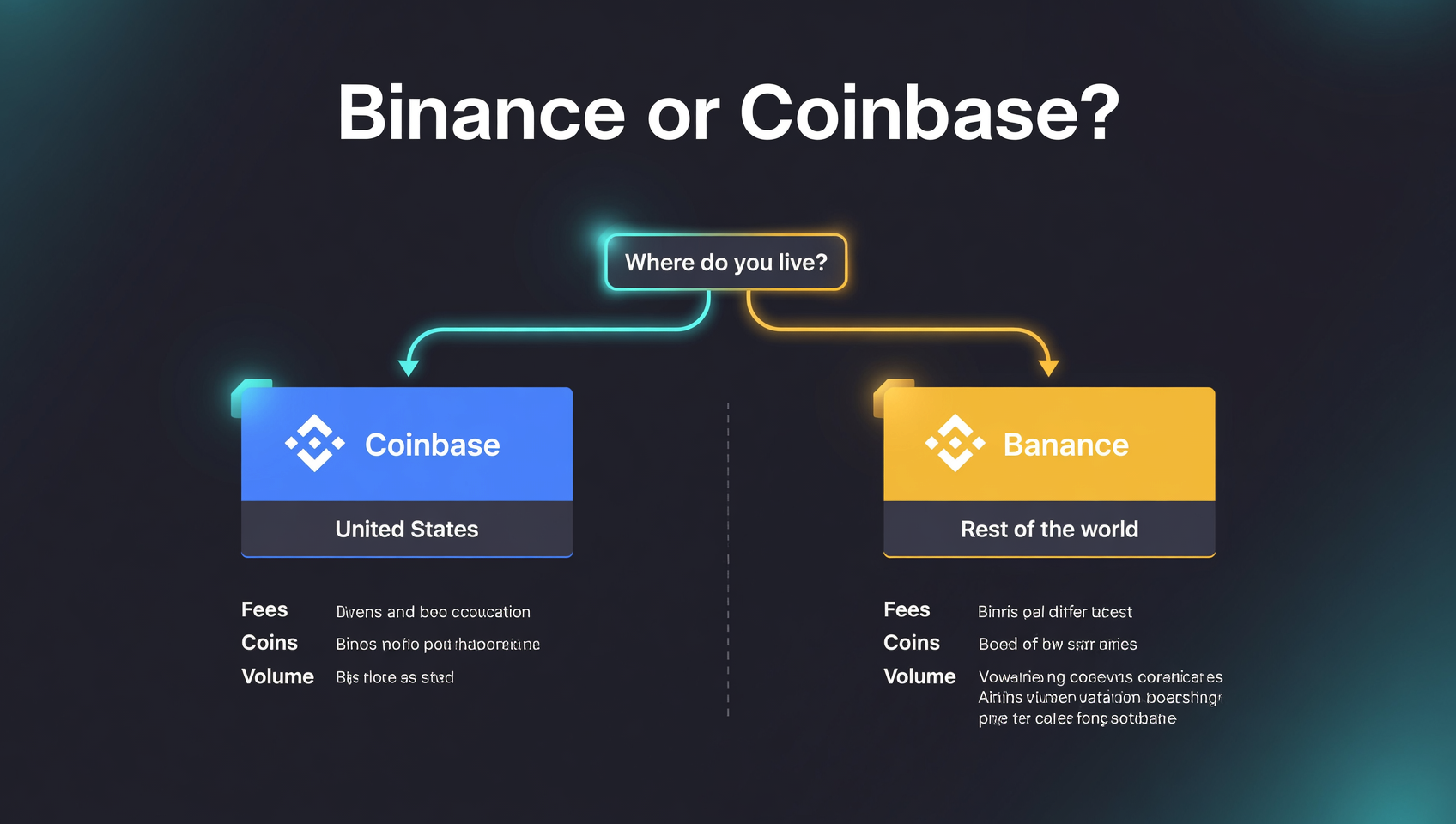
Ask "Binance or Coinbase?" and most articles will lay out a fee table and let you "choose." But for the majority of the world's population, there is no choice to make — Binance.com is restricted for US residents, and Coinbase is a US-first exchange whose simplest interface is disproportionately expensive for non-US users who have cheaper local alternatives.
This is why the framing matters:
- If you're a US resident, "Binance vs Coinbase" is answered for you: you can't use Binance.com. Your real question is Coinbase vs Kraken vs Gemini — a different comparison entirely.
- If you're outside the US, Coinbase is generally the more expensive option with fewer coins and weaker local fiat ramps. Binance (or a regional exchange) usually wins. For Chinese-speaking users, the practical comparison is Binance vs OKX, not Binance vs Coinbase.
The counterintuitive takeaway: "Binance vs Coinbase" is, for most readers, a false choice. The two exchanges optimized for different regulatory worlds and barely compete for the same customer. The people for whom it's a real decision are a narrow band: non-US users who specifically want a US-regulated, Nasdaq-listed venue (for trust or custody), or US residents deciding whether Binance.US's limited product is worth it (it usually isn't).
Fees, Calculated: What $100 and $5,000 Actually Cost
Fees are where the two exchanges diverge hardest. Let's put numbers on it1:
Buying $100 of BTC:
| Venue | Fee | What you pay |
|---|---|---|
| Binance spot (0.1%) | $0.10 | ~$100.10 |
| Coinbase Advanced, taker (0.6%) | $0.60 | ~$100.60 |
| Coinbase Simple (spread + ~1.5%) | ~$1.50+ | ~$101.50+ |
Buying $5,000 of BTC:
| Venue | Fee | What you pay |
|---|---|---|
| Binance spot (0.1%) | $5.00 | ~$5,005 |
| Coinbase Advanced, maker (0.4%) | $20.00 | ~$5,020 |
| Coinbase Advanced, taker (0.6%) | $30.00 | ~$5,030 |
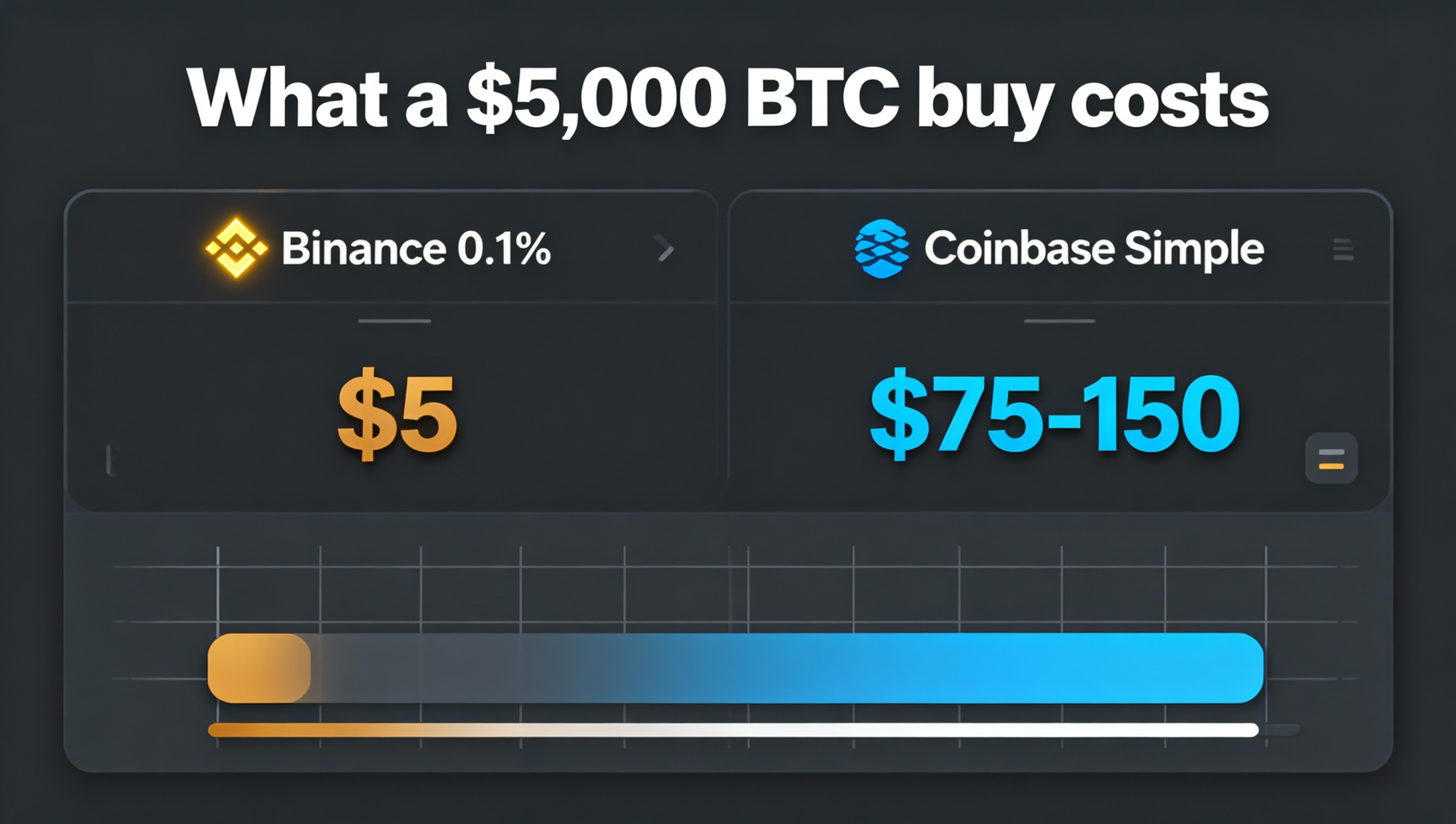
| Coinbase Simple (spread + fee) | ~$75–150 | ~$5,075–5,150 |
Three conclusions:
- Casual Coinbase users overpay the most. The "Simple" buy interface is where the spread-plus-fee silently eats 1.5%–4%. A $5,000 buy can cost $75–150 there versus $5 on Binance spot. That's not a small difference — it's a 15–30x gap on the same trade.
- Use Coinbase Advanced if you use Coinbase at all. Switching interfaces drops you from ~1.5% to 0.6%/0.4%. Use limit (maker) orders and you're at 0.4%.
- Fees compound with frequency. If you trade even a few times a month, the 0.5% per-trade delta between Binance and Coinbase Advanced becomes the single largest controllable cost — bigger than your asset selection.
💡 To cut Binance fees further: hold BNB for a 25% discount (0.1% → 0.075%) and register with a referral code for a rebate. For Coinbase: Advanced Trade + limit orders, or Coinbase One ($29.99/month) if you trade a lot.
Coins and Liquidity: Where the Slippage Is
Binance wins on breadth; Coinbase wins on curation. Binance lists ~481 coins versus Coinbase's ~403 as of mid-20264. The practical consequences:
- Altcoin and memecoin traders get earlier and broader access on Binance — most new listings land there first, and the launchpad/launchpool ecosystem funnels new tokens to Binance users.
- Compliance-conscious and US buyers actually prefer Coinbase's shorter, more-vetted list — every listing passed a stricter legal review, and it holds the assets (BTC, ETH, USDC, the major alts) that most institutional money trades.
- Liquidity = less slippage. Binance's ~5x daily volume means a large market order moves the price less than the same order on Coinbase. For orders above a few thousand dollars, this can matter more than the headline fee.
The honest framing: if you trade altcoins or sizeable positions, Binance's depth is a genuine edge; if you're a buy-and-hold BTC/ETH investor in the US, Coinbase's thinner alt list costs you nothing.
Safety: "Which Is Safer" Needs to Be Split in Two
The question everyone asks, and the answer most articles get wrong. You have to separate platform-level risk from account-level risk.
Platform level — Coinbase has the cleaner record. Coinbase has never suffered a large-scale hot-wallet theft of customer crypto and keeps ~98% of assets in cold storage5. Binance was hacked in May 2019 for 7,000 BTC ($40M), though it reimbursed every affected user from its SAFU fund5.
Account level — the picture flips, and this is what actually loses people money:
- Coinbase's insurance does NOT cover your individual account. Its commercial crime policy covers internal/theft events, but explicitly excludes losses from phishing, SIM-swap, or credential theft of your own account5. Its FDIC pass-through coverage applies only to USD cash balances, not crypto.
- Binance's SAFU is a ~$1B discretionary fund that reimbursed the 2019 hack. It's real and tested, but it's not statutory deposit insurance — payouts are at the exchange's discretion5.
The uncomfortable truth: neither exchange protects you from your own mistakes. The most common "my crypto got stolen" story isn't an exchange hack — it's a phishing link, a leaked password, or a SIM-swap on a personal account. No SAFU or insurance covers that. So the real safety lever is the same on both: hardware 2FA, a unique password, and moving long-term holdings to self-custody.
Regulation: The Real Divide in 2026
This is where the two companies are structurally different animals:
- Coinbase is a US-regulated, Nasdaq-listed public company. It holds the NY BitLicense and state money-transmitter licenses, and it's the custody and on-ramp of choice for institutions and US regulators. That's its moat — and why it can charge higher fees.
- Binance is the global-volume leader but carries regulatory baggage. It paid a $4.3B settlement to the US DOJ in 2023 (with founder CZ stepping down and pleading guilty to money-laundering-related charges), and still operates under compliance monitors3. Under CEO Richard Teng, it has pushed hard into licensing — securing a full license from Abu Dhabi's ADGM and engaging with MiCA in Europe — but its US presence is effectively gone.
What this means for you in 2026:
- In Europe, MiCA full licensing is forcing issuers and exchanges to comply by mid-2026; Binance and Coinbase are both navigating it, though Coinbase (via its EU entities) is further along on the stablecoin side.
- In the US, Coinbase is the default regulated venue; Binance is absent except for the small Binance.US.
- For trust-sensitive or institutional use, Coinbase's public-company transparency (audited financials, SEC filings) is a genuine advantage Binance can't match. For everyday global trading, Binance's scale and product depth still win.
Product Ecosystems: Coinbase's USDC/Base vs Binance's Everything
The two companies are building different empires:
Coinbase's bet is "US-regulated crypto infrastructure":
- USDC — it's a co-founder of Circle, and USDC is the compliance-clean stablecoin of choice, deeply integrated with Coinbase.
- Base — its own Layer 2 (built on Optimism), where USDC is the native gas token and which has become a major DeFi hub.
- Institutional — Coinbase Prime custody, 270+ Crypto-as-a-Service clients, and the ETF custodian for many US spot bitcoin/ether ETFs.
Binance's bet is "the everything exchange":
- The widest product line — spot, futures, options, margin, Earn (staking/savings), Launchpad/Launchpool, P2P/C2C across 100+ fiat currencies.
- BNB Chain — its own L1/L2 ecosystem, one of the largest by usage.
- Global reach — 323M users, 43% of all crypto holders, aggressive local fiat on-ramps.
For most retail users, Binance's "everything" is more immediately useful. For institutions and compliance-first users, Coinbase's USDC/Base/Prime stack is the point.
Practical Paths: Three Playbooks
Path A — You're a US resident:
- Use Coinbase (or a US-regulated exchange). Binance.com is not an option.
- Trade on Coinbase Advanced, not Simple — it cuts your fee from ~1.5% to 0.4–0.6%.
- Use limit orders; buy-and-hold BTC/ETH, or use a spot ETF for tax-advantaged accounts.
Path B — You're outside the US and want to trade actively:
- Register on Binance with a referral code for a fee rebate.
- Hold a little BNB to get the 25% fee discount (0.1% → 0.075%).
- For fiat on-ramp in your local currency, use Binance P2P/C2C.
- Keep a Coinbase account only if you need a US-regulated off-ramp or custody.
Path C — You hold meaningful amounts long-term:
- Don't keep large holdings on either exchange — move them to a hardware wallet. See our cold storage guide.
- Use exchanges only for active trading capital and fiat on/off-ramping.
Stop conditions — pause if any of these are true:
- A site asks for your seed phrase or password via DM → it's a scam, stop.
- You're being rushed to "claim a bonus" or "verify your account" under time pressure → scam.
- The fee on a trade is over ~1% and you're on a "simple" interface → switch to the pro interface first.
- You're about to keep more than a few months' savings on an exchange → move it to self-custody first.
FAQ
Which is better, Binance or Coinbase?
For most people it's decided by geography. US residents → Coinbase (Binance.com is geo-blocked). Everyone else → Binance wins on fees (0.1% vs 0.6%), coins (481 vs 403) and volume (~5x). Coinbase's edge is regulatory clarity, US-listed transparency and institutional custody.
Why is Coinbase so much more expensive?
Casual users pay Coinbase's "Simple" spread + ~1.5–4% fee; even its pro interface starts at 0.6% taker vs Binance's 0.1%. It's partly a compliance-and-US-market premium. Switch to Advanced Trade and limit orders to cut it to 0.4%.
Is Coinbase safer than Binance?
Platform level: Coinbase has the cleaner record (never a major customer-crypto breach, ~98% cold). Account level: neither protects you — Coinbase's insurance excludes phishing/SIM-swap of your own account, and Binance's SAFU is discretionary. Your own 2FA and habits matter more than which exchange.
Can I use Binance in the US?
No — Binance.com is restricted for US residents. Binance.US is a separate, much smaller platform (0% maker fees but limited coins and ~$15M/day volume). US residents should use Coinbase or another regulated venue.
Which has more coins?
Binance (~481) has more than Coinbase (~403) as of mid-2026. Binance is better for altcoins and new listings; Coinbase covers everything a compliance-conscious or institutional buyer needs.
How do I reduce Coinbase fees?
Use Advanced Trade instead of Simple (drops ~1.5% → 0.4–0.6%), use limit (maker) orders, and consider Coinbase One ($29.99/month) if you trade frequently. On Binance, hold BNB for a 25% discount and use a referral-code rebate.
Should I have accounts on both?
Often yes — they solve different jobs. Coinbase for the cleanest USD on-ramp and regulated custody; Binance for cheap, deep-liquidity active trading. Just never hold long-term large amounts on any centralized exchange — move those to a hardware wallet.
Further Reading
- Binance vs OKX 2026 Comparison — the relevant comparison for most non-US readers
- Best Bitcoin Cold Storage 2026 — where large holdings should actually live
- Crypto Wallet Complete Guide: Hot vs Cold — self-custody basics
- How to Buy Bitcoin 2026: Exchange Comparison — the full buying flow and fee comparison
- CEX vs DEX Comparison — whether you even need a centralized exchange
Data verification note: fees, coins, volume and user figures verified 2026-09-19 from the sources cited below12345. Exchange fees and listings change frequently — always confirm on the platform before trading.
This article is not investment advice; trading crypto carries risk and you should follow your local laws.
Footnotes
-
Coinbase fee schedule and Binance fee tiers — spot 0.1% (0.075% with BNB); Coinbase Advanced 0.4%/0.6% entry tier, Simple ~1.49%–3.99%. See Coinbase fees and Binance fees. ↩ ↩2 ↩3
-
Daily trading volume: Binance ~$9–11B vs Coinbase ~$1.9B; Coinbase Q1 2026 total volume $361B. Sources: CoinLaw, EdifyingCrypto, Coinbase 10-K. ↩ ↩2 ↩3
-
Binance $4.3B DOJ settlement (2023), CZ plea and compliance monitors; Richard Teng's licensing push and ADGM full license. Sources: Binance 9th-anniversary release (July 2026), CoinDesk. ↩ ↩2 ↩3
-
User counts (Binance ~323M, ~43% of crypto holders; Coinbase ~110M verified) and coins listed (Binance ~481 vs Coinbase ~403). Sources: Binance 9th-anniversary report, Seoul Economic Daily (2026-08-31), Coinbase FY2025 Form 10-K. ↩ ↩2 ↩3 ↩4
-
Binance May 2019 hack (~7,000 BTC, SAFU reimbursement, SAFU ~$1B); Coinbase ~98% cold storage, crime insurance exclusions and FDIC USD-only coverage. Sources: Binance Academy SAFU glossary, CoinBureau exchange-security analysis. ↩ ↩2 ↩3 ↩4 ↩5