
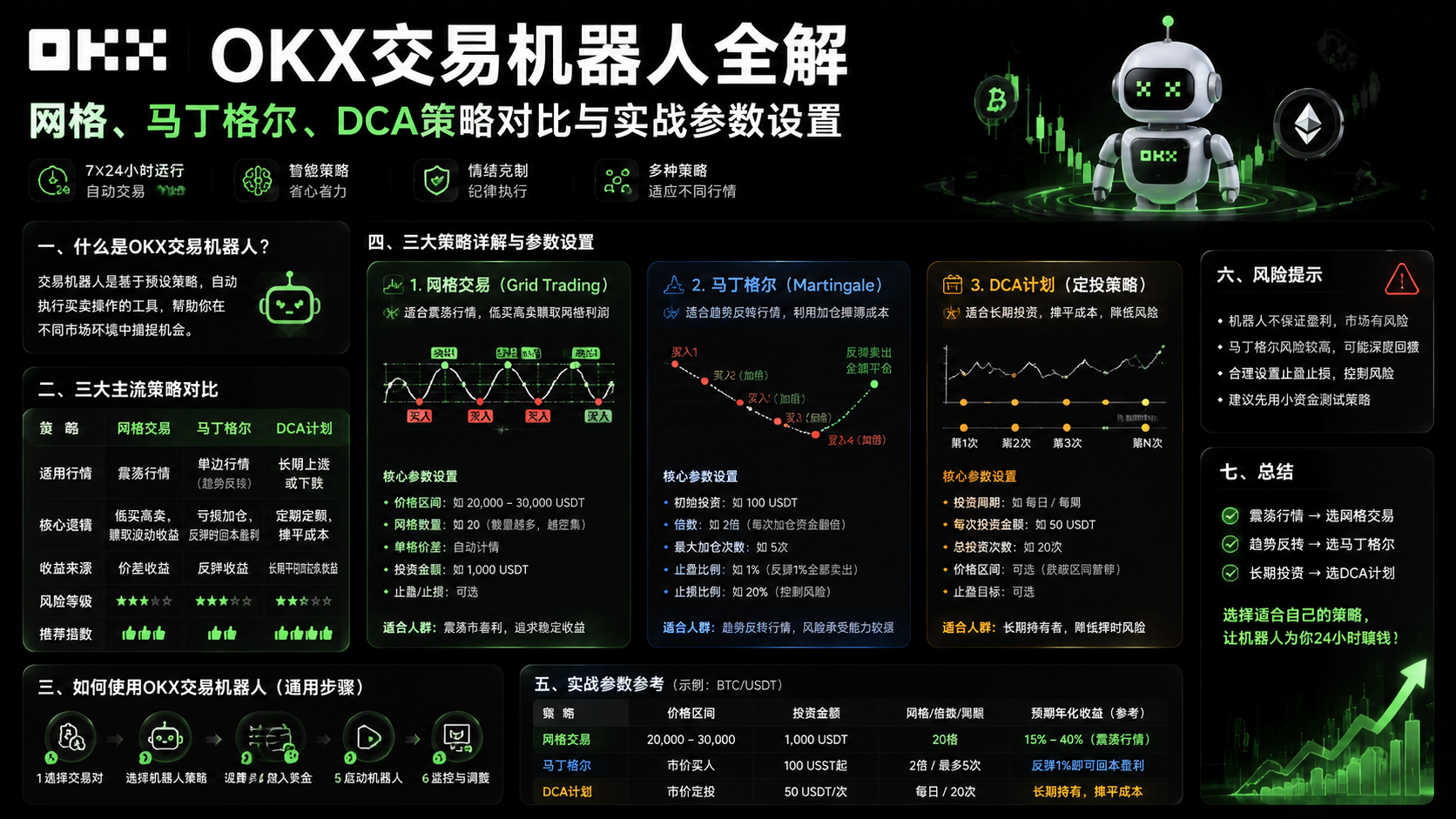


TL;DR
- OKX offers three core trading bots — Grid (range-bound markets), Martingale DCA (dip averaging), and Signal Bot (TradingView Webhooks)
- Grid strategy — automated buy low/sell high within a set price range, 15-25 grid levels, ideal for sideways markets
- Martingale DCA — buy more as price drops, profit on a single rebound, requires strict layer and capital controls
- Signal Bot — execute external trading strategies via Webhook with isolated risk budgets
- All bots are free — only standard trading fees apply; OKB holders get 50%+ fee discounts
The crypto market in 2026 has been highly volatile — BTC swung from $73K down to $58K and back above $65K in July alone. Manual trading makes it nearly impossible to time such moves perfectly. OKX's automated trading bots help you run strategies 24/7 without emotional decision-making.
But trading bots are not "money printers" — each strategy has its optimal market conditions and risk boundaries. Understanding the core logic and parameter meaning is essential before using any bot.
What Are OKX Trading Bots
OKX trading bots are server-side automated strategy tools. You set the parameters, and the bot runs 24/7, executing trades automatically based on market movements.
Three key advantages:
- Server-side execution — no need to keep your computer on or maintain local network
- Zero extra fees — only standard trading fees apply, bots themselves are free
- AI parameter recommendations — OKX 2026 supports AI-powered parameter suggestions based on historical data and market conditions
In March 2026, OKX launched Agent Trade Kit, an open-source MCP toolkit that allows AI agents to interact with OKX's trading system through natural language. Beyond trade execution, AI can read K-lines, order books, funding rates, and recommend grid/DCA strategy parameters. In May 2026, One-Click Quick Connect was added — an OAuth-like authorization flow eliminating manual API key management, with permissions auto-expiring after 7 days of inactivity.
Three Bot Types Compared
| Dimension | Grid Bot | Martingale (DCA) | Signal Bot |
|---|---|---|---|
| Best market | Range-bound / sideways | Trending pullbacks / accumulation | All markets (signal-dependent) |
| Logic | Buy low, sell high within range | Buy more on dips → profit on rebound | Execute Webhook signals |
| Profit model | Per-grid spread accumulation | Single rebound profit | Depends on signal strategy |
| Risk profile | Range breakout risk | Safety layer exhaustion | Signal error / interruption |
| Leverage | ✅ Futures Grid supports leverage | ✅ Futures DCA supports leverage | ✅ Isolated margin + leverage |
| Recommended capital | ≥500 USDT (spot) | ≥200 USDT (spot) | ≥100 USDT |
| Best use case | BTC/ETH in range-bound periods | Dip-buying / position building | TradingView strategy automation |
| Automation level | ⭐⭐⭐⭐⭐ | ⭐⭐⭐⭐ | ⭐⭐⭐ (signal-dependent) |
1. Grid Bot — Automated Range Trading
How It Works
A grid bot places a series of buy and sell orders evenly across your defined price range. When the price drops to a grid level, it buys; when it rises to a grid level, it sells — repeatedly capturing the spread.
Example: You set a BTC/USDT grid from $60,000 to $66,000 with 20 levels. When BTC drops from $63,000 to $62,700, the bot buys. When price rebounds to $63,000, the bot sells. Each cycle captures ~0.48% spread.
OKX Grid Bot Types
| Type | Description | Use Case |
|---|---|---|
| Spot Grid | Real asset trading, no leverage, no liquidation | Beginners, long-term holding + grid yield |
| USDT-M Futures Grid | USDT-margined perpetual swap grid, supports leverage | Long/short BTC/ETH with amplified returns |
| Coin-M Futures Grid | Coin-margined perpetual grid (e.g., BTC-USD-SWAP) | Miners or holders hedging with shorts |
Core Parameters
| Parameter | Meaning | Recommended (BTC/USDT) |
|---|---|---|
| Upper price | Highest sell price | $66,000-$68,000 |
| Lower price | Lowest buy price | $58,000-$60,000 |
| Grid count | Number of grid levels | 15-25 levels |
| Arithmetic/Geometric | Equal price vs percentage spacing | Geometric (recommended) |
| Per-grid profit | Spread per cycle | ≥0.3% (must exceed round-trip fees) |
| Investment | Total capital allocated | 500-2,000 USDT |
Parameter tuning principles:
- Range width = 1.5-2x recent price volatility (minimize breakout risk)
- Grid count = capital ÷ (range width ÷ minimum profit per grid)
- Min 10 USDT per grid (prevent fee dominance)
Real Template (July 2026)
BTC/USDT Spot Grid (July 2026):
Upper price: $66,500 Lower price: $60,000 Grid type: Geometric Grid count: 20 Investment: 1,000 USDT Per-grid profit: ~0.48%
OKX 2026 supports "AI Recommended Parameters" when creating grids. The system analyzes current volatility (ATR), historical prices, and your capital to suggest a price range and grid count. For beginners, this is a great starting point — just fine-tune from the AI suggestion.
2. Martingale (DCA) Bot — Averaging Into Positions
How It Works
The Martingale strategy's core is "buy more as price drops." You set a first order amount. When the price declines by a defined percentage, the bot places a larger buy order. This repeats until the price rebounds to your take-profit target, when the bot sells all holdings for a single profit.
This is a mechanized version of the classic "cost averaging" strategy. Buying 1 BTC at $64,000 all at once vs. buying in at $64,000 → $62,000 → $60,000 → $58,000 in batches — the latter achieves a significantly lower average cost.
OKX DCA Bot Types
| Type | Description |
|---|---|
| Spot DCA | Buy spot with USDT, long only |
| Futures DCA | Perpetual swap, supports long or short with leverage |
Core Parameters
| Parameter | Meaning | Recommended |
|---|---|---|
| First order amount | Initial buy size | 20-50 USDT |
| Max safety orders | Maximum additional buy layers | 5-6 layers ⚠️ key risk control |
| Price deviation | % drop between each layer | 1.5%-3% (or 300-500 points) |
| Volume multiplier | Multiplier for each subsequent order | 1.5-2.0x |
| Take-profit ratio | % gain from avg cost to sell | 1%-3% |
| Reinvest | Auto-restart after profit | ✅ Enable |
Multiplier Explained
The volume multiplier is the most critical Martingale parameter. Example: first order 20 USDT, multiplier 2.0, 5 layers:
- Layer 1: 20 USDT (first order)
- Layer 2: 40 USDT (triggers at -2%)
- Layer 3: 80 USDT (triggers at -4%)
- Layer 4: 160 USDT (triggers at -6%)
- Layer 5: 320 USDT (triggers at -8%) Total capital: 20+40+80+160+320 = 620 USDT
Higher multiplier = stronger cost-averaging but faster capital consumption. Conservative: 1.5x, Aggressive: 2.0x.
Risk Control — The Martingale Achilles' Heel
The biggest risk in Martingale isn't the trade itself — it's poorly designed safety order layers:
| Risk | Consequence | Solution |
|---|---|---|
| Deviation too small | Normal volatility triggers buys, capital depletes fast | Set ≥2% deviation (or based on ATR) |
| Too many layers | Capital exhausted in extreme moves | Max 5-6 layers with sufficient buffer |
| Over-allocation | All capital trapped in one strategy | Martingale ≤ 30% of total capital |
| No stop-loss | No exit mechanism after all layers triggered | Set stop-loss + daily loss circuit breaker |
OKX Martingale bots support price deviation alerts and "daily max loss circuit breaker." Suggested setting: auto-pause all bots when daily loss exceeds 10% of total investment. This is a life-saving feature — turn it on.
Real Template (July 2026)
ETH/USDT Spot DCA (July 2026):
First order: 20 USDT Max safety orders: 5 layers Deviation: 2% (~$36-$40) Volume multiplier: 2.0x Take-profit: 2% Daily loss circuit breaker: On (10%)
3. Signal Bot — TradingView Automated Execution
How It Works
OKX Signal Bot listens for Webhook signals from TradingView or similar platforms and automatically executes trades on OKX.
Setup steps:
- Create a strategy on TradingView, set up Alert → Webhook URL
- Create a Signal Bot on OKX with your signal name and Webhook secret
- Configure trading parameters (pair, long/short, size, leverage)
- Launch the bot
Key Features
| Feature | Details |
|---|---|
| Isolated budget | Each bot has its own margin envelope, isolated from main account |
| No-code setup | No API keys or programming needed |
| Perpetual swaps only | Signal Bot currently supports futures/perp trading only |
| Setup time | ~15 minutes from zero to running |
Signal Bot vs Grid/Martingale
| Aspect | Signal Bot | Grid / Martingale |
|---|---|---|
| Strategy source | External (TradingView etc.) | Built-in logic |
| Flexibility | ⭐⭐⭐⭐⭐ Nearly any strategy | ⭐⭐⭐ Fixed patterns |
| Difficulty | ⭐⭐⭐ Requires TradingView knowledge | ⭐ Configure in UI |
| Reliability | ⭐⭐⭐⭐ Depends on signal source | ⭐⭐⭐⭐⭐ Fully autonomous |
| TradingView limit | Up to 5 signal sources per account | N/A |
4. Strategy Selection Guide
Market View → Strategy Match
| Your market view | Recommended strategy | Why |
|---|---|---|
| "BTC will range $60K-$66K for weeks" | Grid | Range-bound is grid's sweet spot |
| "BTC may dip to $58K but bull by year-end" | Martingale DCA | Average in during dips, wait for recovery |
| "I have a proven TradingView strategy" | Signal Bot | Reuse existing strategy logic |
| "No idea where the market is headed" | Grid (wide range) | Most reliable all-purpose strategy |
| "I want to DCA into BTC hands-free" | Recurring Buy | Simplest periodic investment |
Risk Hierarchy
Risk (low to high): Recurring Buy < Spot Grid < Futures Grid < Spot DCA < Futures DCA < Signal Bot
Recommended learning path: Spot Grid → Spot DCA (small test) → Futures Grid → Futures DCA → Signal Bot
5. OKX 2026 Trading Bot Ecosystem Updates
Agent Trade Kit (March 2026)
OKX's Agent Trade Kit is the most complete exchange MCP toolkit in the industry, with 82 tools covering market data, trade execution, strategy bots, account management, and demo mode. It's currently the only exchange MCP toolkit supporting options trading.
One-Click Quick Connect (May 2026)
Traditional API key management has been the biggest barrier for non-technical users. One-Click Quick Connect uses an OAuth-like authorization flow — users just scan to confirm permissions (Read/Trade/Earn, scoped). Auto-expires after 7 days of inactivity. All connections can be viewed and revoked from a centralized dashboard.
OKX AI Quant (Open Source)
The community-built OKX AI Quant trading system offers 7 built-in strategies (trend, momentum, breakout, mean reversion, etc.) with SQLite audit logging, Telegram notifications, and LLM trade summaries. Supports demo mode testing before going live.
6. FAQ
Can grid bots guarantee profit?
No grid bot can guarantee profit. In a strong uptrend, it underperforms HODL (part of capital is in USDT). In a strong downtrend, it also incurs unrealized losses. A grid bot's advantage is generating steady spread income in range-bound markets — not "guaranteed profit."
What's the difference between Martingale and DCA?
On OKX, Martingale and DCA refer to the same product. DCA (Dollar-Cost Averaging) is the standard financial term for buying in batches to lower average cost. "Martingale" is the quantitative trading term for "doubling down on losses." OKX names it "Martingale Strategy," but its essence is DCA with a volume multiplier.
How do funding rates affect futures grid bots?
Futures grid bots pay/receive funding rates every 8 hours (typically ±0.01%). Long positions pay when the rate is positive. Running futures grids long-term requires factoring in cumulative funding costs. When funding rates are persistently positive (bullish sentiment), long futures grid bots have higher holding costs.
Which pairs do OKX trading bots support?
OKX trading bots support most USDT and USDC pairs on the platform. Major coins (BTC, ETH, SOL, XRP, DOGE, etc.) have the best liquidity and highest grid execution efficiency. Smaller market cap pairs are supported but carry liquidity risk — grid orders may not fill for extended periods.
Can I run multiple bots simultaneously?
Yes. OKX allows unlimited bots running concurrently on the same account, each independently. However, total capital committed across all bots must stay within your account balance. Recommended: keep total bot-allocated capital under 50% of your portfolio.
⚠️ Risk Disclaimer: No OKX trading bot guarantees returns. Grid, Martingale DCA, and Signal Bot strategies may incur losses under certain market conditions. Futures Grid and Futures DCA use leverage that amplifies both gains and losses. Martingale DCA strategies carry a risk of significant unrealized loss during extreme one-sided moves when safety order layers are exhausted. Choose strategies based on your risk tolerance and allocate capital wisely. Cryptocurrency markets are highly volatile. This article does not constitute investment advice.
Recommended: Binance | OKX Registration
📚 Further Reading: On-Chain Guide — Learn Blockchain from Zero
📖 Related Articles: