
What Is Dollar-Cost Averaging (DCA)? 2026 Beginner's Guide to DCA Bitcoin & Crypto
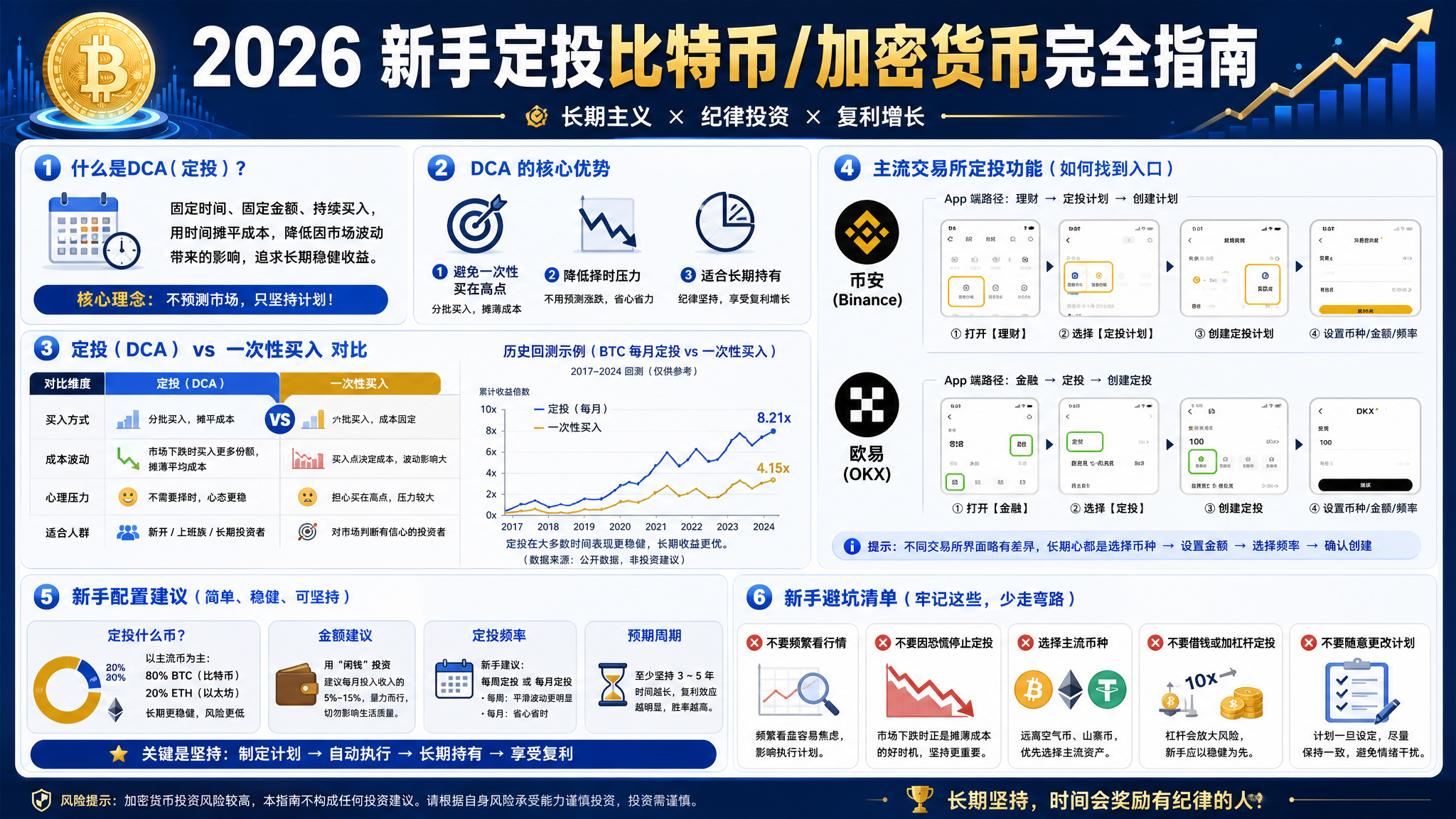
Dollar-cost averaging (DCA, the average cost method) means buying a fixed amount on a fixed schedule, again and again, so time averages out your buy price and you avoid dumping everything in at the top. This guide explains how DCA works, how it compares to lump-sum investing, how to automate it with Binance Auto-Invest and OKX recurring buy, and what to DCA, how much, and how often — plus a beginner's mistake checklist.
TL;DR
Dollar-cost averaging (DCA, the "average cost method") means buying a fixed amount on a fixed schedule, over and over, so time averages out your buy price and you avoid throwing everything in at the top. For beginners, its biggest value isn't "the highest returns" — it's that you never have to call tops or bottoms, you stop chasing rallies and panic-selling, and you can actually stick with it. On the practical side, Binance has Auto-Invest and OKX has its recurring-buy strategy; both let you set an amount and a schedule (daily/weekly/monthly) and buy automatically, starting from a few dozen dollars or even 2 USDT. Remember three preconditions: only DCA mainstream assets like BTC/ETH, only use money you can afford to lose, and be ready to hold long-term — DCA isn't a guarantee of profit, and it can't save a coin that's going to zero, nor an impatient investor.12
Disclosure: the registration links below are CoinVado referral links. Signing up through them costs you nothing extra; we may receive a commission from the platform, which keeps this site running.
No account yet? Register on Binance (referral code: BINANBT), or register on OKX (referral code: 60895497).
1. What is dollar-cost averaging (DCA), exactly?
Dollar-cost averaging (DCA) is short for "averaging out your cost in dollars." What it does is extremely simple:
Invest a fixed amount at a fixed interval, buying the same asset.
For example, "spend $500 buying Bitcoin on the 1st of every month" for 12 straight months is a bare-bones DCA plan. It doesn't predict moves, it doesn't time the market — it works purely through discipline and time.
Why does it average out your cost? Because prices fluctuate: the same $500 buys more coins when the price is low and fewer when it's high. Over time, the average cost of your coins drifts toward the average price, instead of landing on a single (possibly peak) price.
A simple example (numbers are illustrative only):
| Month | Price (hypothetical) | What $500 buys |
|---|---|---|
| Month 1 | $100 | 5 |
| Month 2 | $50 (dipped) | 10 |
| Month 3 | $200 (rallied) | 2.5 |
You invested $1,500 total across three months and got 17.5 coins, for an average cost of about $85.7 per coin. If you'd put the whole $1,500 in at $100 in month one, your cost would be $100 per coin — DCA lets you "buy more automatically" when the price falls, pulling your cost down.
2. Why beginners should prefer DCA (three reasons)
① You probably can't time the market. The most common beginner mistake is chasing rallies and panic-selling on dips. DCA replaces that with a mechanical "fixed amount + fixed schedule" rule and skips the hardest question — "should I buy now?" You don't need to judge the timing; you just need to keep going.
② It cures the "I bought and it immediately dipped" anxiety. The fear of a lump sum is buying at a local top and watching paper losses build until you capitulate and sell. DCA is naturally spread out — a dip actually means "next time I get more for the same money," which is emotionally far easier to ride through.
③ It forces you into "spare money, long horizon." DCA is a fixed monthly expense, small enough that it never hurts, naturally matching crypto's high-volatility, long-cycle character.
3. DCA vs lump-sum investing: which earns more?
This is the most-asked question. First, the comparison:
| Dimension | Lump sum | DCA |
|---|---|---|
| Upside | Highest if you buy at a low | Smoother, averaged returns |
| Risk | Worst drawdown if you buy at a top | Builds in gradually on the way down, gentler drawdown |
| Mindset required | High — easy to panic and sell | Low — just execute mechanically |
| Who it suits | Veterans with judgment and risk tolerance | Beginners who can't time and fear buying high |
An honest conclusion: several long-term backtests of traditional securities show that, entering at a random historical date, a lump sum outperforms roughly two-thirds of the time — because markets trend up over the long run, so getting in earlier and fully wins. But that's the "result view," not the "experience view." DCA's real value is that you won't suffer a crash-style loss if you happen to buy at a top, and you can actually hold on. For a beginner, holding on matters far more than buying cleverly.
One sentence: chasing maximum returns and can stomach the swings → lump sum; want it steadier and can stay consistent → DCA. You can also combine them: build a base position with a lump sum first, then keep adding with DCA.
4. Who DCA is for — and who it isn't
Good fit:
- Beginners with no ability to judge the market
- People who want to use "spare money" to build long-term crypto exposure
- People easily swayed into chasing rallies and panic-selling, who need discipline
Poor fit:
- People who want quick in-and-out short-term profits (DCA is slow)
- People whose only money is needed short-term (DCA capital must be long-term spare money)
- People betting that "DCA'ing a junk coin will turn things around" (DCA can't save a coin going to zero)
To build the full beginner framework first, read the crypto beginner's first lesson; to decide between spot and futures before you pick one, read the spot vs futures beginner's guide.
5. How to DCA on Binance / OKX (step by step)
Both leading exchanges have built-in DCA features — no manual monitoring, set it and it runs.
Binance Auto-Invest: open the app → Earn → Auto-Invest → choose a coin (single, or build a portfolio of up to 10 coins) → set the amount and schedule (daily / weekly / biweekly / monthly) → choose the payment method → confirm. Binance also offers a "Smart" Auto-Invest: it auto-adjusts each period's amount based on the Fear & Greed Index (buying more when fearful, less when greedy).13
OKX recurring-buy (DCA) strategy: open the app → Trade → Strategy Trading → choose "Recurring buy" → pick coins (up to 20) → set the schedule (hourly/daily/weekly/monthly) and per-period amount → confirm. OKX also lets you set a "price range," so it only buys when the price falls within that range, avoiding buying at the top.2
Feature comparison (2026-09, always confirm against the live app):
| Feature | Binance Auto-Invest | OKX recurring buy |
|---|---|---|
| Entry | Earn → Auto-Invest | Trade → Strategy Trading → Recurring buy |
| Schedule | Daily / weekly / biweekly / monthly | Hourly / daily / weekly / monthly |
| Minimum | Varies by coin and Binance rules | As low as ~2 USDT per period |
| Coins | Single coin, or a portfolio up to 10 | Up to 20 |
| Highlights | Smart Auto-Invest (adjusts by Fear & Greed) | Price-range setting, 0 service fee |
👉 Register on Binance (referral code BINANBT): https://www.bsmkweb.cc/register?ref=BINANBT 👉 Register on OKX (referral code 60895497): https://www.promooboost.com/join/60895497
For signup and deposit details, see the Binance registration guide and the OKX registration guide.
6. What to DCA: 90% of the time, stick to these two
What you DCA matters more than how you DCA. Remember one brutal reality: DCA averages out your cost, but it can't average out a wrong pick — DCA'ing a junk coin means losing steadily all the way to zero.
| Asset type | Good for DCA? | Why |
|---|---|---|
| Bitcoin (BTC) | ✅ Best | Strongest consensus, largest market cap, most institutional money — the closest thing to a "long-term asset" in crypto |
| Ethereum (ETH) | ✅ Good | Real ecosystem and cash-flow narrative; the second mainstream asset |
| Top L1s (e.g. SOL) | ⚠️ Cautious | A small allocation is fine, but more volatile and less certain than BTC/ETH |
| Altcoins / meme coins | ❌ Don't DCA | Most go to zero; DCA can't save a fundamentally weak asset |
A default allocation for beginners: if you DCA only one thing, pick BTC; to diversify a little, go BTC-led + ETH (say 70% / 30%), plus at most a sliver of a top L1. Don't use DCA to catch a falling small coin you don't actually understand.
7. How much and how often to DCA (with real numbers)
How much? One executable principle: use money you could lose entirely without affecting your life — say 5%–10% of your monthly disposable income. DCA money must be long-term money you don't need; never next month's rent, and never borrowed.
How often? Daily, weekly, or monthly barely differs in the long run; what matters is fixed + consistent. Weekly or monthly is the least hassle — just align it with your cash-flow rhythm (e.g. the day after payday).
A real long-term calculation: suppose you DCA $100 a week, about 52 weeks a year, for $5,200 total. If the price rises 50% over that period, your average cost sits below the final price, so your actual paper gain is slightly above 50% (because the early shares cost less); conversely, if the price falls overall, you're "buying more as it drops" and constantly lowering your cost. DCA doesn't promise a return — it promises you won't dump everything in at the single worst moment.
8. Four DCA mistakes beginners must avoid
"DCA = guaranteed profit." Wrong. DCA averages out cost, not risk. When the asset trends down, DCA still loses — just more gently. DCA's premise is that you believe the asset has long-term value.
"Stop on a dip, chase on a rally." That dismantles DCA's discipline by hand. DCA's whole point is "keep buying on the dip — in fact, buy more." Pausing out of fear is exactly what kills the cost-averaging effect.
"DCA with leverage or borrowed money." Absolutely forbidden. DCA money must be spare money. Add leverage and one big drop liquidates you, wiping out the whole "long-term" meaning of DCA in an instant.
"DCA altcoins to swing for a big one." DCA's value rests on "the asset trends up over the long run" — altcoins and meme coins have no such foundation. If you want a short-term gamble, do it separately; don't use the long-term tool that is DCA to catch junk.
FAQ
Q1: Which earns more — DCA or lump-sum investing? There's no absolute answer. Several long-term studies of traditional stock markets show a lump sum outperforms in about two-thirds of historical windows — but that's the "result view." For a beginner, DCA's point is to lower the risk and pain of "buying at the top and panic-selling." If you can't time and fear buying before a dip, DCA is the calmer entry.
Q2: How much should I DCA, and how often? Size it by "money you can afford to lose," e.g. 5%–10% of monthly income, or tens to hundreds of dollars (OKX starts at ~2 USDT per period). Weekly or monthly both work; the key is fixed and consistent — don't do it for three days and quit.
Q3: What's the best coin to DCA? Beginners should DCA strong-consensus, large-cap, real-ecosystem assets like BTC and ETH — not altcoins or meme coins. DCA'ing a junk coin is "losing steadily," because DCA can't save a coin going to zero. To diversify, allocate BTC + ETH by ratio.
Q4: Is DCA really guaranteed to profit? No. DCA averages out your buy price, but not the risk that the asset keeps falling. If it trends down long-term, DCA still loses, just more gently than buying at the top. DCA's premise: you believe in the asset's long-term value and can hold through a bear market.
Q5: Do Binance and OKX have DCA features? How do I use them? Both do. Binance calls it Auto-Invest (under Earn); OKX calls it the recurring-buy strategy (Trade → Strategy Trading). Both set amount + schedule (daily/weekly/monthly) and deduct and buy automatically.
Q6: Does DCA require manual action? No. Once set, the system buys automatically on your schedule and amount; you just keep enough funds. You can adjust the schedule, amount, or stop anytime from the plan page.
10. The bottom line: three sentences to remember
One: DCA replaces timing with discipline. Fixed amount, fixed schedule, keep buying — you don't need to call tops or bottoms, only to stay consistent.
Two: DCA's premise is "good asset + spare money + long horizon." Only DCA mainstream assets like BTC/ETH, only use money you can afford to lose, and be ready to hold for three to five years.
Three: DCA isn't guaranteed profit, but it's the way beginners are least likely to make a big mistake. It can't save a junk coin, and it can't save an impatient person — but it keeps you alive in the market, and "staying alive" is the most important thing for a beginner.
If you haven't signed up yet, use the official links (the referral codes don't cost you anything extra):
🎁 Binance signup: https://www.bsmkweb.cc/register?ref=BINANBT — referral code BINANBT 🎁 OKX signup: https://www.promooboost.com/join/60895497 — referral code 60895497
About the author
CoinVado Research is CoinVado's content research team, focused on blockchain technology education, on-chain data interpretation, and crypto investing education. We hold every figure verifiable and never fabricate, helping beginners build sound crypto knowledge and risk awareness.
⚠️ Risk disclaimer: this article is for educational purposes only and is not investment advice. Cryptocurrency prices are highly volatile and can fall sharply or go to zero; only use money you can afford to lose. Dollar-cost averaging does not guarantee returns, and each platform's DCA features, minimums, and rules can change at any time — always confirm against the live platform page before acting.
📖 Related reading:
- Crypto beginner's first lesson: from zero — the framework every beginner needs in their first contact with crypto
- Spot vs futures: a beginner's guide — DCA uses spot, so understand the difference first
- What's the minimum to buy crypto? — start safely with the smallest amount
- What to do when crypto crashes — why DCA stays calm in a downturn
- Binance 2026 registration guide — signup, KYC, and deposits
- OKX 2026 registration guide — signup, KYC, and deposits
- Crypto staking: complete guide — another passive strategy beyond DCA
- On-Chain Guide (CoinVado) — more on-chain data and crypto education
Footnotes
-
Binance, "How to use Auto-Invest (Dollar-Cost Averaging) on Binance App" (https://www.binance.com/zh-CN/support/faq/detail/18e010cba5aa47bcb6be7ec862bc8cb7): Binance Auto-Invest entry point, schedules, payment methods, and plan management. Verified 2026-09-06. ↩ ↩2
-
OKX, "DCA trading bot: how to mitigate risk by dollar-cost averaging" (https://www.okx.com/zh-hans/learn/dca-trading-bot-how-to-mitigate-risk-by-dollar-cost-averaging): OKX spot DCA strategy's coin count, schedules, minimum amount, and 0 service fee. Verified 2026-09-06. ↩ ↩2
-
Binance, "Auto-Invest (Smart Plan)" FAQ (https://www.binance.bh/zh-TC/support/faq/detail/2f31706a3f2943638909ce3009eb7476): the Smart Auto-Invest plan dynamically adjusts each period's amount based on the Fear & Greed Index. Verified 2026-09-06. ↩