


Table of contents
- TL;DR: the bottom line
- Decision table: match yourself in 30 seconds
- Fees first: how far apart are they really?
- Safety: not a single dimension
- Coins and liquidity: an order of magnitude apart
- Compliance and listing: one veteran, one newcomer, one shelved
- The three questions that actually decide your pick
- For non-US users: are these three worth it?
- How to use each exchange the right way
- FAQ
- Further reading
TL;DR: the bottom line
US beginners who want an easy way to buy mainstream coins → Coinbase; traders who want the most coins and lowest fees → Kraken; the most conservative users who want institutional-grade custody → Gemini. But the more important point: these three are often lumped together as "the big three safe US exchanges," when in reality they've already become three different kinds of products for three different kinds of users.
Three supporting judgments:
- The fee gap is in the interface, not the platform. Pro taker fees are 0.60% on Coinbase, 0.40% on Kraken, and 0.40% on Gemini — but in simple mode all three charge 1% or more1. The most common beginner mistake is paying 3x by using Coinbase's simple interface.
- "Safe" isn't a single axis. None of the three has ever had customer assets stolen in a hack, but Gemini's Earn product froze ~$940M in 2022 when its counterparty went bankrupt2 — the real risk is in what product you put your money into, not whether the platform gets hacked.
- Coin selection differs by an order of magnitude. Kraken has ~500+ coins, Coinbase ~250+, Gemini ~70–1003. If you want to buy smaller coins, Gemini simply doesn't list them.
⚠️ This article is about how to pick a tool, not investment advice. There is no FDIC deposit insurance on crypto at any exchange (FDIC only covers USD cash); your coins are held in custody by the platform, and risk is yours to manage. Never keep more on an exchange than you can afford to lose.
Who shouldn't read this yet: if you're brand new and haven't grasped spot vs futures or CEX vs DEX, start with our spot vs futures guide and CEX vs DEX comparison first.
Decision table: match yourself in 30 seconds
| Your situation | Pick | Why |
|---|---|---|
| US beginner, just buying BTC/ETH | Coinbase | Biggest brand, simplest UI, public transparency; use Advanced to cut fees |
| US trader wanting most coins + lowest fees | Kraken | 500+ coins, 0.40% taker on Pro, 14 years without a hack |
| Most conservative, institutional custody, strongest trust charter | Gemini | NYDFS trust company, 100% cold storage; but fewest coins |
| Non-US users (Europe/Asia/LatAm) | Binance / OKX first | Lower fees, more coins, easier local-currency on-ramps |
| Want US stocks or tokenized stocks | Depends | Real stocks → Coinbase; tokenized stocks → Binance |
| Want to stake for yield (US) | Check your state | US staking is restricted; Coinbase/Kraken policies vary by state |
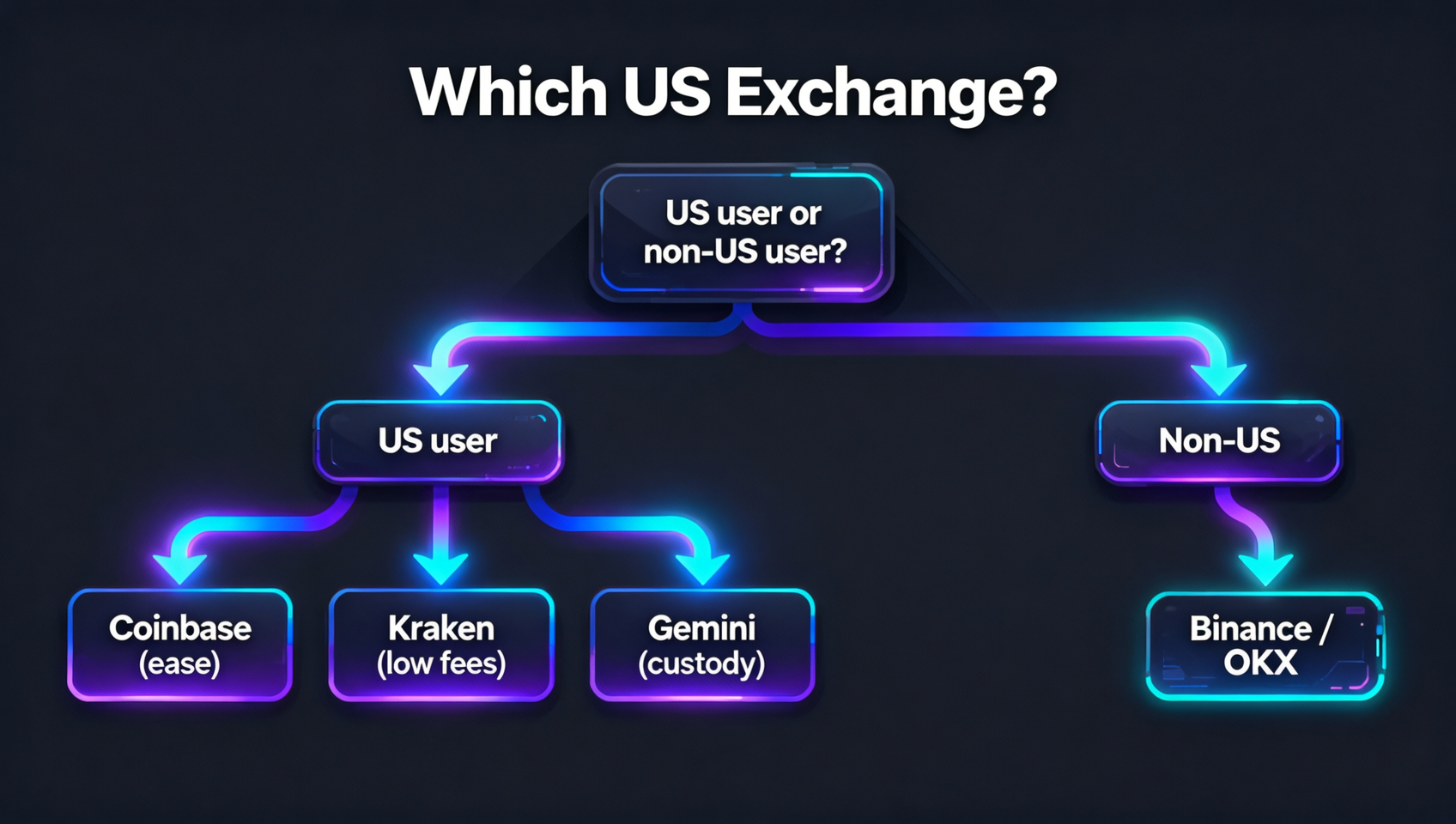
💡 The logic repeats throughout: first ask "am I a US user or not," then ask "do I want ease, low fees, or maximum regulatory custody." All the data below supports this.
Fees first: how far apart are they really?
This is the most easily misunderstood item, because it depends on whether you use the simple interface or the pro interface. Entry-tier fees, checked 2026-091:
| Metric | Coinbase | Kraken | Gemini |
|---|---|---|---|
| Pro taker / maker | 0.60% / 0.40% | 0.40% / 0.25% | 0.40% / 0.20% |
| Simple-mode fee | ~1.49% + flat fee | ~1% + spread | ~1.49% + convenience fee |
| Lower-fee entry | Advanced Trade / Coinbase One | Kraken Pro / Kraken+ | ActiveTrader |
| Membership | Coinbase One from $4.99/mo | Kraken+ $4.99/mo | None |
In concrete numbers, buying $1,000 of BTC at entry-tier taker:
| Method | Fee |
|---|---|
| Coinbase simple | ~$15–17 |
| Coinbase Advanced | ~$6 |
| Kraken simple | ~$10 |
| Kraken Pro | ~$4 |
| Gemini simple | ~$15–17 |
| Gemini ActiveTrader | ~$4 |
Three readings worth remembering:
- The pro tiers are close; Kraken and Gemini are slightly cheaper. Entry taker is 0.40% vs 0.60% — the gap only shows over frequent trading. What really separates them is simple mode: that ~1.49% is a tax on not bothering to switch interfaces.
- The first move to save money is switching to pro mode, not switching platforms. On Coinbase alone, going from simple to Advanced drops fees from ~1.49% to 0.60% — a ~60% cut. It's free and takes minutes.
- Bigger amounts, bigger gaps. On a $10,000 taker order, Coinbase Advanced charges $60, Kraken Pro $40, Gemini ActiveTrader $40. Over hundreds of trades a year, that compounds into thousands of dollars.
⚠️ This is a 2026-09 snapshot; Kraken repriced some tiers in mid-2026, so check each app's live schedule. Withdrawal and fiat on/off-ramp fees are a separate cost — don't look only at trading fees.
Safety: not a single dimension
Everyone asks "which is safest," but most articles just repeat "all regulated, all cold storage." The truth has three layers:
Layer 1 — hack record. All three are clean here: none has suffered a large-scale customer hot-wallet hack. Kraken has a 14-year zero-hack record and runs quarterly Proof of Reserves4. Coinbase keeps most assets in cold storage with ~$255M in crime insurance; Gemini holds 100% of client assets in cold storage.
Layer 2 — regulatory strength. Gemini is the strongest — it's a trust company chartered by the New York State Department of Financial Services (NYDFS), with a fiduciary duty under the strictest state regime. Kraken holds a NY BitLicense and multiple state licenses; Coinbase is publicly listed, so its financials are audited4.
Layer 3 — counterparty / yield-product risk. This is the real dividing line. In November 2022, Gemini's Earn product froze ~$940M when its counterparty Genesis went bankrupt after FTX collapsed. Users got a 100% in-kind return by May–June 2024, and the SEC dismissed its case in January 20262.
The uncomfortable truth: an exchange's biggest risk is usually not "being hacked" but "your money being lent to someone who can't pay it back." Any product promising fixed yield (interest accounts, Earn, staking) earns that yield because someone else is borrowing with leverage. Gemini Earn proved that even an exchange that's never been hacked can have your assets dragged down by a counterparty. So don't read "this exchange is safe" as "any product on it is safe."
Coins and liquidity: an order of magnitude apart
This is the most visible difference, and the one most people overlook3:
| Metric | Coinbase | Kraken | Gemini |
|---|---|---|---|
| Tradeable coins | ~250+ | ~500+ | ~70–100 |
| Listing pace | Fast but cautious | Fast, widest long-tail coverage | Slow, extremely conservative |
- Kraken is the "most coins" exchange. 500+ coins means most mid-cap and new-narrative tokens are here, suiting traders willing to research and chase opportunity.
- Coinbase is "large and steady." ~250+ coins skew toward mainstream and compliant assets — cautious but not slow, and enough for most people.
- Gemini is "few and refined." ~70–100 coins, almost only the most mature, compliant assets. This is the direct cost of being the most conservative — a new coin you want probably isn't listed.
On liquidity, Coinbase — the largest US exchange — has the deepest BTC/ETH books and institutional market-making; Kraken has decent depth on long-tail coins; Gemini's volume is notably smaller. For small retail trades the slippage difference is negligible; for large orders, Coinbase's depth is steadier.
Compliance and listing: one veteran, one newcomer, one shelved
All three sell "US compliance," but their capital structures differ sharply:
- Coinbase listed on NASDAQ as COIN back in 2021 — the "public face" of US crypto and the only mainstream exchange with a long public-audit history5.
- Gemini listed on NASDAQ as GEMI in September 2025, raising ~$425M at roughly a $1.14B valuation5.
- Kraken planned a first-half-2026 IPO, raised $800M at a $20B valuation in November 2025 and filed its S-1 confidentially, then shelved the listing as markets fell6.
What does being public mean? Not "safer," but "more transparent" — public companies must disclose audited financials regularly, so you can at least see whether it's profitable and healthy. That's a plus for judging stability, but limited help for the question "will my coins be stolen."
The three questions that actually decide your pick
Before asking "which is better — Coinbase, Kraken, or Gemini," answer these three:
- Which country are you in? This is priority one. US residents can use all three; non-US users usually get better fees and coin selection from Binance or OKX. Geography largely decides for you — the same conclusion as our Binance vs Coinbase comparison.
- Do you want ease, low fees, or maximum regulatory custody? Ease → Coinbase (biggest brand, friendliest to beginners, but priciest); low fees → Kraken (cheapest pro tier, most coins); maximum custody → Gemini (NY trust + 100% cold storage, but fewest coins and the Earn history).
- Will you touch yield/staking products? If so, first understand where the yield comes from, who the counterparty is, and whether there's a lockup — that's the Gemini Earn lesson. If not, all three are solid for pure trading.
The counterintuitive conclusion: for most people, "which US exchange" is a question that geography and needs converge on quickly. What's actually worth your time isn't agonizing among the three, but deciding "should I switch from simple to pro mode to save 0.2%" — that move pays off far more than switching platforms.
For non-US users: are these three worth it?
The short answer: for most non-US users, these three usually aren't the best choice unless you specifically need USD on/off-ramps or US stocks.
- Fiat deposits are inconvenient. All three are USD-centric and need a US bank account or overseas identity, making it hard for many non-US users to deposit or withdraw.
- Fees and coins aren't competitive. Binance spot at 0.1% and OKX spot at 0.1% are far cheaper than Coinbase Advanced's 0.60%, and Binance's 480+ coins rival Kraken's selection. Non-US users should read our Binance vs OKX comparison first.
- The real use cases. You're in the US or hold USD, need compliant US stocks/USD assets, or are an institution needing US-regulated custody — only then are these three worth it.
💡 If you don't have an account yet, you can start with Binance (referral code BINANBT) or OKX (code 60895497) — registering through either link enjoys a 20% fee rebate. For non-US users, this is usually more practical than opening a US exchange account.
How to use each exchange the right way
Case A: US beginner, just buying BTC/ETH
- Sign up for Coinbase and complete KYC.
- First move: switch to Advanced Trade to drop fees from ~1.49% to 0.60%.
- Buy BTC/ETH with USD, or subscribe to Coinbase One to cut fees further (worth it for frequent traders).
Case B: trader wanting the most coins + lowest fees
- Sign up for Kraken and use the Kraken Pro interface (0.40% taker / 0.25% maker).
- Add Kraken+ ($4.99/mo) if you want the simple-mode fee waived.
- Find long-tail and new-narrative coins here, with the fullest liquidity.
Case C: maximum regulatory custody or institutional use
- Use Gemini — as a NYDFS trust company it carries a fiduciary duty.
- Accept fewer coins and slower listings in exchange for the strongest regulation and 100% cold storage.
- Treat any yield-promising product with caution: first understand who the counterparty is.
Stop conditions — if any of these happens, stop first:
- Someone DMs you asking for your 2FA code or seed phrase → 100% scam, stop.
- You want to put most of your savings into a "high-yield" product → first find out who it lends to, or reduce to what you can afford to lose.
- You'd open an opaque offshore account or borrow someone's identity to save 0.2% → not worth it.
- You treat "publicly listed = absolutely safe" as settled → listing means transparency, not that a counterparty can't drag your coins down.
FAQ
Which is better, Coinbase, Kraken, or Gemini?
No single "best," only "best for you": US beginners buying mainstream coins → Coinbase; traders wanting the most coins and lowest pro fees → Kraken; those wanting the strongest regulatory custody → Gemini. Non-US users should look at Binance and OKX first.
Are these three safer than Binance or OKX?
At the platform level they're more heavily regulated and more transparent, but "more regulated" isn't "zero risk" — Gemini's Earn product froze ~$940M in 2022 over a counterparty bankruptcy. For non-US users, Binance and OKX have equally mature cold storage and safety funds, plus lower fees and more coins. Safety depends on the product you use and how you protect your account.
Why are Coinbase fees higher than Kraken and Gemini?
Mostly brand premium plus US compliance costs. Coinbase's simple interface charges ~1.49% spread plus a flat fee; Advanced entry taker is 0.60%, 1.5x Kraken Pro (0.40%) and Gemini ActiveTrader (0.40%). Buying $1,000 of BTC costs ~$6 on Coinbase Advanced vs ~$4 on Kraken Pro. The key is switching to the pro interface, not changing platforms.
What happened with Gemini Earn, and did users get their money back?
In November 2022 the counterparty of Gemini's Earn product, Genesis, went bankrupt and froze ~$940M. Through the bankruptcy, users got a 100% in-kind return by May–June 2024, and the SEC dismissed its case in January 2026. It was counterparty risk, not a hack — a reminder that any yield product's risk is who it lends to.
Will Kraken and Gemini go public?
Gemini already did — GEMI on NASDAQ in September 2025, raising ~$425M at ~$1.14B. Kraken planned a H1-2026 IPO, raised $800M at a $20B valuation and filed its S-1 confidentially in November 2025, then shelved it amid the downturn. Coinbase has been public (COIN) since 2021.
Can non-US users use these three US exchanges?
Technically yes, but usually needlessly — all three are USD-centric with inconvenient fiat on-ramps and some region restrictions. Unless you need USD on/off-ramps or US stocks, Binance and OKX are more practical on fees, coins, and local-currency deposits.
Further reading
- Binance vs Coinbase 2026: Fees, Safety & Features Compared — the "geography decides" framework
- Binance vs OKX 2026: Full Comparison — the two exchanges non-US users should compare first
- Crypto Trading Fees Explained: Maker/Taker & Spread — the logic behind the fees
- Exchange Rebate Comparison: Binance vs OKX — how referral codes cut your fees
- How to Identify Fake Exchanges & Phishing Sites — your first line of account defense
- Chain Guide — more blockchain explainers and on-chain tutorials
Data note: fees, coin counts, security events, and listing status were checked on 2026-09-26; see footnotes143265. Exchange fees and coin counts change in real time — check each app's live figures before trading.
This article is not investment advice; crypto trading involves price, custody, regulatory, and counterparty risk. Decide based on your own situation and comply with local laws.
Footnotes
-
Entry-tier fees: Coinbase Advanced 0.60% taker / 0.40% maker (simple mode ~1.49% spread + flat fee), Kraken Pro 0.40% taker / 0.25% maker (simple mode ~1% + spread), Gemini ActiveTrader 0.40% taker / 0.20% maker (simple mode ~1.49% + convenience fee). Source: Coinbase, Kraken, and Gemini official fee pages (checked 2026-09). Note: Kraken repriced some tiers in mid-2026; use live figures. ↩ ↩2 ↩3
-
Gemini Earn: in November 2022, Genesis froze ~$940M in Earn customer assets; users received a 100% in-kind return in May–June 2024 through the bankruptcy; the SEC dismissed its case in January 2026; Gemini paid ~$37M to NYDFS. Source: CoinDesk, KuCoin, Yahoo Finance. ↩ ↩2 ↩3
-
Coin counts: Kraken ~500+, Coinbase ~250+, Gemini ~70–100. Source: official figures and industry statistics (2026-09; sources differ slightly in methodology). ↩ ↩2 ↩3
-
Security: none of the three has had a large-scale customer hot-wallet hack; Kraken has a 14-year zero-hack record plus quarterly Proof of Reserves (ISO 27001/SOC 2, ~95% cold storage); Coinbase keeps most assets in cold storage with ~$255M crime insurance; Gemini holds 100% of client assets in cold storage as a NYDFS trust company (SOC 1/2, ISO 27001). Source: official security pages and public reporting (2026-09). ↩ ↩2 ↩3
-
Listing status: Coinbase listed on NASDAQ as COIN in 2021; Gemini listed on NASDAQ as GEMI in September 2025 (raising ~$425M at ~$1.14B). Source: public reporting (2026-09). ↩ ↩2 ↩3
-
Kraken listing: raised $800M at a $20B valuation in November 2025 and filed its S-1 confidentially, targeting a H1-2026 IPO, then shelved it amid the downturn; the SEC dismissed its case against Kraken in March 2025; Kraken settled with the SEC for $30M over staking in February 2023. Source: Bloomberg, ForkLog, ChainCatcher. ↩ ↩2