


Introduction
Blockchain fork — it's one of the most frequently used terms in the cryptocurrency space, yet many people's understanding barely goes beyond "fork = Bitcoin splitting into Bitcoin Cash." In reality, forking is the core mechanism through which blockchain protocols evolve and upgrade. Nearly every major blockchain has undergone multiple forks. Without fork mechanisms, blockchains cannot evolve.
As of July 2026, Bitcoin has implemented over 20 protocol upgrades (the vast majority via soft forks), while Ethereum has undergone more than a dozen hard fork upgrades evolving from Homestead through to its current PoS era12. Each fork changes the chain's rules — from minor tweaks like fee calculation methods to fundamental shifts in consensus mechanisms.
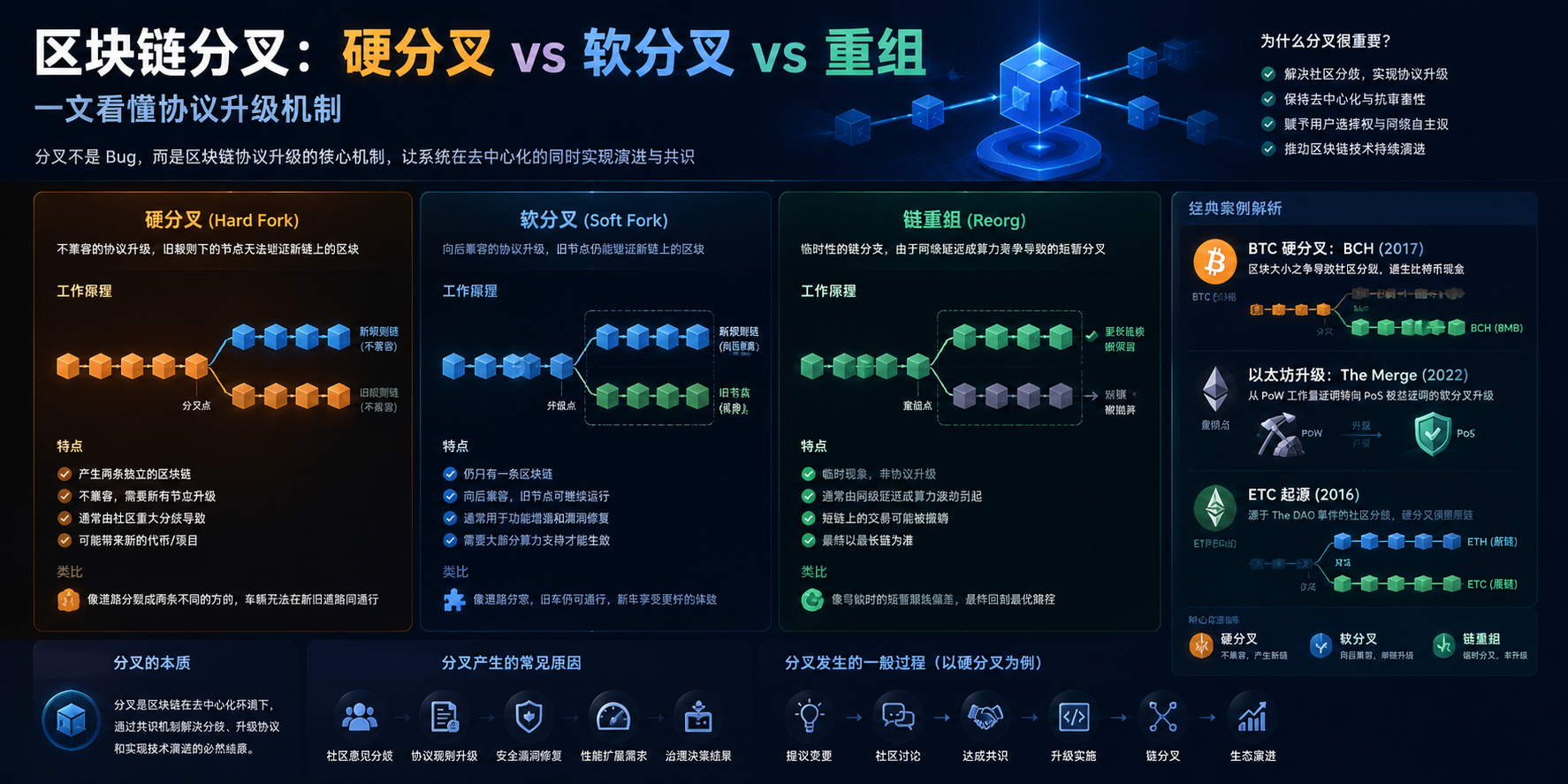
What is the essence of a blockchain fork? Put simply, a fork is the fission or evolution of consensus rules within a blockchain community. If node operators disagree on the rules, the chain may split. If everyone agrees to change the rules, the chain upgrades smoothly.
This article systematically breaks down the three types of forks — hard forks, soft forks, and temporary forks (reorgs) — their technical mechanisms, classic case studies, and potential risks, along with practical guidance on how forks affect you as a holder.
Root Cause: Changes to Consensus Rules
Why do blockchains have "rules"?
A blockchain is a distributed state machine run collectively by thousands of independent nodes worldwide. For all nodes to agree on "what constitutes a valid block," the protocol defines a set of consensus rules:
- What transactions are valid (signature format, input/output relationships)
- What blocks are valid (block size limit, timestamp range, difficulty calculation)
- What chain is authoritative (longest chain / heaviest chain rule)
These rules are hard-coded into each node's software. When the community decides to modify these rules — whether a parameter tweak or a complete rewrite — a fork occurs.
Analogy: Imagine a group of people all holding the same map, navigating to the same destination. If half of them decide to take a different route (new rules) while the other half sticks to the old route — they will diverge. That's a fork.
Three scenarios that trigger forks
Not all forks stem from controversy. Forks occur in three distinct scenarios:
| Trigger Scenario | Technical Cause | Classic Example |
|---|---|---|
| Protocol upgrade | Community agrees to change rules, network upgrades collectively | Ethereum Berlin/London, Bitcoin SegWit |
| Community split | Fundamental disagreement on upgrade direction, both sides run their own chain | BTC→BCH, ETH→ETC |
| Network race condition | Two miners produce valid blocks at nearly the same time, creating a temporary branch | Daily reorgs, attack reorgs |
Hard Fork: Backward-Incompatible Chain Split
Technical definition of a hard fork
A hard fork is a modification to the consensus rules such that old nodes cannot validate blocks produced under the new rules. Technically:
If a block is valid under the new rules but invalid under the old rules, and old nodes cannot forward-compatibly accept these blocks — that's a hard fork.
Simple test: The "authoritative chain" seen by old nodes and new nodes diverges at the fork point and never reconverges.
Hard fork upgrade process
- Proposal: Developers submit an improvement proposal (BIP, EIP), community discusses
- Client implementation: New client implements the new rules with a activation block height or activation time
- Node upgrade: Miners/validators choose whether to upgrade
- Fork point reached: At the designated block height or time:
- Upgraded nodes produce/validate blocks under new rules
- Non-upgraded nodes continue under old rules
- Both chains run in parallel (if both have hashrate support)
Requirements for a successful hard fork
- New block production rules: Clearly defined changes
- Activation point: Block height or Unix timestamp
- Hashrate support: Enough miners/validators to sustain the new chain
- Community consensus (optional but practically necessary): Without it, a chain split is guaranteed
Classic Case 1: Bitcoin → Bitcoin Cash (BTC→BCH)
The 2017 BTC/BCH fork is the most famous hard fork in crypto history:
| Dimension | Bitcoin (BTC) | Bitcoin Cash (BCH) |
|---|---|---|
| Core philosophy | Small blocks + Layer 2 scaling | Big blocks for on-chain scaling |
| Block size | 1 MB → ~4 MB (SegWit) | 8 MB initially → 32 MB |
| Scaling path | SegWit + Lightning Network | Direct block size increase |
| Transaction throughput | ~7 TPS | ~116 TPS (32 MB) |
| Fork date | August 1, 2017 | August 1, 2017 |
| Current market cap | ~$1 trillion+ | ~$5 billion+ |
The core disagreement: Should Bitcoin scale via "base layer security + Layer 2" or by increasing the base layer block size directly? After years of unresolved debate, the two camps each implemented their vision through a hard fork.
At the fork, every holder of 1 BTC automatically received 1 BCH — because both chains share the same genesis block and transaction history up to the fork point. This mechanism is called a "fork airdrop."
Classic Case 2: Ethereum → Ethereum Classic (ETH→ETC)
The 2016 DAO incident fork touched on blockchain's most fundamental philosophical question — "code is law" versus "community intervention":
- June 17, 2016: The DAO smart contract was exploited via a reentrancy attack, stealing approximately 3.6 million ETH (~$70 million at the time)
- Heated community debate: Should the blockchain be rolled back via a hard fork to recover user funds?
- July 20, 2016: The majority of miners and community supported the fork, creating what is now Ethereum (ETH)
- The minority continued mining on the original chain, creating Ethereum Classic (ETC)
As of July 2026, ETH has a market cap of approximately $350 billion+, while ETC stands at approximately $4 billion+. This gap reflects the market's assessment of the "community intervention to protect users" approach.
Philosophical insight: The ETH/ETC fork reveals a profound truth — blockchain "immutability" is not absolute. When a sufficiently large consensus supports rewriting history, the chain can indeed be altered. But what constitutes "sufficient consensus" is inherently subjective — which is why blockchain governance still has no standard answer.
Classic Case 3: Ethereum's Upgrade Hard Forks
Ethereum's non-controversial upgrade hard forks demonstrate that "consensus-backed hard forks don't create chain splits":
| Upgrade | Date | Key Change | Consensus Level |
|---|---|---|---|
| Homestead | 2016-03-14 | Removed Canary contracts, EVM opcode upgrades | Near-unanimous |
| Byzantium | 2017-10-16 | Reduced mining rewards, introduced zk-SNARKs precompiles | Very high |
| Constantinople | 2019-02-28 | Reduced block rewards, optimized gas pricing | Very high |
| Berlin | 2021-04-15 | Optimized gas costs, introduced new transaction types | Near-unanimous |
| London | 2021-08-05 | EIP-1559: Base fee burn mechanism | Very high |
| The Merge | 2022-09-15 | PoW→PoS: Fundamental consensus change | Broad consensus |
| Shanghai | 2023-04-12 | Enabled validator withdrawals | Near-unanimous |
| Dencun | 2024-03-13 | EIP-4844: Blob data, dramatically reduced L2 fees | Near-unanimous |
| Pectra | 2026-03-12 | EIP-7702 account abstraction, validator max 2048 ETH | Very high |
Ethereum's model of regular, planned, community-discussed hard forks has become the industry standard — a sign of a healthy, evolving blockchain, not a crisis.
Soft Fork: Forward-Compatible Upgrades
Technical definition of a soft fork
A soft fork is a modification to the consensus rules such that old nodes can still validate blocks produced under the new rules (though they may miss some validation checks). Technically:
If a block valid under the new rules is also valid under the old rules, but some blocks that were valid under the old rules become invalid under the new rules — that's a soft fork.
Simple test: Old nodes see the same longest chain after the fork as new nodes do. Old nodes may not know the details of new blocks, but they can still follow the chain.
Soft fork upgrade process
- Propose and implement new rules: New rules are a subset of old rules — every block valid under new rules is also valid under old rules, but not vice versa
- Miners go first: A majority of miners upgrade and begin rejecting blocks that don't meet the new rules
- Network convergence: Non-upgraded miners, though they don't validate the new rules, naturally follow the compliant chain because upgraded miners reject non-compliant blocks
- Old nodes follow: Old nodes always follow the longest chain — as long as a majority of hashrate supports the new rules, old nodes are "forced" onto the new chain
Why "soft"?
"Soft" refers to forward compatibility:
- Old nodes don't need to upgrade to keep participating in the network (though they may miss newer features)
- New nodes and old nodes agree on "which chain is authoritative"
- No persistent chain split occurs
Analogy: A soft fork is like adding stricter speed limits to an existing highway. Drivers of old cars can still use the same road — police (upgraded nodes) will ticket speeders (non-compliant blocks). Even if old drivers don't know the new speed limit, they naturally follow the traffic flow.
Classic Case 1: Bitcoin SegWit (Segregated Witness)
SegWit is the most technically complex soft fork in Bitcoin's history, activated in August 2017:
Upgrade content:
- Separated signature data (Witness) from transaction data
- Signature data no longer counted toward the 1 MB block size limit, effectively expanding capacity to ~4 MB
- Fixed transaction malleability, paving the way for the Lightning Network
Why it's a soft fork: SegWit's design cleverly exploited Bitcoin's consensus rules. Old nodes verifying SegWit transactions simply ignore the new Witness data field — because old nodes only validate traditional signatures, and the Witness data is encoded as "anyone-can-spend" outputs that old nodes still consider valid.
Upgrade data: After approximately two years of debate and multiple proposal iterations, SegWit was activated in August 2017 via BIP-91/141/148, with over 95% hashrate support1.
Classic Case 2: Bitcoin Taproot
Taproot, activated in November 2021, is Bitcoin's most recent major soft fork:
| Dimension | Upgrade Content |
|---|---|
| New features | Schnorr signatures (batch verification efficiency), MAST (Merkelized Abstract Syntax Trees), TapScript |
| Privacy enhancement | Complex contract scripts appear identical to normal transactions |
| Script flexibility | Support for more complex spending conditions |
| Signature aggregation | Multi-signature transactions can be combined into a single signature, saving block space |
| Activation | BIP-8 activation, locked in after 90%+ miner signaling |
After Taproot, Bitcoin multi-signature transactions look identical to regular single-signature transactions on-chain, greatly improving user privacy.
Soft Fork vs Hard Fork: Full Comparison
| Dimension | Hard Fork | Soft Fork |
|---|---|---|
| Forward compatibility | ❌ Old nodes cannot validate new blocks | ✅ Old nodes can still validate new blocks |
| Chain split risk | High, can create permanent split | Low, no permanent split |
| Upgrade scope | Can arbitrarily modify rules | Can only tighten rules (subset constraint) |
| Activation condition | Partial node upgrade sufficient | Requires majority hashrate/validator support |
| Examples | ETH The Merge, BTC→BCH | Bitcoin SegWit, Taproot |
| New coin creation | Possible (depends on community split) | Never |
| Technical difficulty | Relatively lower | Higher (requires clever design) |
Why can't all upgrades be soft forks?
Soft forks have a fundamental constraint: new rules must be a subset of old rules. This means:
- Soft forks can tighten rules (forbid some previously allowed behavior)
- Soft forks cannot relax rules (allow behavior previously forbidden)
- Soft forks cannot change fundamental data structure definitions
For example, Ethereum's The Merge (PoW→PoS) could not be a soft fork — PoW block structure and validation are fundamentally different from PoS, and old nodes have no capacity to validate PoS blocks. Major architectural changes (like redesigning data structures or switching consensus mechanisms) must be hard forks.
Temporary Forks and Chain Reorganization (Reorg)
How reorgs work
Chain reorganization (Reorg) is fundamentally different from hard/soft forks — it is not a deliberate protocol change but a temporary divergence caused by network propagation delays:
- Miner A produces a valid block B1 at height N and broadcasts it immediately
- Miner B produces a valid block B2 at the same height N before (or simultaneously with) receiving B1
- Some nodes see B1 first and temporarily extend the chain from B1; others see B2 first
- When the next block is produced: if it's built on B1, the B1 branch becomes the longest chain. Nodes on the B2 branch then reorg back to B1
- The abandoned block B2 becomes an orphan block — its transactions are returned to the mempool for repackaging
Common reorg depths
| Reorg Depth | Frequency | Impact |
|---|---|---|
| 1 block | Several times daily on Bitcoin | No impact, one orphan block discarded |
| 2-3 blocks | A few times per month | Minimal impact; exchanges typically require 3-6 confirmations |
| 6+ blocks | Extremely rare | Highly suspicious, likely an attack |
| Attack reorg | Very few successful cases in history | Double-spend attack succeeds |
Bitcoin's protocol recommends waiting for 6 block confirmations (~1 hour) before considering a transaction fully secure — these 6 blocks provide the safety margin against reorg risk.
Attack reorgs: Double-spending
A deep reorg can be exploited for double-spending:
- Attacker sends a transaction (Tx1) to purchase goods on-chain
- Simultaneously, the attacker secretly mines a fork chain containing a conflicting transaction (Tx2) that sends the same BTC back to themselves
- After Tx1 receives enough confirmations and the merchant ships goods — the attacker broadcasts the secret chain
- If the secret chain is longer — the entire network switches to it, Tx1 is rolled back, Tx2 takes effect
- The attacker keeps both the goods and the BTC
Why this is almost impossible in practice:
- Bitcoin's difficulty adjustment makes secret mining require over 50% of total hashrate
- Attack cost increases exponentially with confirmation depth
- Modern mining pools' coordination mechanisms make large reorgs quickly detectable
Data: As of July 2026, Bitcoin's total hashrate is approximately 700 EH/s. Secretly mining a 6-block reorg requires maintaining over 50% of global hashrate for several hours — requiring hundreds of thousands of mining machines costing billions of dollars, physically distributed across locations3.
The ETC 51% attack lesson
While attacking Bitcoin is unrealistic, smaller PoW chains with lower hashrate have been repeatedly victimized by deep reorg attacks. Ethereum Classic (ETC) is the most documented case:
- August 2020: ETC suffered 3 51% attacks, total losses approximately $5.6 million
- Attackers rented hashrate on the open market (no need to buy mining hardware), at extremely low cost
- ETC was forced to add a checkpoint mechanism to prevent deep reorgs
As of 2026, most low-hashrate PoW chains have upgraded to stronger finality mechanisms or transitioned to PoS to mitigate reorg attack threats.
The Governance Sociology of Forks
Forks are not just technical
Behind every major fork lie deep community governance conflicts and competing interests:
BTC/BCH fork (2017): Scaling roadmap war
- Core camp: Trusted Layer 2 technology, believed the base layer should remain minimal and secure
- Big Block camp: Believed users deserved low fees and high throughput directly on the base layer
- Outcome: Both chains developed independently — Bitcoin took the institutional route (ETF, compliance), BCH pursued the peer-to-peer cash vision
ETH/ETC fork (2016): "Code is law" vs "community intervention"
- Rollback camp: Users need protection, smart contract bugs shouldn't be the users' burden
- Fundamentalist camp: Blockchain's core value is immutability — even if the outcome is undesirable, history shouldn't be rewritten
- This fork remains the most classic thought experiment in blockchain philosophy
SegWit impasse (2015-2017): Political gaming of technical roadmap
- The Bitcoin community debated SegWit for over two years, with multiple rounds of rejection and revision
- Finally broken by the BIP-91 "UASF" (User Activated Soft Fork) proposal
- This event gave birth to the concept of "user sovereignty" in blockchain governance
Economic incentives behind forks
Forks are not always driven by pure ideological differences — economic interests are often the key driver:
- Fork airdrops: New chain's tokens are airdropped to original chain holders, giving them "free" assets
- Miner revenue: New chains need hashrate and typically offer block rewards to attract miners
- Exchange listing fees: Listing new fork coins on exchanges can generate substantial revenue
- Developer funding: New chains can fund development through pre-mines or foundation treasuries
How Ordinary Users Should Handle Forks
Expected protocol upgrades
For non-controversial, widely-supported upgrades (like Ethereum's regular hard forks):
- Exchange users: No action needed — exchanges handle everything automatically
- Self-custody users: Monitor official announcements, upgrade wallet software as directed
- DeFi users: Understand protocol changes before the upgrade (like EIP gas impact) and adjust positions as needed
Controversial hard forks
When the community is clearly divided on the upgrade direction:
| Your Situation | Recommended Action |
|---|---|
| On an exchange | Usually no action needed — exchanges handle fork coin distribution automatically |
| Self-custody wallet | Ensure you have exported private keys or seed phrase before the fork; you can access the same balance on both chains afterward |
| Planning to claim airdrop | Transfer assets to a non-custodial wallet that supports fork coin claiming before the fork |
| Unsure of value | Don't rush to sell fork coins unless you clearly understand their value proposition |
| Avoiding FOMO | Don't trade impulsively due to fork hype — most fork coins eventually go to zero |
Important caveat
Every user who holds private keys at the fork block height automatically owns the same amount of coins on the new chain. If your BTC was in a self-custody wallet, you automatically received an equal amount of BCH after the fork — provided you can import your private keys into a BCH-compatible wallet.
For exchange-held assets, whether you receive fork coins depends on the exchange's policy. Most major exchanges automatically distribute fork coins, but wait for their official confirmation.
Common Myths About Forks
"Fork = community split"
Inaccurate. Most forks are consensus-backed protocol upgrades that don't cause a split. Ethereum's dozens of hard forks from Homestead to Pectra all had broad community support without producing persistent chain splits. Only controversial forks cause community division.
"Hard forks always create new coins"
Not necessarily. A hard fork only creates a new coin if both chains continue to be mined. If all nodes agree to upgrade (like Ethereum's The Merge), the old chain simply dies — no new coin exists.
"Soft forks are safer than hard forks"
That's generally true but not absolute. Soft forks' forward compatibility means they can't cause chain splits, so their risk is lower. However, designing a soft fork is technically difficult (implementing new features within the constraints of old rules), and some upgrades can only be done via hard fork. While hard forks carry higher risk, they may be the only option for critical security fixes.
"A reorg means my coins were stolen"
Almost never. Everyday reorgs are only 1 block deep and don't affect confirmed transactions. The safe practice is to wait for sufficient confirmations (typically 6 for Bitcoin) before considering a transaction final.
The Future of Blockchain Governance
Governance evolution
Forks as a governance tool have clear limitations — community splits weaken network effects, fragment liquidity, and scatter development resources. Blockchain governance is evolving toward more structured approaches:
- On-chain governance: Protocols like Tezos and Polkadot use token voting to decide upgrades, executed automatically
- Standardized improvement proposals: EIPs (Ethereum) and BIPs (Bitcoin) have become industry standards
- Testnet-first: Upgrades run on testnets for months to gather data and feedback before mainnet deployment
- Incremental upgrades: EIP-1559 (base fee burn) and EIP-4844 (Blob data) represent progressive improvement instead of big-bang upgrades
The enduring value of forks
Despite evolving governance models, the fork mechanism as the "ultimate exit option" retains lasting value:
- Forks are blockchain's decentralization insurance — when the governance system is captured by a minority, dissatisfied community members can always fork
- Forks are a marketplace of ideas — different technical roadmaps prove their value through forks (the market votes with market cap)
- Forks are a democratic mechanism of global consensus — no courts, no arbitration — hashrate/stake holders vote with their mining/validating behavior
In summary: Forks are nothing to fear — they are the natural expression of blockchain's decentralized governance. Understanding forks is understanding how blockchains evolve.
FAQ
What is a blockchain fork?
A blockchain fork is a divergence in the blockchain's path caused by protocol rule changes or network race conditions. There are three types: hard forks (backward-incompatible, can create permanent splits), soft forks (forward-compatible, no permanent split), and chain reorganizations (temporary divergences resolved by the longest-chain rule). Forks are a normal part of blockchain evolution, not bugs.
What's the difference between a hard fork and a soft fork?
The core difference is backward compatibility. In a hard fork, blocks produced under new rules cannot be validated by old nodes. In a soft fork, new blocks can still be validated by old nodes (though they may miss some checks). Simple test: if old nodes see a different chain without upgrading, it's a hard fork; if they follow the same chain, it's a soft fork.
What happened with the Bitcoin and Bitcoin Cash fork?
On August 1, 2017, the Bitcoin community hard-forked over the block size debate. Bitcoin Core supported SegWit + Lightning Network (small-block, Layer 2 scaling), while Bitcoin Cash wanted to increase block size from 1 MB to 8 MB for on-chain scaling. Every BTC holder received an equal amount of BCH. This is the most iconic hard fork in crypto history.
Why did Ethereum fork into Ethereum Classic?
In June 2016, the DAO smart contract was exploited via a reentrancy attack, stealing ~3.6 million ETH. The community was divided: the majority supported a hard fork to roll back the hack and return stolen funds, while the minority argued "code is law" and opposed any intervention. On July 20, 2016, the majority executed the hard fork, creating ETH; those who stayed on the original chain formed ETC.
What is a chain reorganization (reorg)?
A reorg occurs when two miners produce valid blocks at nearly the same height, creating a temporary fork. Normal reorgs are only 1 block deep and don't affect confirmed transactions. An attack reorg (multiple blocks deep) could enable double-spending, but Bitcoin's 700 EH/s hashrate makes this economically unfeasible.
Was The Merge a hard fork or soft fork?
The Merge was a hard fork — old PoW nodes cannot validate PoS blocks. However, it received near-unanimous support, so no persistent chain split occurred. This proves that hard forks don't always mean community division.
Examples of soft fork upgrades?
Bitcoin's classic soft forks: P2SH (2012, multi-sig addresses), BIP-34 (2013, version signaling), SegWit (2017, transaction malleability fix + capacity increase), Taproot (2021, Schnorr signatures for privacy and flexibility).
Does a fork create new coins?
A hard fork can create new coins (if both chains continue running), while a soft fork never does. But hard forks don't always create new coins — if all nodes agree to upgrade, the old chain disappears. New coins only emerge when the community splits and both chains are sustained (like BTC/BCH, ETH/ETC).
How should users prepare for a fork?
For expected upgrades: exchange users need no action; self-custody users should update wallets. For controversial forks: transfer assets to a supporting self-custody wallet before the fork. Access private keys to operate on both chains afterward. Don't trade impulsively due to fork hype.
Further Reading
Related Articles on This Site
- Blockchain Technology Principles: Block Structure, Hash Chain & Immutability — Blockchain basics
- Ethereum 2026 Complete Guide: Smart Contracts & L2 Ecosystem — Ethereum's upgrade history
- Bitcoin 2026 Complete Guide: Mining to Layer 2 — Bitcoin technology including SegWit and Taproot
External Resources
- Bitcoin Improvement Proposals (BIPs) — All Bitcoin improvement proposals
- Ethereum Improvement Proposals (EIPs) — All Ethereum improvement proposals
- Bitcoin Fork History — Complete list of Bitcoin forks
- Ethereum Upgrade History — Ethereum upgrade timeline
- Mastering Bitcoin Chapter 10: Segregated Witness — SegWit technical details
- On-Chain Guide - Blockchain Education — More blockchain technology articles
Disclaimer: This article is for educational purposes only and does not constitute investment advice. The cryptocurrency market carries significant risk. Data and opinions may change over time.