


Introduction
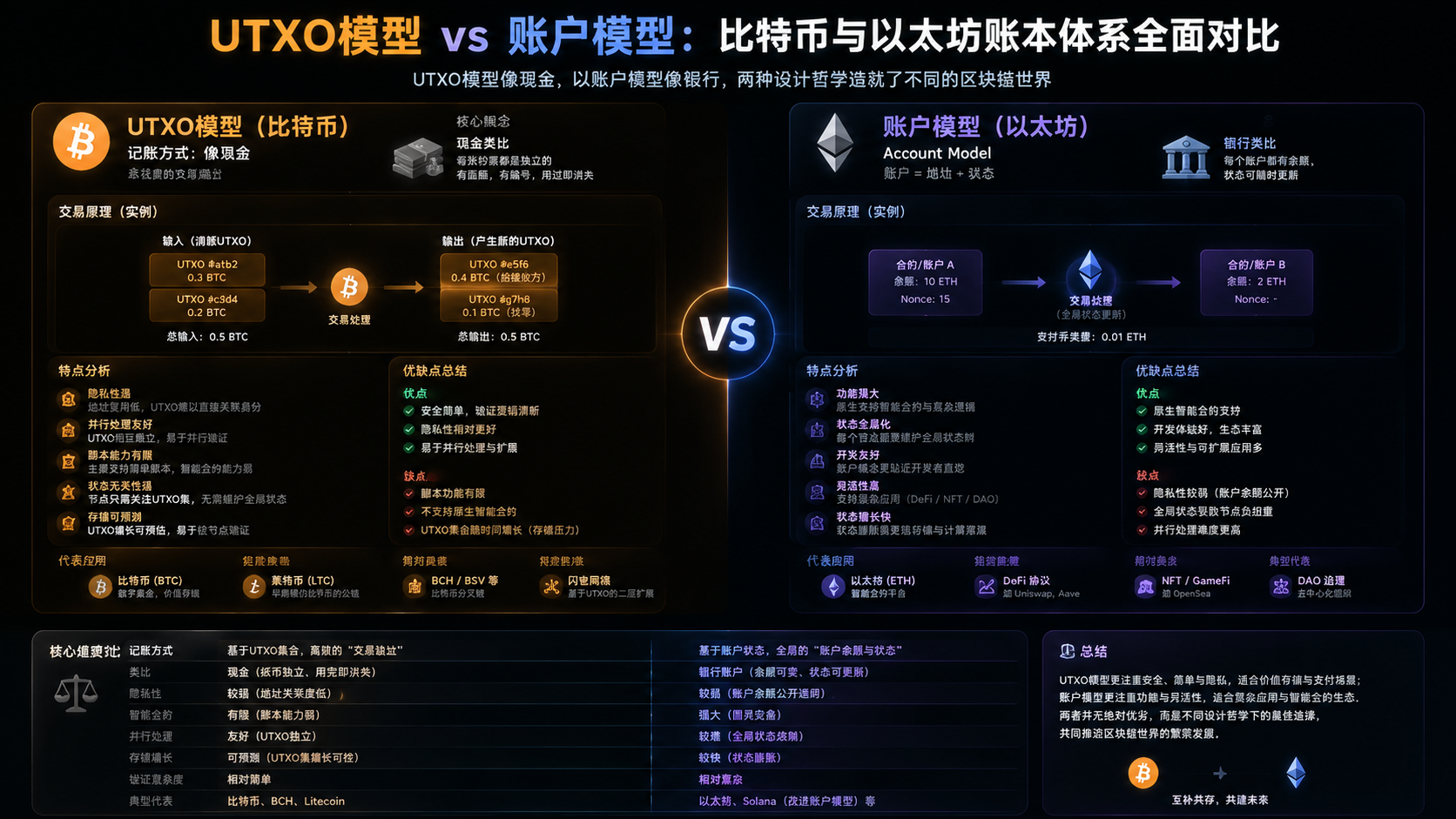
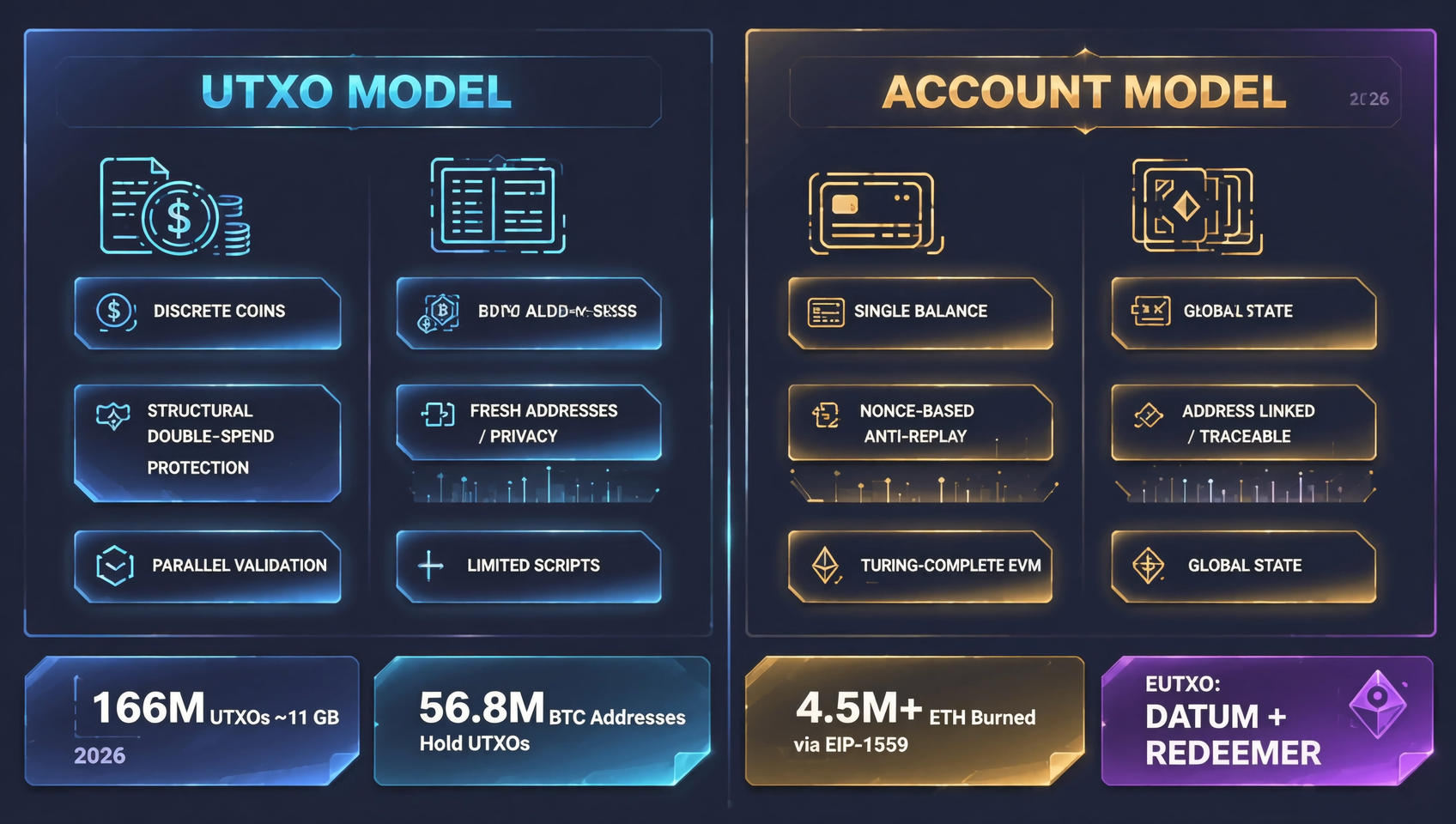
The UTXO model and the account model are the two fundamental ways a blockchain can keep a ledger — Bitcoin works like cash, Ethereum works like a bank account. They determine how on-chain assets are recorded and how transactions are validated, and they explain why Bitcoin can be "digital gold" while Ethereum powers DeFi. As of June 2026, Bitcoin's ledger held roughly 166 million UTXOs occupying about 11 GB of disk space1, while Ethereum's unique addresses had grown past 360 million2. Understanding how the two models differ is the first step to reading the crypto technology stack.
This article systematically compares the UTXO model and the account model across four dimensions — transaction mechanics, privacy, smart-contract capability, and scalability — backed by real 2026 on-chain data.
This is the fourth article in our blockchain technology principles series. We recommend starting with Blockchain Technology Principles: How Hash Chains Work and then Blockchain Node Types to see how the ledger is stored and verified.
What Is the UTXO Model? How Bitcoin Keeps Its Ledger
The UTXO (Unspent Transaction Output) model records on-chain assets as a collection of independent "coins," rather than as account balances. It does not store a balance for any address. Instead it maintains the UTXO set — the collection of every output that has been created but not yet spent.
Cash-Style Accounting
Think of UTXOs as banknotes of different denominations: a $5 note, a $2.35 note, a $100 note. Your Bitcoin "balance" is not a number in the ledger — it is the sum of all UTXOs you control.
Every Bitcoin transaction follows an "Inputs → Outputs" structure:
- Inputs: one or more UTXOs you own (the notes you are spending)
- Outputs: new UTXOs created (the recipient receives new "coins")
- Change: if your input UTXOs are worth more than the amount you send, the difference comes back to you as a new "change UTXO"
Example: You hold three UTXOs worth 0.5, 1.0, and 2.0 BTC and want to send 1.2 BTC. You select the 1.0 and 2.0 UTXOs as inputs (3.0 BTC total), send 1.2 BTC to your friend, and 1.8 BTC comes back as change — your balance moves from 3.5 BTC to 3.3 BTC (1.8 change + 0.5 untouched).
Each UTXO Can Be Spent Only Once
Double-spend protection in the UTXO model is structural: once a UTXO is referenced as an input, it is permanently spent. Every node maintains the UTXO set, and validating a transaction is simply a check that the input UTXOs exist and are unspent. There is no state in which the same money can be spent twice — the double-spend problem does not exist at the ledger level.
The Real Size of Bitcoin's UTXO Set
The UTXO set is the direct measure of network state and a driver of node storage costs:
| Metric | Value | Date |
|---|---|---|
| Total UTXOs | ~166 million (peaked above 180 million) | June 20261 |
| UTXO set disk usage | ~11 GB | 2025-2026 |
| Addresses holding UTXOs | ~56.8 million | July 19, 20263 |
| BTC held in the UTXO set | 20,055,456 BTC | June 20261 |
| UTXOs created since genesis | over 3.77 billion | April 20261 |
The UTXO count exploded in 2023 with Ordinals inscriptions and BRC-20 tokens, peaked in early 2025, and has since been declining — a sign of efficiency gains and long-term holders trading less.
What Is the Account Model? How Ethereum Keeps Its Ledger
The account model (also called the balance model) records assets as a balance stored directly under each address — behaviorally identical to a bank account. A transfer simply debits the sender and credits the receiver. There are no inputs, outputs, or change.
Bank-Account Accounting
Ethereum's ledger is made of two account types:
| Account type | Controlled by | Purpose |
|---|---|---|
| Externally Owned Account (EOA) | Private key | Regular user wallets; sending, calling contracts |
| Contract Account | Smart-contract code | Holds contract state and assets, e.g. DeFi protocols, NFT contracts |
A plain Ethereum transfer is remarkably simple:
from(sender address) →to(receiver address) →value(amount) →nonce(transaction counter) →gas(fee)
Every account also carries a nonce, a counter starting at 0 that increments with each transaction. The nonce is how the account model prevents replay — it is the mechanism-based counterpart to the UTXO model's structural protection.
Why Ethereum Can Run Smart Contracts
The account model's defining advantage is that every account has mutable state. A contract account can store arbitrary data structures (balances, allowlists, collateral), and contract code reads and writes that state when executed. This "globally readable, writable ledger state" is the foundation of Turing-complete smart contracts — which is why Ethereum supports ERC-20 tokens, Uniswap, lending protocols, and more.
In the UTXO model every output is an independent, immutable coin, so expressing contract state requires encoding it into the outputs themselves (as Cardano does with EUTXO) — far more complex and costly to design.
The Real Size of Ethereum's Account System
| Metric | Value | Date |
|---|---|---|
| Unique account addresses | ~294M → over 360M | Jan 2025 → late 20252 |
| Monthly active addresses | ~10.4 million (all-time high) | December 20252 |
| Daily transactions | 2.89 million (all-time high) | January 16, 20264 |
| Average block time | ~12 seconds | ongoing |
Important caveat: address count does not equal holder count — a person or institution can own many addresses, and exchanges hold large pools.
UTXO Model vs Account Model: Head-to-Head Comparison
The core difference: the UTXO model breaks assets into discrete "coins," while the account model stores assets as one mutable "number." Here is a comprehensive comparison across transactions, security, privacy, contracts, and performance:
| Dimension | UTXO Model (Bitcoin) | Account Model (Ethereum) |
|---|---|---|
| Ledger unit | Unspent transaction outputs | Address balances + contract state |
| Asset representation | Discrete "coins" (any denomination) | One continuous number |
| Transaction structure | Inputs + outputs + change | from → to → amount |
| Double-spend protection | Structural (spend-once outputs) | Mechanism-based (nonce) |
| Privacy | ✅ Higher (fresh addresses) | ❌ Lower (transactions tied to one address) |
| Parallel validation | ✅ Natural fit (independent UTXOs) | ❌ Limited by shared global state |
| Smart contracts | Limited (non-Turing-complete script) | ✅ Turing-complete (EVM) |
| State readability | Must scan and aggregate | Direct balance read |
| Developer learning curve | Steeper | Closer to conventional programming |
| Representative chains | Bitcoin, Litecoin, Dogecoin, Cardano* | Ethereum, Solana, Tron, BNB Chain |
| Main risks | UTXO set bloat, address clustering | Reentrancy, MEV, state bloat |
*Cardano (ADA) uses the Extended UTXO (EUTXO) model, which adds smart-contract support on top of UTXO (see below). BNB Chain uses an Ethereum-compatible account model.
Lifecycle of a Transaction: How the Two Ledgers Actually Differ
To "transfer one coin," Bitcoin must split and recombine; Ethereum only has to change two numbers. Here is the same transfer through both models:
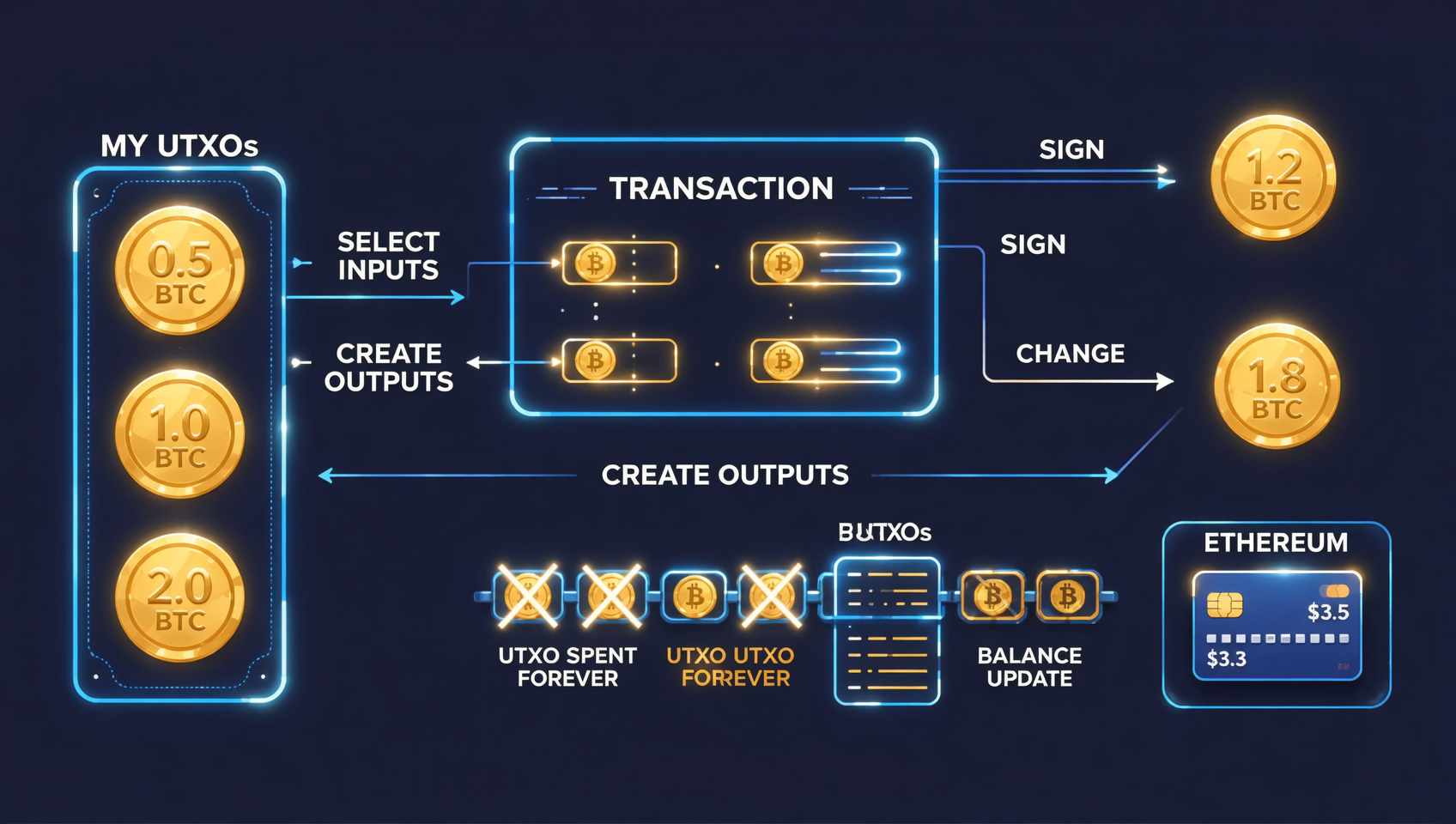
Bitcoin (UTXO) Transfer Flow
- Select UTXOs: the wallet picks UTXOs of sufficient value as inputs
- Build the transaction: inputs (your UTXOs) + outputs (recipient + change) + fee
- Sign: each input is signed with its corresponding private key
- Broadcast & validate: nodes check each input UTXO exists in the set and is unspent
- Update the ledger: input UTXOs are removed from the set, new output UTXOs are added
- Confirmation: ~10 minutes per block; the transaction confirms when included
Ethereum (Account) Transfer Flow
- Specify the transfer: from (my address) + to (recipient) + value (amount)
- Check funds: the node verifies the from-address balance ≥ amount + gas
- Execute updates: from balance decreases by amount + fee, to balance increases
- Increment nonce: the sender's nonce rises by one, preventing replays
- Update the ledger: balances are written directly to the global state tree
- Confirmation: ~12 seconds per block
What you actually see: Bitcoin wallets display "your balance is made up of multiple inputs" and "change addresses"; an Ethereum wallet shows a single number. The address-reuse and transaction-detail behaviors you encounter in our Crypto Wallet 2026 Guide are direct consequences of these two accounting styles.
Privacy: Why UTXO Is Often Called More Private
The UTXO model's privacy edge comes from "fresh addresses" — every transaction can receive coins on a brand-new address, so transactions are not directly linkable. Under the account model, every interaction is bound to a single address.
UTXO Privacy Mechanics
Bitcoin encourages a new address for every transaction (the wallet default). When Alice sends you 0.5 BTC, you receive it on a new address; when Bob sends you 1 BTC, another fresh address. On-chain, the two addresses look unrelated — nobody can tell they belong to the same person.
The Traceability of the Account Model
Ethereum has no change-address mechanism; all activity hangs off one address. Once that address is linked to a real identity (exchange KYC withdrawal, an NFT purchase, an ENS domain), its full history is exposed — DeFi interactions, token holdings, and fund flows can be parsed in seconds by analytics tools.
A Misconception Worth Clearing
UTXO privacy is not absolute:
- UTXO clustering: fresh addresses help, but change outputs are strongly linked to their inputs; analytics firms (e.g. Chainalysis) cluster address sets by change patterns
- Account privacy is possible too: mixing or privacy-enhancing tools can improve anonymity
- Bitcoin's Taproot upgrade (Schnorr signatures + MAST) makes complex scripts look like ordinary transactions, improving protocol-level privacy5
Smart-Contract Capability: The Account Model's Killer Feature
The account model's globally mutable state is what makes complex smart contracts natural — and it is why Ethereum became the center of DeFi. The programmability gap between the two models is fundamentally a gap in state design.
Bitcoin Script: Simple by Design
Bitcoin does have a scripting system, but it is non-Turing-complete:
- Its role is limited to "spending conditions" — signature checks, multisig, time locks
- No loops, no complex state transitions
- The design deliberately keeps things simple: scripts cannot modify global state; each transaction only handles its own inputs and outputs
This is part of Bitcoin's "conservative security" philosophy — maximize base-layer safety at the cost of programmability. Capability expansion (Lightning Network, Ordinals) happens through Layer 2 or within script constraints via soft forks.
Ethereum's EVM: A Turing-Complete State Machine
The Ethereum Virtual Machine executes arbitrary logic:
- Contracts read and write global state: DeFi collateral, lending rates, and token balances live in contract accounts
- Composability: one contract can call another — Uniswap, Compound, and Lido compose into complex DeFi "money legos"
- ERC-20 standard: on the account model, a token is simply a balance mapping in a contract — natural and cheap
The Cost of the Account Model
That programmability brings account-model-specific risks:
- Reentrancy attacks: a contract calls an external contract before updating its own state, allowing repeated calls (the DAO hack lost ~3.6M ETH and triggered Ethereum's hard fork — see our Blockchain Fork Guide)
- MEV front-running / sandwich attacks: the publicly visible mempool lets validators reorder or insert transactions for profit
- State bloat: every contract's storage grows the global state — by 2026 a full Ethereum node exceeded 3 TB of data
Performance and Scalability: Where Each Model Hits Its Wall
The UTXO model validates transactions in parallel naturally; the account model is constrained by shared-state contention — but Ethereum answered scalability through L2s and its own upgrades.
Parallel Processing
| Capability | UTXO Model | Account Model |
|---|---|---|
| Parallel transaction validation | ✅ Independent UTXOs validate in parallel | ⚠️ Transactions touching the same account/state must serialize |
| Localized validation | ✅ Only input/output info needed | ❌ Requires reading global state |
| Sharding friendliness | High | Low (state is highly coupled) |
In theory, the UTXO model's "no shared state" property scales better for parallel execution and sharding. That is why Bitcoin and Cardano communities approach scaling more serenely — at the cost of complex applications being harder to build.
How Ethereum Actually Scaled in 2026
Despite the global-state bottleneck, Ethereum absorbed massive throughput through Layer 2 and successive upgrades:
| Date | Upgrade / Event | Effect |
|---|---|---|
| Aug 2021 | EIP-1559 (London) | Base-fee burn mechanism; over 4.5M ETH burned since6 |
| Mar 2024 | Dencun (EIP-4844) | Blob transactions slashed L2 data costs |
| May 2025 | Pectra | Doubled L2 blob capacity, transaction batching, gas sponsorship |
| Dec 2025 | Fusaka (PeerDAS) | Further blob throughput |
| 2026 | Historic fee lows | Mainnet gas ~0.05-0.16 Gwei; plain transfers cost under $0.017 |
On January 16, 2026, Ethereum set an all-time high of 2.89 million daily transactions4 — with most activity on L2s while mainnet provides settlement and security. The account model's scaling problem is being externalized through L2 migration.
Bitcoin's Scaling Path
Bitcoin's route is modest block scaling + Layer 2 payments (Lightning): blocks of ~1 MB (up to ~4 MB effective with SegWit), ~10-minute block time, theoretical throughput of ~7 TPS. Bitcoin chooses "slow and steady," pushing scaling to Lightning and other Layer 2s.
Real 2026 On-Chain Data: The Two Ledgers at Scale
The data shows what each model actually serves: the UTXO ecosystem is built around value storage; the account ecosystem around programmable finance.
| Metric | Bitcoin (UTXO) | Ethereum (Account) |
|---|---|---|
| Ledger entity count | ~166 million UTXOs | over 360 million addresses2 |
| Active entities | ~56.8 million addresses hold UTXOs | ~10.4 million monthly active addresses |
| Asset forms | Native BTC | ETH + ERC-20 + NFTs + contract state |
| Primary use | Store of value, payments, settlement | DeFi, NFTs, RWA, stablecoins |
| Block time | ~10 minutes | ~12 seconds |
| Throughput | ~7 TPS (+ Lightning) | L1 + many L2s (2.89M/day ATH in 2026) |
| Native token | ~20.05M BTC in the UTXO set | 4.5M+ ETH burned via EIP-1559 |
One mental model: Bitcoin's ledger is like a vault of gold bars — each bar (UTXO) is individually numbered, individually verifiable, and hard to forge. Ethereum's ledger is like a bank's general ledger — each customer (address) has a deposit figure, the bank (EVM) moves money and can even issue loans (contracts).
EUTXO and Hybrid Approaches: Cardano's Third Path
EUTXO (Extended UTXO) adds smart-contract capability to the UTXO model while keeping its advantages — and Cardano (ADA) is its reference implementation. It is the attempt to have both "fish and bear's paw."
How EUTXO Extends UTXO
Cardano adds three components to Bitcoin's UTXO model8:
| Component | Role |
|---|---|
| Datum | Arbitrary data attached to a UTXO, carrying contract state |
| Redeemer | Arguments supplied when spending a script-locked UTXO; the validator decides whether the spend is allowed |
| Script context | A view of the whole transaction, allowing conditions like "this UTXO may only be spent if the transaction also sends 100 ADA to address X" |
Contract state updates by consuming an old UTXO and creating a new one — never by mutating in place, preserving UTXO immutability.
EUTXO Strengths and Weaknesses
| Strengths | Weaknesses |
|---|---|
| Determinism: fixed referenced UTXOs, predictable outcomes | Concurrency limit: the same UTXO cannot be spent by two transactions at once; high-frequency DEX flows need special design |
| No MEV / sandwich: localized validation blocks front-running | Steep learning curve: dApps must be purpose-built for EUTXO, not ported from Ethereum |
| Predictable fees: independent of global congestion | Younger ecosystem: tooling and liquidity trail Ethereum |
| Safer execution: no partial "gas ran out" failures |
EUTXO is positioned as "deterministic settlement," complementing Ethereum's "flexible composability" — some teams run multi-chain strategies, using Cardano for settlement and Ethereum L2s for liquidity8.
Which Model Is Better? What It Means for You
There is no "better" model — there are better fits. Bitcoin chose security and simplicity; Ethereum chose programmability and flexibility. The ledger design serves two different missions.
| Your priority | Model that fits |
|---|---|
| Long-term store of value, "digital gold" | UTXO (Bitcoin) |
| DeFi, NFTs, on-chain yield | Account model (Ethereum) |
| Privacy preference | UTXO + fresh-address habit |
| Developer / builder | Account model has a more mature ecosystem |
| Learning blockchain fundamentals | Understand both — they are two answers to one problem |
Three Practical Takeaways for Users
- Transfer experience: Bitcoin has change and address-reuse concepts; Ethereum does not — your wallet UI shows different structures
- Fee logic: Bitcoin fees are byte-based (complex transactions cost more); Ethereum fees are gas-based (state complexity costs more)
- Security habits: assets on account-model chains interact with contracts (approvals, DeFi) and need extra Web3 security awareness; UTXO chains are "hold-and-hold" safe but mis-sent funds cannot be recovered
In one sentence: understand the UTXO vs account model and you see why crypto diverged into a "currency path" and a "program path" — not by accident, but as the direct result of ledger design philosophy.
FAQ
What is a UTXO and how does the UTXO model work?
UTXO stands for Unspent Transaction Output — the ledger unit used by Bitcoin and other cryptocurrencies. The UTXO model does not store account balances. Instead, it maintains a set of all "unspent outputs": each UTXO is like a coin of a given value that can be spent exactly once. Your Bitcoin "balance" is simply the sum of all UTXOs controlled by your keys. Bitcoin, Litecoin, Dogecoin, and Cardano (EUTXO) all use this model.
What is the difference between the UTXO model and the account model?
The account model works like a bank account: each address stores a single balance, and a transfer simply debits the sender and credits the receiver — there are no inputs, outputs, or change. The UTXO model works like cash: assets are broken into discrete coins that are consumed and recreated in every transaction. Ethereum, Solana, and Tron use the account model.
Does Bitcoin use the UTXO model or the account model?
Bitcoin uses the UTXO model. As of June 2026, Bitcoin's UTXO set contained roughly 166 million unspent outputs and occupied about 11 GB of disk space. Bitcoin never records a balance for any address; wallets compute a balance by summing all UTXOs controlled by that address.
Why can Ethereum run smart contracts with an account model?
Ethereum's account model gives every contract account its own mutable storage, and contract code can read and modify global ledger state. That stateful, Turing-complete environment is exactly what makes smart contracts and DeFi possible. In the UTXO model each output is an independent coin, so expressing complex programmable state is much harder — which is why Bitcoin's script capabilities are limited.
Which is more secure: the UTXO model or the account model?
Both have trade-offs. The UTXO model prevents double spending structurally: each UTXO can be spent only once, and validators only need to check that the input UTXOs exist and are unspent. The account model relies on per-account nonces and global state, and is more exposed to reentrancy attacks and MEV front-running — a factor behind major account-based chain incidents like The DAO hack.
Which model is more private, UTXO or account model?
The UTXO model is generally more private. Bitcoin encourages a new address for every transaction (change addresses included), so transactions are not directly linked to one identity. Under the account model every interaction is tied to a single address, so once that address is linked to an identity, the full transaction history is exposed. UTXO privacy is not absolute — address clustering analysis can still link outputs.
What is the EUTXO model used by Cardano?
EUTXO (Extended UTXO) extends Bitcoin's UTXO with Datum (data attached to an output), Redeemer (spending arguments), and script context, letting UTXOs carry smart-contract logic. It keeps UTXO advantages — deterministic outcomes, no MEV front-running, predictable fees — but has a concurrency constraint: two transactions cannot spend the same UTXO simultaneously.
Do Solana and Tron use the account model?
Yes. Solana and Tron (TRON) both use the account model. Solana stores program state and token balances in accounts with parallel execution, and Tron's TRC-20 token standard is compatible with Ethereum's ERC-20. In practice, chains focused on DeFi and smart contracts nearly all choose the account model, while payment-focused chains (Bitcoin, Litecoin, Dogecoin) use UTXO.
Can a blockchain convert between UTXO and account models?
The two models can be mapped to each other logically — decomposing an account balance into UTXOs, or aggregating UTXOs into a balance — but both require additional state and change the semantics of the ledger. Converting the consensus layer of a mature chain like Bitcoin or Ethereum is practically impossible. The real question is a design trade-off, not a technology replacement.
Does the average crypto user need to understand the UTXO model?
A basic understanding is enough. Knowing the two models helps you understand three real-world behaviors: why Bitcoin transactions need "change," why one wallet can show multiple balance line items, and why fees and confirmation logic differ so much across chains. When you deposit or withdraw Bitcoin on an exchange, what actually happens is the splitting and merging of UTXOs.
Further Reading
Related Articles on CoinVado
- Blockchain Technology Principles: How Hash Chains Work — the foundation beneath every ledger
- Blockchain Node Types: Full Node, Light Node & Archive Node — who maintains these ledgers
- Blockchain Fork: Hard Fork vs Soft Fork vs Reorg — how ledger rules are changed
- Bitcoin 2026 Complete Guide: Mining to Layer 2 — the home turf of the UTXO model
- Ethereum 2026 Complete Guide: Smart Contracts to L2 — the home turf of the account model
- Crypto Wallet 2026 Guide: Hot, Cold & Exchange Wallets — how both ledgers appear in your wallet
External Resources
- Bitcoin Whitepaper (Satoshi Nakamoto) — the original definition of the UTXO model
- Ethereum Whitepaper — the vision behind the account model
- Mastering Bitcoin — Transactions — authoritative UTXO and transaction-structure deep dive
- Ethereum Accounts — official documentation of Ethereum's account model
- ChainQuery UTXO Report — live Bitcoin UTXO set data
- Cardano eUTXO Model — official Extended UTXO technical documentation
- On-Chain Guide — Learn Blockchain from Zero — more in-depth blockchain technology articles
Disclaimer: This article is for educational purposes only and does not constitute investment advice. Cryptocurrency markets are highly volatile; make decisions based on your own risk tolerance. Data and views may change over time.
Footnotes
-
ChainQuery.com, UTXO Repartition / UTXO Set report, snapshot June 21, 2026 (165,898,108 UTXOs); Delving Bitcoin, April 2026. ↩ ↩2 ↩3 ↩4
-
BTCC / CoinCodex, Ethereum address statistics (≈294M in Jan 2025, >360M in late 2025); Token Terminal monthly active addresses, December 2025. ↩ ↩2 ↩3 ↩4
-
ChainQuery.com, Bitcoin Distribution, July 19, 2026. ↩
-
Ethereum on-chain data (Etherscan), daily transactions, January 16, 2026. ↩ ↩2
-
Chaincode Research, Bitcoin Post-Quantum report, mid-2025 (SegWit ~85-90% of transactions; Taproot ~20-40% depending on metric). ↩
-
Ethereum.org, EIP-1559 documentation; Etherscan, EIP-1559 burn statistics. ↩
-
Ethereum Research forum (ethresear.ch) and on-chain gas data, January-February 2026. ↩
-
Cardano Developer Portal, eUTXO model documentation; Input Output Global (IOG), "Six reasons why EUTXO wins." ↩ ↩2