


Table of Contents
- TL;DR: The Bottom Line
- First, a correction: USDT's "$1" is not guaranteed by code
- Minting and burning: how USDT is born and retired
- The $1 peg: how arbitrage pins the price down
- What's actually in the reserves: ~73% US Treasuries
- Cross-chain: TRON, not Ethereum, holds the most USDT
- Freezing and destroying: Tether's "god key"
- What this mechanism means for you
- FAQ
- Further Reading
TL;DR: The Bottom Line
USDT stays at $1 not because code enforces it or Tether promises to redeem you at any time — but because a "mint–redeem–arbitrage" machine keeps it there, backed by a centralized company (Tether) managing $183B in reserves.
Four facts that matter most:
- The peg is arbitrage, not code. When the price dips below $1 someone buys and redeems for profit; when it rises above $1 someone mints and sells. But the redemption channel is institutional-only — $100K minimum and a 0.1% fee — so retail users can never redeem directly with Tether1.
- The reserves aren't "dollars in a bank". About 73.6% is US Treasuries and cash equivalents (direct T-bills
61%), plus gold ($19.8B), Bitcoin ($6.6B) and secured loans ($15.8B), with ~$8.2B in excess reserves2. - The biggest USDT chain is TRON, not Ethereum. TRON holds ~$88–94B, nearly half of all USDT (~48–51%), because transfers are fast and cheap3.
- Tether can freeze your address. From 2023–2025 it froze ~$3.3B across 7,268 addresses4. This "god key" is both why it got accepted and the biggest hidden risk every holder should know.
⚠️ This article explains how USDT works, and is not investment advice. Stablecoins are not zero-risk assets — they carry issuer risk, depeg risk, and the risk of being unilaterally frozen. Understanding the mechanism is homework you should do before holding it.
If you're not yet sure what a stablecoin is, start with the Stablecoins 2026 Complete Guide and come back to this breakdown.
First, a correction: USDT's "$1" is not guaranteed by code
Most people imagine USDT as "dollars on the blockchain" — for every USDT issued, Tether deposits $1 in a bank, so the price is nailed to $1. That picture is far from reality.
USDT's real identity is a centralized "dollar IOU" issued by a company.
- It is not an algorithmic stablecoin — no code auto-adjusts supply and demand to hold the price.
- It has no legal redemption obligation — you didn't deposit money into a deposit-insured bank; you bought a digital token from a private company (Tether Holdings, registered in the British Virgin Islands).
- It holds its price through trust plus arbitrage, not through any hard, contract-enforced guarantee.
This matters because it directly explains USDT's three defining traits: why it can be frozen by law enforcement, why its reserves look the way they do, and why it briefly broke the dollar in extreme moments (hitting ~$0.95 in May 2022).
Once you see it as "a centralized IOU", the next four mechanisms fall into place.
Minting and burning: how USDT is born and retired
USDT's issuance and redemption run through a highly centralized, institution-only channel.
Minting (birth): an institution vetted by Tether (usually a market maker or exchange) deposits $1 with Tether, and Tether "mints" one new USDT on-chain and sends it to them. That $1 goes into Tether's reserve pool, and one USDT enters the market.
Burning (retirement): the reverse — the institution returns USDT to Tether, which "burns" it (removes it from total supply) and sends back the corresponding $1.
The key point: this channel is not open to everyone. Minting or redeeming directly with Tether has thresholds ordinary people can't reach1:
- A $100,000 minimum;
- A 0.1% fee, or $1,000 (whichever is higher);
- A lengthy due-diligence process, plus jurisdiction restrictions.
So in reality: retail users never deal with Tether directly — they buy and sell USDT on exchanges, the secondary market. When you spend $1 for 1 USDT on Binance, you're buying it from another user; that dollar does not flow directly into Tether's reserves.
This leads straight to the next mechanism — if ordinary people can't redeem directly, how does the price stay at $1?
The $1 peg: how arbitrage pins the price down
Since the "$1 redemption" channel is open only to a few institutions, the $1 price is nudged into place by arbitrageurs moving money between the two markets15.
Picture two scenarios:
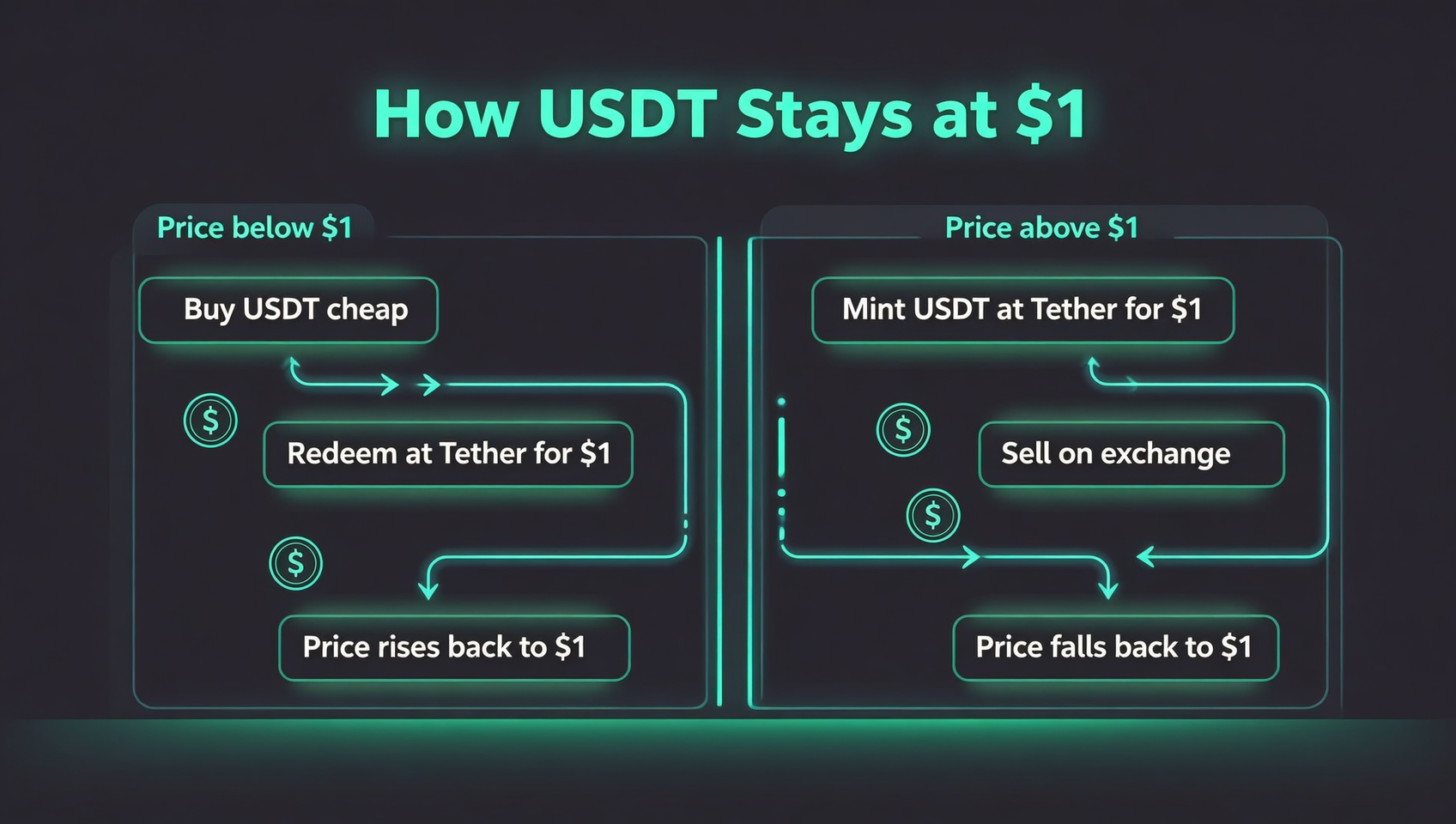
- Price below $1 (say $0.99): an arbitrageur buys USDT on the secondary market for $0.99, redeems it at Tether for $1, and pockets the $0.01 spread. That buying pressure pushes the price back up toward $1.
- Price above $1 (say $1.01): the arbitrageur mints at Tether for $1, gets 1 USDT, and sells it on the secondary market for $1.01. That selling pressure pushes the price back down.
This is the entire secret of USDT's peg: it's not "locked", it "floats around $1 and arbitrage pulls it back". Some analysts go further and say stablecoins are never truly "pegged" at $1 at all — they float near $1, held there by arbitrage5.
The machine only runs under two conditions:
- The reserves are real and liquid. If people doubt Tether actually holds the dollars, a redemption run begins and the price collapses (exactly what happened during the Terra/3AC contagion).
- The redemption channel stays open. In May 2022, USDT dropped to ~$0.95; Tether processed over $10B in redemptions over two weeks, but the discount persisted until the queue cleared — the machine works "slowly" in a panic rather than snapping back instantly5.
One easily-overlooked detail: in a typical month, only about six institutions actually redeem with Tether. Maintaining the $1 exchange rate is effectively carried by a handful of large players' arbitrage. That's why USDT's stability is really "trust plus a few people's arbitrage", not "anyone can redeem"1.
What's actually in the reserves: ~73% US Treasuries
If arbitrage is the "face", the reserves are the "substance". Whether USDT survives a run depends on what Tether actually holds.
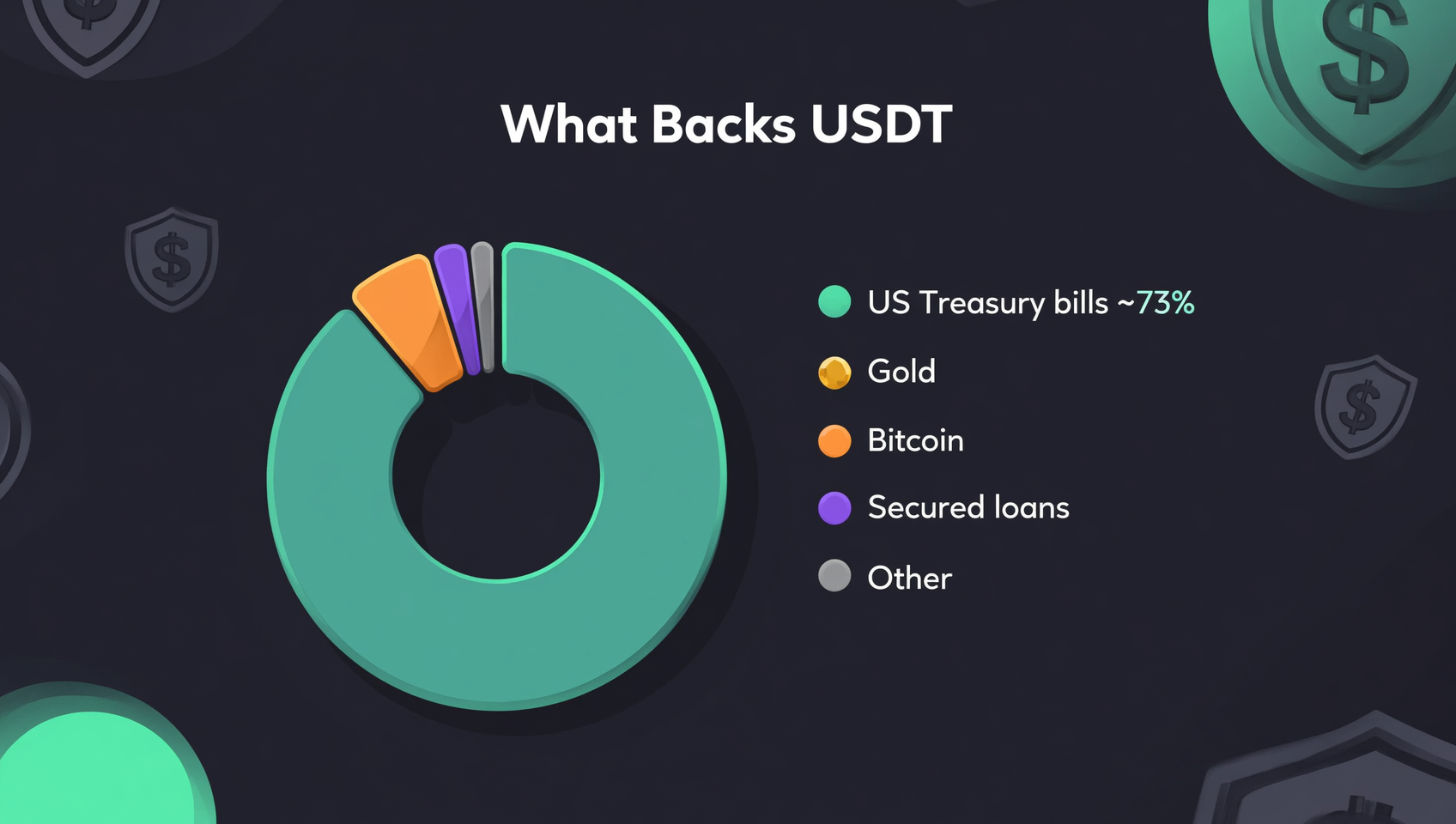
Per Tether's Q1 2026 reserve attestation (by BDO, as of March 31, 2026), total assets were ~$191.7B against ~$183.5B in liabilities, with ~$8.2B in excess reserves. The asset side looks roughly like this2:
| Asset class | Amount (approx.) | Share / note |
|---|---|---|
| Direct US Treasury bills | $117.0B | ~61% |
| Reverse repos (overnight + term) | $24.1B | T-bills + repos ≈ 73.6% |
| Cash & bank deposits | $0.11B | negligible |
| Physical gold (precious metals) | $19.8B | ~10% |
| Bitcoin | $6.6B | ~3.5% |
| Public equities | $3.4B | — |
| Secured loans | $15.8B | ~8% |
| Other investments | $4.8B | — |
Three counterintuitive takeaways from this table:
- USDT isn't "1:1 dollars in a bank", it's "~73% Treasuries plus a mix". Actual cash in banks is only ~$0.1B — nearly negligible. Tether converted most reserves into short-term US Treasuries, which are liquid and earn interest. Some reports note Tether is now roughly the 17th-largest holder of US Treasuries globally — in a sense, USDT has become a "digital extension of dollar hegemony"2.
- It put profits into gold and Bitcoin. That ~$19.8B of gold and ~$6.6B of Bitcoin isn't there "for redemption" — it's Tether investing its profits. This introduces a subtle risk: mixing volatile assets into reserves could, in theory, amplify risk in extreme markets — though the ~$8.2B excess reserve currently provides a buffer.
- "Transparency" is quarterly attestation, not a full audit. BDO provides an "attestation" that confirms specific data points, not an "audit" that opines on the full financials. Tether only announced a full audit by KPMG in March 2026, still in progress as of mid-year6. This is the fundamental gap between it and USDC (which has monthly audits).
Cross-chain: TRON, not Ethereum, holds the most USDT
Most people assume USDT is "an Ethereum stablecoin". The opposite is true — the chain carrying the most USDT is TRON.
As of August–September 2026, USDT's cross-chain distribution looked roughly like this3:
| Chain | USDT supply (approx.) | Share |
|---|---|---|
| TRON | $88–94B | ~48–51% |
| Ethereum | $74–79B | ~40% |
| BNB Chain | ~$9.2B | ~5% |
| Others | small | — |
TRON first overtook Ethereum in early 2025, and the gap has widened since. The reasons are straightforward:
- Transfers are cheap and fast. A TRC-20 USDT transfer costs a few cents, while ERC-20 can cost several dollars on a congested Ethereum — a decisive difference for frequent transfers and on/off-ramping.
- Asia dominates. TRON's USDT volume is enormous — ~$2.1 trillion processed in Q2 2026 alone, with daily volume often above $20–23B and over 400 million accounts3.
One easily-misunderstood point: the same "USDT" on different chains is really a different "issuance". Tether has a separate contract on each chain, and USDT on one chain can't be moved directly to another — it needs a bridge or an exchange. That's why exchanges always ask you to "pick a network" (TRC-20 / ERC-20 / BEP-20) when withdrawing — pick wrong and your coins can get stuck on the wrong chain. For more on this, see our Binance withdrawal network guide (BEP20 vs ERC20).
Freezing and destroying: Tether's "god key"
This is the last piece, and the most counterintuitive — and the one every holder should know: the USDT in your wallet doesn't fully belong to you.
USDT's smart contracts contain three admin-only functions Tether can call — freeze, unfreeze, and destroy4:
- Freeze: blacklists an address, instantly blocking all USDT transfers in or out. The balance is still visible on-chain, but it's money you can see and can't touch.
- Unfreeze: removes an address from the blacklist. Rare — in 2025 only 210 addresses were unfrozen on TRON; once blacklisted, it's almost always permanent.
- Destroy: the more extreme step — permanently zeroes a blacklisted address's balance and reduces total supply. Irreversible at the contract level.
How powerful is this key? From 2023–2025, Tether froze ~$3.3B across 7,268 addresses, working with 275+ law enforcement agencies across 59 jurisdictions — about 30× the value Circle (USDC) froze4. April 2026 saw the largest single freeze on record: ~$344M linked to Iran.
This cuts both ways, and you need to see both:
- The good side: because it can freeze, law enforcement cooperates with Tether, and stolen or scammed funds have a chance of recovery (destroyed funds are often re-minted to victims or authorities). This is Tether's "compliance chip" for global acceptance.
- The risky side: your USDT can be frozen unilaterally, with no on-chain judicial review. If you accidentally receive "tainted" funds (a wrong transfer, or money flowing from a hacked address), your address can be blacklisted too — and the odds of being unfrozen are near zero.
So a practical rule for holding USDT: don't keep large, long-term stablecoin positions in an address that might touch "funds of unknown origin", and spread holdings across issuers like USDC — don't put all your eggs in a basket that can freeze you.
What this mechanism means for you
String the mechanisms together and it boils down to three things:
- For short-term trading, USDT is the most convenient choice. Its liquidity and trading-pair coverage have no rival, and the arbitrage machine holds it near $1 in normal conditions. You only need to "buy and sell" — no need to worry about it suddenly going to zero.
- For large long-term holdings, first understand what you're bearing. You're bearing: a centralized company's reserve-transparency risk (quarterly attestation, not full audit), the risk of being frozen, and a redemption channel controlled by a few institutions. These risks are invisible day-to-day and only surface together in extreme markets.
- For cross-chain transfers, always confirm the network first. USDT is "multi-chain, multi-contract"; picking the wrong chain on a withdrawal is the most common way assets "disappear". Before sending, confirm which chain the recipient is on and that you're picking that same chain.
💡 Whatever you use USDT for — trading, transferring, or earning — you need an exchange account first. If you don't have one yet, you can register on Binance (code BINANBT) or register on OKX (code 60895497) for 20% fee rebates.
FAQ
Why does USDT always stay at $1?
Not through code or a legal promise, but through an arbitrage-plus-redemption machine: when the price falls below $1, arbitrageurs buy cheap and redeem at $1, pushing it back up; when it rises above $1, they mint at $1 and sell, pushing it back down. It works only if reserves are real and liquid and the redemption channel is open — in May 2022 it stalled and USDT briefly hit $0.95 before recovering over two weeks.
What is actually in USDT's reserves?
Not "100% dollars in a bank". Per Tether's Q1 2026 attestation, total assets were ~$191.7B: direct US Treasury bills $117B (61%), and with reverse repos the Treasury/cash-equivalent total was $15.8B) and more, with ~$8.2B in excess reserves.$141.2B ($6.6B), secured loans (73.6%). The rest is gold ($19.8B), Bitcoin (
Is Ethereum the biggest chain for USDT?
No — it's TRON. As of August–September 2026, TRON held ~$88–94B, nearly half of all USDT (48–51%), overtaking Ethereum ($74–79B). TRON won because transfers are cheap and fast, making it the default network for on/off-ramping and transfers in Asia.
Can ordinary people redeem USDT for dollars directly from Tether?
Basically no. Tether's minting/redemption is open only to authorized institutional counterparties; retail users trade on secondary markets. Direct redemption requires a $100,000 minimum, a 0.1% fee or $1,000 (whichever is higher), plus due diligence and jurisdiction restrictions. Research shows only about six institutional arbitrageurs redeem with Tether in a typical month.
Can Tether freeze my USDT?
Yes. USDT's contracts contain three admin-only functions — freeze, unfreeze, and destroy. Once blacklisted, an address's USDT can't be moved; "destroy" permanently zeroes it. From 2023–2025 Tether froze ~$3.3B across 7,268 addresses, working with 275+ law enforcement agencies. This "god key" is both why it got accepted and the biggest hidden risk for holders.
Is USDT safe? Could it collapse?
It's the largest and most liquid stablecoin, but "safe" needs unpacking: on the reserve side, ~73% is highly liquid US Treasuries with ~$8.2B in excess reserves — its strongest part. But it's centralized, gets only quarterly attestations (not full audits), can freeze you, has an institution-controlled redemption channel, and won't comply with the EU's MiCA rules. Bottom line: fine for short-term trading; for large long-term holdings, understand these mechanics and diversify across issuers.
Further Reading
- Stablecoins 2026 Complete Guide: USDT, USDC, DAI — what stablecoins are and how they differ
- USDT vs USDC 2026 Deep Comparison — which to choose, transparency and compliance
- Stablecoin Yield Strategy: where to earn on USDT/USDC — how to put stablecoins to work
- Binance Withdrawal Networks: BEP20 vs ERC20 — avoid picking the wrong chain
- Chain-side Guide — more blockchain fundamentals and on-chain tutorials
Data verification note: market cap, supply, reserve composition, cross-chain distribution and freeze figures were verified on 2026-09-27; sources are in the footnotes below123456. On-chain metrics change in real time (especially market cap and cross-chain distribution) — check Tether's official transparency page, CoinMarketCap, and on-chain explorers for live values before acting.
This is not investment advice. Stablecoins carry issuer risk, depeg risk, freeze risk and regulatory risk; cryptocurrency prices are highly volatile. Make decisions based on your own circumstances and comply with local laws and regulations.
Footnotes
-
Mint/redeem mechanism and thresholds: USDT minting and redemption are open only to authorized institutional counterparties; retail trades on secondary markets. Direct redemption requires ~$100,000 minimum, a 0.1% fee or $1,000 (whichever is higher), due diligence and jurisdiction restrictions; on average only ~6 institutional arbitrageurs redeem per month. Sources: Hindenrank "How Does Tether (USDT) Work?", NBER stablecoin arbitrage research (w33882), BlockSec mechanism analysis (queried 2026-09). ↩ ↩2 ↩3 ↩4 ↩5
-
Reserve composition: Tether Q1 2026 attestation (BDO, ISAE 3000 Revised, as of 2026-03-31) — total assets ~$191.77B, total liabilities ~$183.54B, excess reserves ~$8.23B; direct US T-bills ~$117.04B (61%), reverse repos ~$24.08B, cash ~$1.07M, gold ~$19.84B, Bitcoin ~$6.62B, public equities ~$3.41B, secured loans ~$15.83B, other investments ~$4.84B; T-bills + cash equivalents ≈ $141.2B (~73.6%). Sources: Tether Q1 2026 Attestation, CoinMarketCap/MEXC/Bitget reporting (queried 2026-09). ↩ ↩2 ↩3 ↩4
-
Cross-chain distribution: as of Aug–Sep 2026, TRON held ~$91.7–94.3B (~48–51%, overtaking Ethereum), Ethereum ~$73.7–78.7B, BNB Chain ~$9.2B; TRON processed ~$2.1T in USDT transfers in Q2 2026, with daily volume often above $20–23B and 400M+ accounts. Sources: Bitget/KuCoin/Messari reporting, CoinMarketCap community (queried 2026-09). ↩ ↩2 ↩3 ↩4
-
Freezing and destroying: USDT contracts contain freeze/unfreeze/destroy admin functions controlled by a Tether multisig; 2023–2025 saw ~$3.3B frozen across 7,268 addresses, with 275+ agencies across 59 jurisdictions, ~30× Circle's frozen value; April 2026 saw a record ~$344M Iran-linked freeze; 2025 on TRON: 3,509 addresses, $860.87M. Sources: BlockSec "Tether destroyBlackFunds explained", KuCoin reporting (queried 2026-09). ↩ ↩2 ↩3 ↩4
-
Peg/arbitrage and depegs: USDT's price is held by arbitrage + redemption, not code; in May 2022 it depegged to ~$0.95 amid Terra/3AC contagion, recovering after Tether processed >$10B in redemptions over two weeks. Sources: CoinDesk/NYDIG on "stablecoins aren't truly pegged to $1", CoinMarketCap depeg analysis (queried 2026-09). ↩ ↩2 ↩3 ↩4
-
Attestation vs audit: Tether uses quarterly BDO attestations rather than full audits; a full KPMG audit was announced in March 2026 and was still in progress as of June 2026. Sources: CoinGeek "Tether begins first stablecoin audit", AInvest/HTX reporting (queried 2026-09). ↩ ↩2