


Table of Contents
- TL;DR: The Verdict First
- The Decision Table: Match Yourself in 30 Seconds
- The 2026 Numbers Side by Side
- The Trap Everyone Falls For: 220M vs 30M Is Apples to Oranges
- The Security Truth: It's Not a Hacked Wallet, It's a Hacked User
- Fees, Calculated: Which Swap Costs Less
- The Design Divide: EVM DeFi Gateway vs Multi-Chain Mobile
- Who Actually Owns Trust Wallet: The Binance & CZ Connection
- Practical Paths: Pick by Your Chain
- FAQ
- Further Reading
TL;DR: The Verdict First
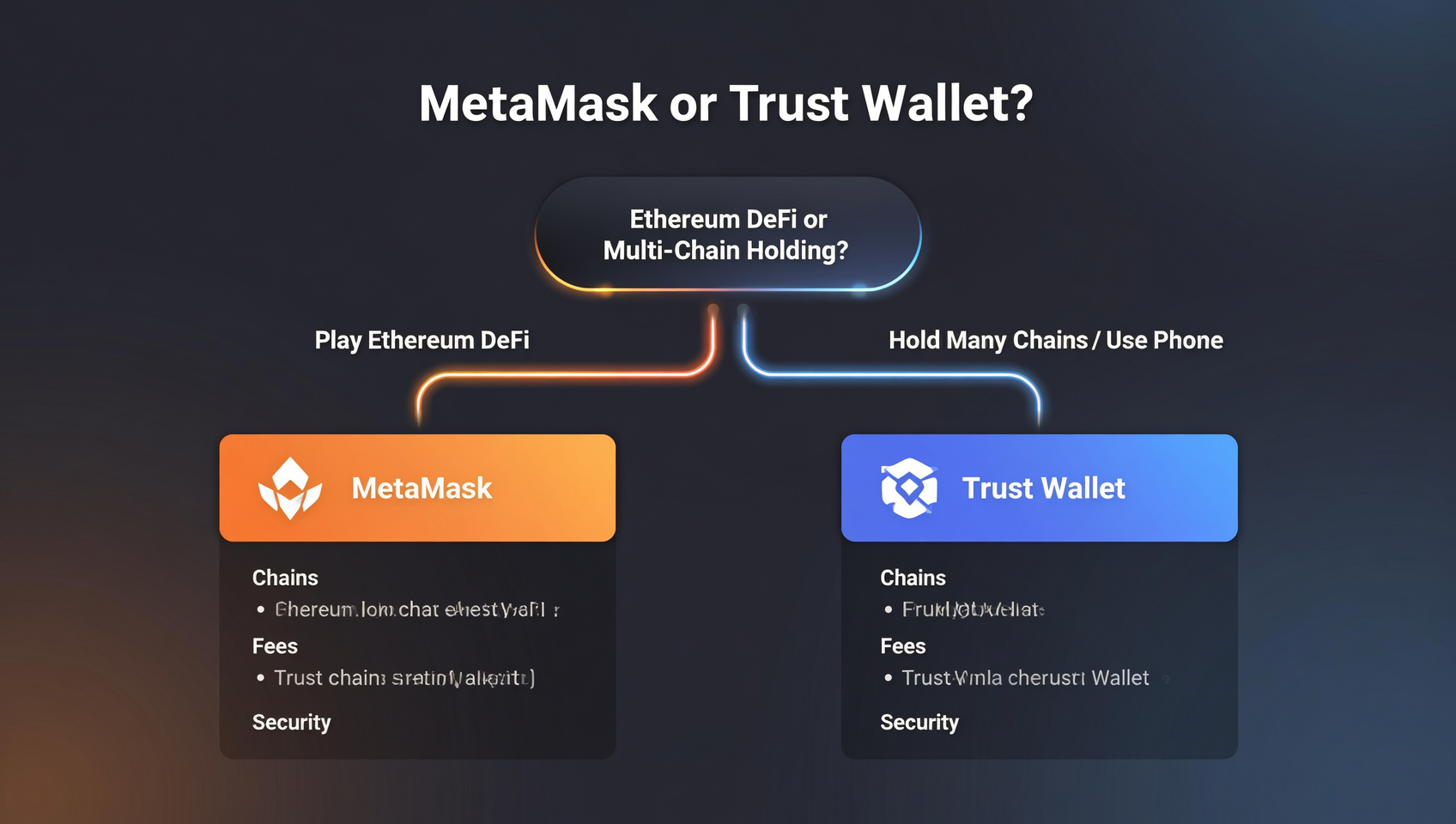
Ethereum/EVM DeFi users → MetaMask. Holders of many-chain assets who mostly use a phone → Trust Wallet. But that hides the most important point: these two wallets aren't even competing in the same lane — MetaMask is an "EVM DeFi gateway," Trust Wallet is a "multi-chain mobile wallet." Most comparisons treat them as interchangeable and force a 2-way pick, but for 2026 users the answer is usually decided by "which chain am I on, and what device do I use" rather than "which is better."
Three judgments that carry the argument:
- Chain coverage decides fit. Trust Wallet natively supports 100+ chains and 10M+ assets; MetaMask has long been Ethereum/EVM-centric and only added Solana (2025), Bitcoin (late 2025) and Tron (early 2026), with TON, Cosmos and most non-EVM chains still unsupported1.
- Both are hot wallets — big money belongs in a hardware wallet. Either way your keys live on an internet-connected device. Once your assets pass a few thousand dollars, the real security upgrade is a Ledger, not agonizing between MetaMask and Trust Wallet2.
- Neither has a "hacked wallet" track record — both have "hacked user" stories. MetaMask's iCloud backup phishing (
$650k) and Trust Wallet's browser-extension bug ($170k) both left the core wallet code untouched; the failures were all user-side34.
⚠️ This article compares tools, not investment advice. The bigger lesson is always the same: keep your seed phrase/private key offline, don't click unknown links, and don't sign contracts you don't understand. Give your seed phrase to anyone, in any wallet, and the money is gone.
Who this article is NOT for: complete beginners who haven't grasped "hot wallet vs cold wallet." If that's you, start with our Crypto Wallet Complete Guide: Hot vs Cold and come back.
The Decision Table: Match Yourself in 30 Seconds
| Your situation | Pick | Why |
|---|---|---|
| Mostly Ethereum/EVM DeFi (Uniswap, Aave, L2s) | MetaMask | 70%+ of Ethereum dApps optimize for it; smoothest desktop browser-extension flow |
| Hold many-chain assets (BTC/SOL/TON/Cosmos/multi-chain NFTs) | Trust Wallet | 100+ chains natively, no manual network setup |
| Mostly use a phone | Trust Wallet | Mobile-first, the smoothest mobile experience |
| Just want to hold + stake for yield (20+ coins) | Trust Wallet | Built-in staking for 20+ assets; MetaMask is mainly ETH staking |
| Heavy DeFi/arbitrage/airdrop farming on desktop | MetaMask | Transaction simulation + Blockaid scam alerts on by default, broadest dApp support |
| Concerned about Binance/CZ, want an independent third party | MetaMask | Trust Wallet is CZ's personal company; MetaMask's parent Consensys is independent |
| Your assets already exceed $1,000 | Skip the debate — get a hardware wallet | Both are hot wallets; big-money safety is about cold vs hot, not brand |
💡 The pattern underneath every row: first ask which chain you're on, what device you use, and how much you hold — then decide. Everything below supports this one idea.
The 2026 Numbers Side by Side
Most "MetaMask vs Trust Wallet" posts still quote 2021–2022 figures. Here are 2026 numbers, verified 2026-09-22123456:
| Metric | MetaMask | Trust Wallet |
|---|---|---|
| Developer / ownership | Consensys (spun off as standalone in 2026) | Binance acquired 2018 → moved to CZ personally 2023 |
| User scale | ~30M MAU (100M+ cumulative installs) | 220M+ users (self-reported cumulative, not MAU) |
| Supported chains | Ethereum/EVM-centric (Solana/BTC/Tron added 2025+) | 100+ chains native |
| Asset coverage | Mostly ERC-20 | 10M+ assets |
| Platform form | Desktop browser extension (also mobile) | Mobile-first (extension added 2023) |
| Swap fee | 0.875% (explicit, plus gas) | ~0.7% (baked into quote, plus gas) |
| Staking | Mainly ETH (pooled/liquid/validator) | 20+ assets, ~3%–20%+ APY |
| Hardware wallet | Ledger + Trezor | Ledger |
| Security features | Blockaid alerts + transaction simulation by default; Transaction Shield paid coverage | ISO 27001/27701 certs; Security Scanner blocked ~$191M in 2025 |
| Real security event | 2023 iCloud backup phishing (~$650k) | 2023 extension WASM bug (~$170k) |
Three readings worth remembering:
- Both "sizes" get used as misleading marketing. Trust Wallet's "220M users" is a self-reported cumulative figure; MetaMask's "30M" is monthly actives. Comparing them directly is apples to oranges — expanded below.
- The fee gap is negligible. 0.875% vs ~0.7% is a dollar or two per $1,000; what really burns you is Ethereum mainnet gas, not the swap fee.
- Security is a wash — and both lose to a hardware wallet. Neither core wallet has been breached; every historical event was user-side. The gap that actually matters is hot vs cold, not these two brands.
The Trap Everyone Falls For: 220M vs 30M Is Apples to Oranges
Almost every comparison trots out "Trust Wallet has 220M users vs MetaMask's 30M, so Trust Wallet is bigger and better." It's a classic misleading comparison, because it places two different-metric numbers side by side:
- Trust Wallet's "220M" is a self-reported cumulative user count — roughly "the number of people who have ever installed the app," including uninstalls, abandoned accounts and zombies, with no third-party audit1.
- MetaMask's "30M" is monthly active users (MAU) — the people actually using it this month — and its cumulative installs also exceed 100M1.
Put it in everyday terms: it's like comparing "WeChat has 2 billion ever-registered accounts" against "some app has 50M monthly actives" and concluding the former is bigger. Compared like-for-like on activity, MetaMask's ~30M MAU actually exceeds Trust Wallet's real monthly actives. So don't let the "220M vs 30M" surface numbers steer you — they reflect a difference in marketing methodology, not in actual user count.
Another easy-to-miss fact: MetaMask is no longer "Ethereum-only." It added Solana in 2025, Bitcoin in late 2025, and Tron in early 2026 (via Snaps and multichain accounts), though TON, Cosmos and other non-EVM chains remain unsupported1. Trust Wallet, by contrast, has been an all-chain wallet from day one — that's its biggest moat.
The Security Truth: It's Not a Hacked Wallet, It's a Hacked User
Everyone asks "which is safer," but the real answer is: neither wallet's core code has ever been directly breached to steal user funds — every historical incident sits on the "user side": phishing, leaked seed phrases, and private keys backed up to the cloud.
MetaMask's signature incident is the April 2023 iCloud backup phishing. One user held roughly $650k in crypto and NFTs in MetaMask; an attacker spoofed Apple support, extracted the victim's Apple ID two-factor code over the phone, then pulled the wallet's encrypted backup out of iCloud and drained it4. MetaMask subsequently told iOS users to turn off the app's automatic iCloud backup — the fault wasn't in the wallet code, but in the default of backing wallet data up to the cloud.
Trust Wallet's signature incident is the April 2023 browser-extension bug. A WebAssembly (WASM) vulnerability affected wallets created through the browser extension between Nov 14–23, 2022; the related exploits caused about $170k in losses, which Trust Wallet found via its bug bounty, patched, and then reimbursed affected users3. In April 2024 Trust Wallet also warned iPhone users of an iMessage "zero-day," but TechCrunch and others questioned the evidence as a likely false alarm3.
The counterintuitive takeaway from both stories: the biggest risk in wallets isn't the wallet code getting hacked — it's the user making a mistake. Screenshots of seed phrases in your photo roll, clicking unknown links, signing approvals you don't understand, backing private keys up to the cloud — these are what actually lose your money. "Is MetaMask or Trust Wallet safer?" is the wrong question; the right reading is in our Seed Phrase & Private Key Security guide and Anti-Phishing guide.
Fees, Calculated: Which Swap Costs Less
Let's be clear up front: both wallets are free to download and create. Where they take money is the swap fee and on-chain gas5:
| Action | MetaMask | Trust Wallet |
|---|---|---|
| Download / create wallet | Free | Free |
| Swap | 0.875% (explicit, plus gas) | ~0.7% (baked into quote, plus gas) |
| Send / receive | On-chain gas only | On-chain gas only |
| Stake / buy | Network fees only | Officially gas only, no extra fee |
| Swapping $1,000 | ~$8.75 + gas | ~$7 + gas |
Three conclusions:
- The swap-fee gap is negligible. 0.875% vs ~0.7% is about $1.75 on $1,000 and ~$17.5 on $10,000. Not worth switching wallets for.
- Transparency matters more than the amount. MetaMask shows the 0.875% explicitly on the trade screen; Trust Wallet bakes ~0.7% into the quote, so the "you receive" amount is already net — smoother, but less transparent than MetaMask.
- The real cost driver is on-chain gas. A swap on Ethereum mainnet can cost tens of dollars in gas; on Arbitrum or Base it's cents. If you want to save, move operations to an L2 rather than chasing a 0.175% difference. A common beginner mistake is withdrawing USDT to Ethereum mainnet and then transacting, burning tens of dollars in gas — see our Binance withdrawal network guide.
The Design Divide: EVM DeFi Gateway vs Multi-Chain Mobile
This is the most fundamental difference, more important than any parameter:
MetaMask is an "EVM DeFi gateway." Centered on the desktop browser extension, it's the "standard interface" of DeFi — over 70% of Ethereum dApps optimize for it first, and Uniswap, Aave, OpenSea and the rest feel smoothest on MetaMask1. Its default-on Blockaid scam alerts and transaction simulation preview the outcome and flag risk before you sign. The cost: it long skewed "Ethereum-first," multi-chain support is a recent add-on, and the interface is complex enough to confuse beginners.
Trust Wallet is a "multi-chain mobile wallet." Mobile-first from the start, it natively supports 100+ chains and 10M+ assets — BTC, ETH, BNB, SOL, TON, Cosmos all in one wallet with no manual network setup1. Built-in staking covers 20+ assets (BNB, ATOM, SOL, TRX, DOT…) at roughly 3%–20%+ APY, ideal for "hold and earn" users. The cost: deep Ethereum DeFi interaction (complex contracts, airdrop farming, arbitrage) isn't as smooth as MetaMask, and its browser extension only arrived in 2023.
Remember it in one line: MetaMask trades multi-chain breadth for DeFi depth; Trust Wallet trades DeFi depth for breadth. Whether you're a DeFi player or a multi-asset holder decides which philosophy fits.
Who Actually Owns Trust Wallet: The Binance & CZ Connection
Ask "is Trust Wallet safe" and most articles answer "self-custody, open-source." But there's a fact many miss that can shape your decision:
Trust Wallet is a "Binance-family" wallet. Binance acquired it in July 2018 as its very first acquisition; in late 2023 it was moved to Binance founder CZ (Changpeng Zhao) personally, becoming CZ's private company6. It's nominally "operationally independent," but its people and capital remain deeply tied to Binance — former CEO Eowyn Chen moved to Binance in 2026, and the new CEO Felix Fan came from OKX6.
This creates a genuine trade-off: if you trust Binance/CZ's backing and ecosystem integration (Trust Wallet and the Binance app plug into each other seamlessly), that's a plus; if you're wary of centralization, regulatory risk, or CZ himself, and want a fully independent third party, MetaMask (whose parent Consensys spun MetaMask off as a standalone company in 2026) fits better6. It's not about right or wrong — it's a stance you need to decide for yourself.
Practical Paths: Pick by Your Chain
💡 Both wallets are free on the App Store / Google Play, and MetaMask also offers a desktop browser extension. Everything below assumes you first buy coins on a reputable exchange, then withdraw to a self-custody wallet. You can register on Binance with referral code BINANBT, or OKX with code 60895497 — registering through either link enjoys a 20% fee rebate.
Path A — You're an Ethereum DeFi user:
- Buy ETH/USDC on Binance or OKX.
- Withdraw to Arbitrum or Base (not Ethereum mainnet — gas is expensive); see our Binance withdrawal network guide.
- Install the MetaMask extension, import your wallet, and connect to Uniswap/Aave. Full setup in our MetaMask install & security guide.
Path B — You're a multi-asset holder who mostly uses a phone:
- Buy BTC/SOL/BNB/TON etc. on an exchange and withdraw each to its own chain.
- Use Trust Wallet's "Receive" function, pick the right network per asset, and receive them one by one.
- For yield, open the built-in "Stake" section, pick an asset, and check the APY and lock-up period before committing.
Path C — Your assets already exceed $1,000:
- Buy a Ledger (or Trezor) and move your long-term holdings onto it.
- Keep MetaMask/Trust Wallet as your "daily small-amount wallet," signing via the hardware wallet.
- Full thinking in our Best Crypto Wallets by use case guide.
Stop conditions — pause if any of these are true:
- Someone asks for your seed phrase or private key in a DM or group → it's a scam, stop.
- You've screenshotted your seed phrase or backed it up to cloud storage/photo albums → delete it now and re-back-up offline on paper or a metal plate.
- A "support agent" tells you to connect your wallet to a website to "verify" or "unfreeze" it → that's phishing, don't click.
- You're about to put more than a few months' savings into a single hot wallet → shrink it to "fine to lose," or use a hardware wallet.
FAQ
Which is better, MetaMask or Trust Wallet?
It depends on your chain and device. Ethereum/EVM DeFi users get the smoothest experience on MetaMask; multi-chain holders and phone-first users should pick Trust Wallet. Both are free hot wallets, and many people run both. The real question isn't these two — it's hot wallet vs hardware wallet: big money belongs in a Ledger.
Is Trust Wallet owned by Binance? Is it safe?
Trust Wallet was acquired by Binance in 2018 and moved to founder CZ personally in late 2023, so it stays in the Binance orbit. As a wallet it's self-custody, open-source, and ISO 27001/27701 certified — but if you have Binance/CZ concerns, that ownership link matters.
Is MetaMask safe? Can it be hacked?
Its core wallet has never been directly breached; almost every incident is user-side (phishing, leaked seed phrases, iCloud auto-backup — one user lost ~$650k in 2023). It enables Blockaid alerts and transaction simulation by default and supports Ledger/Trezor. Security comes down to your habits, not the brand.
What's the swap fee difference?
Tiny — MetaMask is an explicit 0.875% (~$8.75 per $1,000), Trust Wallet bakes ~0.7% into the quote. Both add gas. The real cost is Ethereum mainnet gas, so use Arbitrum or Base.
Trust Wallet has 220M users vs MetaMask's 30M — is it stronger?
The numbers aren't comparable. "220M" is a self-reported cumulative count; "30M" is monthly actives (with 100M+ cumulative installs). On MAU, MetaMask is actually higher. Don't be misled by the surface gap.
Should a beginner use MetaMask or Trust Wallet?
A phone-first beginner holding many-chain coins should start with Trust Wallet (simplest, multi-chain). Install MetaMask when you start Ethereum DeFi, airdrop farming, or desktop work. Test with small amounts, back up the seed offline, and move to a hardware wallet past ~$1,000.
Further Reading
- MetaMask Wallet: Install & Security Setup — from download to secure configuration
- MetaMask Signature Security: Signature Phishing & Permit — the wallet's most dangerous "sign" action
- Crypto Wallet Complete Guide: Hot vs Cold — understand hot vs cold first
- Best Crypto Wallets by Use Case — Trust Wallet, MetaMask, Ledger, Trezor ranked
- Seed Phrase & Private Key Security Guide — the first lesson of wallet safety
- Binance Withdrawal to MetaMask: Which Network? — don't pick the wrong withdrawal network
- On-Chain Guide — more blockchain explainers and on-chain tutorials
Data verification note: user scale, chain coverage, fees and security events verified 2026-09-22 from the sources cited below123456. Wallet features and fees change constantly — always confirm in the official MetaMask and Trust Wallet apps before acting.
This article is not investment advice; cryptocurrency carries price, lost-key and smart-contract risk. Follow your local laws.
Footnotes
-
User scale & chain coverage: MetaMask ~30M MAU with 100M+ cumulative installs, spun off by Consensys as a standalone company in 2026; Trust Wallet 220M+ self-reported users (cumulative), 100+ chains and 10M+ assets natively; MetaMask added Solana (2025), Bitcoin (late 2025), Tron (early 2026), with TON/Cosmos still unsupported. Sources: Trust Wallet compare page, CoinLaw MetaMask statistics, Koinly comparison (Sept 2026). ↩ ↩2 ↩3 ↩4 ↩5 ↩6 ↩7 ↩8
-
Hot vs hardware wallet security: both hold keys on connected devices; a hardware wallet keeps keys offline. Sources: Ledger, our Best Crypto Wallets guide. ↩ ↩2 ↩3
-
Trust Wallet security events: Apr 2023 browser-extension WASM bug (affected wallets created 2022-11-14~23, ~$170k losses, patched and reimbursed); Apr 2024 iMessage "zero-day" warning questioned by TechCrunch for weak evidence; Security Scanner blocked ~$191M in fraudulent transactions in 2025; holds ISO/IEC 27001:2022 + 27701:2019 certifications. Sources: The Block, TechCrunch, Trust Wallet (Sept 2026). ↩ ↩2 ↩3 ↩4 ↩5
-
MetaMask security event: Apr 2023 iCloud auto-backup phishing, user Domenic Iacovone lost ~$650k (attacker spoofed Apple support, extracted the 2FA code, and pulled the encrypted backup from iCloud); MetaMask then advised disabling iCloud auto-backup. Sources: The Block, Gate.io blog (Sept 2026). ↩ ↩2 ↩3 ↩4
-
Swap fees: MetaMask swap fee 0.875% (explicit, ~$8.75/$1,000); Trust Wallet swap fee ~0.7% (baked into quote), with no extra fee on staking/buying/sending beyond gas. Sources: Trust Wallet compare page, Koinly comparison (Sept 2026). ↩ ↩2 ↩3
-
Ownership: Trust Wallet acquired by Binance 2018-07-31 (Binance's first acquisition), moved to founder CZ personally in late 2023; former CEO Eowyn Chen moved to Binance in 2026, new CEO Felix Fan came from OKX; MetaMask's parent Consensys spun MetaMask off as a standalone company in 2026. Sources: Wikipedia Trust Wallet, KuCoin (Sept 2026). ↩ ↩2 ↩3 ↩4 ↩5