


Table of Contents
- TL;DR: The Bottom Line
- In One Sentence: What an MPC Wallet Is
- The Counterintuitive Core: MPC Isn't "More Secure," It Trades Risks
- How It Works: The Key Is Split, and the Full Key Never Exists
- MPC vs Seed Phrase vs Multisig vs Exchange Custody
- The 2026 MPC Landscape: Three Tiers
- The Hidden Cost of "No Seed Phrase": Who Holds Your Recovery?
- Who Should Use MPC? A Decision Table
- The 2026 Failures: Math Didn't Break, Implementations Did
- FAQ
- Further Reading
TL;DR: The Bottom Line
MPC wallets don't solve "absolute security" — they solve the real problem that ordinary people can't reliably store a seed phrase. They use cryptography to split a private key into several key shares spread across a phone, a server, and the cloud, and at signing each party contributes a partial signature that's combined — the complete private key never exists on any single device1.
Three judgments to remember:
- It trades "protect a piece of paper yourself" for "trust a system." Seed-phrase wallets fail when you lose or leak the phrase; MPC wallets fail when the provider shuts down, your account is taken over, or the implementation has a flaw. For most people the first is harder, which is why MPC is the 2026 mainstream default2.
- "No seed phrase" ≠ "true self-custody." Many consumer MPC wallets hold one share themselves (ZenGo is 2-of-2, Binance Web3 Wallet is 2-of-3), which is strictly "semi-custodial" — part of your recovery power sits with the provider3.
- The cryptography is fine; every failure has been in implementation. The BitForge bug affected ZenGo/Coinbase/Binance, and in July 2026 Coinkite's Coldcard entropy weakness caused ~$130M in losses — so "is it MPC" was never a security guarantee45.
⚠️ This article explains how MPC wallets work and how to choose one. It is not investment or security advice. No wallet setup is absolutely safe — only a risk profile that fits you. Never hand your key shares, seed phrase, or biometric verification to any person or page, under any circumstances.
Not the right article for you: if you've never used a wallet and don't yet know what a private key or seed phrase is, start with the Complete Crypto Wallet Guide and Crypto Wallet Types: Cold vs Hot vs Exchange, then come back.
In One Sentence: What an MPC Wallet Is
An MPC (Multi-Party Computation) wallet uses cryptography to turn "one private key" into several key shares that multiple parties hold, and signs transactions jointly. Its single defining feature: no device, no party, at no point in time — not at generation, not at signing — ever holds the complete private key1.
A seed-phrase wallet follows "one key, one lock" logic: private key → 12/24-word seed phrase → whoever has the phrase is the owner. The upside is full control; the downside is that key exists only once and only you can protect it. Lose it and it's gone forever; have it stolen and it's permanently compromised.
An MPC wallet follows "this safe needs two or more keys turned at once, held by different people" logic. Technically this is a Threshold Signature Scheme (TSS): the key is split into N shares, any M of them (e.g., any 2 of 3) can sign, and no single share can reconstruct the full key1.
Once you see the two different logics, every later question — "which is safer," "which should I choose" — reduces to one comparison: are you more afraid of losing the key yourself, or of someone else holding part of it?
The Counterintuitive Core: MPC Isn't "More Secure," It Trades Risks
A lot of MPC marketing frames it as "a more secure, more advanced wallet," which is only half right. The accurate statement: MPC doesn't eliminate risk — it swaps one kind of risk for another.
| Seed-phrase / hardware wallet | MPC wallet | |
|---|---|---|
| Biggest enemy | Yourself (lose, forget, photograph, leak the phrase) | The provider (shutdown, outage, takeover, implementation flaw) |
| Failure mode | Permanently locked out / permanently compromised, no appeal | Depends on the provider surviving and acting honestly; can appeal but on someone else's terms |
| Demands on you | High: reliably hide one secret for years | Low: log into email, use an app, pass a face scan |
| Signature incident | Coinkite entropy weakness, $130M (2026-07) | BitForge implementation bug, affected ZenGo/Coinbase/Binance |
What this table says: seed-phrase wallets fail because of "people"; MPC wallets fail because of "systems." Saying MPC is "more secure" really means — for most people who can't reliably guard a secret, outsourcing that risk to an audited, compliant, legally-backed system is less likely to go wrong than hiding a piece of paper yourself.
But that doesn't make MPC a "more advanced evolution." For large, long-term, fully offline assets, a hardware wallet + seed phrase is still the gold standard, because it depends on no third party surviving2. MPC sits in the middle: more self-control than exchange custody, more convenience than a raw seed phrase.
How It Works: The Key Is Split, and the Full Key Never Exists
To judge whether an MPC wallet is trustworthy, you need at least a rough idea of how the mechanism runs. Three steps:
Step 1: Key generation (Distributed Key Generation, DKG). It's not "generate one key then split it." Each party independently generates random data, and through rounds of encrypted messages they jointly "compute" one public address and several key shares. The complete private key never exists from the moment of generation — nobody ever sees the full form1.
Step 2: Threshold signing (TSS). To move funds, the shares aren't reassembled into a full key. Each party computes a "partial signature" with its own share, and Lagrange interpolation combines those partials into one ordinary, valid on-chain signature. The chain can't tell it's MPC, or how many parties and what threshold were behind it — which is why MPC works on almost every chain1.
Step 3: Key refresh. Shares can be periodically "re-rolled" without changing the address: old shares are discarded, new shares redistributed — like changing the pins of a lock without changing the lock. A lost device doesn't require moving funds to a new address; you just issue a fresh share to the new device1.
Common share layouts (the key thing to look at when choosing):
- 2-of-2: two shares, both required. ZenGo is the classic example — one share on your phone, one on ZenGo's server3.
- 2-of-3: three shares, any two can sign. Binance Web3 Wallet is the classic example — phone, Binance's server, and an encrypted cloud backup3.
- m-of-n: common in institutions, with a configurable threshold (e.g., 3-of-5), offered by custodians like Cobo3.
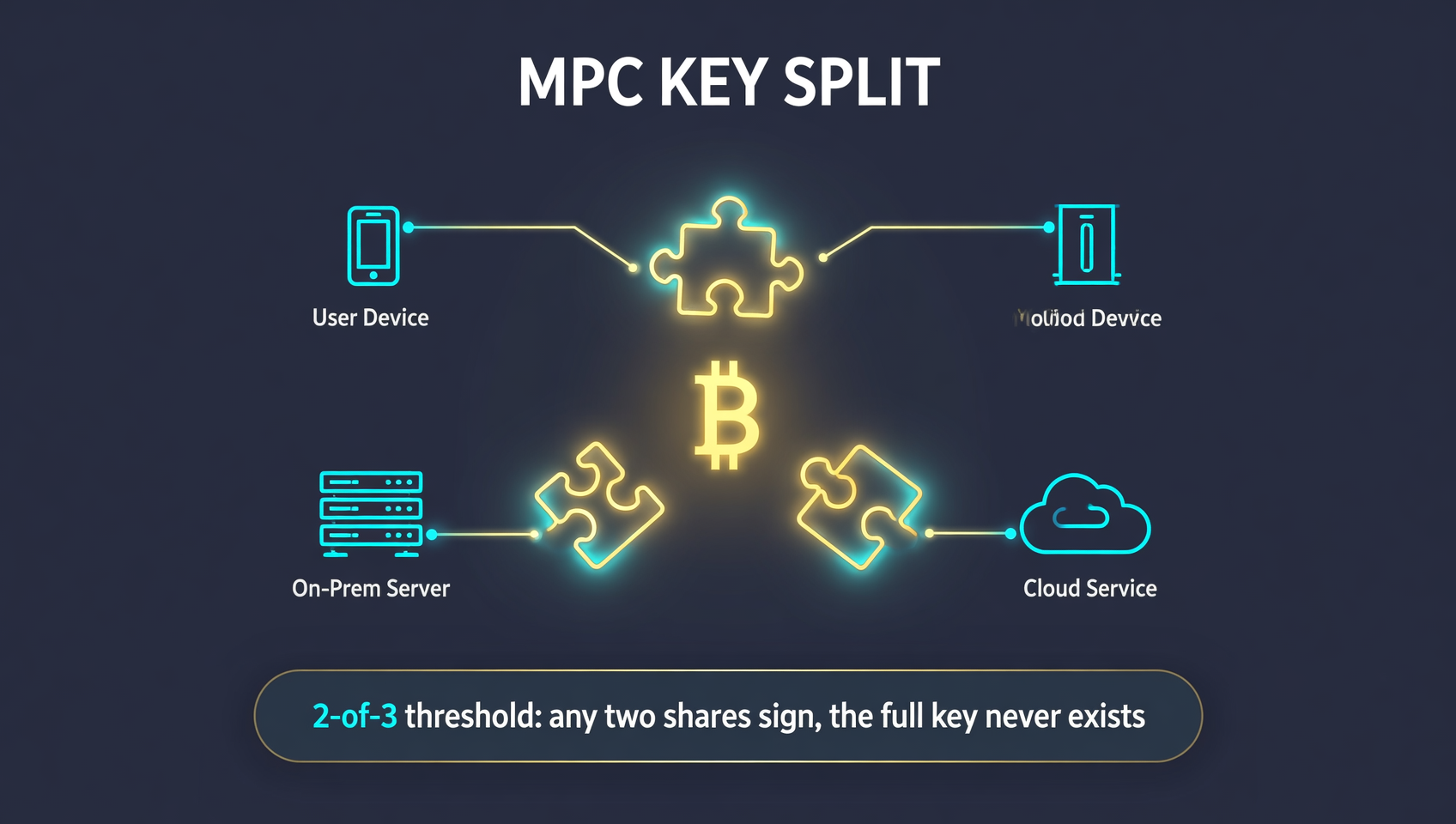
A distinction you must know: MPC/TSS ≠ Shamir Secret Sharing (SSS). Both look like "splitting the key," but SSS must reassemble the full key on a single device at signing time — recreating a single point of failure in that instant — whereas TSS/MPC never rebuilds the key from generation through signing. Mistaking "secret sharing" for MPC is a common error6.
MPC vs Seed Phrase vs Multisig vs Exchange Custody
Put the four approaches on one table and the differences become clear:
| Approach | Where the key lives | Recoverable if lost? | Depends on | Fees / chain support | Best for |
|---|---|---|---|---|---|
| Seed-phrase wallet | One full key + 12/24 words | ❌ Gone forever if lost | Only yourself | Low, all chains | Long-term holders who can self-discipline |
| Hardware wallet | Key offline in a device | ❌ Relies on phrase backup, same loss risk | Yourself + hardware vendor | Low, all chains | Large cold storage (gold standard) |
| MPC wallet | Several shares in multiple places | ✅ Reissue a share after re-verifying | Provider + yourself | Low, all chains | Daily self-custody, phrase-phobic users |
| Multisig wallet | Multiple independent keys | Partially (needs other signers) | Multiple signers | High, fewer chains | Team/institutional shared custody |
| Exchange custody | Platform holds it | ✅ Reset password | Fully the platform | None (in-platform) | Pure convenience, accept full custody |
The easiest confusion is MPC vs multisig: multisig uses several truly independent keys, with rules in an on-chain smart contract and every signer publicly visible — at the cost of higher fees and fewer chains; MPC uses shares of one key, coordinated off-chain, emitting one standard signature — cheaper, more universal, more private, but without on-chain auditability7. Simple memory aid: multisig is public, auditable, and expensive; MPC is private, universal, and cheap.
The 2026 MPC Landscape: Three Tiers
By 2026, MPC wallets have stratified clearly. Choose by who you are:
Tier 1: Consumer / mobile (everyday personal use).
- ZenGo: one of the most mature consumer MPC wallets, 2-of-2 (device + server), no seed phrase, three-factor recovery (3D face + email + encrypted cloud backup), claims no exploited vulnerability since 2018,
70+ chains. Advanced security features (multi-wallet isolation, transaction simulation) require ZenGo Pro ($9.99/month)8. - Coinbase Wallet: MPC + self-custody, supports EVM, Solana, BTC, and Base, with cloud/passkey recovery, deeply tied into the Coinbase ecosystem; its developer-facing
cb-mpcis an open-source MPC library8. - Binance Web3 Wallet: 2-of-3 MPC (phone + Binance server + encrypted cloud backup), the smoothest for on-chain interaction inside the Binance ecosystem, but note it's not available to US users. If you don't have an account yet, use the official Binance registration entry38.
Tier 2: Institutional / custody infrastructure (not for individual retail users).
- Fireblocks: the de facto leader in institutional MPC custody, SOC 2 Type II certified, 70+ chains, over $6 trillion in cumulative transfers, focused on configurable policies, compliance audit, and disaster recovery8.
- Cobo: offers both organization-controlled custody (2-of-2) and user-controlled self-custody (m-of-n with flexible thresholds), known for enterprise-grade flexible configuration3.
Tier 3: Developer / embedded wallets. Coinbase WaaS (open-source cb-mpc), Dynamic, and others package MPC as an API, letting any app embed a "seedless wallet" — the mainstream "wallet-as-a-service" trend for Web3 apps in 20268.
One-line selection principle: for everyday personal use, pick whichever of ZenGo / Coinbase Wallet / Binance Web3 Wallet fits your ecosystem; for serious money and compliance audit, look at Fireblocks / Cobo; don't compare institutional and consumer products as if they were the same category.
The Hidden Cost of "No Seed Phrase": Who Holds Your Recovery?
MPC's biggest selling point is "never memorize 12 words again," but behind that sentence hides a rarely-spelled-out question: without a seed phrase, who actually decides whether you can recover your assets?
For a pure seed-phrase wallet, the recovery logic is: with that paper, you can recover in any wallet software anywhere, depending on no company. That's its ultimate strength — and its ultimate risk (lose the paper and it's over).
For an MPC wallet, the recovery logic is: re-verify your identity (email/face/recovery contact) → the provider issues a fresh share to the new device → the old device is locked. Address and on-chain history are unchanged, and the experience is smooth2. But the costs:
- It depends on the provider surviving. If the provider shuts down, changes policy after an acquisition, or someday refuses to cooperate, your recoverability erodes. Some products (like ZenGo) use a third-party escrow (e.g., Coincover) as a "shutdown fallback," but that's a contractual arrangement, not a pure cryptographic guarantee8.
- It depends on your identity credentials staying safe. If your email, phone number, or biometrics get taken over, the recovery channel itself becomes an attack surface. Cloud-backup recovery that relies only on an Apple/Google account can compromise the wallet if that one account is breached2.
- It may not be true self-custody. As long as one share sits with the provider, it's strictly "semi-custodial" — the assets are truly yours only as long as the provider doesn't freeze you or shut down.
So before choosing an MPC wallet, ask three things: ① where does each key share live? ② to recover, who must you go through, and can they refuse? ③ if the provider goes bankrupt, is there a third-party fallback? If the answers are missing or vague, be cautious.
Who Should Use MPC? A Decision Table
By two axes — your asset size and your self-discipline / technical ability — you can match yourself quickly:
| Your situation | Recommended approach | Why |
|---|---|---|
| Small amounts, just starting, hate hassle | Exchange custody or consumer MPC | Convenience; loss is capped |
| Want self-custody but can't store a seed phrase | Consumer MPC | MPC's home turf: convenient + recoverable |
| Change phones often, want an inheritance path | MPC | Recovery isn't tied to a piece of paper; family can take over |
| Large, long-term, untouched for months | Hardware wallet + seed phrase | Depends on no third party; still the gold standard |
| Team/institution jointly managing funds | Multisig wallet | On-chain auditability, clear permissions; MPC can't replace it |
| Can't trust any platform at all | Hardware wallet (or pure self-custody MPC) | Minimize "trust a third party" |
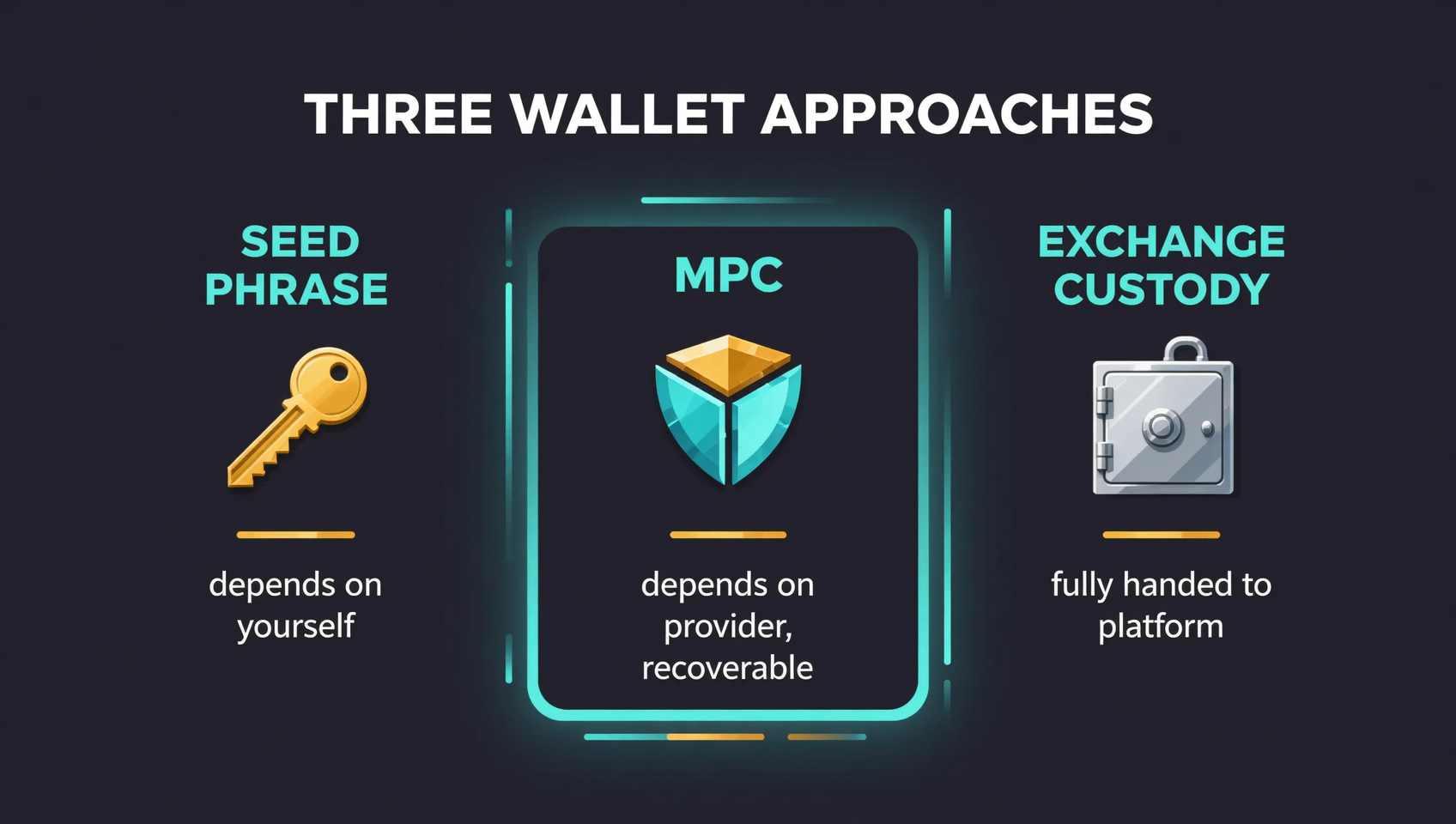
One-line selection logic: MPC solves "self-custody's entry barrier is too high," not "self-custody is unsafe." If you can already reliably guard a secret, a hardware wallet is still purer; if you can't (and most people can't), MPC is the 2026 answer that makes self-custody actually usable.
The 2026 Failures: Math Didn't Break, Implementations Did
One crucial insight: MPC's cryptographic math is rigorously proven, but wallets are implemented in code, and code has bugs. Recent major incidents all landed on "implementation" or "key generation," with zero cases of the MPC math itself being cracked:
- BitForge (disclosed 2023-08). Fireblocks researchers found implementation flaws in mainstream MPC protocols (GG-18/GG-20, Lindell17), tracked as CVE-2023-33242, affecting ZenGo, Coinbase, and Binance MPC implementations. All were remediated within the 90-day disclosure window, with no major public asset loss4.
- TSSHOCK (Black Hat 2023). Demonstrated that, in specific implementations, a malicious party could extract the key within 1–2 signing sessions — again showing "right protocol, wrong implementation, still breaks"4.
- Coinkite Coldcard entropy weakness (2026-07). This one stung the seed-phrase camp specifically: Coldcard firmware generated seed phrases with insufficient entropy, letting attackers regenerate the leaked phrases, with losses up to ~$130 million — even users who diligently backed up their phrases were hit, because the key was weak from birth5.
These three point to the same conclusion: "MPC or seed phrase" is not the deciding factor in security; "is the implementation audited, is the key strong, who holds the shares" is. So when choosing a wallet, instead of arguing about technical routes, check three things: third-party audits, open source vs closed source, and who's accountable when something goes wrong.
FAQ
What is an MPC wallet, and how is it different from a normal wallet?
An MPC wallet uses cryptography to split one private key into several key shares held on different devices or by different parties; at signing, each computes a partial signature that's combined into one full signature, with no one ever holding the complete key. A normal seed-phrase wallet uses one full key expressed as 12/24 words — whoever has the phrase fully controls the wallet.
MPC wallets have no seed phrase — what if I lose my phone?
Recovery doesn't depend on finding a piece of paper but on re-verifying your identity and reissuing a share: the old device locks, you verify via email/face/recovery contact, and the provider issues a fresh share to the new device, with the same address and history. The tradeoff is that this recoverability depends on the provider staying operational and willing to cooperate.
Are MPC wallets safe? Safer than seed-phrase wallets?
Depends on for whom and compared to what. MPC solves the fatal loss from a stolen/photographed/forgotten phrase but shifts risk to trusting the provider. The cryptography is sound; failures were in implementation — BitForge affected ZenGo/Coinbase/Binance, and Coinkite's Coldcard entropy weakness (July 2026) caused ~$130M in losses. So "is it MPC" isn't a guarantee; "who holds shares and whether it's audited" is.
What's the difference between an MPC wallet and a multisig wallet?
Multisig uses multiple independent keys with on-chain smart-contract rules and publicly visible signers, at the cost of higher fees and fewer chains; MPC uses shares of one key coordinated off-chain, emitting one standard signature — cheaper, universal, private, but without on-chain auditability. In short: multisig is public, auditable, and expensive; MPC is private, universal, and cheap.
Is an MPC wallet true self-custody, or custody?
Depends on who holds the shares. If all shares are on your devices and your own backup, and the provider only computes signatures, it's close to self-custody; but many consumer MPC wallets (ZenGo 2-of-2, Binance Web3 Wallet 2-of-3) keep a share on the provider's server — strictly "semi-custodial." Before choosing, ask where each share lives and who decides on recovery.
Who is MPC best for?
Ordinary people who want self-custody but fear losing a seed phrase: those who can't store 12 words, change phones often, or want an inheritance path. Large long-term holders should still use hardware wallets + seed phrases (gold standard); convenience-first users can use exchange custody. MPC is the middle ground — the 2026 mainstream default between convenience and control.
Do MPC wallets cost money?
Basic wallets are mostly free (ZenGo basic, Coinbase Wallet, Binance Web3 Wallet), though advanced features need a subscription (ZenGo Pro ~$9.99/month). Institutional MPC (Fireblocks, Cobo) is priced as custody infrastructure, not for retail users. Consumers choosing a consumer MPC wallet usually pay nothing extra.
Will MPC completely replace seed-phrase wallets?
Short term it's coexistence plus layering. In 2026 Binance and Coinbase migrated core wallet architecture to MPC, making it the mainstream daily default; but hardware wallets + seed phrases remain the gold standard for large offline holdings, and multisig is irreplaceable for team custody. The sensible approach is layering: MPC for small recurring amounts, hardware wallets for large cold storage.
Further Reading
- Complete Crypto Wallet Guide: Hot, Cold & Exchange Wallets — the wallet fundamentals MPC builds on
- Crypto Wallet Types: Cold vs Hot vs Exchange — understand the three big wallet categories first
- MetaMask vs Trust Wallet 2026: Which Wallet Wins — the seed-phrase era's flagship comparison
- Seed Phrase & Private Key Security: The Ultimate Guide — the "guard the key" problem MPC tries to solve
- What Is Account Abstraction? ERC-4337 & Smart Wallets — another route to seedless wallets
- DeFi Approval Security: How to Revoke Unused Contract Approvals — approval cleanup every wallet needs
- On-Chain Guide — more blockchain explainers and on-chain tutorials
Fact-check note: the MPC key-share / threshold-signature mechanism, mainstream share layouts (ZenGo 2-of-2, Binance Web3 Wallet 2-of-3, Cobo m-of-n), the BitForge (CVE-2023-33242) and TSSHOCK vulnerabilities, and the Coinkite Coldcard entropy weakness (~$130M) were verified on 2026-10-01; sources are in the footnotes below13672458. Wallet features, supported chains, and subscription prices change over time — confirm with each provider's latest official information.
This article is not investment or security advice. No wallet setup is absolutely safe; MPC wallets carry provider dependency, implementation-flaw, identity-takeover, and residual phishing/approval risks. Choose according to your own situation and comply with local laws and regulations.
Footnotes
-
MPC wallet mechanism: key shares, threshold signature scheme (TSS), distributed key generation (DKG), partial signatures combined via Lagrange interpolation into an ordinary on-chain signature, and the complete private key never existing at generation or signing; MPC vs multisig (off-chain coordination vs on-chain contract). Sources: Binance Academy, Ledger Academy, MoonPay, Cobo docs. ↩ ↩2 ↩3 ↩4 ↩5 ↩6 ↩7
-
MPC tradeoffs and recovery: seed-phrase recovery rated "poor" (depends on physical backup surviving; permanent loss if lost/leaked); MPC recovery rated "excellent" (re-verify + reissue share, old device locked); MPC's costs are provider dependency, implementation trust, and residual phishing/approval risk; "MPC requires trusting a provider; seed phrases require trusting yourself to store paper for decades." Sources: The Block Research, MoonPay, Cobo. ↩ ↩2 ↩3 ↩4 ↩5
-
Mainstream share layouts: ZenGo 2-of-2 (device + server); Binance Web3 Wallet 2-of-3 (device + Binance server + encrypted cloud backup); Cobo offers organization-controlled 2-of-2 and user-controlled m-of-n. Sources: Zelcore Academy, Cobo product manuals. ↩ ↩2 ↩3 ↩4 ↩5 ↩6 ↩7
-
BitForge (disclosed 2023-08, CVE-2023-33242): Fireblocks found implementation flaws in GG-18/GG-20 and Lindell17, affecting ZenGo/Coinbase/Binance, all remediated within the 90-day disclosure window; TSSHOCK (Black Hat 2023) demonstrated key extraction within 1–2 signing sessions. Sources: Fireblocks, public disclosure records. ↩ ↩2 ↩3 ↩4
-
Coinkite Coldcard entropy weakness (disclosed 2026-07): Coldcard firmware generated seed phrases with insufficient entropy, allowing attackers to regenerate leaked phrases, with losses up to ~$130M, affecting even users who backed up their phrases correctly. Source: Zelcore Academy "Beyond the Seed Phrase." ↩ ↩2 ↩3
-
MPC/TSS vs Shamir Secret Sharing (SSS): SSS must reassemble the full key on a single device at signing, recreating a single point of failure; TSS/MPC never rebuilds it. Source: Zelcore Academy. ↩ ↩2
-
MPC vs multisig: multisig = multiple independent keys + on-chain smart contract (higher fees, fewer chains, signers publicly visible); MPC = shares of one key + off-chain coordination (lower fees, universal, private, no on-chain auditability). Sources: Binance Academy, Ledger Academy. ↩ ↩2
-
2026 mainstream MPC wallets: ZenGo (2-of-2, no seed, three-factor recovery, no exploited vulnerability since 2018, ~70+ chains, ZenGo Pro ~$9.99/month, shutdown fallback via Coincover); Coinbase Wallet (MPC + self-custody, EVM/Solana/BTC/Base, open-source cb-mpc); Fireblocks (institutional leader, SOC 2 Type II, 70+ chains, $6T+ cumulative transfers). Sources: spark.money, G2, Bitget Academy, and other 2026 roundups. ↩ ↩2 ↩3 ↩4 ↩5 ↩6 ↩7