


Table of Contents
- TL;DR
- What stablecoin yield actually is: four different sources
- The benchmark: a ~4.5% risk-free rate, don't be fooled by high APY
- Method 1: Exchange earn — easiest, best for beginners
- Method 2: DeFi lending — decentralized, yield follows the market
- Method 3: Stablecoin liquidity pools (LP) — earn fees, fear depegs
- Method 4: Synthetic dollars / basis trading — high yield, high risk
- Method 5: RWA yield — real-world interest rates
- The math: $10,000 parked for a year, what each method earns
- Risk ranking: what premium are you really earning
- Decision table: choose by amount, horizon, and risk tolerance
- The 5 mistakes beginners make
- FAQ
- Summary: remember this one line
TL;DR
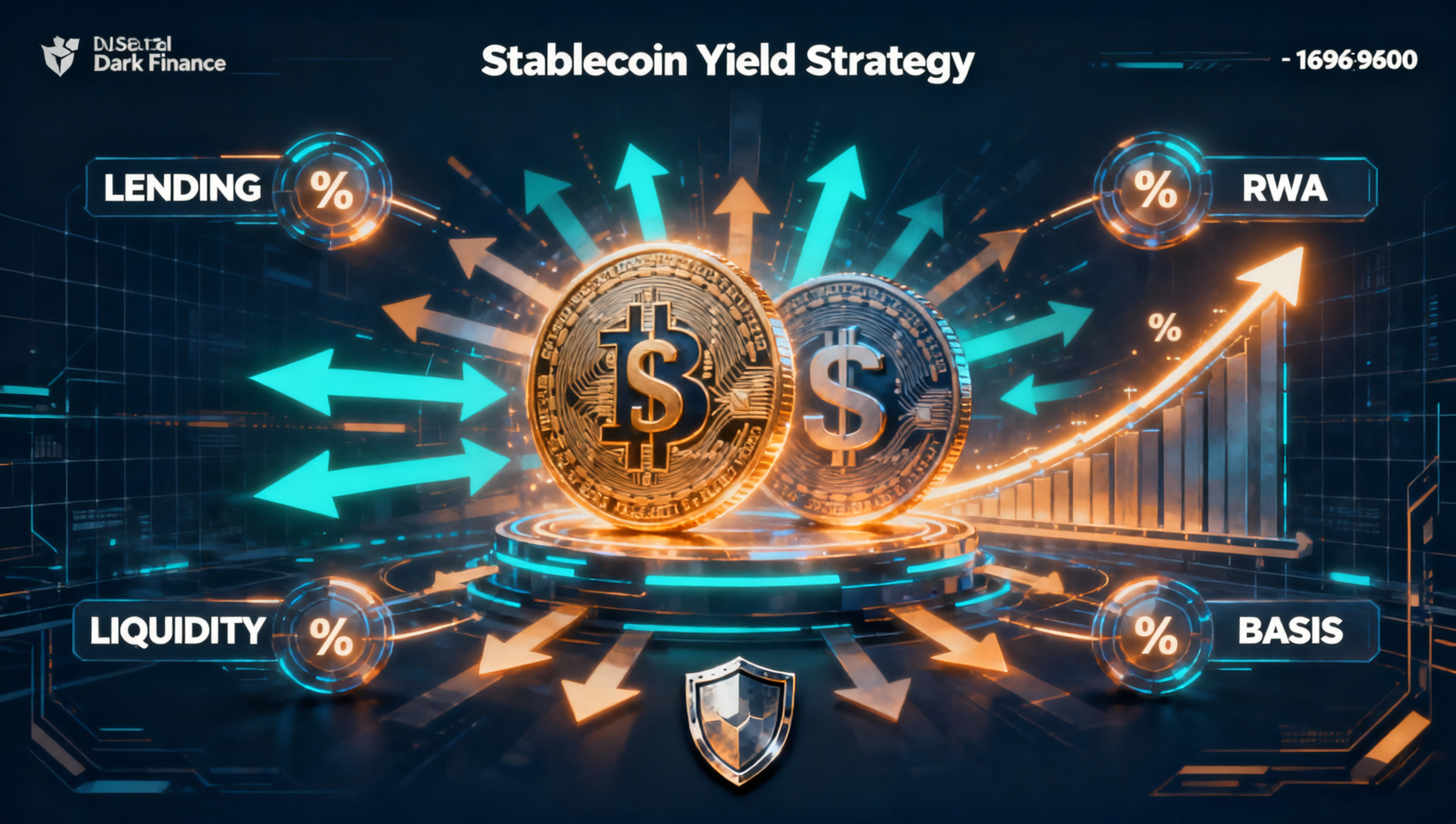
Here's the short version: stablecoin yield comes from four different types of money — borrower interest, real-asset interest, trading fees, and directional "basis" — in rising order of risk; and the first thing to remember in 2026 is a benchmark: the 1-year Treasury yields about 4.5%, and any APY far above that line almost always hides risk you haven't seen. In practice: the easiest choice for beginners is exchange flexible/locked earn (Binance Simple Earn pays ~2.5%-4.5% on USDT flexible, up to 7% APR during campaigns); the next steps are Aave/Compound lending (3%-6%), stablecoin liquidity pools (Curve 3%-10%), and RWA yield (money-market funds ~4%); anything above 10%-12% (synthetic dollars like sUSDe) should be treated as a risky asset, not "guaranteed interest." When choosing a channel, don't look at one APY number — first ask three questions: where does the yield come from, who is subsidizing it, and what's the worst case123.
What stablecoin yield actually is: four different sources
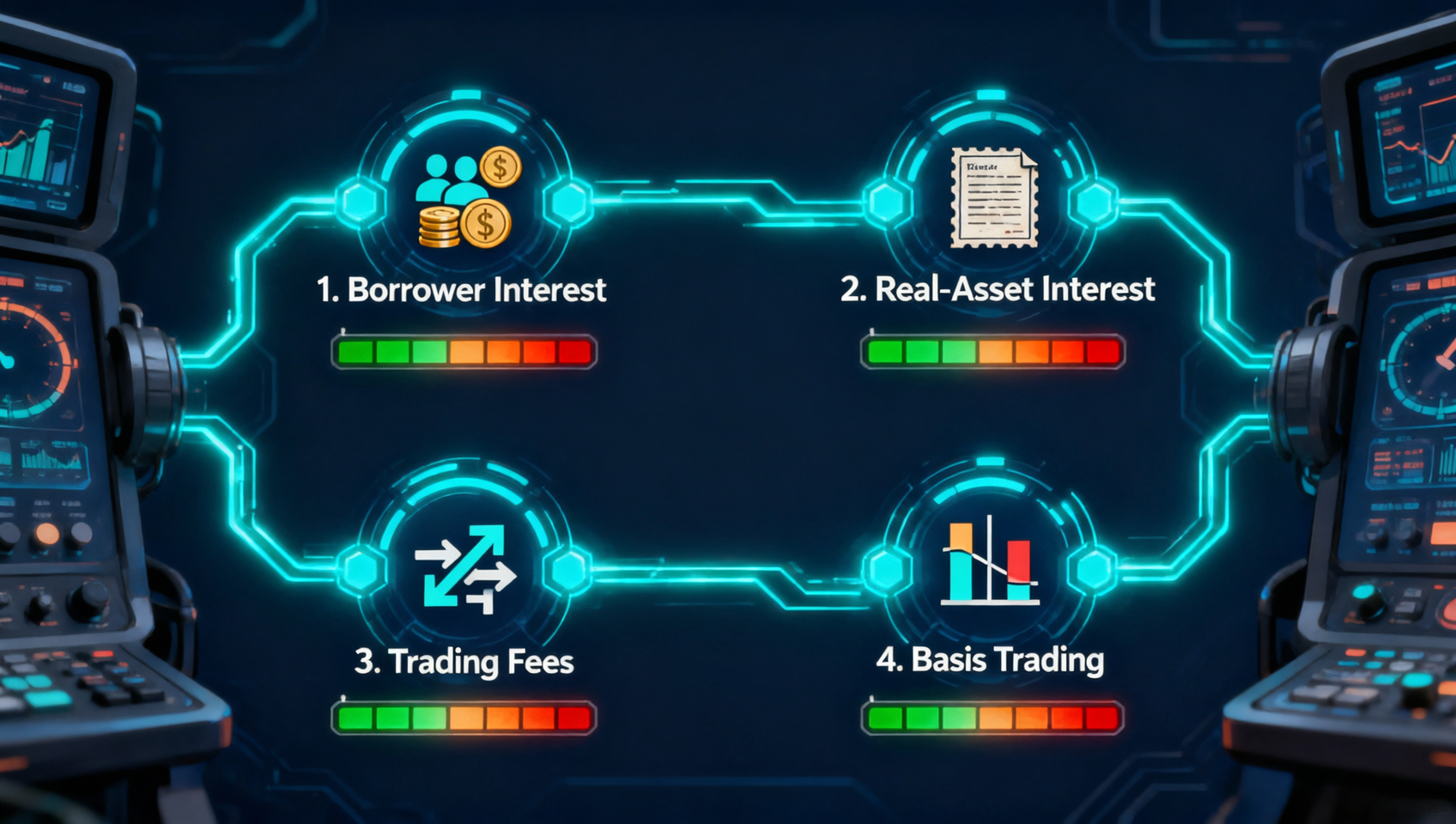
Many guides treat "stablecoin yield" as one vague concept, but it's actually four completely different things. Tell them apart and the word "high APY" stops fooling you:
- Borrower interest (DeFi lending) — you deposit USDT/USDC into Aave, Compound, or Morpho, and borrowers pay you interest. The yield comes from people willing to pay to leverage, arbitrage, or cover short-term liquidity.
- Real-asset interest (RWA yield) — the underlying assets are U.S. Treasuries, money-market funds, corporate bonds, or private credit, and tokenized products pass the interest to you. The yield comes from real-world rates.
- Trading fees (liquidity provision) — you put stablecoins into a DEX pool like Curve, and the swap fees others pay are shared with you. The yield comes from how often and how much others trade.
- Basis / directional money (synthetic dollars) — products like Ethena's sUSDe hold spot/staked assets while shorting an equal notional in perpetual futures, earning the funding-rate spread. The yield comes from "bull-market longs paying shorts a positive funding rate."
These four are completely different in stability, risk, and barrier to entry. The first two are relatively "real"; the last two are relatively "speculative" — especially the fourth, which pays high yields in bull markets and can turn negative in bear markets. There's also a special channel — exchange earn — which doesn't create a new yield source itself, but packages these types of money for you. Four sources plus this channel make the five ways to put money to work that we'll walk through next.
The benchmark: a ~4.5% risk-free rate, don't be fooled by high APY
This is the single most important mental tool in this article: judge any stablecoin yield against the ~4.5% 1-year Treasury rate3. Why?
- Treasuries are the "near-risk-free" anchor. Depositing USDC into Aave is essentially "taking on smart-contract risk + depeg risk" to earn a return; if that return doesn't even beat Treasuries, you're taking that risk for nothing.
- The brutal 2026 fact: DeFi lending yields often trail Treasuries. One analysis found that Aave's USDC yield was below the 1-year Treasury about 78% of the time in 2026, by an average of ~31 basis points (0.31%)4. The popular intuition that "DeFi yields are high" is outdated in 2026.
- Exchange flexible earn doesn't reliably beat them either. USDT flexible earns 2.5%-4.5%, roughly at or below Treasury levels; what consistently beats them are locked terms, optimized lending like Morpho, or RWA products15.
So this article's core method is: don't get excited by an isolated "8% APY" — first ask "what risk am I being paid for the part above the 4.5% risk-free rate." Every extra percentage point corresponds to a specific, potentially principal-losing risk.
Method 1: Exchange earn — easiest, best for beginners
Putting money into the earn/savings products of centralized exchanges like Binance or OKX is the lowest-barrier, most hands-off way to earn on stablecoins. It suits people with idle USDT who don't want to deal with complexity and want instant access.
Taking Binance Simple Earn as an example, the real structure of USDT flexible (Flexible products) is2:
- Standard flexible: about 2.5%-4.5% (APR floats by the minute, accrues in real time).
- Campaign periods: up to 7% APR, but it's tiered — typically only amounts up to 800 USDT get 7% (4% bonus tiered APR + ~3% real-time APR), and anything above 800 USDT earns only ~3%. Campaigns have start/end dates (e.g. 2026-08-25 to 09-07, and 09-08 to 09-22), first come, first served.
This hides the most commonly missed point for beginners: "up to 7%" doesn't mean "your entire principal earns 7%." Deposit 5,000 USDT and only the first 800 USDT might get 7%, while the remaining 4,200 USDT earns 3% — the blended rate is under 4%.
Reference ranges at other major platforms (2026): Coinbase USDC rewards ~3.5%-5%, Kraken stablecoin rewards 4%-6%1.
Pros: zero barrier, withdraw anytime, platform risk controls as a backstop, beginners won't "click the wrong button" and lose money. Cost: generally lower yield, centralized custody risk (exchange collapse/freeze), and rates that change anytime.
Method 2: DeFi lending — decentralized, yield follows the market
Depositing into decentralized lending protocols like Aave, Compound, or Morpho pays you directly from borrower interest, with no middleman taking a cut. This is the most mainstream and most "solid" source of DeFi stablecoin yield.
Real yield ranges (2026, varying by chain and utilization)13:
- Aave V3: ~3%-6% on USDC/USDT; USDT has a smaller supply pool and higher utilization, so it typically pays 50-100 bps more than USDC.
- Compound V3: ~2%-5% on USDC.
- Morpho Blue (optimized lending): ~4%-10%, with conservative curators around 4%-5% and a 90-day median of ~4.79%.
What risk does the extra over exchange earn buy you? Three specific risks:
- Smart-contract risk: a bug in the protocol code can get deposits drained.
- Bad debt and contagion: real example — the Kelp DAO bridge exploit left Aave with roughly $196 million in bad debt and triggered ~$6.6 billion in withdrawals3. One failure spreads across the ecosystem.
- Volatile rates: yields reprice instantly with borrowing demand — they can spike above 20% in a bull market and fall back within 48 hours.
Who it suits: advanced users who can operate a wallet and accept smart-contract risk — especially using USDC (compliant, transparent, and most widely used in DeFi).
Method 3: Stablecoin liquidity pools (LP) — earn fees, fear depegs
Put stablecoins into a DEX pool like Curve and you earn the swap fees others pay. Stablecoin-to-stablecoin pools (e.g. USDC/USDT/DAI) are among the lowest-risk LP options.
Real yield ranges (2026)6: stablecoin-to-stablecoin Curve pools at roughly 3%-10%, but split it apart — pure fee yield is only 0.5%-1%, and the bulk comes from CRV/CVX governance-token incentives, which can shrink at any time.
Correct one concept here: the main risk of stablecoin LPs isn't "impermanent loss" — it's "depeg."
- For stablecoin-to-stablecoin, coins trade near $1, so impermanent loss is genuinely minimal.
- But if one coin in the pool depegs (say to $0.90), the AMM mechanism makes the pool "all-in on the depegged coin" — you withdraw almost entirely the depreciated one, and the real loss materializes. In March 2023, USDC depegged to $0.88 during the Silicon Valley Bank crisis, and liquidity providers were stuck holding discounted USDC1.
Who it suits: users who want a bit more than lending yields and can accept "forced holding during a depeg"; not suitable for money placed in pools containing coins with depeg history or opaque reserves.
Method 4: Synthetic dollars / basis trading — high yield, high risk
Products like Ethena's sUSDe are "synthetic dollars": they hold spot/staked assets while shorting an equal notional in perpetual futures, earning the funding-rate spread to stay dollar-neutral in theory. This was the hottest "high-yield stablecoin" narrative of 2024-2025.
Real yield ranges (2026)17: sUSDe's 7-day APY is about 3.6%-7% (~7.1% in June 2026), far below the 20%+ of cycle highs.
Why did the yield collapse? Because its source is weather-dependent, and it has quietly restructured:
- The yield mainly comes from perpetual funding rates — in bull markets longs outnumber shorts and funding is positive, so shorts collect; when the market turns bearish and funding flips negative, shorts pay instead, and the yield can go negative.
- More importantly, in April 2026 Ethena restructured significantly: perpetual collateral dropped to just 11% of backing, with the bulk moved into CLOs (collateralized loan obligations), investment-grade corporate bond funds, and short-term credit1. In other words, it shifted from a "pure crypto-native yield" product to a "hybrid product propped up by RWAs" — which itself proves pure crypto-native yield can't survive a full cycle.
Four specific risks: funding-rate reversal (yield goes negative), centralized-exchange counterparty risk (about half the short positions sit on CEXs like Binance), synthetic-dollar depeg, and smart-contract risk.
Who it suits: veterans who understand basis-trading logic and can accept the yield turning negative; not recommended for beginners — it's a structured financial position, not "deposit and collect interest."
Method 5: RWA yield — real-world interest rates
Convert stablecoins into tokenized real-world assets (U.S. Treasuries, money-market funds, corporate bonds, private credit), and the interest comes from real-world rates. This is one of the fastest-growing and most "real" stablecoin yield sources of 2026 — it doesn't depend on crypto borrowing demand or trading activity, but on traditional-finance interest.
Real yield ranges (2026)3:
- Money-market funds (e.g. Fidelity's USD MMF vault): ~4%, denominated in USDC.
- Treasury-linked (BlackRock BUIDL): ~3.4% 7-day APY (June 2026).
- Corporate bonds: ~6%.
- Private credit: ~9%, but usually locked and carries borrower-default risk.
Its risk is "another type": no longer smart-contract bugs, but default/credit risk of the underlying assets + issuer operational risk; some products have lockup periods and can't be withdrawn anytime.
Who it suits: conservative users who want a bit more than Treasuries without bearing DeFi contract risk or basis-reversal risk. The key action is to read the underlying asset and issuer clearly — "RWA" is just a wrapper; what really determines safety is whether it's packed with Treasuries or private credit.
The math: $10,000 parked for a year, what each method earns
Using $10,000 as the base and 2026 median yields, here's the tangible difference between methods:
| Method | APY (median/range) | ~1-year return | Main risk |
|---|---|---|---|
| Treasury (benchmark) | ~4.5% | ~$450 | Nearly none |
| Exchange flexible | 2.5%-4.5% | $250-450 | Platform custody |
| Exchange campaign (tiered) | up to 7% (capped at 800 U) | blended <$400 | Custody + rate drop |
| Aave/Compound lending | 3%-6% | $300-600 | Contract + bad debt |
| Morpho optimized lending | 4%-8% | $400-800 | Same + strategy risk |
| Stablecoin LP (Curve) | 3%-10% | $300-1000 | Depeg, forced holding |
| RWA (money-market fund) | ~4% | ~$400 | Underlying + issuer |
| RWA (private credit) | ~9% | ~$900 | Borrower default + lockup |
| Synthetic dollar sUSDe | 3%-7% | $300-700 | Funding reversal + counterparty |
Three conclusions from this table:
- The yield gap is smaller than you think. From the easiest exchange flexible to the most advanced DeFi lending, the median yield differs by only 1-3 percentage points — a difference of one or two hundred dollars a year on $10,000. Taking on contract + bad-debt risk for that gap isn't worth it for beginners.
- A real yield jump requires a qualitative risk jump. To reliably earn 8%-9% you need RWA products like private credit (with borrower-default and lockup risk); to earn 10%+ you're generally touching synthetic dollars whose yield can turn negative.
- "High APY" is often a "tiered + time-limited" marketing number. Binance's 7% campaign and Morpho's 10% are not "your entire principal steadily earns this." Do the math on the "effective APY" and the low end of the range first.
Risk ranking: what premium are you really earning
Rank the five methods by principal risk from low to high, and you'll see what the extra yield is buying:
- Treasuries / money-market RWA: lowest risk, ~4%. You bear issuer and underlying-asset risk.
- Exchange earn (top platforms): 2.5%-4.5%, platform custody risk. The bigger and more compliant the platform, the lower the risk — but never zero.
- DeFi lending (Aave/Compound): 3%-6%, smart-contract + bad-debt risk, the balance point between "decentralized" and "safe."
- Stablecoin LP / optimized lending (Morpho): 3%-10%, depeg-forced-holding or strategy-execution risk layered on top of lending risk.
- Private-credit RWA / synthetic dollars: 6%-10%+, borrower-default, lockup, or funding-reversal and counterparty directional risk.
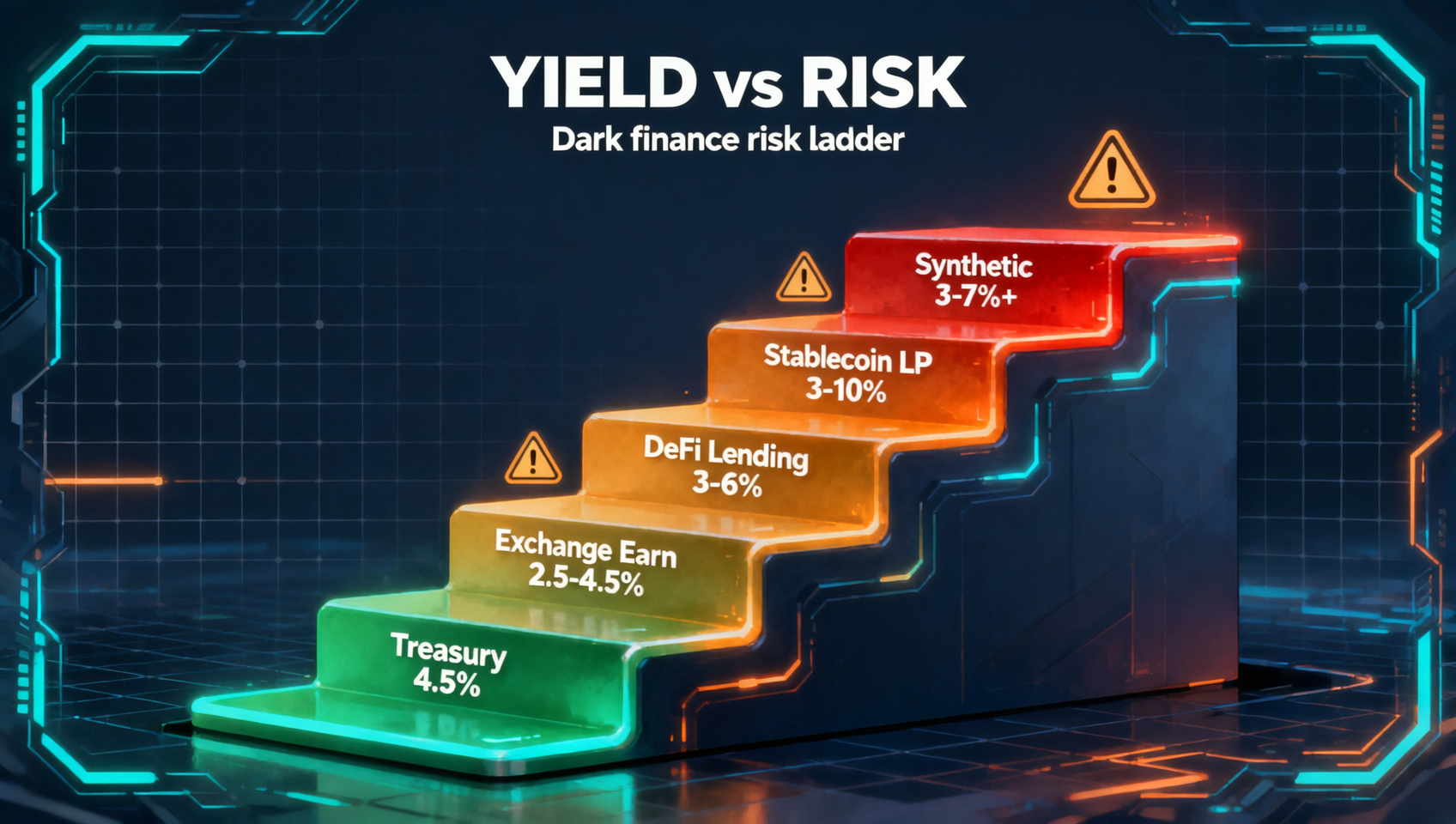
A reusable judgment standard: every time the yield steps up a tier, first ask "what risk is this tier paying me for." If you can't answer — or the other party talks only about returns and never about "where the yield comes from, who subsidizes it, and the worst-case loss" — then assume that tier isn't for you.
Decision table: choose by amount, horizon, and risk tolerance
There's no "best" channel, only the one that fits your current situation. Match against three variables:
| Your situation | Recommended move | Why |
|---|---|---|
| Beginner / small amount / want it easy | Exchange flexible (USDT) | Zero barrier, withdraw anytime, complete the "deposit-collect-withdraw" loop first |
| Idle funds / can lock 1-3 months | Exchange locked terms or RWA money-market fund | Lockup buys higher, steadier yield |
| Can operate a wallet / want steadier yield | Deposit USDC in Aave/Compound | Decentralized, market-driven but relatively "real" |
| Want more yield / accept depeg risk | Curve stablecoin pools / Morpho | Earn 1-3 points more, but understand depeg and strategy risk |
| Veteran / understand basis trading / can handle negative yield | sUSDe-style synthetic dollars | Highest ceiling, but can turn negative |
| Insist on beating 10% no matter what | Stop and reassess risk | Stablecoins shouldn't yield this much; there's likely a catch |
Three "stop conditions" — hit any one and hold off:
- You only understand "X% APY," not "where the yield comes from" → stop, understand the source before investing.
- Someone promises "principal and interest guaranteed," "can't lose," or "risk-free" → treat it as a scam or false advertising and walk away.
- The yield is clearly more than double the Treasury rate (~9%-10%) yet no one can explain who's subsidizing it → stop; this is the same signal seen before UST's collapse in 2022.
The 5 mistakes beginners make
- Treating "maximum APY" as "actual APY." Binance's 7% only applies tiered to amounts up to 800 USDT; Morpho's 10% is a historical peak. Neither is your entire principal's steady return. Calculate the "effective APY" and look at the low end first.
- Assuming "crypto yield always beats banks." In 2026 DeFi lending often trails the ~4.5% 1-year Treasury, and exchange flexible doesn't reliably beat it either. Stop assuming crypto passively prints money.
- Swapping coins for a 0.5% spread. You see USDT paying slightly more than USDC and swap everything over — but USDT has weaker reserve transparency and compliance, so you've traded security for a few dollars of yield. Not worth it.
- Providing LP while only looking at APY, not the pool's contents. A stablecoin pool that depegs becomes "all-in on the depegged coin," and you withdraw depreciated coins. Check first whether the pool holds coins with depeg history or opaque reserves.
- Treating synthetic dollars as "high-interest deposits." sUSDe-style products can go negative and carry counterparty risk — they're structured financial positions, not "deposit and collect interest." If you don't understand the basis logic, don't touch them.
FAQ
Q1: Is stablecoin yield safe? Can I lose my principal? You can lose principal. Stablecoins carry depeg risk, and each yield channel adds its own risk (exchange custody, contract bugs, LP depeg, funding reversal). No yield channel guarantees your principal — first ask "where does the yield come from."
Q2: Why is DeFi yield usually higher than exchange earn? The extra is compensation for taking on more risk yourself — no middleman takes a cut, so the ceiling is higher, but you bear smart-contract and bad-debt risk yourself.
Q3: Is stablecoin yield higher than banks or Treasuries? Not necessarily. The 1-year Treasury is ~4.5%, and Aave's USDC yield has been below it about 78% of the time in 2026. Stop assuming crypto yields are always higher.
Q4: Can I touch a product paying 10%+? Default to treating it as a red flag. A stablecoin paying a steady 10%+ either has unsustainable yield or isn't a real stablecoin. UST paid 20% and went to zero.
Q5: Where's the easiest place for a beginner? Exchange flexible earn (Binance Simple Earn USDT flexible 2.5%-4.5%, up to 7% during campaigns), withdrawable anytime, lowest barrier. Move to Aave/Compound once you know on-chain operations.
Q6: Can I lose money providing stablecoin LP? Yes, mainly from depegging — when a coin in the pool depegs, you end up holding lots of the depreciated coin. Stablecoin-to-stablecoin pools have minimal impermanent loss; the real risk is depeg.
Q7: Which pays more, USDT or USDC? Usually USDT pays slightly more (0.5%-1% higher on Aave), but the gap is small. Choose the coin you trust more first, then compare yields within that coin — don't swap for a small spread.
Q8: Do I pay taxes on yield? Likely, depending on your jurisdiction. Most places treat stablecoin interest/earn rewards as taxable income. This article is not tax advice — consult a local professional.
Summary: remember this one line
Stablecoin yield comes from four different kinds of money (borrower interest, real-asset interest, trading fees, basis money) in rising order of risk; use the ~4.5% 1-year Treasury as your ruler, then judge what risk each "high APY" is paying you for — beginners start with exchange flexible, the next step is Aave/Compound, add some RWA for steadiness, and treat anything above 10% as a risky asset rather than "guaranteed interest."
To build up the prerequisites in order: start with the Stablecoin Complete Guide to understand how USDT/USDC/DAI work, then USDT vs USDC deep comparison to pick your coin, and Stablecoin Regulation for 2026's compliance changes — finally, use this article to decide where to park your money for yield.
Don't have a Binance account yet? Register on Binance (referral code: BINANBT) — see Binance registration & deposit guide for the signup, KYC, and first deposit flow. You can also use OKX (referral code: 60895497); both offer flexible and locked earn products for USDT/USDC to put idle stablecoins to work.
📚 Further reading: On-chain Guide — a free tutorial site for learning blockchain and on-chain data from scratch.
Disclaimer: This content is for educational purposes only and does not constitute investment, financial, or tax advice. Stablecoins and their yield products carry depeg, platform, and contract risks that may result in loss of principal. Please make decisions based on your own situation and consult a professional where necessary.
Footnotes
-
CleanSky, "Best stablecoin yields (2026) — where to earn on USDC, USDT, and DAI" (https://cleansky.io/learn/best-stablecoin-yields/): Aave V3 USDC/USDT ~3%-6%, USDT typically 50-100 bps above USDC; Compound V3 USDC 2%-5%; Morpho Blue 4%-10% with conservative curators at 4%-5%; Coinbase USDC rewards 3.5%-5%, Kraken 4%-6%; Ethena sUSDe historical range and 2026 decline; stablecoin depeg and LP risk. Verified 2026-09-09. ↩ ↩2 ↩3 ↩4 ↩5 ↩6 ↩7
-
Binance official announcement, "Binance Will Renew USDT Simple Earn Flexible Products Campaign With Up to 7% APR" (https://www.binance.com/support/announcement): USDT Flexible products campaign up to 7% APR, tiered as 4% bonus tiered APR + ~3% real-time APR, typically only on subscription amounts up to 800 USDT, with the excess at the real-time APR; campaign periods 2026-08-25 to 09-07 and 09-08 to 09-22; standard USDT flexible real-time APR ~2.5%-4.5%. Verified 2026-09-09. ↩ ↩2
-
IXS Finance, "Stablecoin Yield in 2026: The Four Models and Where Each One Breaks" (https://www.ixs.finance/news/stablecoin-yield-in-2026-the-four-models-and-where-each-one-breaks/): the four stablecoin yield models (DeFi lending / RWA / basis trading / native stablecoin yield) and their failure modes; Aave USDC briefly at 2.61% in April 2026; the Kelp DAO bridge exploit leaving Aave ~$196M in bad debt and triggering ~$6.6B in withdrawals; Sky sUSDS falling from a 12.5% 2024 peak to 1.6%-4.5%; BlackRock BUIDL ~3.40% 7-day APY, private-credit vault ~9%. Verified 2026-09-09. ↩ ↩2 ↩3 ↩4 ↩5
-
BingX flash news, "Onchain stablecoins top $290B, yet DeFi lending yields often lag 1-year U.S. Treasuries" (https://bingx.com/en/flash-news/): in 2026 Aave's USDC yield was below the 1-year Treasury about 78% of the time, averaging ~31 bps below; 1-year Treasury yield ~4.5%. Verified 2026-09-09. ↩
-
DeFi Risk Monitor, "DeFi Yield Strategies Q2 2026: Stablecoin Yields, LST Loops, and Risk Tiers" (https://defi-monitor.com/blog/defi-yield-strategies-q2-2026-stablecoin-yields-lst-loops-and-risk-tiers-explained/): Morpho optimized-lending yield tiers and sUSDe yield compression to ~3.72% in Q2 2026. Verified 2026-09-09. ↩
-
Aggregated public data (Curve/Convex stablecoin pool yield structure): stablecoin-to-stablecoin Curve pools ~3%-10%, of which pure fee yield is 0.5%-1% and the rest comes from CRV/CVX governance-token incentives. Verified 2026-09-09. ↩
-
eco.com, "sUSDe Explained: Ethena's Yield-Bearing Stablecoin" and public data: sUSDe 7-day APY ~7.1% in June 2026 (~9.4% in April), all-time high 35.2% and low 4.1%; after Ethena's April 2026 restructuring, perpetual collateral fell to 11% of backing with the bulk moved to CLOs and corporate bonds/short-term credit. Verified 2026-09-09. ↩