


TL;DR
- Cashing out isn't the same as withdrawing — "turning crypto into cash" really means selling: you sell USDT for fiat and a buyer transfers money to your bank account
- A frozen account isn't caused by cashing out — it's caused by receiving tainted money — money from fraud or gambling cases is the biggest cause, bank risk controls second
- Safe cash-out comes from transparency + verified identity + reputable channels, not secrecy — the more you can prove you're a clean, verifiable counterparty, the safer you are
- The direct answer for beginners: an account in your own name + high-reputation merchants on a reputable exchange + full records; for large amounts, use a licensed OTC desk, and never chase "high-price" offers
People who ask "how do I cash out crypto" usually have one picture in their head: find a buyer, sell the USDT, money lands in the bank account, done.
But anyone who has been through this step knows it's the highest-risk final mile of the whole process — no matter how much you made earlier, a frozen account or tainted funds can wipe you back to zero overnight. This guide walks through the full cash-out paths, the two real reasons accounts get frozen, and the right way to do it safely, then hands you a "pick by amount" decision table.
Table of Contents
- First, get clear: you're selling, not withdrawing
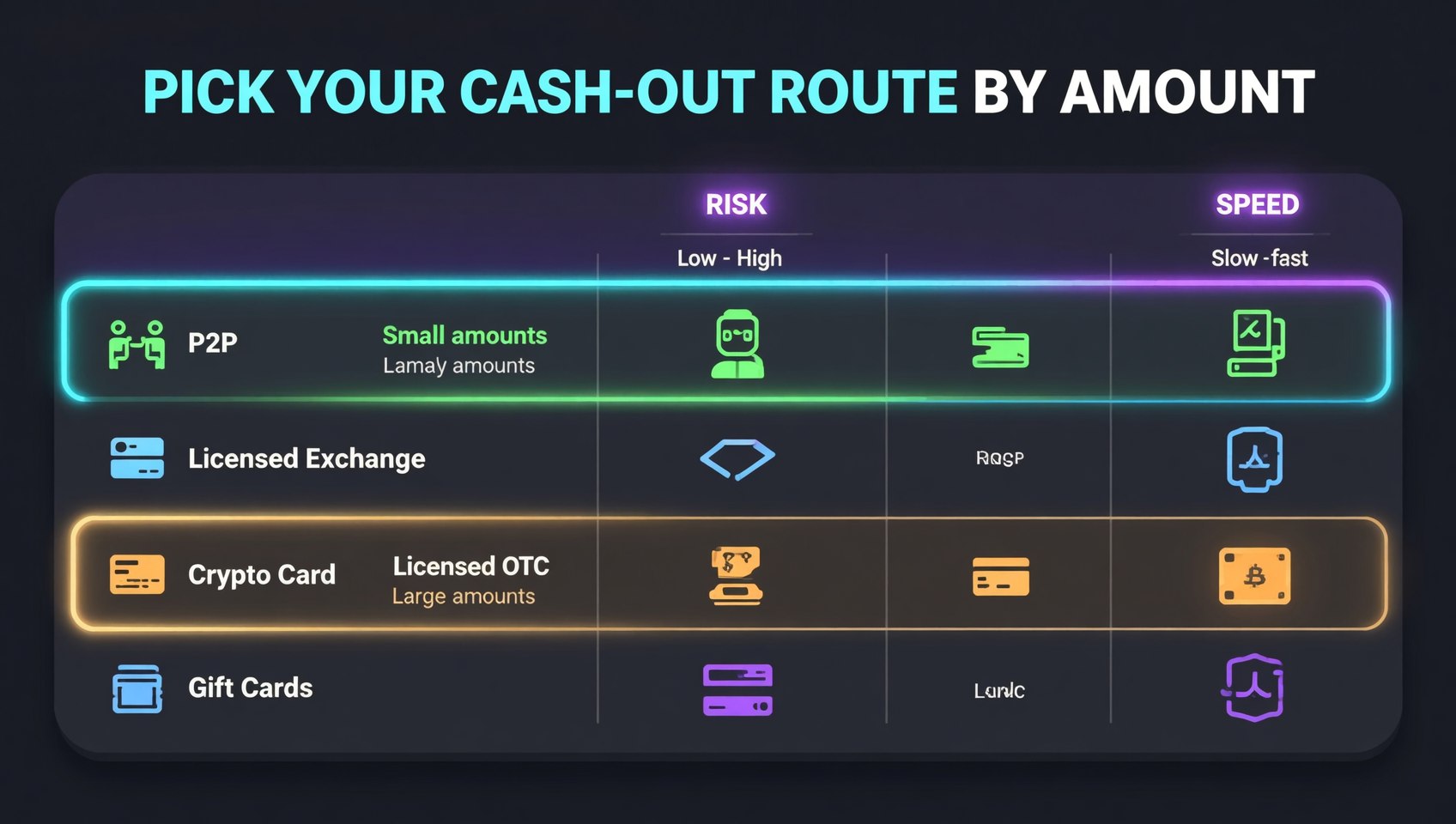
- The 4 main cash-out routes, with very different risk and cost
- Why do accounts get frozen? Two real reasons
- How to cash out safely: a decision framework
- Large amounts: don't force retail P2P
- If your account is frozen: what to do
- 4 reality checks beginners should know
- 5 red lines: never do these
- FAQ
- Summary: one sentence to remember
First, get clear: you're selling, not withdrawing
Before you start, untangle the confusion most beginners have. "Cashing out" sounds like "withdrawing," but it's completely different from a crypto withdrawal:
- Withdraw (提币): moving coins from an exchange to a wallet, or between wallets — the coins are still coins, just stored somewhere else.
- Cash out (出金): selling the coins for fiat (CNY, USD, etc.) and transferring it to your bank account. There's a counterparty — you sell USDT to someone who pays you fiat.
Cashing out is a sale, not a transfer. This leads to the single most important point: your safety doesn't depend on whether your coins are clean — it depends on whether the money your buyer pays you is clean. This is the root of every frozen-account story below.
The 4 main cash-out routes, with very different risk and cost
| Route | How it works | Cost / speed | Risk | Who it's for |
|---|---|---|---|---|
| ① Exchange C2C/P2P | Sell USDT to a KYC merchant on Binance/OKX's P2P market; the merchant transfers fiat to your card | Usually 0 platform fee, minutes | Medium (tainted-money risk, depends on who you pick) | Most people, small amounts |
| ② Licensed-exchange fiat withdrawal | Use a licensed exchange's official fiat rail; funds come from the official account | Has fees, possibly T+1/T+2 | Low | People with compliant accounts |
| ③ Crypto card | Spend or withdraw at ATMs with a crypto card (Visa/Mastercard) | Funding/ATM fees | Low (doesn't touch your bank account) | People who need overseas spending |
| ④ Spend directly / gift cards | Pay directly with crypto, or buy JD/Amazon gift cards | Some discount | Low | People who want to spend crypto as money |
In one sentence: small amounts use ①, large amounts use ②/③, and ④ is for spending crypto as money. Most users start with route ① (C2C) because it's the lowest-barrier and fastest — which is exactly why it's also where frozen-account risk concentrates. Let's focus on it.
Why do accounts get frozen? Two real reasons
This is the most important section. A frozen account isn't a mystery — there are only two causes. Understand both and you'll know how to avoid them:
Reason one: your account received tainted money (police/judicial freeze)
This is the most common and most serious case. You sell USDT on C2C, and the buyer pays you fiat — but that fiat may not be the buyer's own money: it could be proceeds from a fraud or gambling case, or a laundering ring swapping dirty cash for your USDT (converting dirty money into clean crypto assets).
Once tainted money flows into your account and a victim or the police trace it back, your account gets a police/judicial freeze. You did nothing wrong — you were simply, innocently, turned into a "relay stop" on a laundering chain.
This is why "high-price offers" are the most dangerous — a normal buyer pays market price; only someone in a hurry to launder dirty money will pay above market for your coins. A high price often smells like dirty money.
Reason two: abnormal account activity (bank risk-control freeze)
Banks run anti-money-laundering / anti-fraud models that flag patterns like "in-and-out transfers," "large late-night transfers," or "frequent transfers from many different strangers." The bank may put a risk-control freeze first and ask you to explain in person.
This doesn't involve crime — as long as you can explain the source of funds (transaction records, platform orders), it usually clears after review.
The key insight: the first kind of freeze (tainted money) is the truly troublesome one, since it involves criminal investigation and can last six months. So the number-one priority of safe cash-out is keeping tainted money out of your account — not trying to make your operations more discreet.
How to cash out safely: a decision framework
Once you understand the two causes, the right actions are clear. The core principle is one sentence: make yourself a verifiable, clean, well-documented counterparty.
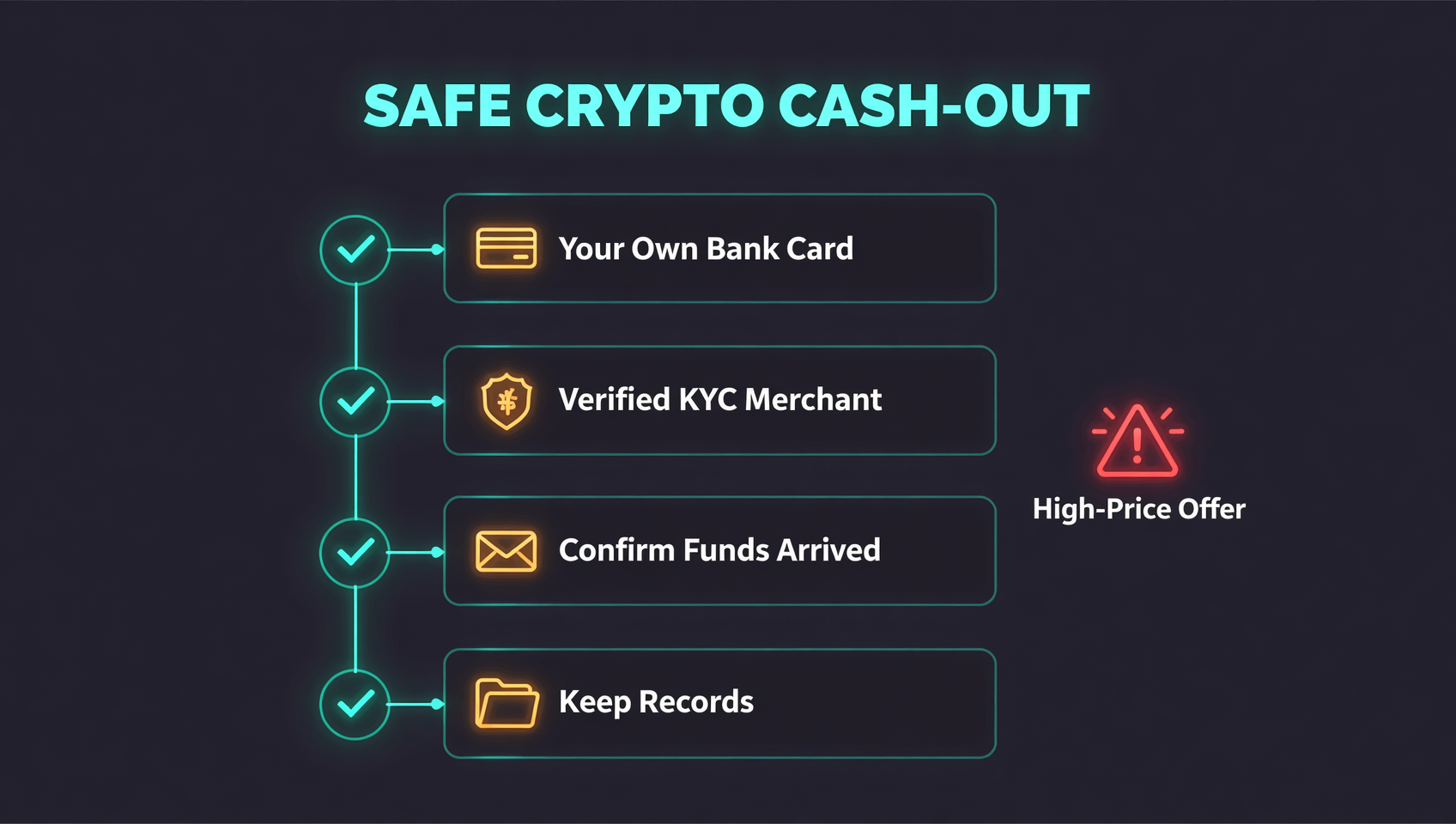
1. Card: your own name + dedicated
- Always use a bank account in your own name, with the exchange KYC name matching the bank account name exactly. Receiving money on someone else's card (even a family member's) is itself a major risk signal.
- Use a dedicated, rarely-used card for cashing out — not your salary card, mortgage card, or main spending card, so a freeze doesn't disrupt your life.
- Prefer regional banks (city/rural commercial banks); big national banks have stronger cross-region freezing power and more branches.
2. Counterparty: reputable platform + high-reputation merchant
- Only use the C2C market on a major exchange like Binance or OKX — never trade privately over WeChat/Telegram. The platform provides escrow and KYC, so there's a paper trail if anything goes wrong.
- Choose platform-certified merchants with high trade volume (1000+), a long history (1+ year), and normal pricing. Abnormally high/low prices, low volume, or brand-new accounts are all red flags.
- Never chase "high-price" offers — a bid above market for your USDT is very likely dirty money.
3. Process: keep records + verify
- Keep full records: order screenshots, chat logs, the on-chain transfer hash, and bank statements — all four. These are the key materials for unfreezing later.
- Verify before releasing crypto: confirm the amount and payer name match the order, and that the money actually arrived in your bank account (not just a screenshot the buyer sent).
- Leave the transfer memo blank — don't write "USDT," "crypto," or similar.
4. Prefer T+1/T+2 platforms or channels
Platforms with a funds buffer (delayed release after deposit) are inherently more compliant and less used for laundering. Better to wait a day than to grab a risky "instant" channel.
Large amounts: don't force retail P2P
As the amount grows, retail P2P risk multiplies — a single large transfer more easily triggers bank risk controls and attracts laundering rings.
For roughly $100,000 (≈700,000 CNY) or more, skip retail P2P entirely and prefer:
- Licensed OTC desks in Hong Kong/Singapore: a signed agreement, third-party escrow, and KYC; funds move through the licensed institution's official account, which banks treat as normal institutional business — far lower risk than person-to-person.
- Licensed-exchange fiat channels: exchanges with proper licenses and direct fiat rails.
- Crypto cards: load USDT onto a crypto card and spend or withdraw at ATMs, bypassing your personal bank account entirely.
Small amounts via DCA, large amounts via licensed channels — that's the base layer for cashing out cleanly and safely.
If your account is frozen: what to do
If the worst happens, don't panic, and don't grasp at straws. The many "paid unfreezing" and "inside-connection unfreezing" offers online are all scams — the only real path is cooperating with the investigation + providing records.
Step one: identify the freeze type
Ask the bank (or customer service) who froze it and why:
- Bank risk-control freeze: from abnormal activity. Bring your ID and card to your branch, explain the source of funds, submit transaction records, and it usually clears within days.
- Police/judicial freeze: from receiving tainted funds. The bank will tell you the freezing agency name, case number, and contact.
Step two: handling a police/judicial freeze
- Contact the freezing agency and explain you are a good-faith third party — a normal crypto transaction, with no knowledge of the funds' origin.
- Submit full records: bank statements, platform orders, chat logs, the on-chain hash — proving it was a real, ordinary transaction.
- Cooperate with the statement-taking and wait for review. These freezes usually last 3 days initially; if converted to a formal freeze it's typically 6 months, during which you cooperate and explain.
- If needed, seek a lawyer to assert good-faith acquisition.
Step three: after unfreezing
After it's unfrozen, switch to a new dedicated card for cashing out — don't reuse the frozen one, which is now flagged and more likely to trigger again.
4 reality checks beginners should know
Your account freezes because of tainted money, not because you cashed out. Beginners think "cashing out = risky" and look for a "discreet channel." That's backwards — what you need to avoid isn't the act of cashing out, it's "money from an unknown source."
Safe cash-out comes from transparency, not secrecy. The more you can prove you're clean, verifiable, and well-documented, the safer you are. Conversely, the more discreet your operations, the more they look like laundering and the more likely you are to trigger risk controls or be treated as an accomplice.
A "high-price" offer isn't a bargain — it's dirty money. Someone willing to pay above market for your USDT is usually not a fool but someone in a hurry to launder. The few points you save aren't worth six months of a frozen account.
"Instant" isn't necessarily better. A T+1/T+2 buffer is the platform protecting you. Grabbing an "instant" channel means deliberately skipping that protection.
5 red lines: never do these
- Never receive money on someone else's card, and never collect/forward payments for others. That's the classic "laundering accomplice" profile — if a case is involved, you go from innocent victim to accomplice.
- Never chase high-price or mysterious "large orders." High price = dirty money; engrave this judgment in your head.
- Never trade privately over WeChat/Telegram. No platform escrow, a scam hotbed, and no recourse if something goes wrong.
- Never write "USDT," "crypto," or "BTC" in the transfer memo. A few words can turn a normal transfer into a flagged one.
- Never trust "paid unfreezing" or "inside-connection unfreezing." Cooperation with the investigation is the only path; everything else is a second scam.
FAQ
How do I cash out crypto? What are my options?
There are four main routes: ① exchange C2C/P2P to sell USDT for fiat (most common), ② licensed-exchange fiat withdrawal, ③ a crypto card to spend or withdraw at ATMs, and ④ spending directly or buying gift cards. Small amounts can start with a reputable exchange's P2P; large amounts should prefer a licensed OTC desk or licensed-exchange fiat channel.
How do I convert USDT to cash?
On a reputable exchange like Binance or OKX, use the C2C/P2P market to sell USDT to a KYC-verified merchant, who transfers fiat to a bank account in your own name. Confirm the funds actually arrived before you release the crypto, and never trade privately over messaging apps.
Will cashing out freeze my bank account?
Possibly, but a frozen account is usually caused by receiving tainted money or by abnormal account activity, not by cashing out itself. Using an account in your own name, choosing high-reputation merchants on a reputable platform, avoiding suspiciously high offers, and keeping full records substantially lowers the risk, but it can't be reduced to zero.
What should I do if my account gets frozen?
First identify the type: a bank risk-control freeze (abnormal activity) is resolved at your branch with proof of funds; a police/judicial freeze (tainted funds) requires you to obtain the freezing agency and case number, cooperate with the investigation, and submit your transaction records to show you acted in good faith. Never trust anyone offering "paid unfreezing."
What's the safest way to cash out a large amount?
For amounts around $100,000 or more, don't go through retail P2P. Prefer a licensed OTC desk in Hong Kong or Singapore (contract, third-party escrow, KYC), or a licensed exchange's fiat channel, or a crypto card. Funds moving through a licensed institution's official account carry far less bank risk than person-to-person transfers.
Do I pay tax when cashing out crypto?
That depends on your local tax rules. Most countries treat gains from selling crypto as taxable income (capital gains). Consult a local tax professional; this is not tax or legal advice.
Summary: one sentence to remember
Safe cash-out = an account in your own name + high-reputation merchants on a reputable platform + full records; small amounts via DCA, large amounts via licensed channels — the core is transparency, not secrecy; never chase high-price offers, never touch dirty money.
Get the fundamentals right first — read what stablecoins are and how USDT works. To start, register on Binance (code BINANBT) or register on OKX (code 60895497), then see the Binance C2C guide and OKX C2C guide to sort out the on-ramp side too.
Disclaimer: this content is for educational purposes only and is not investment, legal, or tax advice, nor does it teach any method of evading regulation, bank risk controls, or platform restrictions. Crypto-related operations exist in a legal and regulatory gray area in mainland China. Always use an account in your own name, choose licensed and reputable channels, comply with the law, and verify each platform's latest rules, fees, and your local laws yourself.
📚 Further reading:
- On-chain guide — more on-chain data and crypto education
- What are stablecoins? USDT, USDC, DAI explained
- How USDT works: minting, pegging, reserves, freezing
- Crypto deposit & withdrawal: exchange to wallet
- Binance deposit guide: C2C, quick buy, on-chain
- OKX C2C guide: buy USDT with CNY + avoid frozen cards