



Table of Contents
- TL;DR: The Bottom Line First
- What a Memecoin Actually Is
- The Counterintuitive Data: Memecoin Survival Rates
- The Big Three: DOGE / SHIB / PEPE
- A Cautionary Tale: How the TRUMP Coin Harvested Its Buyers
- What Actually Makes a Memecoin Pump? Who Makes the Money?
- Should You Touch Memecoins? Four Profiles
- If You Must Participate: 5 Red Lines
- FAQ
- Further Reading
TL;DR: The Bottom Line First
Can you buy memecoins? Yes, but first fix one fundamental misconception: a memecoin is not an investment — it's an "attention lottery ticket." It creates no value, and its price depends entirely on whether more people pile in behind you. Every dollar you make comes from the next buyer, not from the project accomplishing anything.
Three judgments to remember:
- Blue-chip memecoins and on-chain shitcoins are two different worlds. DOGE (
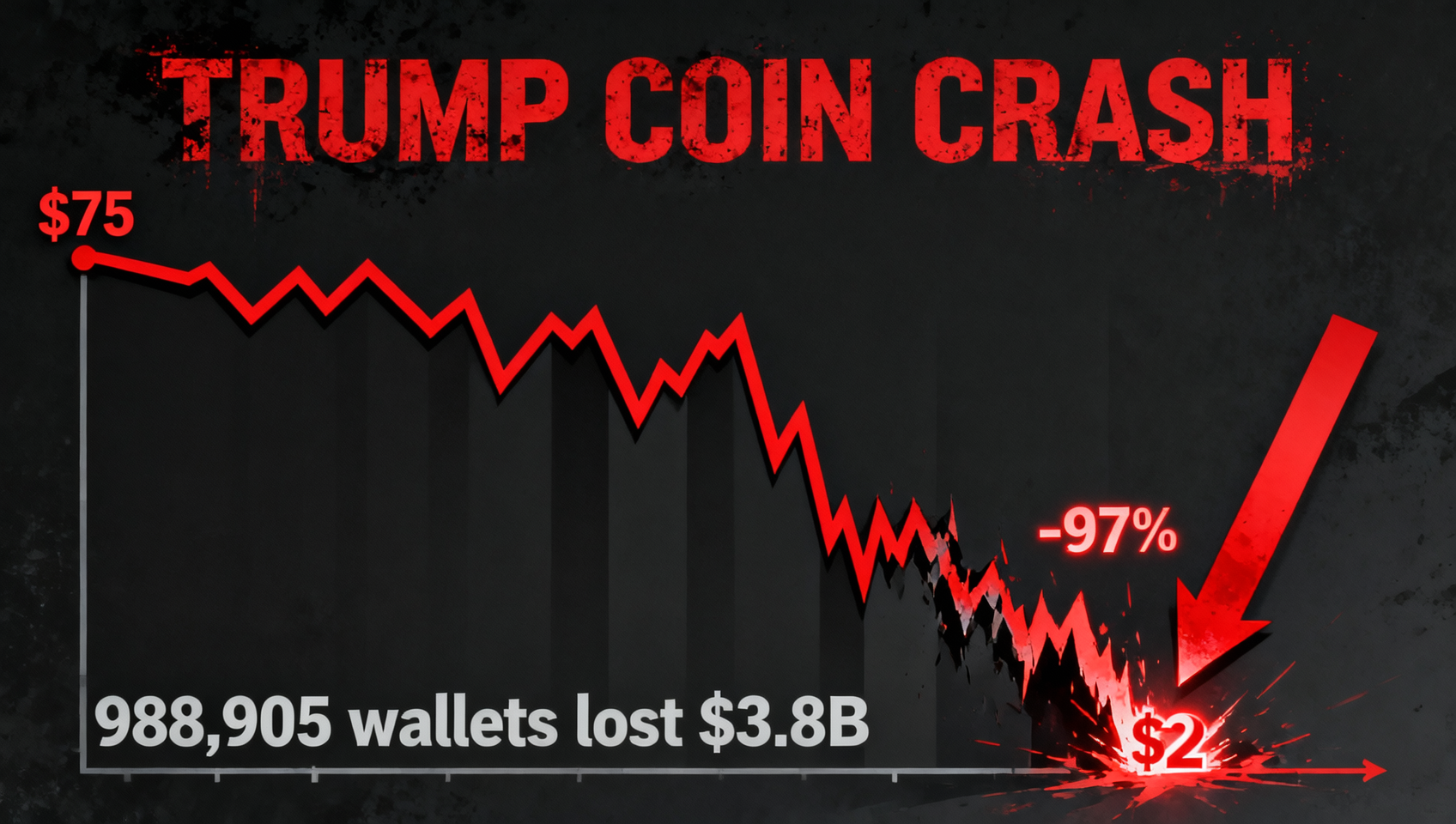
$15B market cap), SHIB ($3B) and PEPE (~$1.5B) are listed on Binance and OKX, are liquid, and won't vanish in a day; but of the 20,000+ tokens launched on pump.fun every day, 80% die within a day and only 4.55% survive 90 days1. - A celebrity endorsement is a danger signal, not a value signal. The TRUMP coin fell from $75.35 to about $2 (a 97% drop), and Nansen counted roughly 988,905 wallets losing a combined $3.81 billion2. The bigger the hype, the bigger the harvest.
- Only ever buy memecoins with money you can afford to lose completely. There is no "fundamental" to repair the price — whether it comes back is pure luck.
⚠️ This article explains what memecoins are and their risks; it is not investment advice. Memecoins are highly speculative and most go to zero — only participate with money you can afford to lose in full.
Who this article is not for: complete beginners who don't yet know what a wallet, gas fee or spot trading is and want to get rich fast — start with the complete crypto wallet guide and what DeFi is first.
What a Memecoin Actually Is
A memecoin is a cryptocurrency built around an internet meme, emoji or cultural symbol. Its "selling point" isn't technology or a product — it's the meme itself: a Shiba Inu (DOGE), a frog (PEPE), a celebrity, or even a politician (TRUMP).
The most fundamental difference from a major coin is where its value comes from:
| Dimension | Bitcoin (value coin) | Memecoin (attention coin) |
|---|---|---|
| What it has | 21M hard cap, decentralized consensus, 14-year security record | a meme, a community, a pile of emojis |
| Supply | capped at 21 million | uncapped inflation (DOGE) or trillions (SHIB 589T, PEPE 420T) |
| What problem it solves | censorship-resistant value storage | solves almost no real problem |
| What drives price | scarcity + network effects | attention + emotion + fresh buyer money |
This table is a mechanical fact, not a value judgment: a memecoin has no cash flow, no product and no fundamentals, so its price can't be anchored to any "value" — only to hype. When hype arrives, it doubles in a day; when hype leaves, it goes to zero overnight. Understand that, and everything else falls into place.
The Counterintuitive Data: Memecoin Survival Rates
Most people only see DOGE doing hundreds of times over or PEPE getting listed on Binance, but they don't see that 97% of projects in this market are already dead. Here's the real distribution (CoinGecko's study of pump.fun, January 2024 – June 2026)1:
| Metric | Figure |
|---|---|
| Total tokens launched | ~18.67 million |
| Average new tokens per day | over 21,000 |
| Ended trading on launch day | 68.67% |
| Died within a day | 80.37% |
| Survived past 90 days | only 4.55% (~850,000 tokens) |
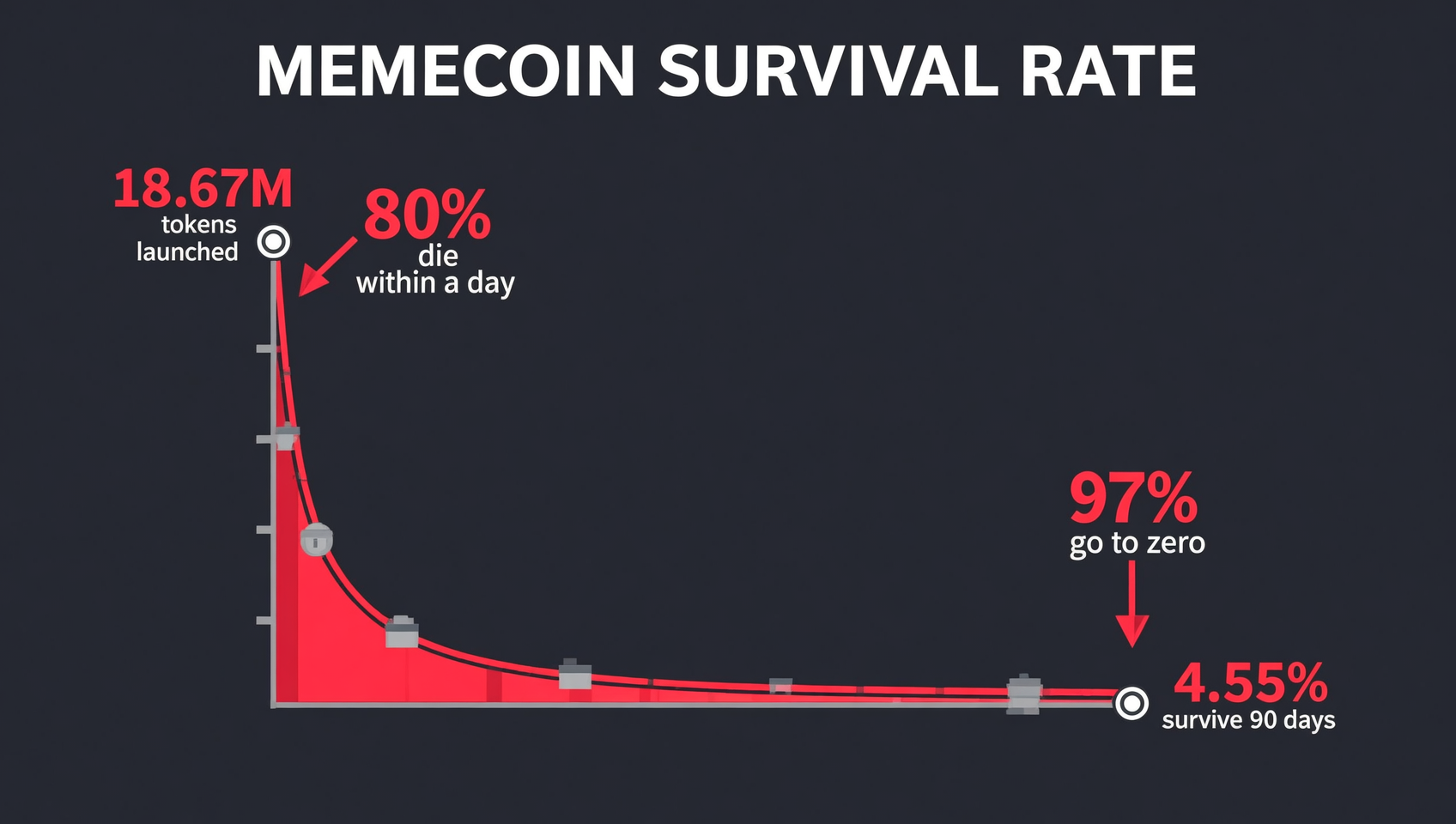
In other words, behind every "100x memecoin" you see are thousands of tokens that went to zero. That's survivorship bias — the media only reports the winners, and the losers don't make headlines. And another figure stings even more: roughly 97% of memecoins ultimately fail3.
The Big Three: DOGE / SHIB / PEPE
DOGE, SHIB and PEPE are "surviving blue chips," not "assets worth buying." What they share: they've accumulated enough market cap and liquidity, and all are listed on major exchanges like Binance and OKX, so they won't go to zero in a day the way a shitcoin would. The difference is in their narratives and tokenomics.
Dogecoin (DOGE) — the original joke coin. Created as a joke by two engineers in 2013, it survived for over a decade and became the largest memecoin (around $15 billion). But note its economic model: it has no supply cap and inflates by roughly 5 billion coins a year — it's fundamentally a perpetually inflating asset45. It's alive today not because of tech, but because of cultural inertia: Musk's tweets, community faith, and a tipping use case.
Shiba Inu (SHIB) — the self-proclaimed "DOGE killer." Born in 2020, its supply is a staggering 589 trillion tokens (which is why its price looks like a tiny fraction of a cent), with a market cap around $3 billion. SHIB has tried to escape the "pure meme" label by building an ecosystem (ShibaSwap, a Layer 2), but the bulk of its token value is still sentiment-driven5.
Pepe (PEPE) — the 2023 frog wave. Based on the famous frog meme, with a supply around 420 trillion tokens and a market cap near $1.5 billion. It pushed the memecoin to its purest form: the team openly declared that "PEPE has no utility and no expectation of value," and it runs purely on community sentiment and FOMO5.
One-line summary: DOGE is the "old inflationary joke coin," SHIB is the "traffic coin trying to legitimize itself," and PEPE is the "pure sentiment coin." None has fundamentals — the only difference is community size and how much self-deception is involved. If you want to buy any of these, see the is Dogecoin worth buying guide for the decision framework.
A Cautionary Tale: How the TRUMP Coin Harvested Its Buyers
The Official Trump memecoin ($TRUMP) is a textbook case of the "celebrity memecoin." It pushed the "memecoin = attention lottery" essence to its logical extreme.
The timeline was short: after launching in January 2025, $TRUMP rode inauguration hype to a peak of $75.35, briefly inflating to a market cap around $27 billion. But hype is fuel, and once it burns out, there's nothing left — by October 2026 the price was about $2, down more than 97% from the peak2.
The scale of the loss was equally striking. Blockchain analytics firm Nansen counted roughly 988,905 wallets (two-thirds of buyers) losing a combined $3.81 billion; a $1,000 buy at the peak was worth only about $37 by April 20262.
The lesson isn't that "Trump's project was bad" — it's a more general law: a celebrity, politician or brand "endorsement" is a signal amplifier for harvesting, not a guarantee of value. Celebrity hype can vacuum up enormous retail capital in a very short time, and hype always fades faster than the insiders can dump.
What Actually Makes a Memecoin Pump? Who Makes the Money?
A memecoin has exactly one price driver: more people buying at a higher price later. It pays no interest, no dividend, and generates no cash flow, so any price rise is a wealth redistribution within a zero-sum game — for every winner there's a loser of equal size (minus fees and the insiders' cut).
The chain usually goes like this:
- A few early players and "whales" accumulate at rock-bottom prices (near-zero cost).
- They manufacture hype through KOL shills, community FOMO, and "100x" narratives on social media.
- Retail buys in only after the price has already run up.
- Hype peaks, and the early players and whales dump in batches at the top.
- The price crashes, and retail is left holding the bag.
The money you make comes from people who enter later than you; the money you lose goes into the pockets of people who entered earlier. That's a mechanical description, not a moral judgment. Once you understand it, the answer to "can you make money with memecoins" becomes clear: yes, but it's a negative-sum game (there are fees and insider take), so the long-term expected value is negative.
Should You Touch Memecoins? Four Profiles
The conclusion is simple: most people shouldn't, a few can with a tiny position, but only if you treat it as gambling, not investing. Match your situation:
| Your situation | Should you? | Why |
|---|---|---|
| Complete beginner wanting to get rich fast | ❌ No | No stop-loss discipline, easily ruled by FOMO, likely to be the bag holder |
| Looking for a "fundamentals-backed" long-term investment | ❌ No | Memecoins have no fundamentals; "value investing" doesn't apply |
| Some experience, just want a small bet, can afford total loss | ⚠️ Tiny position | Buy only blue chips (DOGE/PEPE/SHIB), use a real exchange, take profit strictly |
| Chasing shitcoins on a "celebrity endorsement" for a 100x | ❌ No | Celebrity endorsement is a harvest signal — 988,905 TRUMP buyers already verified this with real money |
My reasoning: I won't say "all memecoins are scams" — DOGE and PEPE do have real communities, and some people do make money. A more accurate statement is: memecoins are a negative-expected-value speculation game; you can gamble a small amount for fun if you understand the rules, but never treat them as asset allocation or a path to riches. If you have to pause to think about what "negative expected value" means, then the answer is simply: don't.
Stop conditions — stop immediately if any of these apply: the money you're about to put in is living expenses, rent or borrowed; you've started "adding to lower my average"; you're buying out of anxiety from seeing others 100x; or you can't explain why the coin is worth its current price.
If You Must Participate: 5 Red Lines
If, after all that, you still want to try with a small position, at least hold these five lines to keep "losing it all" within what you can tolerate:
- Only use money you can afford to lose completely. Going to zero is the norm for memecoins — treat this money as spent on an experience.
- Only buy blue-chip coins listed on major exchanges. DOGE, PEPE and SHIB can be bought by registering on Binance or OKX, and their liquidity and safety far exceed on-chain shitcoins. Don't chase on-chain shitcoins to "get in earlier and cheaper" — entering a day earlier means one more chance of being harvested by a honeypot or rug pull.
- Set a take-profit line before you enter, and sell when it hits. A memecoin has no "hold until value returns" — taking profit is the only way to survive.
- Never add to a position out of FOMO, and never borrow or use leverage. Memecoin volatility can wipe out your position instantly, and leverage multiplies that speed several times over.
- Run the identification checklist before touching any shitcoin. At minimum, check whether the contract is open-source, whether liquidity is locked, and whether holders are over-concentrated — see how to identify rug pulls and the honeypot token detection guide for the full four-step checklist and tools.
FAQ
What is a memecoin, and how is it different from Bitcoin?
A memecoin is a cryptocurrency built around an internet meme, emoji or cultural symbol — no product, no cash flow, no real use, with value driven entirely by community consensus and attention. The difference from Bitcoin: Bitcoin has a 21-million hard cap and clear decentralized consensus, while memecoins have supplies in the trillions (SHIB 589T, PEPE 420T) or inflate forever (DOGE ~5B/year), and solve no real problem.
Can you make money with memecoins? Why do some people 100x?
You can, but it's winning a zero-sum game, not earning an investment return. A memecoin creates no value; its only price driver is more people buying higher later, so a few 100x because many more hold the top. CoinGecko found 80.37% of pump.fun tokens die within a day and only 4.55% survive 90 days — you see the survivors, not the 97% already at zero.
Should I still buy DOGE, PEPE or SHIB?
They're surviving blue chips, not "worth buying." Market caps are roughly $15B, $3B and $1.5B respectively (2026, fluctuating). They're liquid and won't vanish like a shitcoin, but they're still pure sentiment with no fundamentals. If you buy, use only money you can afford to lose, and use a real exchange like Binance or OKX — never on-chain shitcoins.
What happened with the TRUMP (Official Trump) coin?
Launched January 2025, peaked near $75.35, collapsed to about $2 by October 2026 — down over 97%. Nansen counted roughly 988,905 wallets losing about $3.81 billion. It's a textbook political memecoin: celebrity hype sucks in massive capital, then the crash comes when hype fades. Celebrity endorsement isn't value — it usually means a bigger harvest.
Why do people keep buying shitcoins (on-chain memecoins)?
Because the "get rich quick" dream and the "someone already 100x'd" narrative are too seductive. A shitcoin costs a few hundred dollars to mint and launches in minutes, so the cost is near zero — hence 20,000+ new tokens a day, most dead within a day. It's a tiny-probability bet on a huge payoff with negative long-term expected value; stay away unless you have strict take-profit discipline and treat it as pure gambling.
How do I tell if a memecoin is a scam (shitcoin / honeypot)?
Three checks: the contract (open-source? privileged mint/sell functions?); liquidity (locked? how long? how much in the pool?); and holder distribution (top 10 over 80% = insider control). For the full four-step checklist and tools, see our rug pull identification guide and honeypot detection guide.
I'm stuck holding a memecoin at a loss. What do I do?
Face the honest fact: a memecoin has no "fundamentals that will recover" — recovery depends entirely on whether hype returns, which is unpredictable. If you invested money you can afford to lose, cut or reduce your position; if you invested money you can't afford to lose, lower leverage and position immediately, and never borrow or add to a worthless asset to lower your average cost.
Further Reading
- Is Dogecoin Worth Buying? 2026 Decision Guide — the full DOGE decision framework
- What Is a Rug Pull? How to Identify Scam Coins — the shitcoin/air-coin identification framework
- Honeypot Token Detection: How to Avoid Scam Coins with DEXTools — how to detect honeypot coins
- Common Crypto Scams 2026: Complete Guide — the full taxonomy of crypto scams
- What Is Bitcoin? A Beginner's Guide — contrast "value coins" with "attention coins"
- On-Chain Guide — more blockchain education and on-chain tutorials
Data verification note: memecoin market caps, supplies, the TRUMP coin decline and pump.fun survival rates were verified on 2026-10-04; sources in the footnotes below45213. Market caps and prices move constantly — always check CoinMarketCap, CoinGecko and exchange prices in real time before acting.
This article is not investment advice. Memecoins are highly speculative and most go to zero, carrying risks of price crashes, liquidity drains, rug pulls, honeypot contracts and backdoors. Only participate with money you can afford to lose in full, and comply with your local laws.
Footnotes
-
pump.fun survival rates (CoinGecko study, 2024-01-14 to 2026-06-18): ~18.67 million tokens launched, 21,000+ per day; 68.67% ended trading on launch day, 80.37% died within a day, only 4.55% (~850,000) survived 90 days. Source: CoinGecko (via crypto.news, KuCoin). ↩ ↩2 ↩3
-
TRUMP coin (Official Trump): launched January 2025, ATH ~$75.35, ~$2.05–$2.25 by October 2026 (down over 97%); market cap fell from ~$27 billion to ~$393 million; Nansen counted ~988,905 wallets losing ~$3.81 billion; a $1,000 peak buy was worth ~$37 by April 2026. Source: CoinGecko, Nansen, Yahoo Finance, Gate News. ↩ ↩2 ↩3 ↩4
-
Roughly 97% of memecoins ultimately fail. Source: Gate News ("Three meme coins hold $1B valuations as 97% of tokens fail"). ↩ ↩2
-
Dogecoin was created in 2013 by Billy Markus and Jackson Palmer, has no supply cap, and inflates by roughly 5 billion coins a year (10,000 DOGE block reward, ~1 minute blocks). Source: CoinMarketCap, Dogecoin.com. ↩ ↩2
-
Memecoin market caps and supplies (2026, fluctuating): DOGE ~$12.6B–$17.2B, circulating ~154.3–168.2 billion; SHIB ~$2.55B–$3.59B, circulating ~589 trillion; PEPE ~$1.11B–$1.62B, circulating ~413–421 trillion. Source: CoinMarketCap, CoinLore. ↩ ↩2 ↩3 ↩4