


Table of Contents
- TL;DR
- First, three terms straight: spot, futures, leverage
- Spot vs futures: the core differences at a glance
- How spot makes and loses money
- How futures makes and loses money
- Which one should a beginner start with?
- When is it actually okay to touch futures?
- The 3 most common beginner mistakes
- FAQ
- Summary: the one line to remember
TL;DR
The core difference: spot means "buy and hold" — you actually own the coin; futures means "bet on direction" — you own nothing, you just pick a side and use leverage to magnify the result. For a beginner the answer is simple: start with spot, skip futures. Here's why: if you buy BTC on spot and it drops 50%, you still hold your BTC and can wait for a recovery. If you open a 10x leveraged futures position and the price moves 10% against you, you're liquidated — your margin is gone. The test is one question: are you investing in an asset, or gambling on a direction? Learn to invest first; only once you can trade profitably and manage risk should you touch futures with a small amount you can afford to lose.
First, three terms straight: spot, futures, leverage
Beginners get stuck because these three words blur together. Let's separate them:
- Spot: buying the actual coin with real money. The coin lands in your account and belongs to you — you can withdraw it, transfer it, or hold it long-term. The BTC or ETH you buy on an exchange's "Buy" page is spot.
- Futures / Perpetuals: you're not buying the real coin. You're entering a contract to buy or sell at a future price. You only judge direction — long if you're bullish, short if you're bearish. Futures almost always come with leverage.
- Leverage: borrowing from the platform to multiply your position. 10x leverage means you put up 1 part of margin and the platform lends 9, so gains and losses are both calculated on 10 parts.
One line to remember: spot = owning the asset, futures = betting on direction, leverage = magnifying the bet. On exchanges like Binance and OKX, spot and futures are two separate sections — make sure you're in the right one.
Spot vs futures: the core differences at a glance
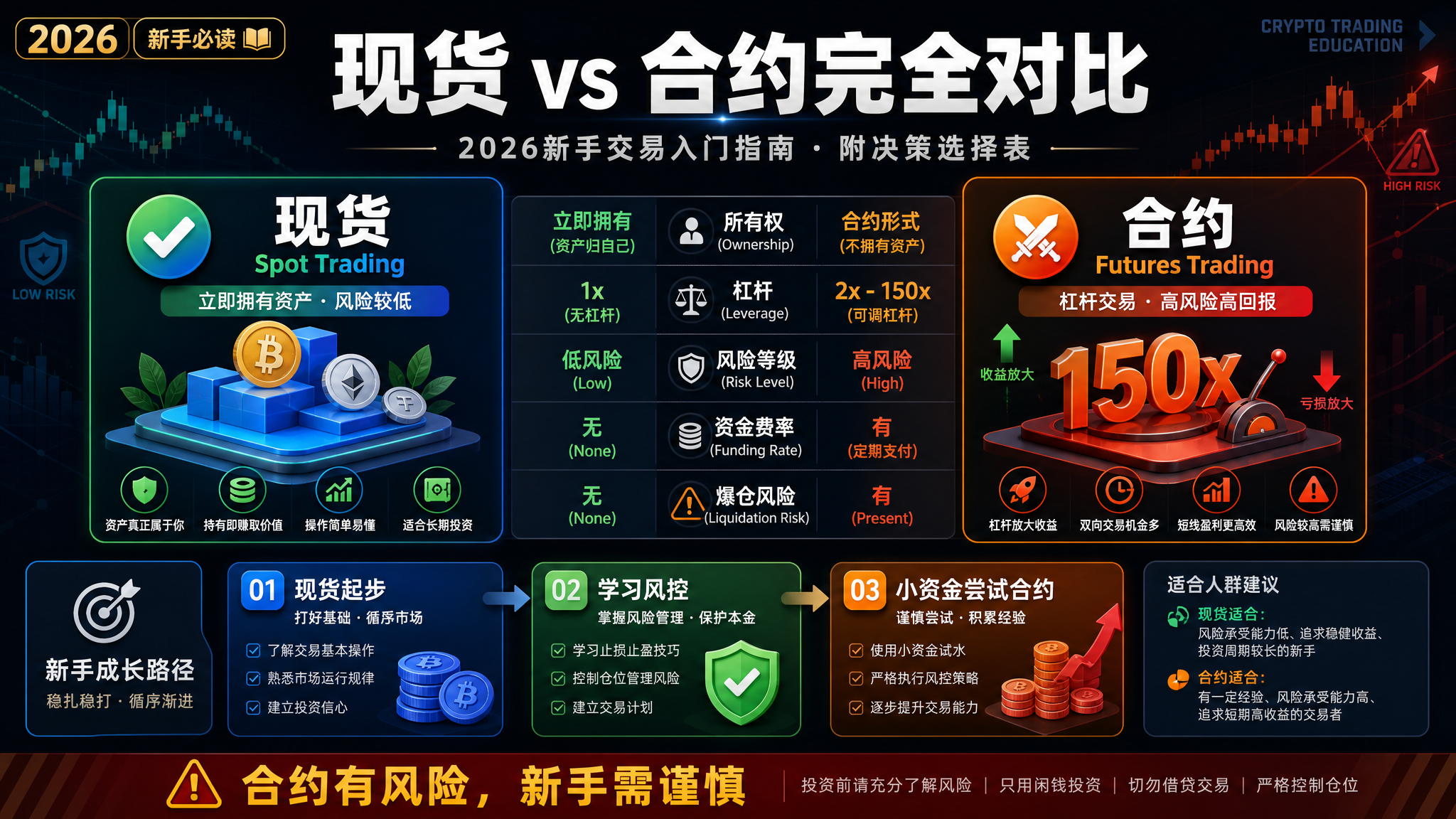
| Your situation | Spot | Futures |
|---|---|---|
| Do you own real coins? | ✅ Yes — yours to withdraw | ❌ No — just a contract |
| Can you only go long? | ✅ Buy low, sell high | ❌ Long or short |
| Can you use leverage? | Usually no (or minimal) | ✅ Common, 1x–125x |
| Can you be liquidated? | ❌ No (without leverage) | ✅ Yes — hits liquidation price, gone |
| Funding fee? | ❌ None | ✅ Yes, on perpetuals |
| Worst case | Lose your principal (coin to zero) | Lose your entire margin (liquidation) |
| Best for | Beginners, long-term holders | Experienced traders with risk control |
Bottom line: spot turns money into an asset; futures turns money into a contract that can go to zero. Let's look at how each one makes and loses money.
How spot makes and loses money
Spot makes money in one way: buy low, sell high, keep the difference. Example: BTC is at $50,000 and you spend $5,000 to buy 0.1 BTC. When it hits $60,000 you sell, making $1,000 (about 20% profit). If it drops to $40,000, you're down $1,000.
Spot's biggest advantage: as long as you don't sell and don't get hacked, the coins stay in your hands. If the price drops 50%, you're sitting on a paper loss but you still own 0.1 BTC — wait for a recovery and you're whole again. The only way to "zero out" is if the coin itself collapses (a rug pull or dead project). Buying mainstream coins like BTC or ETH and holding long-term means you never get force-closed.
This is why beginners should start with spot — you have room to be wrong. You can hold through a dip, and the most you lose is the coin's actual value, never your entire position on a single swing. For a walkthrough of placing orders, see this Binance spot trading guide.
How futures makes and loses money
Futures also pays when you pick the right direction, but leverage and liquidation change everything. Example: you open a $10,000 BTC long (bullish) with 10x leverage on $1,000 of margin:
- If BTC rises 10%, you make $1,000 — your margin doubles.
- If BTC falls 10%, you lose $1,000 — your margin is wiped out in a forced close (liquidation).
That's the double-edged sword of leverage: the same price move multiplies both gains and losses by 10x. Beyond liquidation, futures carry two costs beginners often miss:
- Funding rate: perpetuals settle a fee between longs and shorts every few hours to keep the contract price tracking spot. The longer you hold, the more it stacks up.
- Liquidation price: your position gets force-closed at a specific price — not when the coin hits zero, but when your margin can't cover the loss. The higher the leverage, the closer that liquidation price sits to your entry.
So the real danger of futures isn't "how much you lose" — it's that a single move against you closes the whole position and removes any chance to hold and wait for a recovery. For the mechanics in depth, see this Binance futures trading guide.
Which one should a beginner start with?
Start with spot, and leave futures until after you've learned risk control. This isn't being conservative — it's how the math works. The liquidation mechanism means an inexperienced beginner will most likely lose everything in the first big drop.
Ask yourself three questions:
- Do you understand position sizing and stop-losses? If not, do spot first and learn "what to do when it drops" before touching futures.
- Would losing this money hurt your life? If so, stick to spot with money you can afford to lose.
- Are you investing, or trying to "make it back fast"? "Fast recovery" is exactly the mindset that leads to liquidation.
Spot gives you time on your side: you can wait out a dip, with no need to watch the chart constantly or fear a forced close. For a beginner, walking the full "sign up → buy spot → hold" path with a small amount matters far more than learning how to open leverage. For how much to start with, see the minimum amount to buy crypto.
When is it actually okay to touch futures?
Only consider futures — with a small amount you can afford to lose — if you meet all of these:
- You've traded spot for at least a few months and can consistently control losses;
- You understand liquidation, liquidation price, and how funding is calculated;
- You set stop-losses, and a single loss is no more than 1%–2% of your total funds;
- The money is spare, and small enough that losing it all wouldn't bother you.
If even one of these doesn't hold, don't touch futures yet. These are also the "stop conditions" to watch for: the moment you catch yourself wanting to "add leverage to win back a loss," stop immediately — that's the most common prelude to a liquidation.
The 3 most common beginner mistakes
- Buying futures thinking it's spot — you want to "buy BTC and hold," but you entered the futures section with leverage, and one dip liquidates you. Before buying, confirm you're in the "Spot" section, not "Futures."
- Using high leverage to gamble — stacking 10x, 20x, 50x to bet on a direction. At high leverage, normal volatility is enough to liquidate you. That's not investing; that's donating money to the market.
- Ignoring funding and the liquidation price — watching only the price while funding slowly drains your position and you have no idea where your liquidation price is. The position dies to fees and forced closes before the price even moves much.
FAQ
Which is riskier, spot or futures?
Futures are far riskier than spot. Spot without leverage cannot be liquidated — the worst case is your coin dropping to zero. Futures use leverage, so a move against you can hit your liquidation price and wipe out your margin. For an inexperienced trader, futures can empty an account in minutes.
Should beginners trade crypto futures?
No. The liquidation mechanism and leverage magnification mean a beginner without position-management skills will likely lose everything in the first sharp move. Start with spot for a few months, learn stop-losses and risk control, then try futures with only money you can afford to lose.
Can spot trading go negative?
No (without leverage). With spot you hold a real asset, so the worst case is the coin going to zero — you never owe more than you put in. "Going negative" only happens in futures edge cases like forced liquidation gaps, but under normal liquidation mechanics your loss is capped at your margin.
What does liquidation mean in futures?
Liquidation is forced closing — the platform automatically sells your position and you lose your entire margin. When the price moves against you to your "liquidation price," the platform closes the position to stop your loss exceeding your margin. The higher your leverage, the closer that liquidation price sits to your entry.
What is the funding rate in futures?
A periodic fee (usually every 8 hours) settled between longs and shorts that keeps the perpetual contract price anchored to spot. Holding a position overnight means repeatedly paying or receiving funding, so this cost adds up over time.
Are futures fees higher than spot fees?
Futures fees are usually lower than spot. At Binance's default tiers, spot is 0.10% while USDT-margined futures run roughly 0.02%–0.05% (check the live fee page for exact rates)1. But futures also charge funding, so long-term holding can actually cost more overall.
Summary: the one line to remember
Spot turns money into an asset you can hold through a dip; futures uses leverage to bet on direction and liquidates you when it goes wrong — so beginners should start with spot and leave futures for the day they can manage a position.
Now that you understand the two, the next step is to actually trade. Further reading: Crypto Trading for Beginners 2026, Binance spot trading guide, Binance futures trading guide, and the on-chain guide — a free starting point for crypto beginners.
Disclaimer: This content is for educational purposes only and does not constitute investment advice. Cryptocurrency investing involves risk; please make decisions based on your own circumstances.
Footnotes
-
Binance fee schedule (https://www.binance.com/en/fee): default spot trading fee is 0.10%; USDT-margined perpetual futures default to maker 0.02% / taker 0.05%, and can go lower with BNB discount or higher VIP tiers. Verified 2026-08-24. ↩