


⚠️ The most important thing first: don't tap Sign Up directly in the app — you'll miss all the new-user rewards. They only apply when you register via an invite link or enter the invite code BINANBT.
TL;DR
Does Binance require real-name verification? Short answer: yes. Without completing KYC (identity verification), you cannot deposit, trade, or withdraw — even already-registered legacy accounts get downgraded to "withdrawal-only" mode. This is a hard anti-money-laundering compliance requirement, not Binance being difficult. As for "is identity verification safe" — Binance officially says documents are handled confidentially, but you are after all submitting an ID card and your face, so the risks mainly lie in two things: personal-information leakage, and never buying or selling a verified account. This article answers these high-frequency questions in one go.
Does Binance require real-name verification? Can you use it without it?
Yes. Binance requires all new users to complete "standard identity verification" to use its products and services, and unverified legacy accounts are switched to a "withdrawal-only" mode. 1
Specifically, here's what happens without verification:
| Account status | Deposit | Trade | Withdraw |
|---|---|---|---|
| New user, unverified | ❌ | ❌ | ❌ |
| Legacy user, unverified (withdrawal-only) | ❌ | ❌ | ✅ |
| Standard verification complete | ✅ | ✅ | ✅ |
So the conclusion is clear: to use Binance normally, identity verification is the unavoidable first step. Any "no-KYC Binance" or "Binance without verification" is either a fake phishing site or someone selling you an account registered under another person's name (a violation that is very easily banned or stolen).
Why does Binance require identity verification? What is KYC?
KYC (Know Your Customer) is a hard anti-money-laundering and counter-terrorism-financing compliance requirement whose purpose is to verify each user's real identity. 2
Why do crypto exchanges in particular require verification? Three reasons:
- Crypto has anonymity, making it easy to use for money laundering, fraud, and tax evasion — exchanges must prove they aren't helping criminals launder money.
- Blockchain transactions are irreversible, so once scammed, funds are very hard to recover — verification is the basis for accountability and fraud prevention.
- Global regulation keeps tightening, with every country requiring exchanges to do KYC; a platform that skips KYC basically cannot legally operate under a license.
For ordinary users, KYC also has a positive side: it protects your own account — once verified, it's harder for others to impersonate you or open an account in your name.
Is Binance identity verification safe? Could my personal information leak?
Binance officially states the verification process is secure and documents are handled confidentially, backed by ISO 27001 certification; but submitting an ID card and face scan inherently carries a theoretical risk of data leakage. 3
Look at this from two sides:
- Platform side: as a top global exchange, Binance holds ISO 27001/27701 information-security certifications, with industry-leading security investment and a top-tier compliance team; it explicitly states document information is handled confidentially.
- Your side: an ID card and face scan are sensitive personal information, and in theory could be misused if the platform suffers a data breach. This is a risk shared by all exchanges (and traditional banks too), not unique to Binance.
Three practical ways to reduce risk:
① Submit only through the official app or website — not on third-party sites, and never send your ID photo to any "support agent". ② Use your own genuine information; fake KYC triggers risk controls and leads to an account ban. ③ Never buy or sell an already-KYC'd account — that's a violation, and the account can be frozen or stolen at any time.
What documents does Binance KYC require? ID card or passport?
Mainland China users choose either an "ID card" or a "passport"; note that mainland users cannot use a driver's license for KYC. 3
What to prepare:
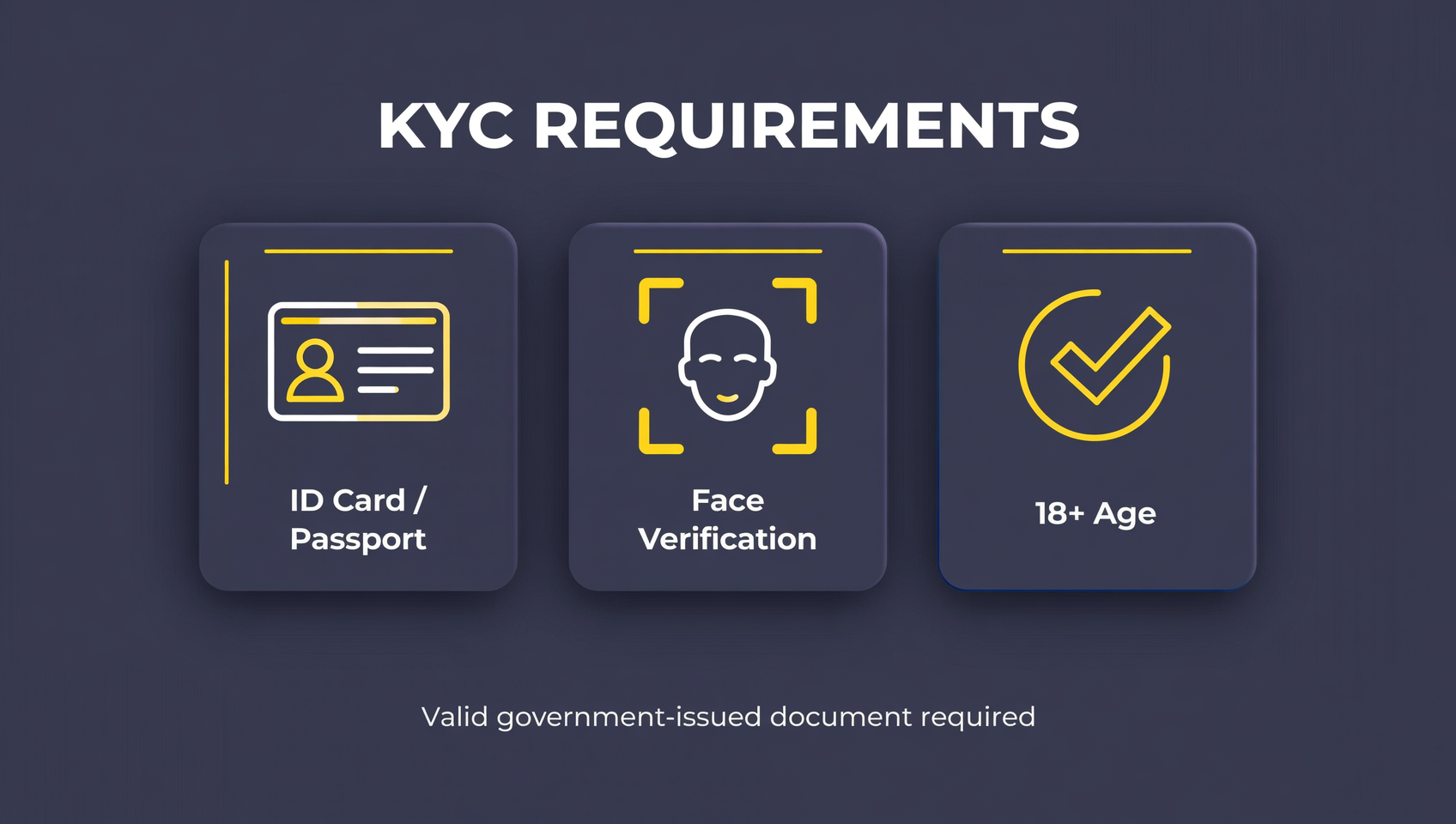
| Item | Requirement |
|---|---|
| Document | ID card or passport (mainland users cannot use a driver's license) |
| Validity | Must be within validity, upload both front and back |
| Face recognition | Complete the liveness check yourself — cannot be done by someone else |
| Age | At least 18 years old |
| Information consistency | Name, date of birth, and document number match the document exactly |
ID card vs passport — which to choose? An ID card is the most common choice for mainland users and scans quickly; a passport uses an internationally unified format, and if you have overseas identity or may travel abroad, a passport is more versatile across regions. Both have high pass rates — pick whichever document is clearest on hand.
How do you complete Binance identity verification? Face recognition is the easiest step to fail
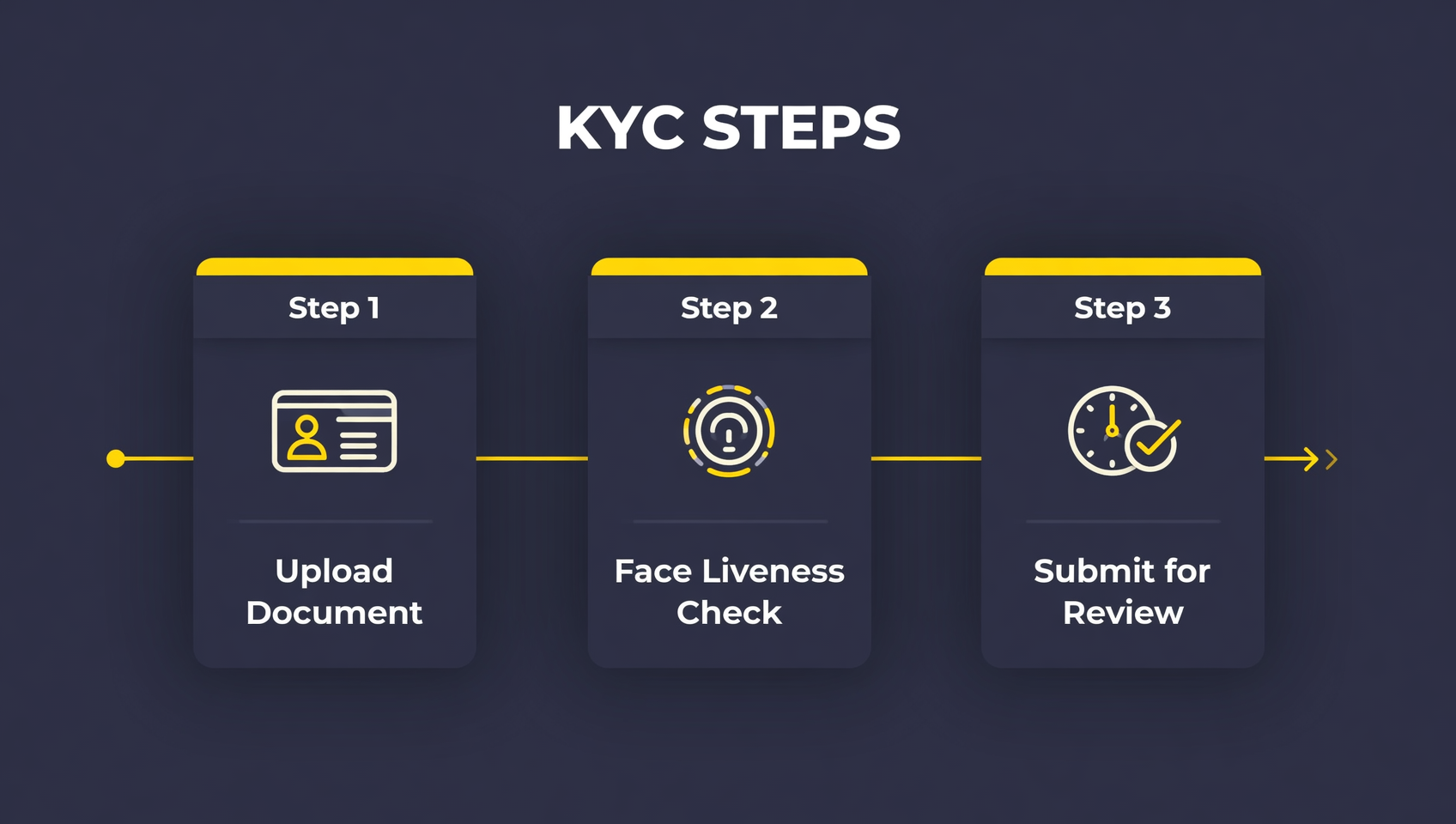
Core flow: upload the front and back of your document → face-recognition liveness check → fill in and confirm your information → submit for review. 1
Face recognition is the step most likely to fail. Practical tips to avoid getting stuck:
- Good lighting, no backlight and no dim light;
- Remove hats, glasses, and masks, and don't use filters;
- Capture all four corners of the document, clear with no obstruction or glare;
- Face the camera straight, and follow the prompts to blink/turn your head.
As long as the document is clear, the face is your own, and the information matches the document, most people pass on the first try.
How long does Binance identity verification take?
The official line is review within 48 hours; in practice, most cases pass within tens of minutes to a few hours. 1
Key points:
- Normally review is quick — many users receive the approval notice minutes to hours after submitting;
- During peak periods it may extend to several hours or more, but generally no more than 48 hours;
- If there's no result after 48 hours, contact support;
- You can attempt identity verification up to about 10 times a day; if rejected 10 times within 24 hours, you must wait 24 hours before retrying — so don't repeatedly submit failing materials; prepare carefully before uploading.
What if identity verification fails or is rejected?
The most common causes are a blurry document, inconsistent information, or failed face recognition — check against the prompt and resubmit. 1
Common sticking points, ordered by frequency:
- Document photo blurry, glare, or not all four corners captured;
- The name/date-of-birth/document number you entered doesn't match the document;
- Poor lighting during face recognition or wearing glasses/hats;
- The document has expired, or you used material not accepted for mainland China (such as a driver's license).
Fix the matching issue and resubmit, and it basically passes. If you're repeatedly rejected, don't keep forcing it (only 10 attempts a day) — contact Binance's official support and explain the situation.
Mainland China users verifying on Binance: is it safe? Is it legal?
Technically, the data-security mechanisms are the same for all users globally; legally, however, mainland China has taken a clear regulatory stance on virtual-currency trading since February 2026, and individuals participate at their own risk. 4
On February 6, 2026, the People's Bank of China and seven other departments issued the "Notice on Further Preventing and Disposing of Virtual Currency Trading Speculation Risks" (Yin Fa [2026] No. 42), characterizing "fiat-to-crypto exchange" and "overseas platforms providing services to domestic entities," with individuals bearing their own losses.
So this article's stance is: we are not urging you to verify, nor judging the legal risk for you — we're only laying out the facts of "must you verify, why verify, and is it safe." If you decide to use it, be sure to use your own genuine information, use only official channels, and bear both the legal and financial risks yourself.
FAQ
Does Binance require real-name verification? Can I use it without it?
Yes. New users cannot deposit, trade, or withdraw without verification; legacy users without verification are downgraded to "withdrawal-only" mode.
Why does Binance require identity verification (KYC)?
Anti-money-laundering (AML) and counter-terrorism-financing (CFT) compliance — also a hard global regulatory requirement — used to verify each user's real identity and prevent fraud.
Is Binance identity verification safe? Could my personal information leak?
Officially it's handled confidentially with ISO 27001 certification, but submitting an ID and face scan inherently carries a theoretical risk of leakage; the key is to use official channels, use your own information, and never buy or sell a verified account.
What documents does Binance KYC require? ID card or passport?
Mainland users use an ID card or passport (no driver's license), within validity, upload both sides, plus one face liveness check, and be at least 18.
How long does Binance identity verification take?
Officially within 48 hours, in practice usually tens of minutes to a few hours; up to about 10 attempts per day.
Is Binance identity verification safe and legal in mainland China?
Data-security mechanisms are the same globally; legally, mainland China has made virtual-currency trading regulation clear since February 2026, and individuals participate at their own risk.
Conclusion
Does Binance require real-name verification? Yes — it's a prerequisite to using it and a hard anti-money-laundering compliance requirement. Why verify? To confirm identity, prevent money laundering, and protect your account. Is verification safe? There are safeguards on the platform side, but submitting an ID and face scan carries privacy risk; your job is to use only official channels, use your own information, and never buy or sell accounts.
If you've decided to register, don't register directly in the app — that way you'll miss every new-user bonus; you only get it by registering through an invitation link or entering referral code BINANBT, then complete identity verification after registering.
Recommended to register:
📚 Further reading:
- Binance Registration & KYC Verification Complete Guide
- Is Binance Safe? 2026 Item-by-Item Check: SAFU, Proof of Reserves & Exit-Scam Rumors
- Binance Anti-Phishing & Scam Prevention Guide
- Binance Account Unlock Guide: How to Recover a Restricted/Frozen Account
- On-chain Guide - Learn Blockchain from Zero
⚠️ Disclaimer: This article is an objective explanation of Binance identity verification (KYC) only. It is not investment advice and does not endorse the compliance of any action. Cryptocurrency trading carries extremely high risk, and regulatory policies vary widely across jurisdictions (such as the regulatory stance in mainland China). Please make decisions cautiously based on the laws in your region and your own risk tolerance. The information in this article is current as of October 22, 2026, and the platform's identity verification rules and review process may change at any time.
Footnotes
-
Binance Help Center, "How to Complete Identity Verification for a Personal Account" and related KYC FAQs, 2026. ↩ ↩2 ↩3 ↩4
-
Binance Academy, "What Is KYC (Know Your Customer)", 2026. ↩
-
Binance official KYC documentation (mainland users accepted with ID card/passport, face liveness check, ISO 27001 certification, etc.), 2026. ↩ ↩2
-
People's Bank of China and seven other departments, "Notice on Further Preventing and Disposing of Virtual Currency Trading Speculation Risks" (Yin Fa [2026] No. 42), February 6, 2026. ↩