


📋 Table of Contents
- TL;DR Summary
- What Is Liquidation: DeFi Lending's Risk-Control Mechanism
- Health Factor & Liquidation Threshold: How the Trigger Is Computed
- The Liquidation Process: Bots, Partial Liquidation & Flash Loans
- How Much You Lose: The 5-15% Penalty
- Real Case: 2.3% of AAVE Supply Liquidated
- Aave V4's New Design: Target Health Factor & Dynamic Bonus
- How to Avoid Liquidation: 6 Practical Rules
- The Future of Liquidation: LLAMMA & Options
- FAQ
- About the Author
TL;DR Summary
DeFi liquidation = when your collateral drops enough that the health factor falls below 1, a liquidator takes your collateral at a discount. Core formula: health factor = (collateral value × liquidation threshold) ÷ total debt; major assets like ETH have a ~80% threshold, and the penalty is 5-15%. The key to avoiding liquidation: don't max out (if the protocol liquidates at 75% LTV, operate at 50-55%), diversify collateral, set health-factor alerts, and keep dry powder. In 2026, Aave V4's target-health-factor design makes liquidation gentler, and Curve's LLAMMA has protected ~86% of borrowing positions from forced liquidation.
What Is Liquidation: DeFi Lending's Risk-Control Mechanism
DeFi lending (e.g., Aave, Compound) lets you collateralize crypto to borrow other assets. But borrowed money must be repaid — the protocol guarantees this through "liquidation":
| Element | Detail |
|---|---|
| Collateral | The crypto you deposit (e.g., ETH, WBTC) |
| Borrowed asset | The stablecoin or token you borrow against collateral |
| Liquidation | When collateral drops to an unsafe level, anyone repays your debt and takes your collateral at a discount |
| Purpose | Prevents borrowers from defaulting when collateral is no longer sufficient (bad debt) |
Simple view: collateral is your "repayment guarantee." When price drops make the guarantee insufficient, the protocol lets someone "take over" your collateral and repay your debt to keep the platform solvent. Liquidation is not the platform confiscating your money — it is a risk-control mechanism.1
Health Factor & Liquidation Threshold: How the Trigger Is Computed
The trigger point is the Health Factor (HF):
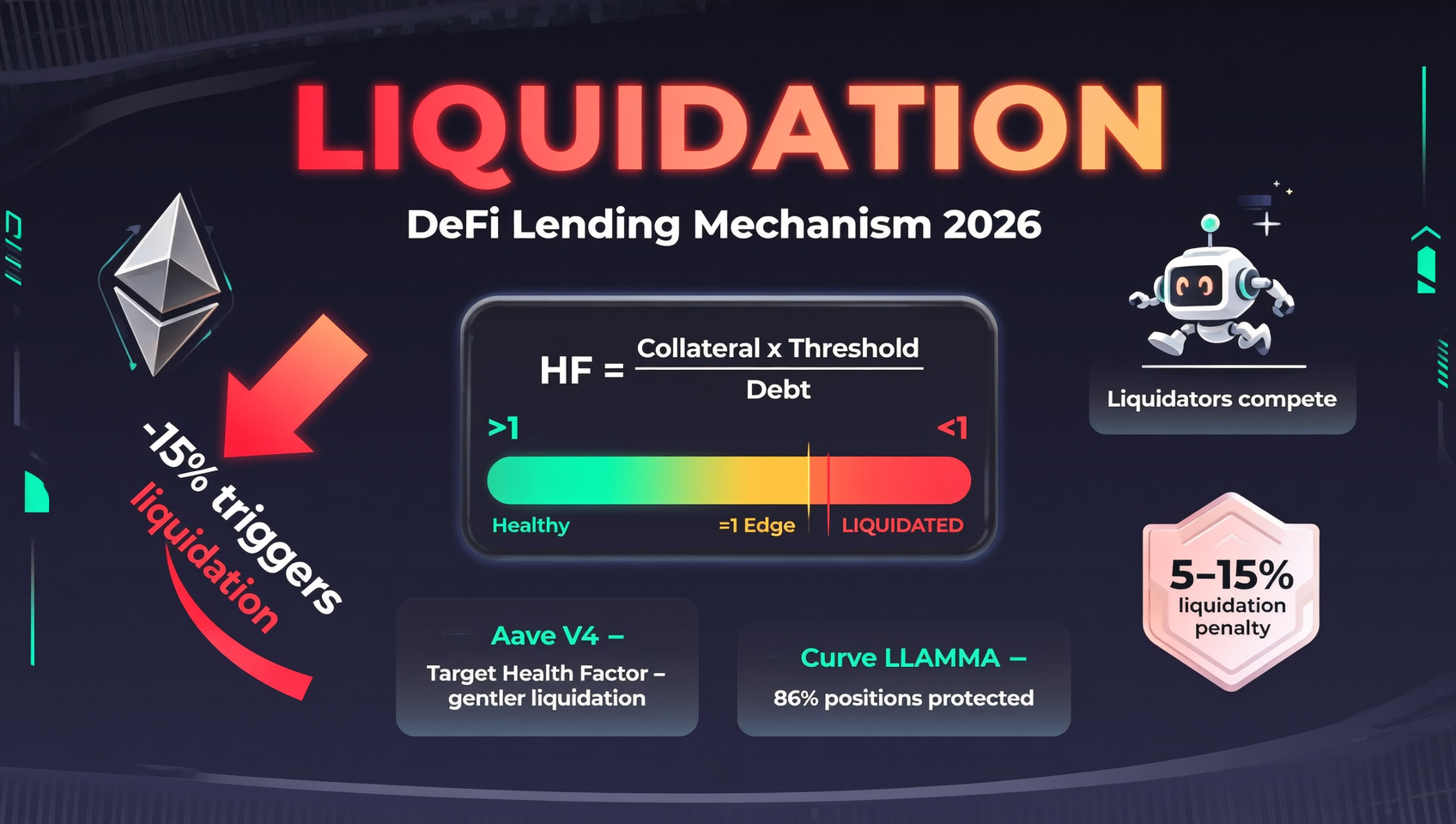
HF = (collateral value × liquidation threshold) ÷ total debt
| Value | Status |
|---|---|
| HF > 1 | 🟢 Healthy, cannot be liquidated |
| HF = 1 | 🟡 At the edge |
| HF < 1 | 🔴 Eligible for liquidation by anyone |
The liquidation threshold (LT) is the safe ratio per collateral asset — major assets like ETH sit at about 80-83% (Aave uses ~80% for ETH).
Example: collateral of $10,000 in ETH (threshold 80%) can back up to $8,000 of debt. If you borrow $7,000 (HF≈1.14) and ETH drops 15% to $8,500 collateral, HF falls below 1 → liquidation is triggered. This is why "maxing out" is dangerous.2
The Liquidation Process: Bots, Partial Liquidation & Flash Loans
Once triggered, keeper bots execute the liquidation automatically:
| Step | Detail |
|---|---|
| Monitoring | Bots track health factors in real time, simulating against oracle prices |
| Execution | Whoever submits the liquidation tx first earns the bonus — competitive |
| Flash loans | Often combined for atomic execution, no own capital needed |
| Partial liquidation (close factor) | Aave V2/Compound cap a single liquidation at 50% of debt; Aave V3 can clear 100% when HF≤0.95 or amounts are tiny |
| After liquidation | Only the minimum needed to restore health is cleared; HF recovers above 1 |
Key insight: liquidation is usually "partial," not "one-click wipeout." A 50% close factor means at most half the debt is repaid per transaction — giving borrowers a chance to recover from a brief wick. But Aave V3 allows 100% when the position is deeply unhealthy.3
How Much You Lose: The 5-15% Penalty
The liquidator repays your debt in exchange for your collateral — but at a discount:
| Parameter | Value |
|---|---|
| Liquidation penalty/bonus | Usually 5-15% (varies by asset) |
| Aave V4 proposed fee | 8-18% range |
| Example | Debt $10,000, penalty 10% → liquidator pays $10,000, takes ~$11,000 of collateral |
Net loss = the debt you owed anyway + the collateral margin given up at a discount. The higher the penalty, the bigger your liquidation loss — which is why avoiding liquidation matters so much.4
Real Case: 2.3% of AAVE Supply Liquidated
A real 2026 case: a loan backed by 2.3% of total AAVE supply ($28.4M in AAVE collateral) was liquidated in tranches as AAVE fell to ~$103-104, with liquidators seizing AAVE collateral at a discount to cover USDC debt.
Three lessons from this case: ① large positions don't escape liquidation; ② liquidations often happen in tranches (the close factor caps each transaction); ③ liquidators step in with stablecoins like USDC, all executed automatically by bots.5
Aave V4's New Design: Target Health Factor & Dynamic Bonus
The 2026 Aave V4 upgrade significantly improves the liquidation mechanism:
| V4 improvement | Detail |
|---|---|
| Target Health Factor (THF) | Liquidates only the minimum needed to restore health — no more fixed 50% — avoiding "over-liquidated by just a little" |
| Dynamic liquidation bonus | The worse the health factor, the higher the reward — risky positions are cleared fast, healthy ones left alone |
| Hub & Spoke architecture | Centralizes liquidity, stabilizing rates |
| Risk-based pricing | Stronger collateral earns better borrowing terms |
Core benefit for borrowers: V4 shifts liquidation from a blunt "50% cut" to "precisely restore health," so a brief wick no longer means a large loss.6
How to Avoid Liquidation: 6 Practical Rules
- Don't max out: if the protocol liquidates at 75% LTV, operate at 50-55% — absorb 20-30% sudden swings
- Diversify collateral: don't bet one coin (especially not "collateral" and "directional bet" on the same coin)
- Set health-factor alerts: monitor with bots/tools, don't rely on push notifications
- Keep dry powder: maintain spare stablecoins or collateral to top up anytime
- Understand oracle mechanics: fast drops + slow oracles distort liquidation timing
- Stress-test: simulate "down 25% + thinning liquidity" — can your position survive? If not, resize
In one line: liquidation is not a "luck problem," it's a "collateral-ratio problem." Keep buffer, diversify, set alerts, and a short wick won't liquidate you.7
The Future of Liquidation: LLAMMA & Options
| Direction | Progress |
|---|---|
| Curve LLAMMA | Gradually converts collateral to crvUSD across a price range, reversible on recovery — in Q1 2026 it protected ~86% of borrowing positions ($44.24M TVL) from forced liquidation |
| Vitalik's options proposal | Splits 1 ETH into paired P/N option assets, eliminating liquidation by construction — research stage, not live |
Industry trend: liquidation is moving from "hard threshold, one-shot clear" to "gentle, gradual, minimal." Curve LLAMMA already sharply reduces forced liquidation in production, and DeFi lending will keep getting more "wick-resistant."8
FAQ
Q: What is DeFi liquidation?
When collateral price drops so the health factor falls below 1, anyone can repay part of your debt and take your collateral at a discount. This is how lending protocols (Aave, Compound) control risk and prevent bad debt.
Q: How is the health factor calculated?
HF = (collateral value × liquidation threshold) ÷ total debt. The threshold is each asset's safe ratio — ~80-83% for ETH. HF>1 is safe, =1 is the edge, <1 triggers liquidation. Collateralize $10,000 of ETH, borrow $7,000, and a 15% drop triggers it.
Q: How much do I lose if liquidated?
The discount the liquidator takes on your collateral is your net loss, usually 5-15% depending on the asset. Aave V4 proposes 8-18%. The debt is owed anyway; the discount is the extra loss.
Q: How do I avoid DeFi liquidation?
Six rules: ① don't max out (75% line → operate at 50-55%); ② diversify collateral; ③ set health-factor alerts; ④ keep dry powder; ⑤ understand oracles; ⑥ stress-test. Keep buffer and a short wick won't liquidate you.
Q: Does liquidation wipe out everything at once?
Usually not. Aave V2/Compound cap a single liquidation at 50% of debt (close factor); only deeply unhealthy positions (HF≤0.95) or tiny amounts are cleared 100%. Partial liquidation leaves room to recover.
Q: What changed in Aave V4's liquidation mechanism?
Target Health Factor (THF) and dynamic bonus: it liquidates only the minimum needed to restore health, with higher rewards for worse health factors. Compared to V3's blunt "50% cut," V4 is friendlier to borrowers — a brief wick no longer means a big loss.
About the Author
CoinVado Research is CoinVado's content research team, focused on blockchain education, on-chain data analysis, and cryptocurrency investment education. We are committed to verifiable data and never fabricate information, helping beginners build sound crypto knowledge.
⚠️ Risk Disclaimer: This article is for educational purposes only and does not constitute investment advice. DeFi lending carries liquidation, smart-contract, oracle, and asset-devaluation risks; always rely on each protocol's official parameters. Cryptocurrency markets are extremely volatile; manage your risk.
📚 Continue Learning:
- Aave Lending & Borrowing Guide 2026
- DeFi Liquidity Pools & Impermanent Loss Guide 2026
- DeFi 2026 Complete Guide: From Beginner to Advanced
Footnotes:
Footnotes
-
Source: MEXC "What is liquidation in crypto? Margin calls, health factors"; CoinBrain DeFi lending risk analysis ↩
-
Source: DEXTools "Liquidation Penalty, Close Factor and Health Factor"; DeFi Saver Aave V3 liquidation docs ↩
-
Source: DeFi Saver "Liquidations on Aave"; Fortress Accounting DeFi liquidation guide, 2026 ↩
-
Source: DEXTools liquidation parameters; Aave V4 governance proposal (8-18% fees) ↩
-
Source: The Block "Loan backed by 2.3% of AAVE supply hit by cascading liquidations," 2026 ↩
-
Source: Aave V4 governance forum "V4 Spoke Liquidation Parameters"; Chaos Labs math framework ↩
-
Source: MEXC/CoinMarketCap "DeFi Liquidation Risk"; CoinBrain avoidance strategies ↩
-
Source: Curve LLAMMA Q1 2026 data; The Block "Vitalik proposes options-based synthetic assets" ↩