


Table of Contents
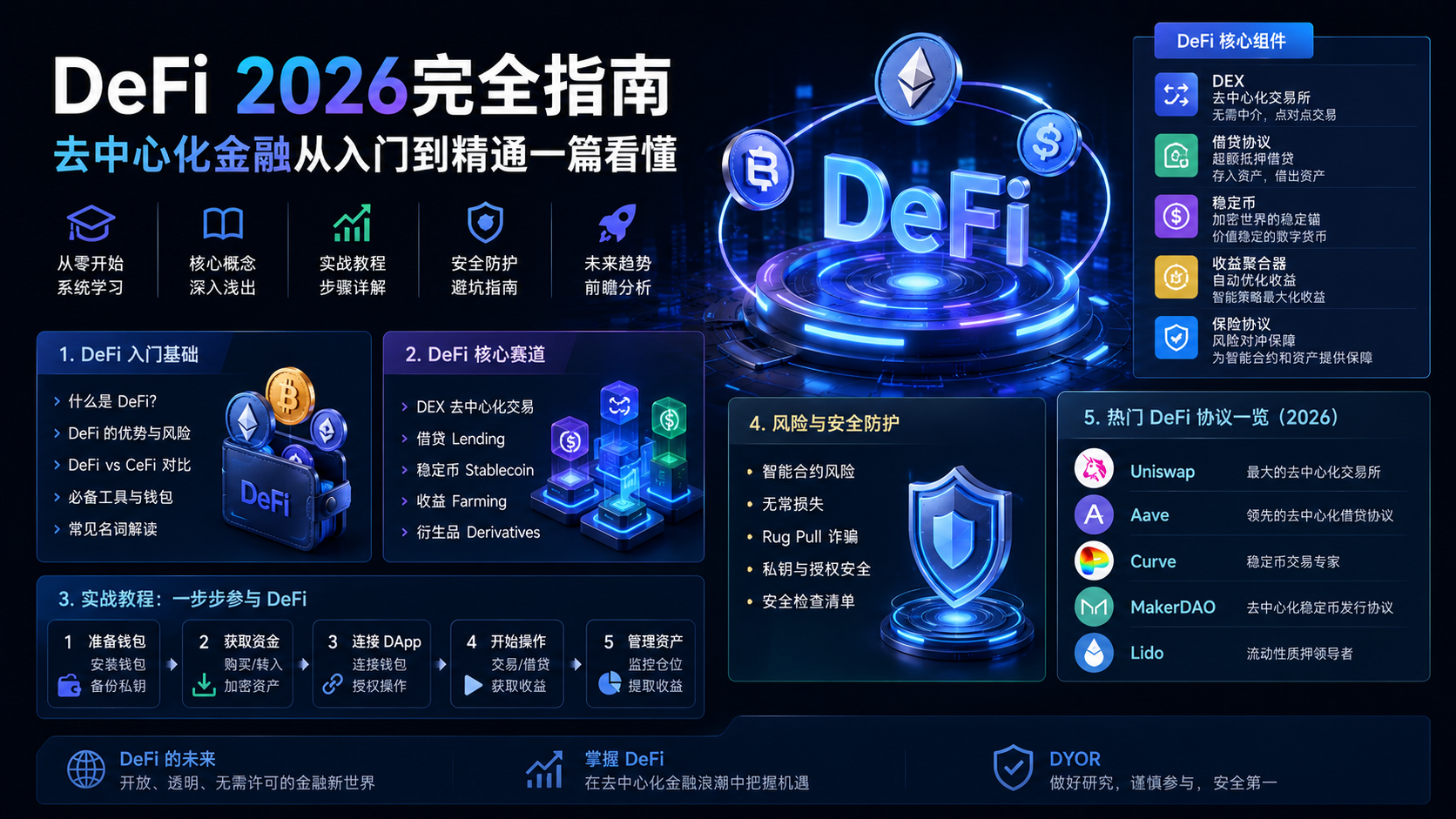
- TL;DR Key Takeaways
- Introduction: What Is DeFi?
- How DeFi Works: Three Technical Pillars
- The Four Core DeFi Sectors
- 2026 DeFi Ecosystem: Data & Trends
- Deep Dive: Three Flagship Protocols
- DeFi vs Traditional Finance: Full Comparison
- DeFi Risks & Security Guide
- How to Start Using DeFi as a Beginner
- FAQ
- Further Reading
TL;DR Key Takeaways
DeFi (Decentralized Finance) replaces traditional financial intermediaries with blockchain smart contracts, allowing anyone to lend, borrow, trade, and earn yield without a bank account. As of July 2026, total DeFi TVL stands at ~$75.1B, with Ethereum commanding ~54.39% market share1.
Lido ($17.2B TVL) and Aave ($13.5B TVL) are the two largest protocols, offering stablecoin deposit yields of 3-6%. Three trends define 2026: RWA tokenization bringing $12B+ traditional assets on-chain, account abstraction lowering entry barriers, and MiCA regulation driving compliance.
Beginner recommendation: Start on Base or Arbitrum L2 with a small Aave deposit. Deposit only, don't borrow, and get comfortable with the workflow before exploring advanced strategies.
Introduction: What Is DeFi?
DeFi (Decentralized Finance) is an open, blockchain-based financial ecosystem where smart contracts automatically execute lending, trading, staking, and derivatives — no banks, brokers, or middlemen required. The core philosophy is "code is trust" — instead of trusting a bank's integrity, you verify publicly audited open-source code on an immutable ledger.
One sentence captures the difference: Traditional finance says "trust the institution"; DeFi says "verify the code."
As of July 2026, the DeFi ecosystem stands at:
- Total TVL: ~$75.1B — down from the 2021 peak of $180B, but liquidity depth and protocol maturity are far superior1
- Ethereum DeFi TVL: ~$40B — 54.39% market share, maintaining dominance2
- Top 5 protocols: ~$54B combined — ~72% of total TVL, strong concentration3
- Daily DEX volume: ~$10-15B — Uniswap alone contributes $2-4B4
- On-chain stablecoin supply: $200B+ — USDT at $76.5B, USDC at $46.9B, the liquidity bedrock of DeFi5
This guide covers how DeFi works, the four core sectors, the 2026 landscape, flagship protocol deep-dives, risk assessment, and a beginner's step-by-step tutorial — everything you need to go from zero to confident DeFi user.
How DeFi Works: Three Technical Pillars
DeFi runs on three technical pillars: smart contracts, automated market makers (AMM), and decentralized oracles. Together they create a financial system that requires no trusted intermediaries.
Smart Contracts: DeFi's "Legal System"
Smart contracts are self-executing programs deployed on a blockchain, immutable once live. In DeFi, they serve as the equivalent of "legal contracts + bank tellers + clearing systems" all in one:
| Dimension | Traditional Finance | DeFi Smart Contract |
|---|---|---|
| Rule maker | Central bank / regulator / bank | Developer writes → DAO votes → chain deploys |
| Rule enforcer | Bank staff / risk systems | EVM executes automatically |
| Rule changes | Internal management decision | DAO governance vote + upgrade |
| Transparency | Internal docs / NDAs | Open-source code on Etherscan |
| Reversibility | Bank can reverse | Irreversible (if code is correct) |
When you deposit USDC into Aave, the smart contract automatically records your deposit, calculates interest, and manages liquidation parameters — no human review needed.
Automated Market Makers (AMM): DeFi's "Trading Engine"
AMMs replace the traditional "order book + market maker" model with a mathematical formula. Instead of waiting for a buyer to match your sell order, you trade directly against a liquidity pool.
The AMM logic is straightforward:
- Liquidity providers (LPs) deposit two tokens into a smart contract pool
- The AMM uses the constant product formula (x×y=k) to price trades automatically
- Traders swap directly with the pool — no counterparty matching needed
Uniswap, the leading AMM, processes $2-4B in daily volume across 9 chains as of July 20266.
Decentralized Oracles: DeFi's "Information Feed"
DeFi protocols run on-chain but need off-chain data — asset prices, interest rates, weather data. Oracles bridge this gap.
Chainlink is the most widely used oracle network, feeding price data to Aave, Lido, and hundreds of other protocols. When your Aave collateral value drops below the liquidation threshold, Chainlink's ETH/USD price feed triggers automatic liquidation — no human intervention, no single point of trust.
The Four Core DeFi Sectors
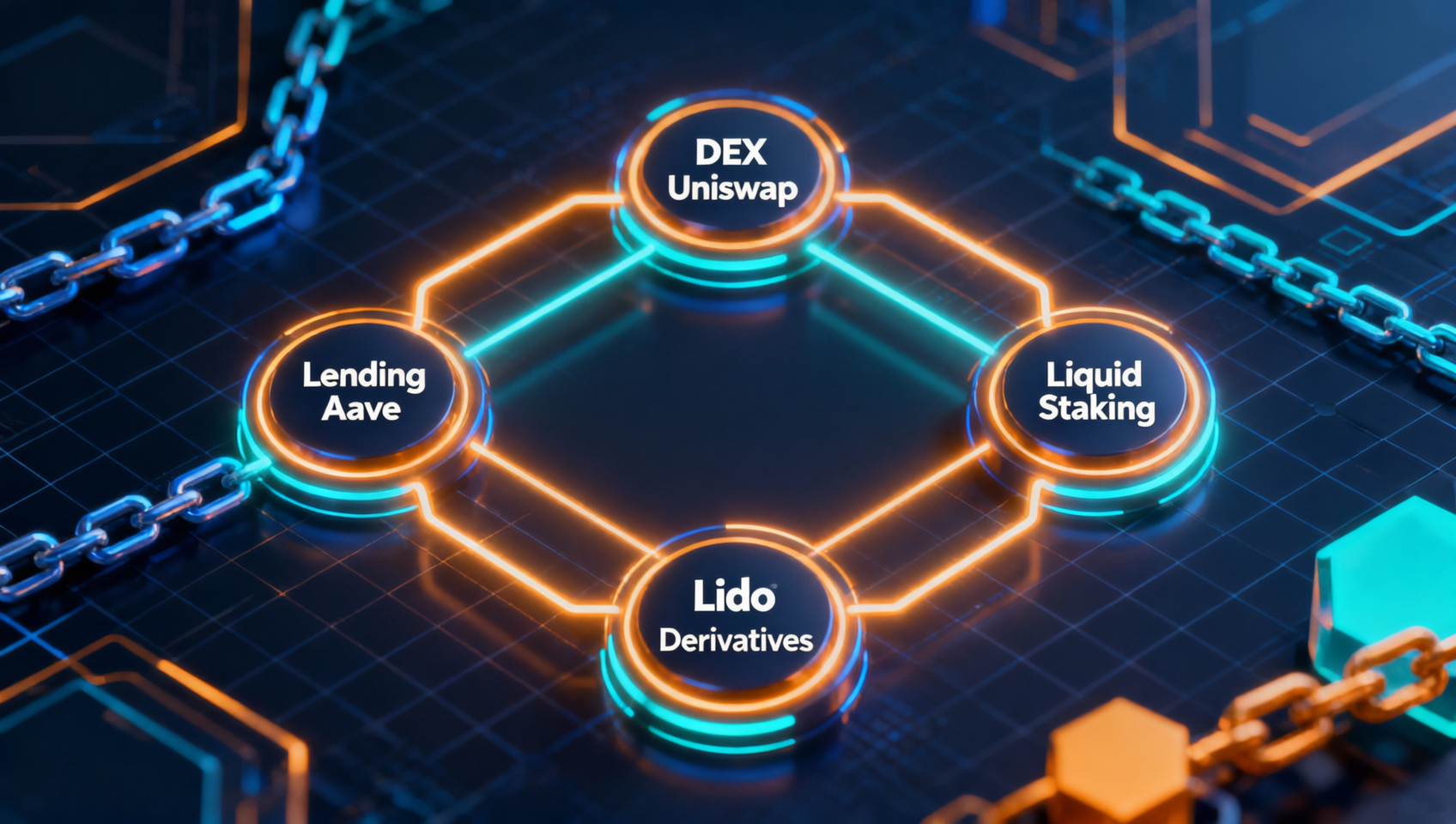
DeFi revolves around four core financial services: lending, trading, staking, and derivatives. Each has dominant protocols and unique economic models.
Sector 1: Decentralized Lending
Decentralized lending is DeFi's largest sector with ~$40B+ in total value locked, allowing anyone to earn interest on deposits or borrow against crypto collateral without KYC4.
Key protocols:
- Aave: $13.5B TVL, industry leader. Invented flash loans, V4 upgrade live, 17 chains
- Compound: $3.4B TVL, Compound III upgrade launched in 2026
- Morpho: $4.2B TVL, introduces peer-to-peer matching layer for better rates
Interest rates adjust automatically based on supply and demand. July 2026 Aave rates:
| Asset | Deposit APY | Borrow APY | Demand |
|---|---|---|---|
| USDC | 4.2-5.5% | 7.2-9.5% | High |
| ETH | 1.5-3.0% | 2.8-4.5% | Stable |
| WBTC | 1.0-2.0% | 2.0-3.5% | Low |
How it works: Deposit $1,000 USDC into Aave and earn 4.5% APY ($45/year). Or deposit $1,000 ETH as collateral and borrow up to ~$700 USDC. But be careful — if ETH price falls and your collateral ratio drops below the liquidation threshold (typically 75-80%), your ETH gets liquidated.
Sector 2: Decentralized Exchanges (DEX)
DEXes let you trade tokens directly from your wallet without depositing to a platform. July 2026 daily DEX volume is ~$10-15B, representing ~25-30% of total crypto spot trading.
Key protocols:
- Uniswap: Largest DEX, AMM pioneer. $2-4B daily volume, 9 chains
- Curve Finance: Optimized for stablecoin trading, minimal slippage
- Aerodrome: Base chain's largest DEX, ~$2B TVL
DEX vs CEX comparison:
| Dimension | CEX (Binance) | DEX (Uniswap) |
|---|---|---|
| Asset custody | Platform holds assets | Always in your wallet |
| Registration | KYC required | None needed |
| Token listing | Platform review | Any ERC-20 automatically listed |
| Fiat on-ramp | Yes (P2P, credit card) | No |
| Speed | Instant (off-chain) | On-chain confirmation (seconds on L2) |
| Exchange collapse risk | Yes (FTX, etc.) | No (assets in your wallet) |
The DEX's killer advantage is self-custody — you never lose funds because an exchange collapsed. The trade-off is higher complexity (gas fees, private key management) and no fiat on-ramp. The smart approach: use Binance/OKX for fiat on-ramp and high-volume trades, Uniswap for long-tail tokens and DeFi composability.
Sector 3: Liquid Staking
Liquid staking lets you earn staking rewards while keeping your assets liquid — no need to lock tokens in a contract and lose flexibility.
Ethereum's transition to Proof of Stake in 2022 made staking available to anyone, but direct staking requires 32 ETH (~$110K) and has an unbonding period. Lido solves both problems:
| Dimension | Direct Staking | Via Lido |
|---|---|---|
| Minimum | 32 ETH (~$110K) | 0.1 ETH (~$350) |
| Lock period | Withdrawal queue | Sell stETH on DEX instantly |
| Yield | ~3.2% APY | ~2.9% APY (Lido takes 10% fee) |
| Liquidity | None — locked | Full — stETH is DeFi-composable |
Lido data (July 2026): $17.2B TVL, ~10.5M stETH managed, ~31% of all staked ETH7. stETH is deeply integrated into Aave, Uniswap, and MakerDAO — you can deposit stETH into Aave for extra interest, earning "staking yield + lending yield" simultaneously.
Sector 4: Decentralized Derivatives
Decentralized derivatives are DeFi's fastest-growing sector. Perpetual futures DEXes now process $50-100B in monthly volume, still far behind CEXes but growing rapidly.
Key protocols:
- dYdX: Fully on-chain order book perpetuals, up to 25x leverage
- GMX: Multi-asset liquidity pool perpetuals
- Synthetix: Synthetic assets — trade fiat, commodities, and stocks on-chain
The core challenge for derivatives DeFi is speed and depth — on-chain latency makes order book models hard to scale. But the value proposition of self-custody is powerful: your positions are managed by smart contracts, eliminating exchange bankruptcy risk entirely.
2026 DeFi Ecosystem: Data & Trends
The 2026 DeFi market is in a "value reassessment" phase — TVL has cooled from the 2021 peak of $180B to ~$75.1B, but ecosystem quality has improved significantly, with genuine product-market fit now visible.
Macro Data
- Total DeFi TVL: $75.1B (July 17, 2026), down ~34% from start of 2026 but up 3.9% from the $69.3B low8
- Ethereum share: 54.39%, up 1.39 percentage points in 30 days — capital is concentrating in core ETH protocols2
- Monthly DEX volume: ~$300-400B, ~25-30% of total spot market
- On-chain stablecoin supply: $200B+, the "monetary base" of DeFi remains large5
Protocol TVL Ranking (July 17, 2026)
| Rank | Protocol | TVL | Sector | 7d Change |
|---|---|---|---|---|
| 1️⃣ | Lido | $17.2B | Liquid Staking | +8.6% |
| 2️⃣ | Aave | $13.5B | Lending | +4.7% |
| 3️⃣ | SSV Network | $9.1B | Staking Infrastructure | — |
| 4️⃣ | Morph | $7.3B | L2/L3 Network | — |
| 5️⃣ | Binance Staked ETH | $6.9B | Liquid Staking | — |
| 6️⃣ | Morpho | $4.2B | Lending | — |
| 7️⃣ | Uniswap | $5B+ | DEX | — |
| 8️⃣ | Sky (MakerDAO) | $5B | Stablecoin/Lending | — |
| 9️⃣ | Compound | $3.4B | Lending | — |
| 🔟 | EigenLayer | $3B+ | Restaking | — |
Three Key Trends of 2026
Trend 1: RWA Tokenization — The Bridge Between DeFi and TradFi
This is 2026's most significant structural shift in DeFi. BlackRock's BUIDL fund (tokenized US Treasury bills) has surpassed $500M, with Franklin Templeton, WisdomTree, and Ondo Finance following suit10. Total on-chain RWA has exceeded $12B as of July 2026, covering Treasuries, private credit, commodities, and real estate.
RWA's significance for DeFi: it brings off-chain yield on-chain. Previously, all DeFi yield came from within-crypto "closed-loop" activity — good in bull markets, scarce in bears. RWA provides yield that's uncorrelated with crypto market cycles, diversifying DeFi's yield structure.
Trend 2: Account Abstraction (ERC-4337) — Breaking the User Onboarding Barrier
Account abstraction is Ethereum's most important UX upgrade in 2026 (part of the Pectra upgrade, EIP-7702). It makes wallet UX nearly as simple as web2 applications — social recovery, gas sponsorship, batch transactions, and session keys. This addresses the single biggest barrier for new DeFi users: the fear that "losing your private key means losing everything."
Trend 3: Regulatory Clarity — MiCA and Compliant DeFi
The EU's MiCA (Markets in Crypto-Assets) framework, fully implemented in 2026, provides clear compliance rules for DeFi protocols. Compliant DeFi can access banking partnerships, insurance, and fiat on-ramps. Meanwhile, Hong Kong, Singapore, and the UAE are building sensible regulatory frameworks. DeFi is moving from "regulatory gray zone" to "regulated innovation"11.
Deep Dive: Three Flagship Protocols
You don't need to memorize dozens of protocols — understanding Lido, Aave, and Uniswap gives you 90% of DeFi's landscape. They represent staking, lending, and trading — the three core financial primitives.
Lido: The Liquid Staking Leader
Lido is the highest-TVL DeFi protocol in 2026 and the infrastructure layer for Ethereum's Proof of Stake economy.
Core product: stETH (Lido Staked ETH). When you stake ETH through Lido, you receive an equal amount of stETH — think of it as "ETH + accumulated staking rewards" in one token.
Why stETH is DeFi's "base layer asset":
- Deposit stETH on Aave for extra lending yield
- Provide stETH/ETH liquidity on Uniswap
- Use stETH as collateral on MakerDAO to mint DAI
- Bridge stETH to Arbitrum, Optimism, Base for cross-chain DeFi
Lido's value in one sentence: It converts "locked" staked ETH into "liquid" stETH, unlocking ~$17B of liquidity into the DeFi ecosystem.
Aave: The Decentralized Banking Standard
Aave is DeFi's lending sector leader — think of it as "a decentralized commercial bank + investment bank."
Core functions:
- Deposit market: Earn interest on USDC, ETH, WBTC — rates set by supply/demand
- Borrow market: Over-collateralized loans — deposit $1K ETH, borrow up to ~$800 USDC
- Flash Loans: Pioneered uncollateralized instant loans — borrow and repay in one transaction, ideal for arbitrage and liquidations
Aave 2026 highlights:
- Aave V4 live with improved interest rate models and cross-chain liquidity
- AAVE buybacks: Protocol revenue now buys back and burns AAVE, ~$2.34M/month12
Regular users' most common comment: "Depositing USDC into Aave for 4-5% is way better than my bank." That's DeFi's most direct value proposition.
Uniswap: The DEX Standard
Uniswap is the inventor of the AMM model and remains the largest DEX in 2026, processing $2-4B in daily volume.
Uniswap V4 launched in 2025, introducing "Hooks" — customizable logic for liquidity pools that dramatically expands the protocol's flexibility. As of mid-July 2026, Uniswap's cumulative all-time trading volume exceeds $2.8 trillion6.
Uniswap's ecosystem role: If Aave is "the bank," Uniswap is "the stock exchange" — every token on every chain can trade freely here. As an LP, you can deposit USDC/ETH pairs to earn ~10-30% APY in trading fees (pool-dependent), while accepting impermanent loss risk.
The December 2025 activation of the Uniswap fee switch was a milestone: 17% of swap fees now go to buying back and burning UNI, directly linking protocol revenue to token value for the first time.
DeFi vs Traditional Finance: Full Comparison
DeFi isn't trying to "destroy" traditional finance — it offers an open alternative that excels in transparency, accessibility, and efficiency, while lagging in fiat on-ramp, customer support, and asset protection.
| Dimension | 🏦 TradFi | 🔗 DeFi |
|---|---|---|
| Access | ID, proof of address, credit history | Just a crypto wallet |
| Hours | Weekdays 9-5 (cross-border T+2) | 24/7/365, instant settlement |
| Interest rates | Central bank + bank board, slow to adjust | Supply/demand algorithm, real-time |
| Transparency | Internal risk controls, not public | Open source + fully on-chain |
| Asset control | Bank can freeze/limit/seize | 100% controlled by your private key |
| Insurance | FDIC $250K/account (US) | None — code bugs = loss |
| Cross-border transfer | $25-50 fee, 3-5 days | <$0.10 fee, minutes |
| Composability | Closed APIs, walled gardens | Open protocols, "money legos" |
| Fiat on/off ramp | Native support | Needs a CEX as bridge |
Real numbers comparison:
A $10,000 one-year fixed deposit in a Chinese bank yields ~2.8% (July 2026 rate). The same $10,000 in USDC on Aave yields ~4.5%. That's $170/year more. For $100K, the gap widens to $1,700/year — DeFi's yield advantage scales linearly with principal.
DeFi Risks & Security Guide
DeFi's core trade-off is "higher returns = higher risk" — between 2024-2026, DeFi losses from smart contract exploits, governance attacks, and price manipulation exceeded $1.5B.
Risk Classification
| Risk Category | Severity | Description | Notable Event |
|---|---|---|---|
| Smart contract bug | 🔴🔴🔴 | Code vulnerability leads to fund loss | Euler Finance $195M (2023) |
| Price manipulation / flash loan attack | 🔴🔴🔴 | Oracle price manipulation | Multiple small-protocol attacks |
| Governance attack | 🔴🔴 | Malicious proposal seizes control | Multiple DAO takeover attempts |
| Liquidation risk | 🟡 | Collateral value drops below threshold | March 2025 ETH crash, $300M+ liquidations |
| Impermanent loss | 🟡 | LP price divergence loss | Every DEX LP faces this |
| Operational risk | 🟡 | Wrong address / malicious approval / phishing | Most common but fully preventable |
Three Security Principles
In DeFi, you are your own bank AND your own security guard. Nobody can stop your transactions — and nobody can reverse your mistakes.
Principle 1: Blue-chip protocols only
The safest DeFi strategy in 2026: only use top-10 TVL protocols — Aave, Lido, Uniswap, MakerDAO (Sky), Compound, Morpho. These protocols:
- Have hundreds of independent audits
- Back billions of dollars in TVL
- Survived multiple market cycles
- Offer bug bounties exceeding $1M
Principle 2: Separate your funds
| Wallet | % of Funds | Use Case | Security |
|---|---|---|---|
| Cold wallet (Ledger/OneKey) | 80-90% | Long-term hold, large storage | Private key offline |
| Hot wallet (MetaMask/Rabby) | 10-15% | Daily DeFi operations | Small balance, transfer back after use |
| Exchange account | <5% | Trading, fiat on/off | Short-term trading only |
Principle 3: Three questions before every transaction
- Which protocol am I using? Is it a confirmed safe protocol?
- What am I approving? Exact amount or "unlimited"?
- Worst case if I make a mistake? If the answer is "lose everything," don't proceed.
One habit that prevents 99% of costly mistakes: send a $1 test transaction before sending the real amount. This catches wrong addresses, wrong chains, and wrong contracts every time.
How to Start Using DeFi as a Beginner
Getting started with DeFi takes three steps: choose an L2 network, deposit funds, and start exploring. The whole process takes under 15 minutes.
What You'll Need
- A crypto wallet — MetaMask (most popular) or Rabby (best security warnings)
- A small amount of ETH — for gas fees on L2, $10-20 lasts months
- An L2 network — Base (best UX, Coinbase ecosystem) or Arbitrum (largest L2 ecosystem)
💡 If you don't have crypto yet, sign up at Binance or OKX to buy ETH or USDC with fiat, then bridge to L2.
Step 1: Choose an L2 and Deposit Funds
Why L2 over Ethereum mainnet? July 2026 gas cost comparison:
| Operation | Ethereum Mainnet | Arbitrum | Base |
|---|---|---|---|
| ETH transfer | $2-8 | $0.01-0.05 | $0.01-0.03 |
| Aave deposit | $5-20 | $0.05-0.15 | $0.03-0.10 |
| Uniswap swap | $3-15 | $0.05-0.10 | $0.03-0.08 |
Rule of thumb: If your capital is under $1,000, stay entirely on L2. Gas savings are 50-100x, and the experience is dramatically smoother.
Step 2: Make Your First Aave Deposit
- Open Aave (app.aave.com), connect your wallet
- Switch to Arbitrum or Base network
- Select USDC as deposit asset (safest choice)
- Enter $20-50, confirm the transaction
- Once confirmed, you'll see your deposit in the dashboard with real-time accrued interest
What you'll see: An "earned interest" number ticking up every few seconds — pennies a day, but it's code paying you automatically. No bank, no manager, no paperwork. This "financial automation" experience is the best DeFi introduction.
Step 3: Advanced Exploration (Optional)
Once comfortable with deposits and withdrawals, try:
- Uniswap: Swap a small amount on Base to experience DEX trading
- Lido staking: If you hold ETH, try obtaining stETH through Lido
- Stablecoin LP: Add USDC/DAI liquidity on Uniswap for low-risk LP experience
⚠️ Beginner rule: Keep your first deposit under $50. Use it for at least a month. Don't borrow, don't chase high yields — learn "not to make mistakes" before learning "how to earn."
FAQ
Q: Is DeFi obsolete? Does the TVL drop from $180B to $75B mean it failed?
DeFi is not obsolete — it's going through a healthy value reassessment. The 2021 $180B TVL was significantly inflated by liquidity mining programs that paid users with inflationary protocol tokens. By 2026, these unsustainable incentives have faded, leaving protocols that achieved genuine product-market fit — Aave, Lido, Uniswap, and Morpho maintain stable TVL through the bear market. The $75B in real locked value is more meaningful than $180B in artificial TVL1.
Q: How much ETH do I need for gas?
On L2, $5-10 of ETH lasts for months. Ethereum mainnet gas is expensive ($5-20 per transaction), but transactions on Base, Arbitrum, and Optimism cost just pennies. Beginners should operate entirely on L2 — just keep $5-10 ETH for gas in your wallet and you're set.
Q: Are stablecoin deposits (USDC/USDT) safe in DeFi?
Relatively safe but not risk-free. Depositing USDC in Aave carries three main risks: ① Smart contract risk — Aave is audited hundreds of times with massive TVL, making exploits unlikely but not impossible ② USDC depeg risk — USDC briefly dropped to $0.88 during the March 2023 Silicon Valley Bank crisis ③ Governance risk — Aave's DAO has been tested but never successfully attacked. The key point: DeFi has no deposit insurance. Use only top-tier protocols and understand you're accepting smart contract risk.
Q: Is DeFi the same on L2 as on Ethereum mainnet?
Nearly identical, and the experience is better on L2. Most major DeFi protocols (Aave, Uniswap, Curve, Lido) have deployed on Arbitrum, Base, Optimism, and Polygon zkEVM. The interfaces are identical, gas is 50-100x cheaper, and confirmation times drop from minutes to seconds. The 2024 Dencun upgrade (EIP-4844) further reduced L2 fees by 90%+.
Q: What is yield farming and is it still worth doing?
Yield farming means moving funds between DeFi protocols to chase the highest returns. In 2021, farmers could earn triple-digit APYs — but those returns came from inflationary token giveaways. By 2026, such opportunities have largely dried up. Strategies yielding over 20% typically involve either new protocols (higher risk), active management (rebalancing positions), or significantly higher risk. Beginners should skip yield farming and focus on 3-6% Aave deposits — which already beats 90% of traditional finance options.
Q: Are DeFi and CEXes competitors or complementary?
They're complementary, not competitive. The typical user path: Buy USDC on CEX (Binance/OKX) with fiat → withdraw to wallet → earn yield on DeFi → bridge back to CEX to cash out. CEXes solve fiat on-ramp and high-liquidity spot trading; DeFi solves "make your idle assets productive." In 2026, exchanges are increasingly integrating DeFi features (Binance Web3 Wallet, OKX Web3 Wallet), blurring the line between the two.
Q: What's the outlook for DeFi in the second half of 2026?
Cautiously optimistic. Bullish factors: ① A potential FOMC rate cut would release liquidity into risk assets, boosting DeFi TVL ② RWA tokenization continues accelerating, bringing more stable yield sources ③ Regulatory frameworks (MiCA, Hong Kong licenses) clear the path for compliant DeFi. Risk factors: ① US-Iran geopolitical tensions could push oil prices and interest rates higher ② CLARITY Act delay keeps US crypto regulatory uncertainty alive ③ DeFi TVL remains near multi-year lows — recovery will take time. For regular investors, allocating some USDC to Aave or Lido for stable yields is a prudent "wait-and-see" strategy.
Further Reading
📚 Related articles from this site:
- What Is DeFi? Complete Beginner's Guide
- What Are On-Chain Assets? From Wallet to RWA
- USDT vs USDC 2026 Deep Comparison
- Ethereum 2026 Complete Guide
- Binance Earn Guide: Flexible & Staking Products 2026
🔗 External resources:
- DefiLlama — Real-time DeFi TVL data
- Aave — Leading lending protocol
- Uniswap — Largest decentralized exchange
- Lido — Top liquid staking protocol
- Chainlink — Decentralized oracle network
- On-Chain Guide — Blockchain tutorials
⚠️ Disclaimer: This article is for educational purposes only and does not constitute investment advice. DeFi involves smart contract risk, market volatility, liquidation risk, and other risks. Please fully understand the risks before participating and never invest more than you can afford to lose.
Recommended: Binance Registration | OKX Registration
Footnotes:
Footnotes
-
WEEX News, "DeFi TVL Reaches $75.1 Billion, Up 3.9% from Last Week," July 17, 2026 ↩ ↩2 ↩3
-
Bitget News, "Ethereum raises DeFi TVL share to 54.39%," July 2026 ↩ ↩2
-
WEEX News, Top Protocols by TVL (via DefiLlama), July 17, 2026 ↩ ↩2
-
Uniswap Official + CoinMarketCap, trading volume data, July 2026 ↩ ↩2
-
BroadChain.info / CoinStats, Lido TVL data, July 2026 ↩
-
WEEX News, "DeFi TVL Reaches $75.1 Billion, Up 3.9% from Last Week," July 17, 2026 ↩
-
BroadChain.info, DeFi TVL Live Rankings, July 2026 ↩
-
RWA.xyz, On-Chain RWA Total, July 2026 ↩
-
EU Markets in Crypto-Assets (MiCA) Regulation, fully implemented 2026 ↩
-
BroadChain.info / CoinStats, Aave TVL data, July 2026 ↩