


📋 Table of Contents
- TL;DR Summary
- What Is a Liquidity Pool: How AMM Replaces the Order Book
- How to Earn by Providing Liquidity
- What Is Impermanent Loss: Why More Volatility Hurts More
- Impermanent Loss Table (Real Data)
- Concentrated Liquidity: The Special Risk of Uniswap v3/v4
- LP Strategies & Risk Management
- FAQ
- About the Author
TL;DR Summary
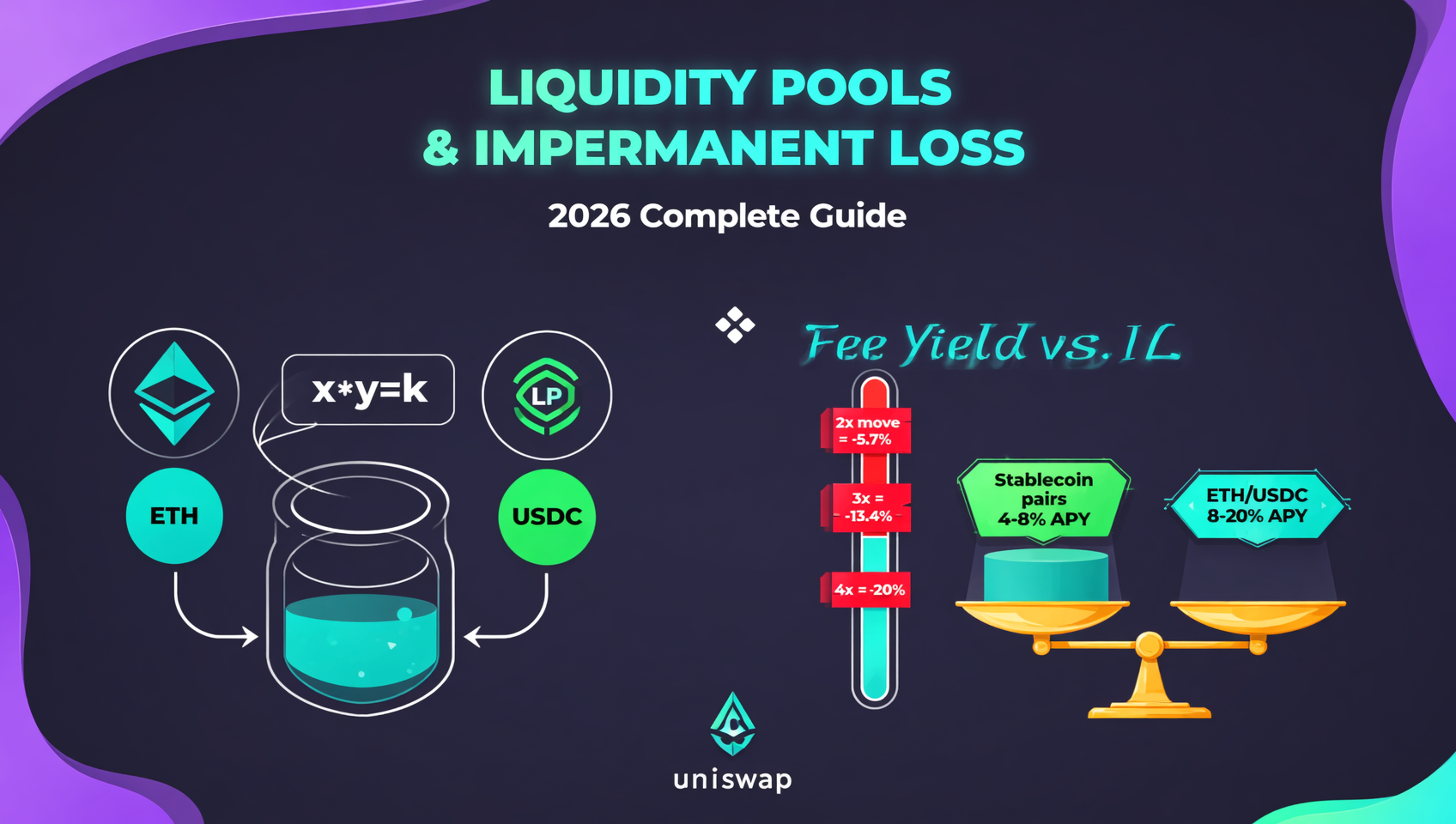
DeFi liquidity pools let you deposit two tokens into an AMM to earn trading fees — but you take on "impermanent loss." IL is the gap between your LP position and simply holding the tokens: a 2x price move costs ~5.7%, a 4x move ~20%. In 2026, stablecoin pair LPs earn ~4-8% APY and blue-chip ETH/USDC pairs ~8-20%. Beginner strategy: full-range stablecoin pairs are the most hands-off; blue-chip pairs pay more but require understanding IL; junk-coin pools are a trap.
What Is a Liquidity Pool: How AMM Replaces the Order Book
Traditional exchanges (CEX) use an order book to match buyers and sellers; decentralized exchanges (DEX, e.g., Uniswap) use an automated market maker (AMM) — no waiting for a counterparty; trades execute against a "liquidity pool."
| Feature | Order book (CEX) | AMM liquidity pool (Uniswap) |
|---|---|---|
| Counterparty | Other users | The liquidity pool |
| Pricing | Bid/ask matching | Formula-priced (x×y=k) |
| Depth needed | No orders = no trades | Any capital in the pool enables trades |
| Examples | Binance, OKX | Uniswap, Curve |
The core AMM formula is x × y = k: the product of the two token amounts in the pool stays constant. When someone buys token A, the pool adjusts the price by the formula — buy more, price goes higher (slippage). That is what "automated market making" means.1
How to Earn by Providing Liquidity
Providing liquidity (LPing) = depositing an equivalent dollar value of two tokens into a pool in exchange for LP tokens.
| Element | Detail |
|---|---|
| LP token | Represents your share of the pool; redeemable anytime |
| Earnings | A pro-rata share of every swap fee paid by traders |
| Fee tiers | 0.01% (stablecoins) / 0.05% (ETH-USDC etc.) / 0.30% (standard) / 1.00% (new coins) |
| Common 2026 APY | Stablecoin pairs 4-8%; blue-chip ETH/USDC 8-20%; concentrated pools up to 8-25% (active management) |
Key distinction: Uniswap fees are real yield (from actual trading activity), whereas many newer protocols pay "inflationary governance token" rewards that collapse once the emissions end. That is why Uniswap's APY is sustainable even if not the highest.2
What Is Impermanent Loss: Why More Volatility Hurts More
Impermanent loss (IL) = during your time in the pool, price moves in the pooled tokens make your position worth less than simply holding both tokens in a wallet.
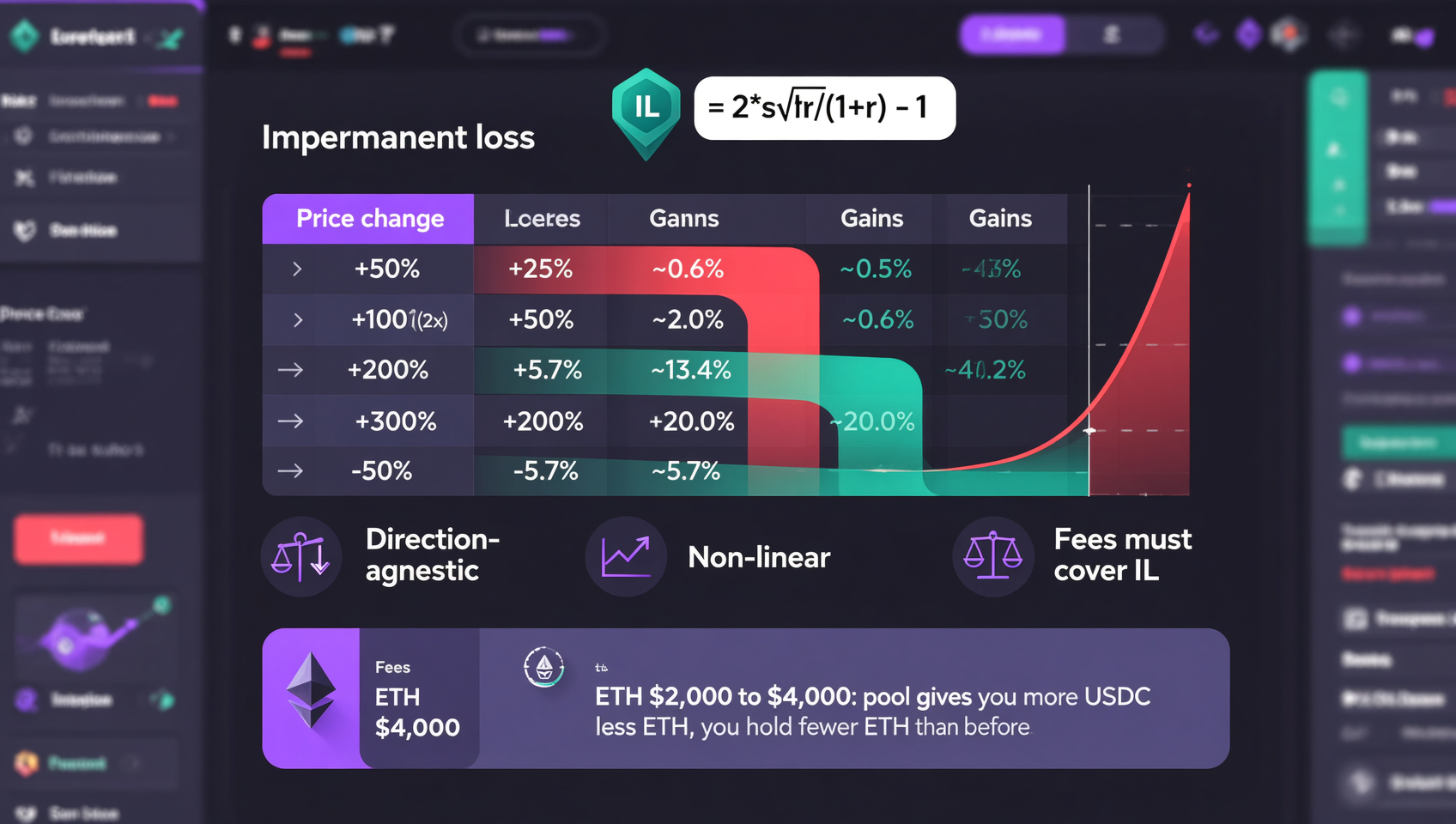
Example: you provide 1 ETH + $2,000 USDC (ETH=$2,000 at entry). If ETH rises to $4,000, the AMM automatically rebalances the pool toward "more USDC, less ETH" — when you redeem, you get fewer ETH than you started with. Compared to "doing nothing and holding 1 ETH," you've effectively lost ~5.7%.
Key insight: IL is not the pool taking your money — it is an opportunity cost. The pool's automatic rebalancing means you capture less of the appreciating asset on the way up. The bigger and more asymmetric the price move, the larger the loss.3
Impermanent Loss Table (Real Data)
Standard IL for a 50/50 constant-product pool (Uniswap v2 style):
| Price change | Price ratio (r) | Impermanent loss |
|---|---|---|
| +25% | 1.25x | ~0.6% |
| +50% | 1.50x | ~2.0% |
| +100% (2x) | 2.00x | ~5.7% |
| +200% | 3.00x | ~13.4% |
| +300% | 4.00x | ~20.0% |
| +400% | 5.00x | ~25.5% |
| −50% (halved) | 0.50x | ~5.7% |
| −75% | 0.25x | ~20.0% |
Three takeaways: ① Direction-agnostic — doubling and halving both cost ~5.7%; ② Non-linear — a 2x move costs 5.7% but a 3x move costs 13.4%; ③ Fee coverage is the deciding factor — a 2x move requires earning >5.7% in fees to break even.4
Concentrated Liquidity: The Special Risk of Uniswap v3/v4
Uniswap v3/v4 introduced concentrated liquidity: you specify a price range and "leverage" your capital within it.
| Feature | v2 (full range) | v3/v4 (concentrated) |
|---|---|---|
| Capital efficiency | Low (spread across all prices) | High (concentrated in your range) |
| Fee yield | Lower | Higher within range |
| Management needed | Almost zero (set-and-forget) | Active management required |
| Out-of-range outcome | — | 100% stops earning, position becomes the weaker token |
The core risk of concentrated liquidity: if price moves outside your range, your position completely stops earning fees and converts entirely into the underperforming token until you manually rebalance or price returns. This is not a "set and forget" strategy. Beginners should start with full-range or stablecoin pairs.5
LP Strategies & Risk Management
| Strategy | Best for | Notes |
|---|---|---|
| Stablecoin pair, full range | 🆕 Beginners | USDC/USDT etc., IL≈0, 4-8% APY, most hands-off |
| Blue-chip pair, full range | Intermediate | ETH/USDC etc., 8-20% APY, some IL to bear |
| Blue-chip pair, concentrated | Advanced | Requires active monitoring and rebalancing |
| Junk/new-coin pools | ❌ Avoid | Coins can go to zero; IL + total loss risk is extreme |
Four beginner rules:
- Only touch stablecoin pairs or blue-chip pairs like ETH/USDC
- Only use audited, well-known protocols (e.g., Uniswap), never shady "high-yield farms"
- Start small, understand IL before adding more
- Be cautious about adding during violent price swings — that is when IL is largest
In one line: LP is not risk-free interest; it is a trade-off between "fee yield" and "impermanent loss." Stablecoin pairs are the safest, blue-chip pairs pay better but require understanding risk, and junk-coin pools are traps.6
FAQ
Q: What is impermanent loss?
The gap between your LP position and simply holding the two tokens, caused by price moves while you provide liquidity. A 2x price move costs ~5.7%. It is "impermanent" because the loss disappears if prices return to the entry ratio; but withdrawing while prices are diverged locks it in. Fee income can offset part of the IL.
Q: How do I calculate impermanent loss?
For a 50/50 constant-product pool: IL = 2×√r/(1+r) − 1, where r = final price ÷ initial price. +25% costs ~0.6%, +50% ~2%, doubling ~5.7%, 4x ~20%. Loss depends only on the magnitude of the price change, not the direction (doubling and halving both cost 5.7%).
Q: How do I earn by providing liquidity?
You earn a share of trading fees. Each swap pays a fee distributed pro-rata to all LPs. Uniswap has four tiers: 0.01% (stablecoins), 0.05% (ETH/USDC), 0.30% (standard), 1.00% (new coins). Common 2026 APY: stablecoin pairs ~4-8%, ETH/USDC ~8-20%.
Q: What's the difference between Uniswap v3 concentrated and v2?
v2 full-range is hands-off but lower APY; v3/v4 concentrated liquidity is more capital-efficient and earns more within range, but if price exits your range the position 100% stops earning and converts to the weaker token — active management needed. Beginners should start with full-range or stablecoin pairs.
Q: Is providing liquidity safe? What are the risks?
Main risks: impermanent loss, out-of-range positions, smart-contract risk, and token de-pegging/going to zero. Beginner advice: stablecoin full-range pairs, only blue-chip pairs, start small, use audited protocols.
Q: When does impermanent loss become permanent?
When you exit the pool while prices are diverged, the loss is locked in. If price returns to the entry ratio, IL goes back to zero — that's why it's "impermanent." Volatile pairs have high IL; stablecoin pairs have almost none.
About the Author
CoinVado Research is CoinVado's content research team, focused on blockchain education, on-chain data analysis, and cryptocurrency investment education. We are committed to verifiable data and never fabricate information, helping beginners build sound crypto knowledge.
⚠️ Risk Disclaimer: This article is for educational purposes only and does not constitute investment advice. DeFi liquidity pools carry impermanent-loss, smart-contract, and token-devaluation risks; APY data changes in real time — always rely on official sources. Cryptocurrency markets are extremely volatile; manage your risk.
📚 Continue Learning:
- DeFi 2026 Complete Guide: From Beginner to Advanced
- Aave Lending & Borrowing Guide 2026
- What Is DeFi? Beginner's Complete Guide
Footnotes:
Footnotes
-
Source: DEXTools "What Is Uniswap? AMM, Liquidity Pools, Fees and UNI Token Explained (2026)" ↩
-
Source: Bitget "Crypto Farming: How Yield Farming and Liquidity Provision Actually Work in 2026"; DEXTools Uniswap guide ↩
-
Source: Status Academy "What Is Impermanent Loss? LP Risk Explained for 2026"; Coinstancy Academy ↩
-
Source: Impermanent Loss Calculator (calculatorcollection/spark.money); DEXsharp IL math analysis, 2026 ↩
-
Source: DEXTools "How to Provide Liquidity on Uniswap: Fee Tiers, Price Ranges and IL Basics (2026)" ↩
-
Source: Coinpaprika "How to Use Uniswap: Step-by-Step Guide to Token Swaps"; strategy synthesis, 2026 ↩