


📋 Table of Contents
- TL;DR Summary
- What is Gwei? Ethereum's Smallest Pricing Unit
- How Gas Fees Work: Why Every Transaction Has a Fee
- EIP-1559: Base Fee + Priority Fee
- Gwei as a "Technical Indicator": Reading Network Congestion
- The 2026 Fee Landscape: Why Fees Are So Cheap
- How to Check Real-Time Gwei
- How to Save on Gas Fees
- FAQ
- About the Author
TL;DR Summary
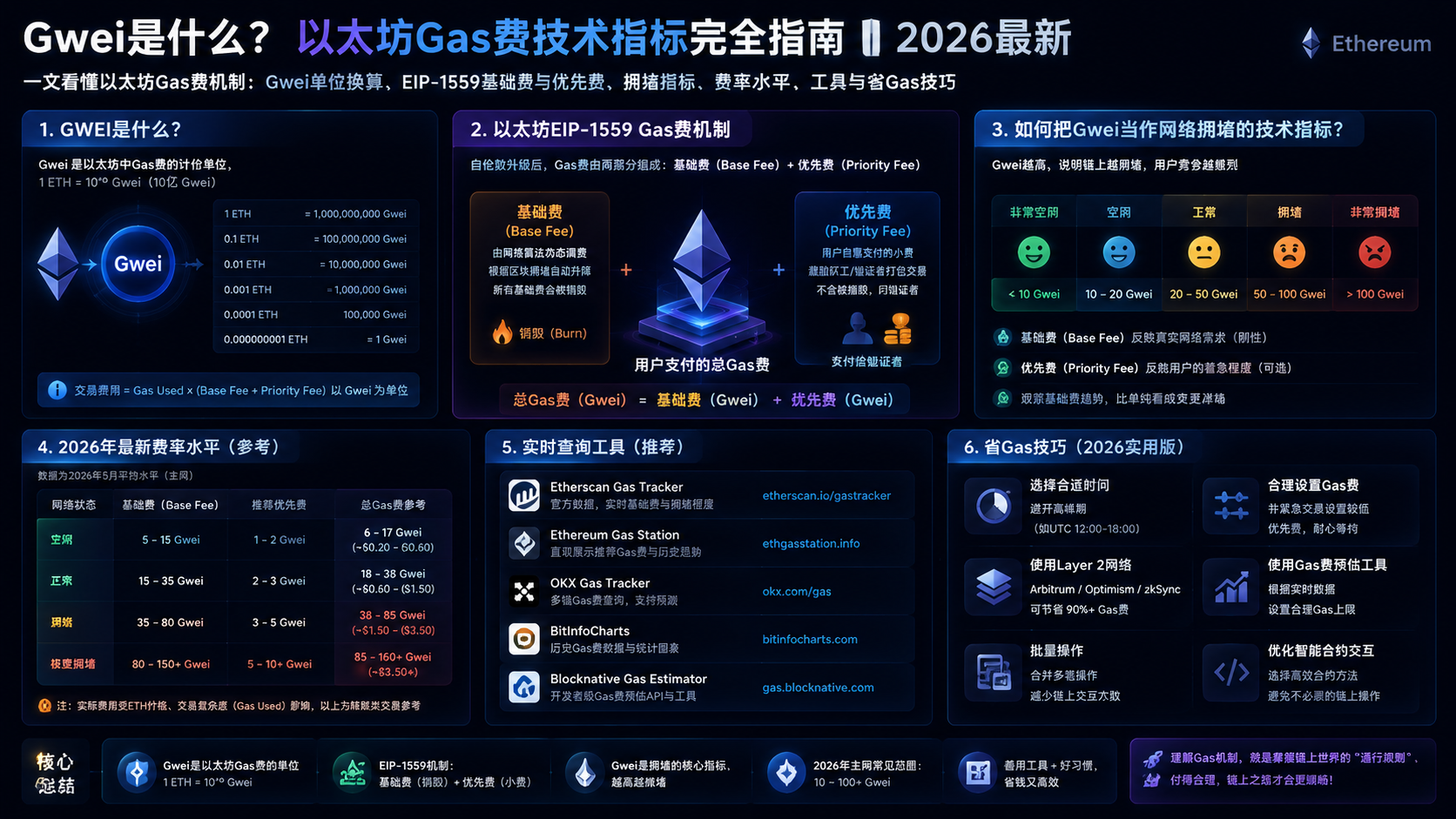
Gwei is Ethereum's fee-pricing unit; 1 Gwei = 10⁻⁹ ETH. Every Ethereum transaction pays a gas fee, and the total = gas used × (base fee + priority fee). After EIP-1559 the base fee is protocol-priced and burned, which makes Gwei a natural "technical indicator" of network congestion: low Gwei = quiet network, high Gwei = crowded chain. In 2026 Ethereum fees are at historic lows (plain transfers often cost under $0.01), and the right tools and timing can save even more.
What is Gwei? Ethereum's Smallest Pricing Unit
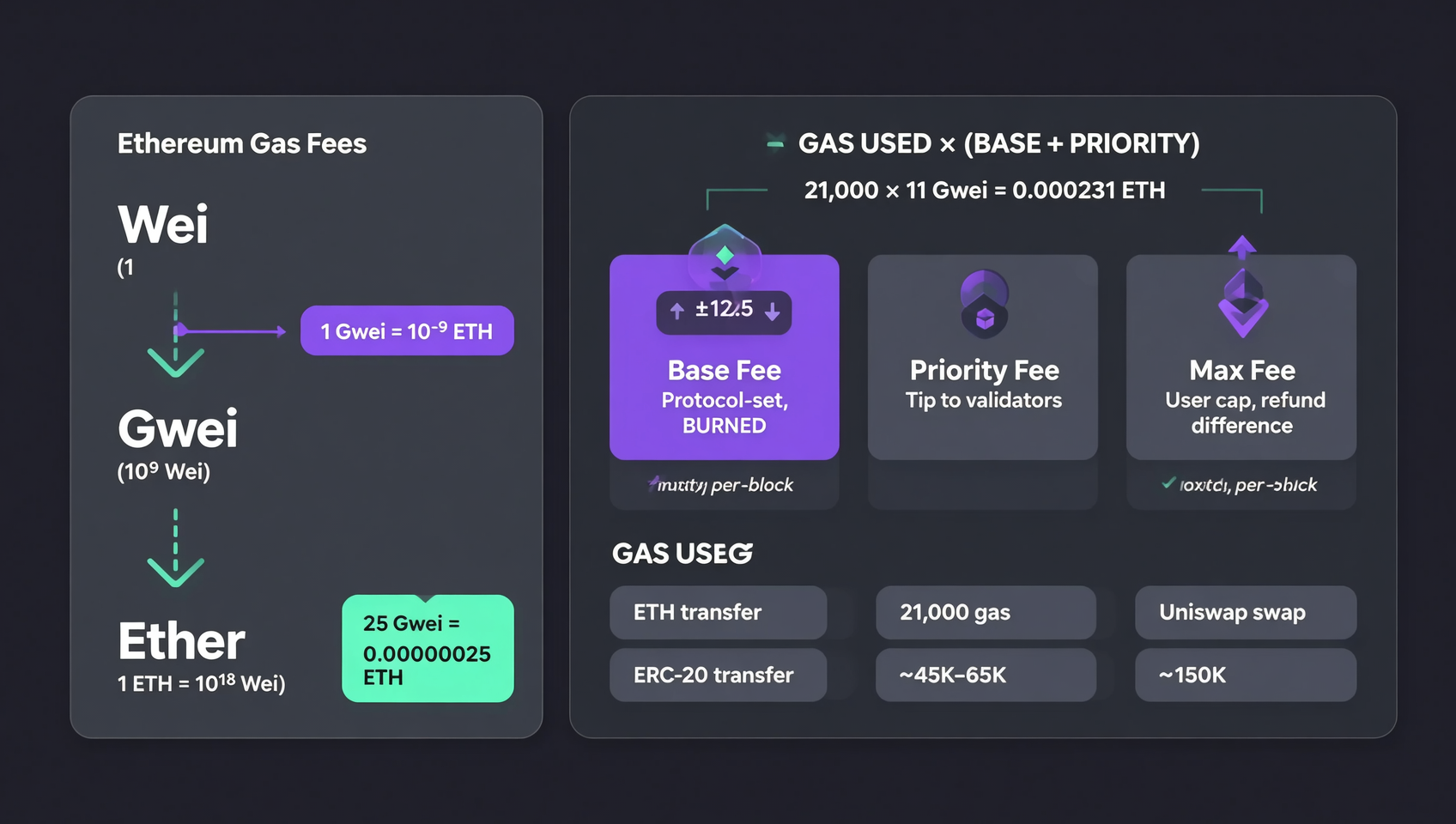
Gwei is short for "giga-wei" and is the most common unit for pricing gas on Ethereum. 1 Gwei = 0.000000001 ETH (10⁻⁹ ETH) — one-billionth of an ETH.
| Unit | Equals how many wei | Equals how much ETH | Use |
|---|---|---|---|
| Wei | 1 | 10⁻¹⁸ ETH | Smallest unit, theoretical |
| Gwei | 10⁹ wei | 10⁻⁹ ETH | Gas pricing (most common) |
| Ether | 10¹⁸ wei | 1 ETH | Everyday pricing |
Why price in Gwei instead of ETH? Because gas prices become a long string of decimals in ETH — "25 Gwei" is instantly readable, while "0.000000025 ETH" is not. It is like using cents to price small purchases instead of writing out huge fractional numbers every time.1
How Gas Fees Work: Why Every Transaction Has a Fee
Every operation on Ethereum (sending ETH, calling smart contracts, trading NFTs) consumes computational resources measured as "gas" and paid per unit:
| Operation | Gas used (reference) |
|---|---|
| Plain ETH transfer | 21,000 gas |
| ERC-20 token transfer | ~45,000–65,000 gas |
| Uniswap swap | ~150,000 gas |
| Complex DeFi interaction | hundreds of thousands of gas |
Total fee = gas used × gas price (Gwei)
Example: a plain transfer uses 21,000 gas; with a 10 Gwei base fee + 1 Gwei priority fee = 11 Gwei, the total is 21,000 × 11 = 231,000 Gwei = 0.000231 ETH. With 2026's low fees, this often costs under $0.01.2
EIP-1559: Base Fee + Priority Fee
The London upgrade (August 2021, EIP-1559) rewrote gas pricing from an auction model to algorithmic pricing. Fees now have three parts:
| Component | Set by | Goes to | Detail |
|---|---|---|---|
| Base Fee | Protocol | Burned | Adjusts up to ±12.5% per block based on demand; targets 50% block fullness |
| Priority Fee (tip) | User | Validator | Higher tip = earlier inclusion within a block |
| Max Fee | User cap | — | Difference is refunded if the actual cost is lower |
The key change of EIP-1559: the base fee no longer goes to miners — it is permanently burned. More than 4 million ETH have been burned since 2021, creating deflationary pressure in periods of high activity. For everyday users the biggest benefit is predictability — no more blind fee bidding; wallets now auto-recommend a reasonable rate.3
Gwei as a "Technical Indicator": Reading Network Congestion
For anyone tracking on-chain data, Gwei itself is a live "network health check" — it directly reflects how congested Ethereum is and how active the chain is:
| Gwei range | Network state | Meaning |
|---|---|---|
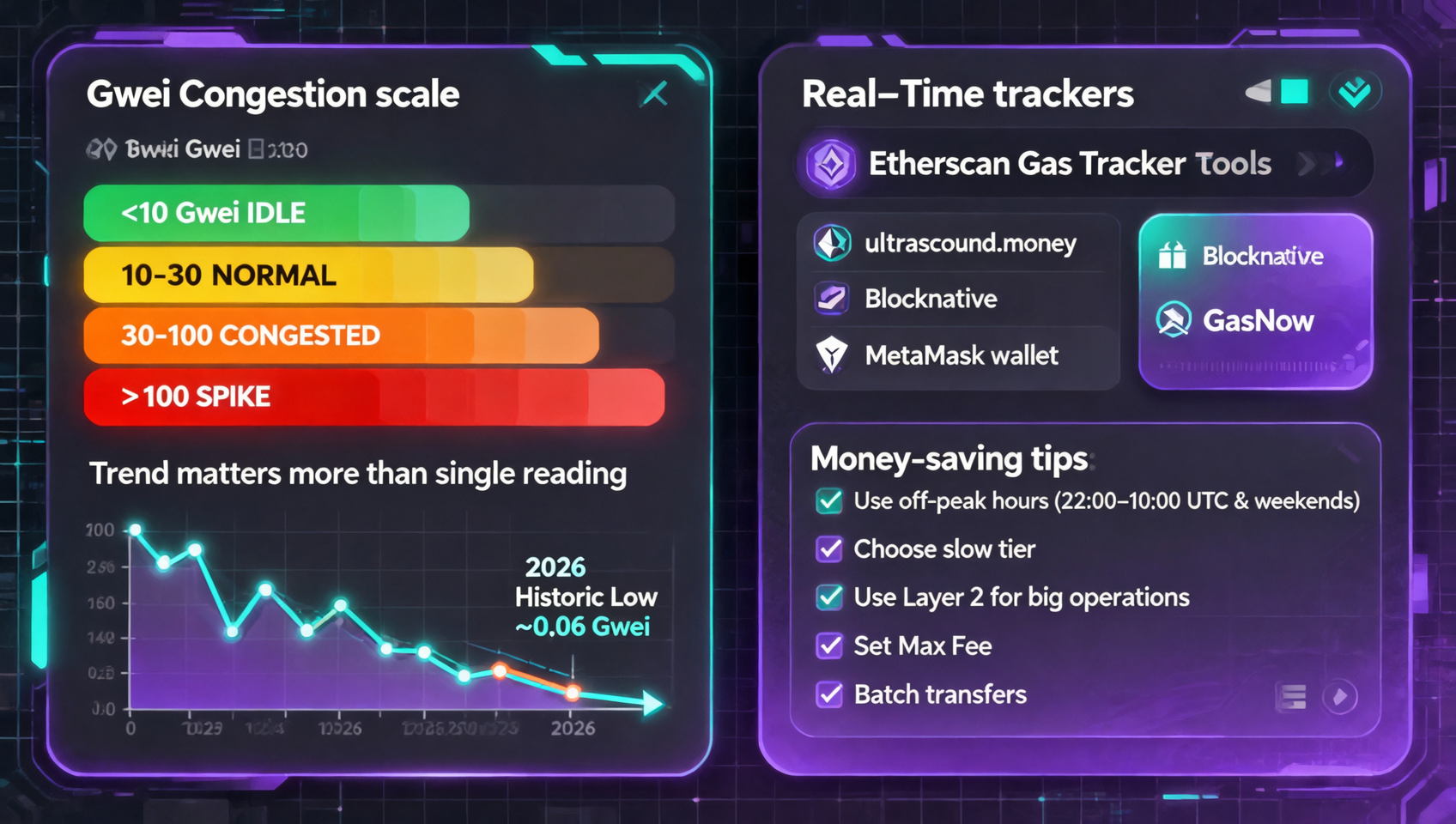
| < 10 Gwei | 🟢 Idle | Low on-chain demand; transfers confirm almost instantly |
| 10–30 Gwei | 🟡 Normal | Everyday activity, moderate fees |
| 30–100 Gwei | 🟠 Congested | Crowded — common during airdrops and DeFi peaks |
| > 100 Gwei | 🔴 Spike | Extreme congestion (liquidation cascades, hot NFT mints, major events) |
How to read it as an indicator? Trend matters more than any single point: several days of falling Gwei usually means cooling on-chain activity (DeFi etc.); a sudden spike usually signals a specific event (airdrop claim, liquidation, NFT launch). Cross-reference Gwei with block utilization and the ETH burn rate (check ultrasound.money) for a fuller picture of on-chain temperature.4
The 2026 Fee Landscape: Why Fees Are So Cheap
In 2026 Ethereum fees sit at historic lows. In the July 2026 Etherscan Gas Tracker snapshot, for example, the standard tier was ~0.06 Gwei, and a plain ETH transfer cost about $0.002 — effectively negligible.
Why fees fell:
| Factor | Effect |
|---|---|
| Layer 2 absorbs the load | Most traffic moved to L2s like Arbitrum and Base, sharply easing mainnet congestion |
| Blob fees (EIP-4844) | L2 data priced separately, freeing up more mainnet capacity |
| Block gas limit expansion | Each block carries more transactions, diluting the per-unit fee |
| Cooler on-chain demand | Overall crypto activity is lower in 2026, reducing queue pressure |
Note: low does not mean forever low. Big events (hot airdrops, liquidation waves, NFT launches) can still push Gwei to 10–50 or higher in moments. Always judge "is it expensive now" against the live Gas Tracker.5
How to Check Real-Time Gwei
| Tool | Feature | Best for |
|---|---|---|
| Etherscan Gas Tracker | Most popular; standard/fast/rapid tiers + base-fee chart | Everyone |
| ultrasound.money | Real-time burn rate & base-fee trends | On-chain researchers |
| Blocknative Gas Estimator | Mempool-based probabilistic estimates, more precise | Advanced users |
| GasNow | Free, open-source live rates + market analytics | Active traders |
| MetaMask & other wallets | Estimated fee shown right on the confirm screen | Everyday users |
The "slow/normal/fast" tiers in wallets are dynamically computed from roughly the 25th / 50th / 75th percentiles of recent block tips — if you are not in a hurry, pick "slow" and save.6
How to Save on Gas Fees
- Trade off-peak: fees are typically lowest between 22:00 and 10:00 UTC and on weekends; most expensive during weekday 10:00–22:00 UTC
- Use the wallet's slow tier: for non-urgent transactions, pick "slow" and keep the difference
- Use Layer 2 for larger operations: bridge to Arbitrum / Base / Optimism for transfers and DeFi — usually 90%+ cheaper
- Set a sensible Max Fee: avoid being packaged at a peak-hour price, but don't set it so low the transaction never confirms
- Batch small transfers: merge multiple small transfers into one and pay gas once
One-line saving strategy: for low-frequency, large, non-urgent transactions, off-peak timing + Layer 2 is the highest value combination.
FAQ
Q: How do I convert Gwei to ETH?
1 ETH = 1,000,000,000 Gwei (10⁹ Gwei). Gwei is short for giga-wei: 1 Gwei = 10⁻⁹ ETH = 10⁹ wei. So 25 Gwei = 0.000000025 ETH. Converters are built into Etherscan and most wallets.
Q: Why is gas priced in Gwei instead of ETH?
Readability. Converted to ETH, gas prices become long strings of decimals; Gwei keeps them readable. Wei is the smallest unit (1 ETH = 10¹⁸ wei), and Gwei is one billion wei — right in the range of everyday fees.
Q: What is the difference between base fee and priority fee?
The base fee is protocol-priced and burned; the priority fee is your tip to the validator. After EIP-1559, the base fee adjusts up to ±12.5% per block and is permanently burned; the priority fee determines ordering within a block — tip higher and you get included sooner. Most users just follow the wallet's recommended total.
Q: What is the Ethereum gas fee right now?
Fees are at historic lows in 2026. In the July 2026 Etherscan snapshot the standard tier was ~0.06 Gwei and a plain ETH transfer cost ~$0.002. But fees fluctuate in real time — airdrops, liquidations, and hot NFTs can push Gwei to 10–50 or higher — so always check the live Gas Tracker.
Q: How can I reduce Ethereum gas fees?
Four ways: ① Trade off-peak — lowest between 22:00–10:00 UTC and weekends; ② pick the slow tier — for non-urgent transactions; ③ use Layer 2 — bridge larger operations to Arbitrum / Base for 90%+ savings; ④ set a reasonable Max Fee — avoid peak-hour prices.
Q: What does a high or low Gwei mean?
Gwei is a congestion indicator. Low Gwei means an idle network with light demand; high Gwei means a crowded, active chain. Watch the trend rather than any single reading: sustained low Gwei usually signals cooling on-chain activity such as DeFi.
About the Author
CoinVado Research is CoinVado's content research team, focused on blockchain education, on-chain data analysis, and cryptocurrency investment education. We are committed to verifiable data and never fabricate information, helping beginners build sound crypto knowledge.
⚠️ Risk Disclaimer: This article is for educational purposes only and does not constitute investment advice. Gas fees and network conditions change in real time — always rely on authoritative tools (e.g., Etherscan Gas Tracker) for live data. Cryptocurrency markets are extremely volatile; manage your risk.
📚 Continue Learning:
- What is Ethereum? Complete Guide 2026
- Ethereum & Smart Contracts: Beginner's Guide
- Ethereum Staking: Complete How-To Guide
Footnotes:
Footnotes
-
Source: Ethereum.org Gas & Fees documentation; Binance Academy "How Do Gas Fees Work on Ethereum," 2026 ↩
-
Source: DEXTools "What Is Gas Price (Gwei)," 2026 ↩
-
Source: EIP-1559 spec (Ethereum London upgrade); ultrasound.money burn data, 2026 ↩
-
Source: MEXC Learn "ETH Gwei Guide," 2026; Etherscan Gas Tracker ↩
-
Source: Etherscan Gas Tracker July 2026 snapshot; zelcore.io Ethereum gas mechanics analysis ↩
-
Source: Ethereum.org wallet gas-estimation docs; MetaMask official docs ↩